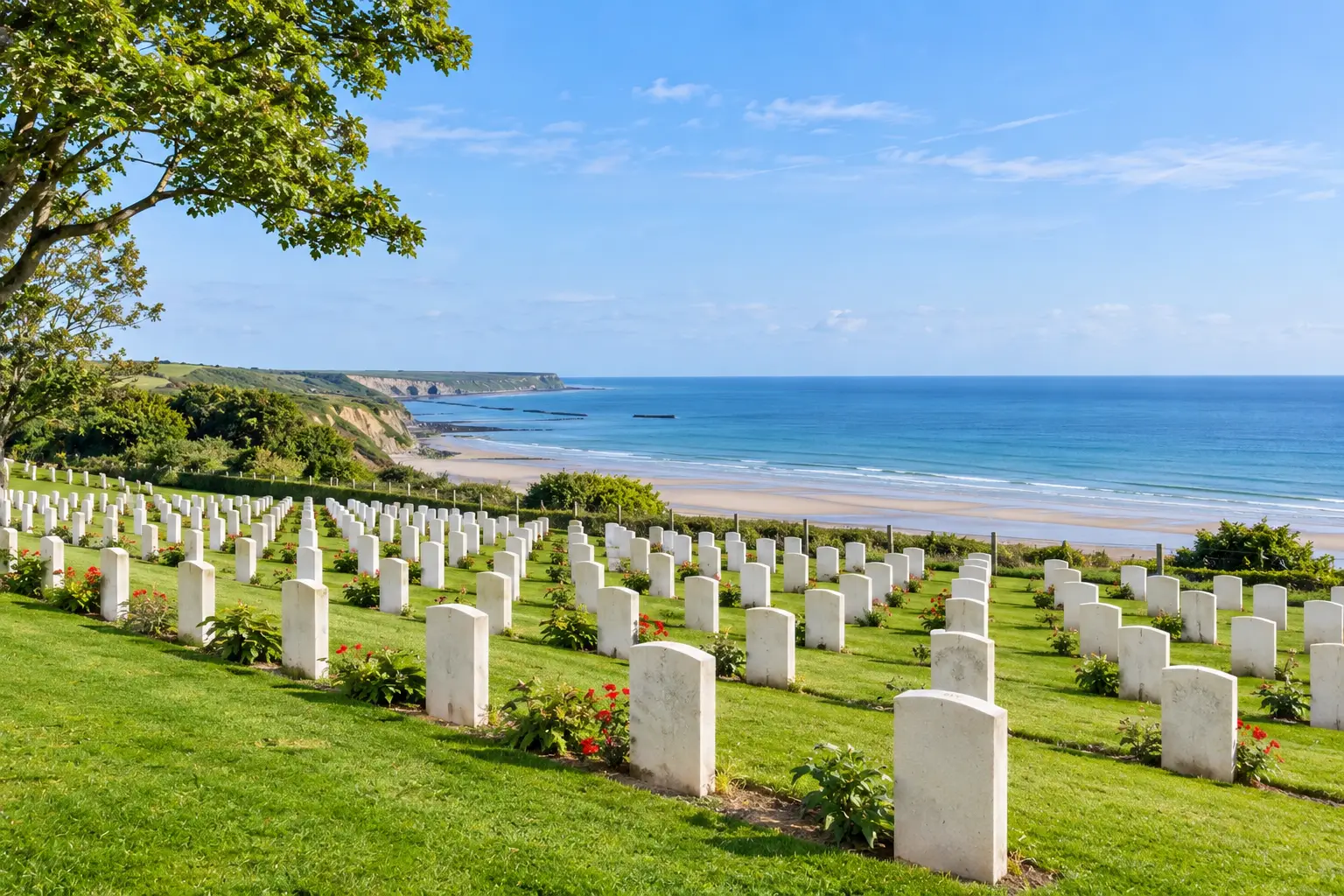
World War 2 began when Germany invaded Poland on 1 September 1939 and ended when Japan formally surrendered on 2 September 1945. These 25 questions cover the road to war, the turning points in Europe and the Pacific, D-Day and the founding of the United Nations.
The questions run roughly in time order, so you can follow the war as it unfolded. Each answer has a short explanation that links the fact to the wider story. The war also included the Holocaust and other mass killings of civilians; the questions that touch on them keep to the established facts.
Quick takeaways
- The war in Europe grew out of German expansion in the 1930s and Britain and France's policy of appeasement.
- Stalingrad, El Alamein and Midway in 1942 and early 1943 are often seen as the turning points.
- Germany surrendered in May 1945 and Japan in September 1945, after the atomic bombings of Hiroshima and Nagasaki.
- The United Nations was founded in 1945 to prevent another world war.
Round 1
What caused World War 2?
Historians usually trace the war's causes to the 1930s. The Great Depression hit Germany and Japan hard, and nationalist leaders promised to restore pride and win new territory. Japan moved into Manchuria in 1931 and invaded the rest of China in 1937. In Germany, Adolf Hitler became chancellor in January 1933 and began to tear up the terms of the Treaty of Versailles.
Britain and France, still scarred by World War I, tried at first to avoid another war by accepting some of Hitler's demands. That policy ended when Germany occupied Prague in March 1939. Britain and France then promised to defend Poland, and when Germany invaded it on 1 September 1939 they declared war two days later.
1Which country invaded Manchuria, in north-east China, in 1931?
Answer: Japan. Japan seized Manchuria after the Mukden Incident of September 1931. When the League of Nations condemned the invasion, Japan announced its withdrawal from the League in 1933.2What name is given to the 1930s policy of giving in to some of Hitler's demands to avoid war?
Answer: Appeasement. Appeasement is most closely linked with the British prime minister Neville Chamberlain. Containment and détente are Cold War terms, and isolationism describes the United States keeping out of European affairs.3In which year did Germany annex Austria in the Anschluss?
Answer: 1938. German troops entered Austria in March 1938 and it was absorbed into the German Reich. The union had been forbidden by the peace treaties after World War I.4Which 1938 agreement allowed Germany to take the Sudetenland from Czechoslovakia?
Answer: The Munich Agreement. Germany, Britain, France and Italy signed it in September 1938 without Czechoslovakia at the table. Six months later Germany occupied the rest of the Czech lands.5What name is given to the August 1939 non-aggression treaty between Nazi Germany and the Soviet Union?
Answer: The Molotov–Ribbentrop Pact. It was named after the two foreign ministers who signed it on 23 August 1939. A secret protocol divided Poland and eastern Europe into German and Soviet spheres.
| Date | Event |
|---|---|
| September 1931 | Japan invades Manchuria |
| January 1933 | Hitler becomes chancellor of Germany |
| October 1935 | Italy invades Ethiopia |
| March 1936 | German troops reoccupy the Rhineland |
| March 1938 | Germany annexes Austria |
| September 1938 | Munich Agreement hands the Sudetenland to Germany |
| March 1939 | Germany occupies the rest of the Czech lands |
| 23 August 1939 | Germany and the Soviet Union sign a non-aggression pact |
| 1 September 1939 | Germany invades Poland |
| 3 September 1939 | Britain and France declare war on Germany |
Round 2
Key battles and turning points in Europe
Germany's fast-moving attacks overran Poland in 1939 and France in 1940, leaving Britain without a major ally in western Europe. The Battle of Britain stopped a German invasion, but the decisive struggle came after June 1941, when Germany invaded the Soviet Union.
Three campaigns between mid-1942 and early 1943 shifted the balance: the defeat of the Axis in North Africa at El Alamein, the German disaster at Stalingrad and, in the Pacific, the American victory at Midway. After them the Axis powers were mostly on the defensive.
6What was the 1940 air campaign in which the RAF fought off the German Luftwaffe over southern England?
Answer: The Battle of Britain. The battle was fought in the summer and autumn of 1940. Because Germany failed to win control of the air, Hitler postponed his planned invasion of Britain.7What was the code name for Germany's invasion of the Soviet Union in June 1941?
Answer: Operation Barbarossa. The invasion began on 22 June 1941 and broke the Molotov–Ribbentrop Pact. It opened the Eastern Front, where more soldiers fought and died than on any other front of the war.8Which Soviet city was besieged by German and Finnish forces for almost 900 days, from 1941 to 1944?
Answer: Leningrad. The siege lasted from September 1941 to January 1944. Hundreds of thousands of civilians died, most of them from starvation during the first winter.9Which battle on the River Volga ended in February 1943 with the surrender of the German Sixth Army?
Answer: Stalingrad. Fighting raged in and around the city from August 1942. The loss of a whole German army is widely seen as a turning point on the Eastern Front.10At which Egyptian town did Montgomery's Eighth Army defeat Rommel's forces in late 1942?
Answer: El Alamein. The Second Battle of El Alamein, in October and November 1942, ended the Axis threat to Egypt and the Suez Canal. Tobruk and Benghazi are in Libya, and Tunis is in Tunisia.
Round 3
D-Day and the liberation of Western Europe
The Soviet Union had pressed its allies to open a second front in the West since 1941. It finally came on 6 June 1944, when American, British, Canadian and other Allied forces landed on five beaches in Normandy, supported by paratroopers and thousands of ships and aircraft.
Paris was liberated in August 1944. A German counter-attack in the Ardennes that winter slowed the Allied advance, but by spring 1945 Allied armies were crossing the Rhine while Soviet forces closed on Berlin from the east.
11On what date did the D-Day landings in Normandy take place?
Answer: 6 June 1944. More than 150,000 Allied troops landed by sea and air on the first day. Bad weather had already forced a one-day delay.12What was the overall code name for the Allied invasion of Normandy?
Answer: Operation Overlord. Overlord covered the whole campaign to win a foothold in north-west Europe. Operation Neptune was the name for its naval assault phase.13Who was Supreme Allied Commander for the D-Day landings?
Answer: Dwight D. Eisenhower. Eisenhower, an American general, led the Allied Expeditionary Force. Montgomery commanded the Allied ground forces under him for the landings. Eisenhower later became US president.14On which D-Day beach did American troops suffer the heaviest losses?
Answer: Omaha. Omaha's high bluffs and strong defences made it the bloodiest of the five beaches. US troops also landed at Utah, British troops at Gold and Sword, and Canadian troops at Juno.15What name is given to Germany's December 1944 offensive in the Ardennes, its last major attack in the West?
Answer: The Battle of the Bulge. German forces pushed a bulge into the American line in Belgium and Luxembourg. The attack failed by January 1945 and used up Germany's last reserves in the West.
Round 4
The war in the Pacific
Japan's attack on Pearl Harbor brought the United States into the war. In the months that followed, Japan captured Hong Kong, Malaya, Singapore, the Philippines and the Dutch East Indies. The war in Asia also included China, which had been fighting Japan since 1937.
After Midway, American forces advanced across the Pacific island by island, while British and Indian forces fought Japan in Burma. The battles for Iwo Jima and Okinawa in 1945 were among the bloodiest of the war and shaped American plans for ending it.
16On what date did Japan attack the US naval base at Pearl Harbor in Hawaii?
Answer: 7 December 1941. The surprise attack sank or damaged much of the US Pacific Fleet. The United States declared war on Japan the next day, and Germany declared war on the United States on 11 December.17Which June 1942 naval battle, in which Japan lost four aircraft carriers, turned the tide of the Pacific war?
Answer: The Battle of Midway. American code-breakers learned of the Japanese plan in advance. Japan lost four fleet carriers and the United States one, and Japan never regained the initiative at sea.18Which 1945 battle is remembered for the raising of the US flag on Mount Suribachi?
Answer: Iwo Jima. US Marines landed on the small volcanic island in February 1945. A photograph of the flag raising became one of the best-known images of the war.19What name was given to Japanese pilots who deliberately crashed their aircraft into Allied ships?
Answer: Kamikaze. Kamikaze means 'divine wind'. Organised suicide attacks began during the Battle of Leyte Gulf in October 1944 and continued off Okinawa in 1945.20What was the name of the B-29 bomber that dropped the atomic bomb on Hiroshima?
Answer: Enola Gay. Enola Gay dropped the bomb on 6 August 1945. Three days later another B-29, Bockscar, dropped a second bomb on Nagasaki.
Round 5
How did World War 2 end?
Hitler killed himself in Berlin on 30 April 1945, and Germany surrendered a week later. As Allied troops advanced they liberated concentration and death camps, exposing the scale of the Holocaust, in which about six million Jews were murdered by Nazi Germany and its collaborators.
Japan fought on until the atomic bombings of Hiroshima and Nagasaki on 6 and 9 August and the Soviet declaration of war on 8 August. Japan announced its surrender on 15 August and signed it on 2 September 1945. The victors set up the United Nations and held war crimes trials at Nuremberg and Tokyo.
21Which three leaders met at the Yalta Conference in February 1945?
Answer: Churchill, Roosevelt and Stalin. At Yalta, in Crimea, the 'Big Three' agreed to divide Germany into zones and planned the United Nations. Truman and Attlee attended the later Potsdam Conference in July 1945.22Which Nazi camp in occupied Poland, liberated by Soviet troops in January 1945, became the largest site of mass murder in the Holocaust?
Answer: Auschwitz-Birkenau. About 1.1 million people were murdered at Auschwitz, most of them Jews. The anniversary of its liberation, 27 January, is now International Holocaust Remembrance Day.23On what date did Germany's unconditional surrender take effect, celebrated in the West as VE Day?
Answer: 8 May 1945. Germany signed the surrender at Reims on 7 May, to take effect on 8 May. Russia marks Victory Day on 9 May because the Berlin signing fell after midnight Moscow time.24Aboard which US battleship did Japan sign its formal surrender on 2 September 1945?
Answer: USS Missouri. The ceremony took place in Tokyo Bay and formally ended the Second World War. The USS Arizona had been sunk at Pearl Harbor in 1941.25In which city was the United Nations Charter signed in June 1945?
Answer: San Francisco. Delegates from 50 countries signed the Charter on 26 June 1945. It came into force on 24 October 1945, now marked as United Nations Day.
| Date | Event |
|---|---|
| February 1945 | Yalta Conference |
| 12 April 1945 | President Roosevelt dies; Harry Truman takes over |
| 8 May 1945 | VE Day: Germany's surrender takes effect |
| 26 June 1945 | United Nations Charter signed in San Francisco |
| 6 and 9 August 1945 | Atomic bombs dropped on Hiroshima and Nagasaki |
| 2 September 1945 | Japan signs the formal surrender |
Five more WWII questions
These review questions are not in the rounds above. Try them without scrolling back.
0 / 5 answered
1Who was British prime minister from May 1940 until July 1945?
Answer: Winston Churchill. Churchill replaced Chamberlain in May 1940. He lost the general election of July 1945 to Clement Attlee's Labour Party.2Which US president died in April 1945, weeks before Germany surrendered?
Answer: Franklin D. Roosevelt. Roosevelt died on 12 April 1945 during his fourth term. Vice-President Harry Truman took over and led the country to the end of the war.3In which German city were leading Nazis tried by an international military tribunal in 1945 and 1946?
Answer: Nuremberg. The tribunal was set up by the United States, Britain, France and the Soviet Union. Nuremberg had been the site of huge Nazi Party rallies.4Which campaign, fought against German U-boats from 1939 to 1945, was the longest continuous campaign of the war?
Answer: The Battle of the Atlantic. Britain depended on convoys across the Atlantic for food, fuel and weapons. Better radar, air cover and code-breaking slowly turned the battle against the U-boats.5Which July 1943 battle in the Soviet Union is often described as the largest tank battle in history?
Answer: The Battle of Kursk. Germany attacked a large bulge in the Soviet line around Kursk. The offensive failed, and the Red Army kept the initiative for the rest of the war.
Frequently asked questions
When did World War 2 start and end?
In Europe the war began on 1 September 1939, when Germany invaded Poland, and Britain and France declared war on 3 September. Fighting in Europe ended with Germany's surrender, which took effect on 8 May 1945. The war as a whole ended when Japan signed its formal surrender on 2 September 1945, after announcing it on 15 August.
What were the main causes of World War 2?
Historians point to several linked causes: anger in Germany at the Treaty of Versailles, the Great Depression, the rise of Hitler and other expansionist regimes, the weakness of the League of Nations and the policy of appeasement. Japan's wars in China and Germany's invasion of Poland turned regional conflicts into a world war.
What was the turning point of World War 2?
There is no single agreed answer. Many historians name Stalingrad, where a whole German army surrendered in early 1943. Others stress Midway in June 1942, which ended Japan's run of victories at sea, or El Alamein in late 1942. Together these battles marked the point when the Axis powers lost the initiative.
Which countries were the Allies and the Axis in World War 2?
The main Axis powers were Germany, Italy and Japan, which signed the Tripartite Pact in 1940. The main Allies were Britain and its Commonwealth, France until its defeat in 1940, the Soviet Union from 1941, the United States from December 1941 and China. Many smaller countries also fought on each side.
How can I learn World War 2 dates for a quiz or exam?
Learn a few anchor dates first: 1 September 1939, June 1941, 7 December 1941, 6 June 1944, 8 May 1945 and 2 September 1945. Then hang the battles on them in order. Short quizzes help too; the World History Quiz app has rounds on the World Wars with an explanation after every answer.
Follow the war in order
World War 2 makes most sense as a sequence: the crises of the 1930s, German and Japanese expansion, the turning points of 1942 and 1943, the Allied advances of 1944 and the surrenders of 1945.
- Learn the six anchor dates from the FAQ before memorising individual battles.
- Pair each turning point with its theatre: Stalingrad in the East, El Alamein in North Africa, Midway in the Pacific.
- Practise with the World History Quiz app, which explains every answer so the facts stay linked.
Check the evidence behind the guide
Use these references to check terminology and pursue a topic in more depth. Photo quizzes help you practise observation; a single picture rarely proves a difficult identification.
Dates and causes are often simplified in summaries. Compare two sources for any event you need to remember, and note where historians still disagree.