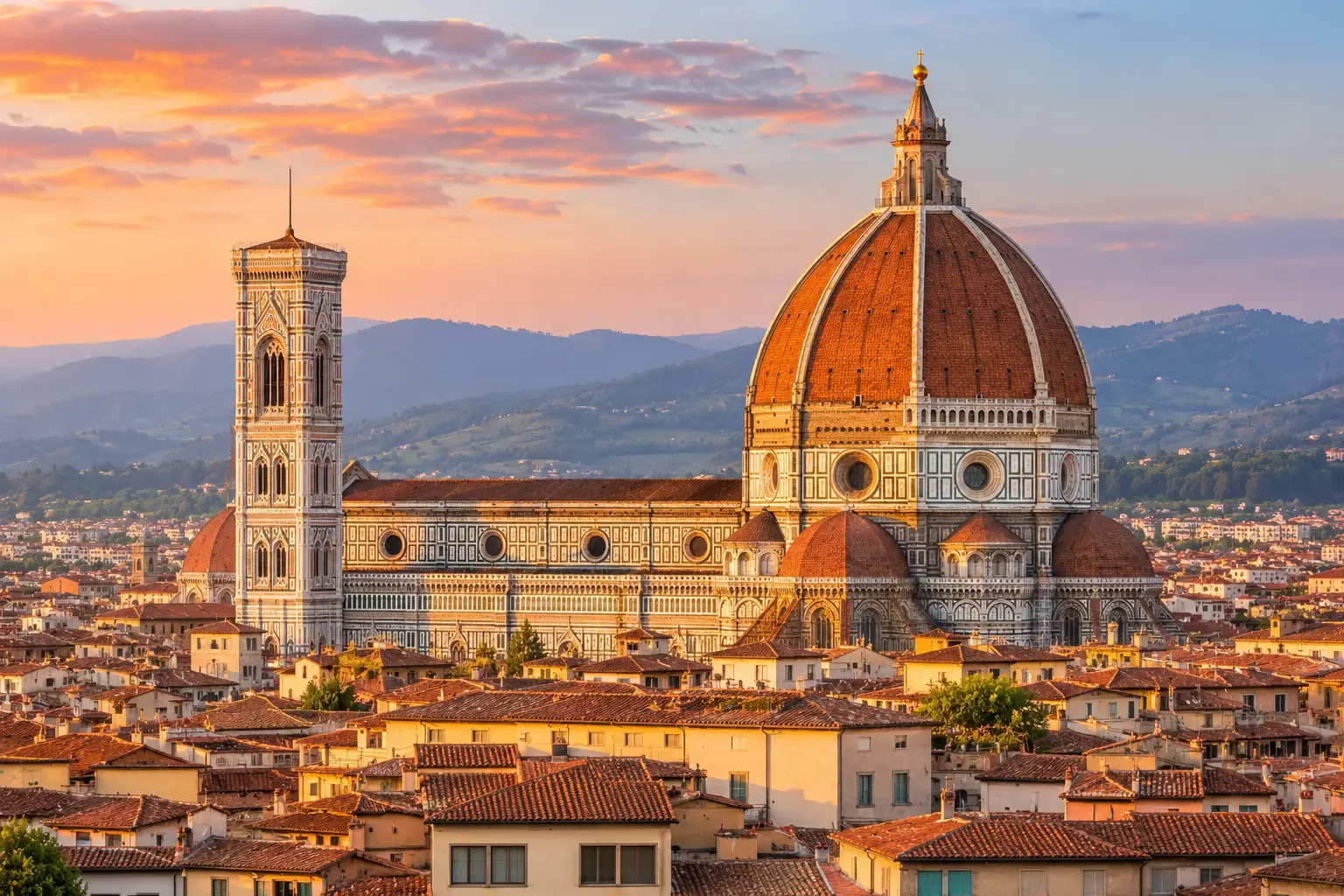
The Renaissance was a period of renewed interest in the art, literature and learning of ancient Greece and Rome. It began in Italy, especially Florence, in the 14th century and spread across Europe in the 15th and 16th centuries, changing painting, architecture, scholarship and science.
The word means 'rebirth'. The idea that the period was a rebirth after a dark Middle Ages came from Renaissance writers themselves, and many modern historians think it exaggerates the break. This guide explains where the movement began, the ideas behind it, the people who shaped it and how printing carried it across the continent.
Quick takeaways
- The Renaissance began in the wealthy city-states of Italy in the 1300s and reached its height around 1500.
- Humanism, the study of classical texts and human achievement, was its central intellectual movement.
- The printing press, from the mid-1400s, spread Renaissance ideas far faster than handwritten copies could.
- The Northern Renaissance in Flanders, Germany, France and England took the movement in its own directions.
Origins
Why did the Renaissance begin in Italy?
Northern and central Italy in the 1300s was a patchwork of city-states, such as Florence, Venice, Milan and Genoa, rather than a single kingdom. Many grew rich from trade across the Mediterranean, from making cloth and from banking. The Medici bank, founded in Florence in 1397, became one of the most powerful in Europe. Wealthy merchants, guilds and rulers competed to show off their status by paying for buildings, paintings and sculpture.
Italy was also surrounded by the remains of ancient Rome. Ruined temples, statues and inscriptions were a daily reminder of a past that Italians saw as their own. Scholars began hunting through monastery libraries for lost Latin texts, and from the late 1300s Greek scholars from the Byzantine Empire taught in Italy. Manuel Chrysoloras began teaching Greek in Florence in 1397, and more Greek scholars and manuscripts arrived as the Ottomans closed in on Constantinople, which fell in 1453.
Other conditions mattered too, although historians weigh them differently. The Black Death of 1347 to 1351 killed perhaps a third or more of Europe's people. Some historians argue that the shock, and the higher wages survivors could demand, unsettled old ways of thinking. Others stress that the revival of classical learning was already under way before the plague.
Money for art
Patrons such as the Medici in Florence, the Sforza in Milan and popes in Rome paid for many of the period's great works.
Ruins on the doorstep
Ancient Roman buildings gave Italian architects and sculptors models to study directly.
Greek arrives
Byzantine scholars brought Greek texts, including Plato, that most western scholars had not been able to read.
Ideas
What was Renaissance humanism?
Humanism was not a rejection of religion; most humanists were devout Christians. It was a programme of study, the studia humanitatis, built on grammar, rhetoric, poetry, history and moral philosophy. Humanists believed that reading the best ancient authors in their original languages would make people wiser speakers, better citizens and better Christians. Their motto might have been ad fontes, back to the sources.
Francesco Petrarch (1304–1374) is often called the father of humanism. He searched for lost classical works, and in 1345 found a collection of Cicero's letters in Verona. Later humanists turned the same close reading into a critical tool. In 1440 Lorenzo Valla used the language of the Donation of Constantine, a document said to grant the popes power over the western empire, to show it was a later forgery.
Humanism also celebrated human ability. Giovanni Pico della Mirandola's Oration on the Dignity of Man, written in 1486, argued that humans could shape their own nature. Political writers studied how power really worked: Niccolò Machiavelli's The Prince, written in 1513 and published in 1532, advised rulers on how to gain and keep power, and became famous for its unsentimental view of politics.
Humanism changed education as well as scholarship. Teachers such as Vittorino da Feltre, who opened a school at Mantua in 1423, taught the sons and some daughters of ruling families Latin and Greek literature alongside physical exercise and good manners. Over the next century this classical curriculum spread to grammar schools and universities across Europe, and for hundreds of years an educated person was expected to know the Latin classics.
People and works
Who were the key figures of the Renaissance?
In Florence in the early 1400s, three men set the direction of Renaissance art. Filippo Brunelleschi built the huge dome of Florence Cathedral between 1420 and 1436 and is credited with working out the rules of linear perspective. The painter Masaccio used those rules in his Holy Trinity fresco of about 1427, which makes a flat wall look like a deep chapel. The sculptor Donatello studied ancient statues and made figures that seem to stand and breathe. Leon Battista Alberti set out the theory in his book On Painting in 1435.
The High Renaissance, roughly the 1490s to the 1520s, produced its most famous works. Leonardo da Vinci painted The Last Supper in Milan in the late 1490s and began the Mona Lisa around 1503, and filled notebooks with studies of anatomy, machines and water. Michelangelo carved his marble David between 1501 and 1504 and painted the Sistine Chapel ceiling for Pope Julius II between 1508 and 1512. Raphael painted The School of Athens in the Vatican, a scene of ancient philosophers in a grand classical hall.
Venice developed its own style, rich in colour and light, led by painters such as Giovanni Bellini and Titian. The Sack of Rome by the army of Emperor Charles V in 1527 is often taken as the end of the High Renaissance in Rome, though the movement continued in other forms for decades.
| Figure | Field | Famous work | Date |
|---|---|---|---|
| Petrarch | Poetry and scholarship | Canzoniere (love poems) | 14th century |
| Filippo Brunelleschi | Architecture | Dome of Florence Cathedral | 1420–1436 |
| Masaccio | Painting | Holy Trinity fresco | c. 1427 |
| Sandro Botticelli | Painting | The Birth of Venus | c. 1480s |
| Leonardo da Vinci | Painting, science, engineering | The Last Supper; Mona Lisa | c. 1495–1498; begun c. 1503 |
| Michelangelo | Sculpture, painting, architecture | David; Sistine Chapel ceiling | 1501–1504; 1508–1512 |
| Raphael | Painting | The School of Athens | c. 1509–1511 |
| Niccolò Machiavelli | Political thought | The Prince | Written 1513 |
Technology
How did the printing press spread the Renaissance?
Before printing, every book was copied by hand, which made books expensive and slow to produce, and every copy could add new mistakes. Johannes Gutenberg's press with movable metal type, developed in Mainz in the mid-1400s, changed that. His Bible was completed around 1455, and within a few decades print shops were working in cities across Europe.
Printing suited humanism perfectly. Scholars could produce accurate editions of classical texts and send identical copies to readers in many countries, so they could argue about the same page. In Venice, Aldus Manutius printed Greek and Latin classics and in 1501 introduced compact books set in italic type that readers could carry. William Caxton set up England's first press at Westminster in 1476.
The press also carried new and controversial ideas further and faster than ever before. When Martin Luther issued his Ninety-five Theses in 1517, printed copies spread across Germany within weeks, helping start the Protestant Reformation. Scientific works travelled the same way: in 1543 Copernicus published his case for a Sun-centred universe and Andreas Vesalius his illustrated study of human anatomy.
Tip: In exam answers, link the printing press to three things: cheaper books, accurate shared texts and the rapid spread of new ideas, including the Reformation.
Beyond Italy
How did the Renaissance spread across Europe?
Renaissance ideas travelled north through trade, war, students, artists and printed books. In the Low Countries, painters such as Jan van Eyck had already perfected oil painting, as in his Arnolfini Portrait of 1434, and Northern artists became known for minute detail and realistic texture. Albrecht Dürer of Nuremberg visited Italy and brought its ideas back to Germany, where his engravings and woodcuts circulated widely as prints.
Northern humanists often turned the new scholarship towards religion and society. Desiderius Erasmus of Rotterdam mocked the failings of the Church in In Praise of Folly (1511) and in 1516 published an edition of the New Testament in the original Greek. His friend Thomas More imagined an ideal society in Utopia, published the same year. Later writers such as William Shakespeare in England and Miguel de Cervantes in Spain drew on Renaissance learning in their own languages.
There is no single end date. Many historians close the Renaissance around 1600, or in the early 1600s, as the Scientific Revolution and Baroque art took over. The term itself was popularised in the 19th century, especially by Jacob Burckhardt's book The Civilization of the Renaissance in Italy (1860). Later historians questioned his picture of a sudden break, pointing to earlier revivals of classical learning, such as the so-called twelfth-century renaissance.
| Feature | Italian Renaissance | Northern Renaissance |
|---|---|---|
| Main centres | Florence, Rome, Venice, Milan | Flanders, Germany, France, England |
| Peak | 15th and early 16th century | Late 15th and 16th century |
| Art style | Classical forms, ideal proportions, linear perspective | Fine detail, oil painting, realistic textures, prints |
| Humanist focus | Classical texts, civic life, rhetoric | Religious reform, Bible scholarship, society |
| Key names | Leonardo, Michelangelo, Raphael, Machiavelli | Van Eyck, Dürer, Erasmus, More |
Check your Renaissance knowledge
Five questions drawn from the guide above.
0 / 5 answered
1What does the word Renaissance mean?
Answer: Rebirth. It refers to the revival of classical learning and art. The Enlightenment was a later movement of the 17th and 18th centuries.2Which Florentine banking family were among the greatest patrons of the Renaissance?
Answer: The Medici. The Medici bank was founded in 1397. Cosimo and Lorenzo de' Medici supported artists and scholars in Florence.3Who designed and built the dome of Florence Cathedral?
Answer: Filippo Brunelleschi. Brunelleschi built the dome between 1420 and 1436 without the huge wooden framework that normally supported a dome during building.4Which painter's Holy Trinity fresco of about 1427 is one of the earliest uses of linear perspective?
Answer: Masaccio. Masaccio applied the rules Brunelleschi had worked out, making a flat wall look like a deep chapel. Giotto lived a century earlier, and Botticelli and Titian came later.5Which Northern humanist wrote In Praise of Folly?
Answer: Erasmus. Erasmus published it in 1511. Thomas More, his friend, wrote Utopia, published in 1516.
Frequently asked questions
Why did the Renaissance start in Florence?
Florence combined several advantages in the early 1400s: great wealth from banking and the cloth trade, rich patrons such as the Medici, guilds and a government that competed to beautify the city, and a strong interest in ancient Rome. Talented artists and scholars gathered there, and their rivalry and shared ideas pushed art and learning forward quickly.
When did the Renaissance start and end?
It is usually said to have begun in Italy in the 14th century, with Petrarch's revival of classical learning, and to have peaked around 1500. It spread across Europe in the 15th and 16th centuries. There is no fixed end date; many historians place it around 1600, when Baroque art and the Scientific Revolution came to the fore.
What is humanism in the Renaissance?
Renaissance humanism was a movement to study the writings of ancient Greece and Rome in their original languages, especially grammar, rhetoric, poetry, history and moral philosophy. Humanists believed this education produced wise, eloquent and responsible people. It did not reject Christianity, but it placed new value on human ability, careful reading and evidence.
How did the printing press affect the Renaissance?
The printing press, developed by Johannes Gutenberg in Mainz in the mid-1400s, made books cheaper and faster to produce. Scholars could share identical, accurate editions of classical texts across Europe. It also spread new ideas quickly, from humanist scholarship to Martin Luther's Ninety-five Theses in 1517 and the scientific works of Copernicus and Vesalius in 1543.
Who are the most important Renaissance artists to know for a quiz?
Start with Brunelleschi, Masaccio and Donatello in early Florence, then the High Renaissance trio of Leonardo da Vinci, Michelangelo and Raphael. Add Botticelli and Titian, and in the North, Jan van Eyck and Albrecht Dürer. Pair each with one famous work, then test yourself with the World History Quiz app.
Rebirth, ideas and print
The Renaissance grew from rich Italian cities that looked back to ancient Rome and Greece. Humanism gave it its ideas, artists such as Leonardo and Michelangelo gave it its images and the printing press carried it across Europe.
- Learn the three reasons Italy came first: wealth and patrons, Roman ruins and texts, and Greek scholars.
- Match each key figure to one work and one date from the table.
- Test yourself on early modern Europe in the World History Quiz app.
Check the evidence behind the guide
Use these references to check terminology and pursue a topic in more depth. Photo quizzes help you practise observation; a single picture rarely proves a difficult identification.
Dates and causes are often simplified in summaries. Compare two sources for any event you need to remember, and note where historians still disagree.