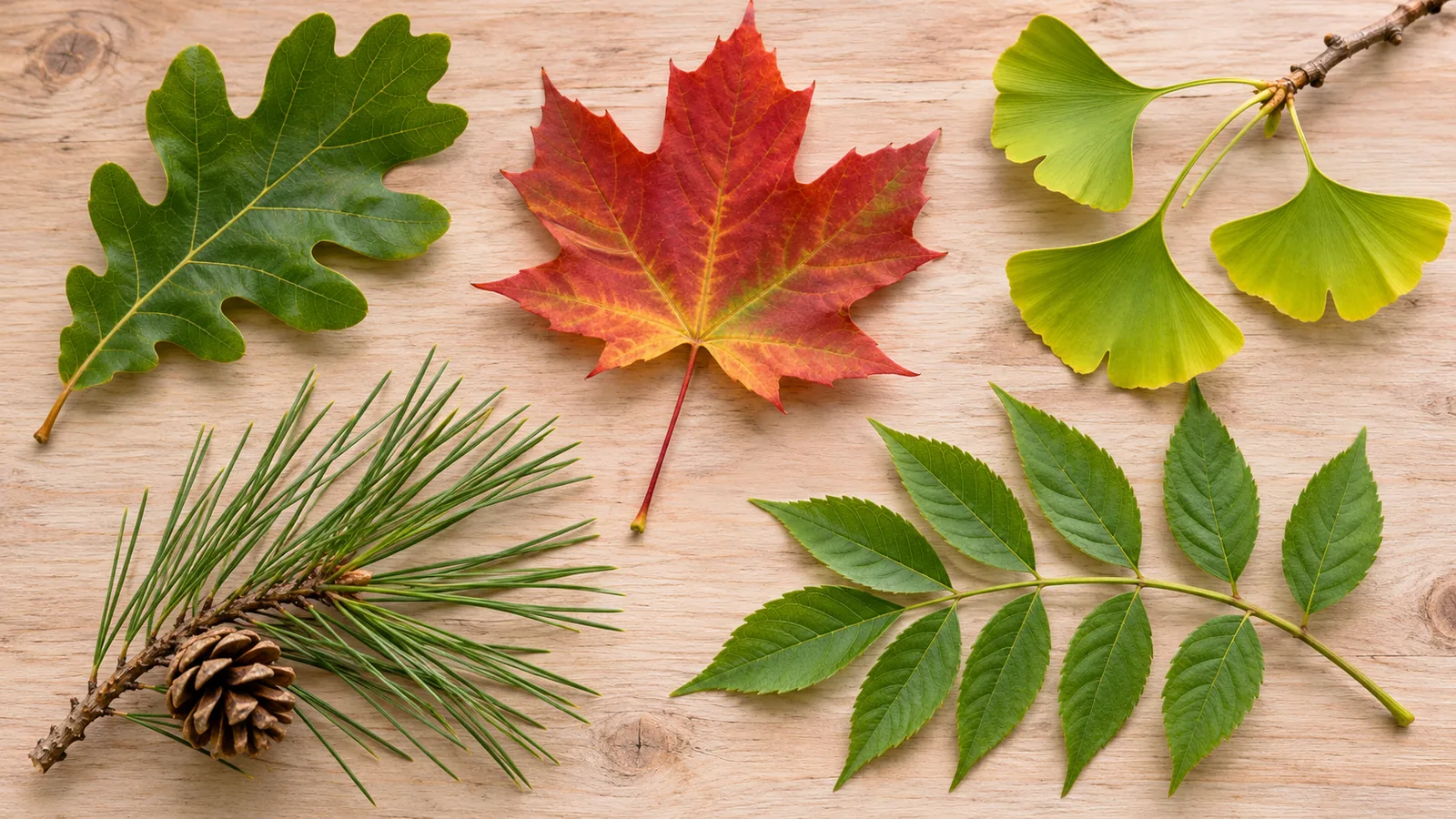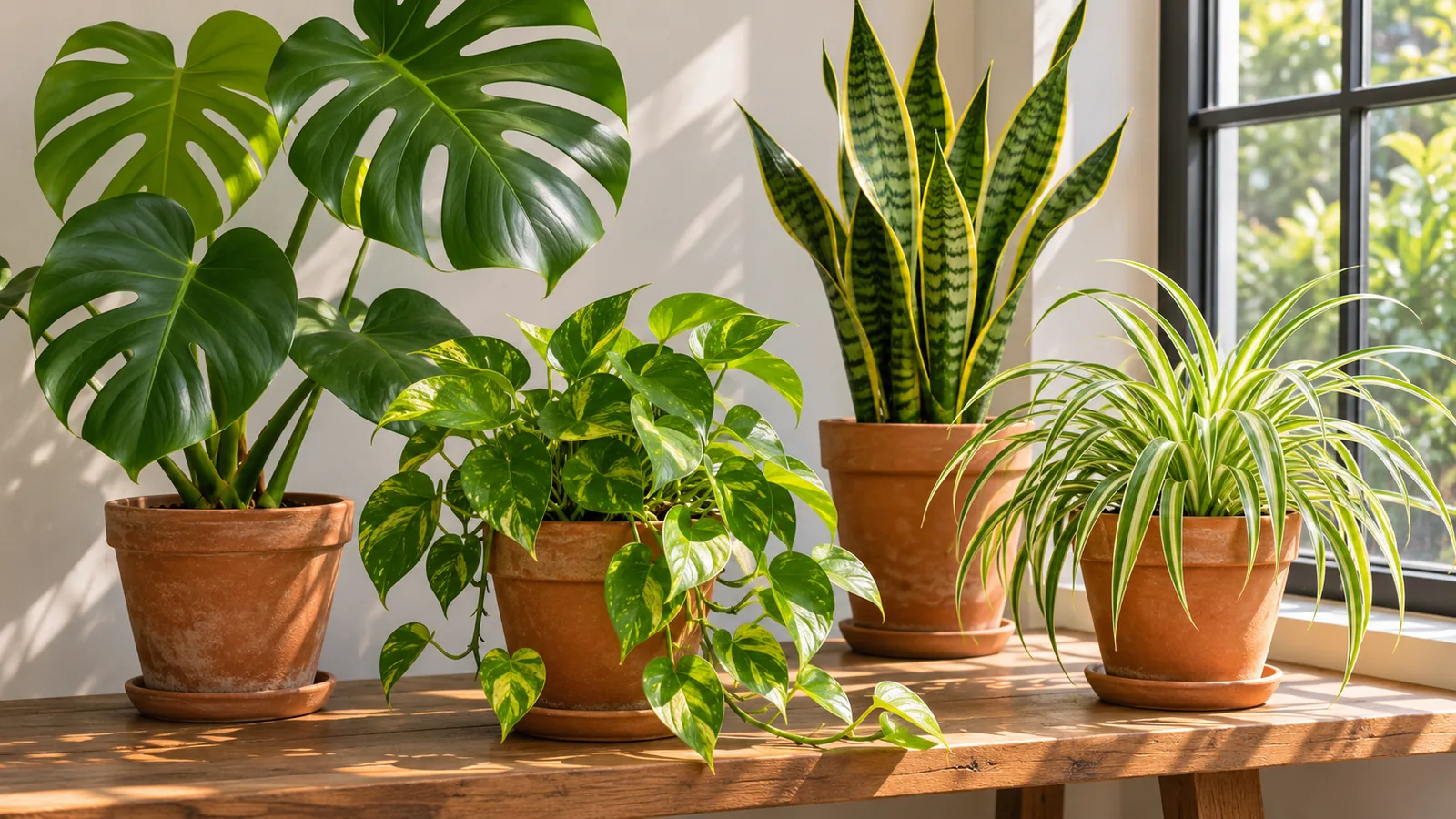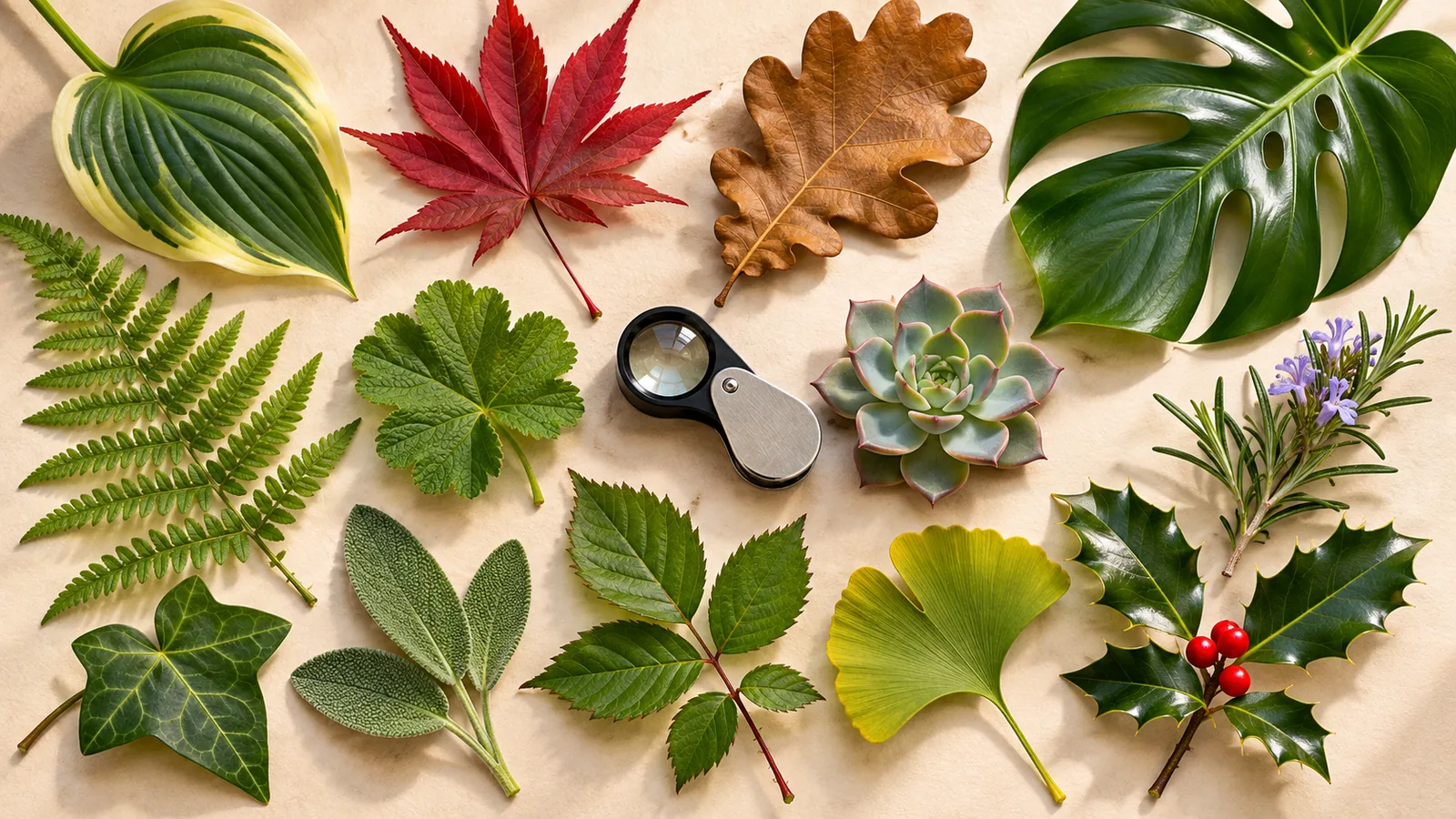
A plant name becomes easier to remember when it has a visible reason attached: an oak's acorn, a ginkgo's fan-shaped leaf or a Monstera's split mature foliage.
These thirty questions are text-based observation practice. They help you learn terms to use with real photos; they are not a guarantee of species identity, and they should never guide eating or using an unknown plant.
Quick takeaways
- Combine leaves with buds, bark, fruit and habitat.
- Learn leaf arrangement before memorizing species.
- Treat lookalikes and cultivars as real sources of uncertainty.
Trees and outdoor plants
Use a memorable combination of leaves, fruit or bark.
1Which tree has deeply lobed leaves and produces acorns?
Answer: Oak. Acorns and lobed leaves are useful clues for many oaks, though species vary.2Which tree is known for broad leaves with pointed lobes and paired winged seeds?
Answer: Maple. Many maples have lobed leaves and paired samaras.3Which tree has fan-shaped leaves?
Answer: Ginkgo. Ginkgo's fan-shaped leaf is distinctive among common street trees.4Which conifer commonly carries needles in bundles?
Answer: Pine. Pines typically bear needles grouped in fascicles.5Which tree commonly produces cones and has single sharp needles?
Answer: Spruce. Spruces are conifers with individual needles and cones.6Which tree's leaves are often divided into several leaflets on one stalk?
Answer: Ash. Many ash trees have compound leaves with multiple leaflets.7Which tree is known for smooth gray bark and simple oval leaves?
Answer: Beech. Beech often has smooth gray bark; confirm with buds and leaves.8Which tree often has white peeling bark in familiar northern species?
Answer: Birch. Paper birch is a familiar white-barked birch; not every birch is white.9Which tropical plant has large split or perforated mature leaves?
Answer: Monstera. Mature Monstera deliciosa leaves can develop splits and holes.10Which houseplant has long arching leaves and produces plantlets on runners?
Answer: Spider plant. Spider plants often produce small offsets at the ends of arching stems.
Houseplants and herbs
Familiar indoor plants are useful practice for describing shape and growth habit.
11Which houseplant is widely known for upright sword-shaped leaves?
Answer: Snake plant. Snake plants have stiff vertical leaves with banded patterns.12Which vine houseplant often has heart-shaped leaves?
Answer: Pothos. Pothos is a common trailing aroid with heart-shaped foliage.13Which succulent has thick pointed leaves arranged in a rosette?
Answer: Aloe. Aloes commonly have fleshy pointed leaves in rosettes.14Which plant group bears spores on fronds rather than flowers and seeds?
Answer: Ferns. Ferns reproduce by spores and have fronds.15Which plant has pads or stems adapted to store water and areoles that can bear spines?
Answer: Cactus. Areoles distinguish cacti from many other succulents.16Which evergreen herb often has narrow, aromatic needle-like leaves?
Answer: Rosemary. Rosemary has narrow fragrant leaves; do not eat an unknown plant based on a photo.17Which herb is familiar for opposite fragrant leaves and square stems?
Answer: Mint. Many mints have opposite leaves and square stems, but family-level confirmation needs more traits.18Which shrub is known for flower heads that can be blue or pink depending partly on soil chemistry?
Answer: Hydrangea. Some bigleaf hydrangeas change flower color with available aluminum in the soil.19Which plant is known for climbing with tendrils and producing grapes?
Answer: Grapevine. Grapevines climb with tendrils and bear grape clusters.20Which tree bears large flowers and often has leathery simple leaves?
Answer: Magnolia. Magnolia flowers and leaves vary by species, but the large blooms are familiar.
Leaf vocabulary and responsible identification
These terms make your observations transferable to a field guide.
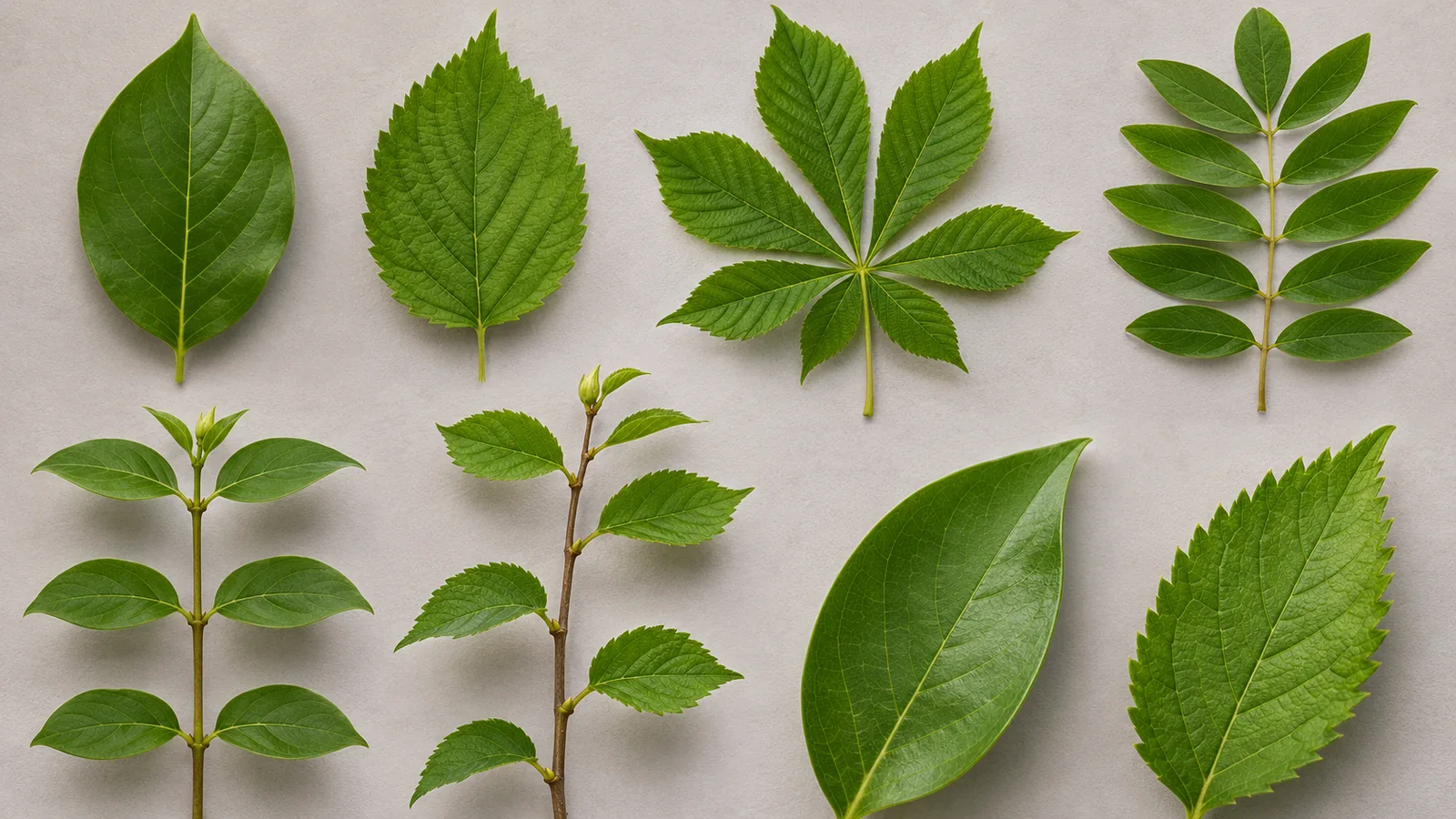
21What is a leaf with several blades on one stalk called?
Answer: Compound leaf. A compound leaf is divided into leaflets.22What is a single undivided blade called?
Answer: Simple leaf. A simple leaf has one blade, even if it is lobed.23What does opposite leaf arrangement mean?
Answer: Two leaves at one stem node. Opposite leaves occur in pairs at a node.24What does alternate leaf arrangement mean?
Answer: One leaf per stem node. Alternate leaves occur singly at successive nodes.25What is the edge of a leaf called?
Answer: Margin. The margin can be smooth, toothed or lobed.26What connects a leaf blade to the stem in many plants?
Answer: Petiole. A petiole is the leaf stalk.27What is the central vein of many leaves called?
Answer: Midrib. The midrib is the prominent central vein.28Which clues help most with a tree identification?
Answer: Leaves, buds, bark and fruit together. Several traits reduce errors caused by season and variation.29Why are flowers not always available for identification?
Answer: Many plants flower seasonally. Leaves and bark are useful outside flowering periods.30What should you avoid doing with an unknown plant?
Answer: Eating it from a photo guess. A quiz is not a safe basis for foraging or medicine.
Five fresh leaf checks
0 / 5 answered
1A fan-shaped leaf suggests which familiar tree?
Answer: Ginkgo. Ginkgo's fan is an easy first clue.2Acorns point toward which group?
Answer: Oaks. Acorns are the fruit of oak trees.3What does a toothed margin describe?
Answer: Leaf edge. The margin is the blade's outer edge.4Which plant often produces plantlets on runners?
Answer: Spider plant. Spider plants often form small offsets on arching stems.5Can a photo quiz establish that a wild plant is edible?
Answer: No. Safe use needs expert confirmation; lookalikes can be harmful.
Frequently asked questions
Can I identify a plant from one leaf?
Sometimes a leaf is distinctive, but buds, bark, flowers, fruit, location and season usually improve confidence.
Make an observation record
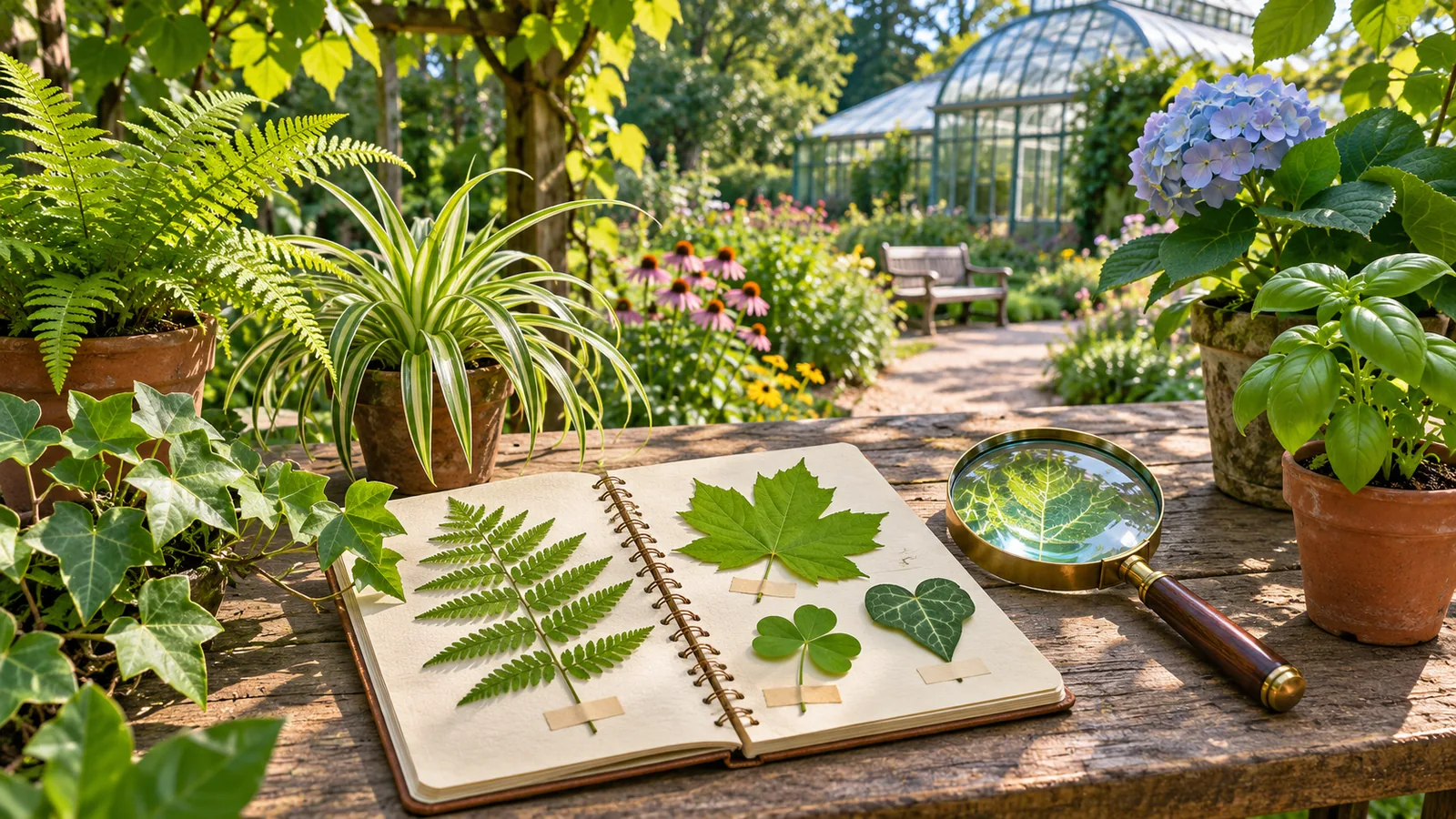
Photograph the whole plant, leaf arrangement, a close leaf, bark or stem and any fruit. Compare all of them with a regional botanical source.
Check the evidence behind the guide
Use these references to check terminology and pursue a topic in more depth. Photo quizzes help you practise observation; a single picture rarely proves a difficult identification.
When a source describes a broad group, compare its details with the exact species, model or specimen you are studying. Record the feature that supports your answer rather than relying on a name alone.