The Industrial Revolution was the shift from hand production to machines, factories and steam power that began in Britain around 1760 and ran to about 1840. It transformed how goods were made, where people lived and how they travelled, and it spread to Europe, the United States and beyond.
The dates are a convention, not a switch that flipped. Change was gradual, uneven and concentrated at first in a few industries, above all cotton, iron and coal. This guide explains why Britain came first, the key inventions, the railways, the effects on working people and the second industrial revolution that followed.
Quick takeaways
- The Industrial Revolution began in Britain around 1760, driven by coal, iron, cotton and steam power.
- Newcomen's engine of 1712 pumped water from mines; James Watt's separate condenser, patented in 1769, made steam far more efficient.
- Railways spread from the 1820s, beginning with the Stockton and Darlington in 1825 and the Liverpool and Manchester in 1830.
- A second industrial revolution from about 1870 brought steel, electricity, chemicals and the internal combustion engine.
Causes
Why did the Industrial Revolution begin in Britain?
No single factor explains it, and historians still debate which ones mattered most. Britain had large deposits of coal and iron ore, often close together and near water. A long period of agricultural improvement had raised food output, so fewer people were needed on the land and more could work in towns. Rivers, a long coastline and, from the 1760s, a growing network of canals made it cheaper to move heavy goods; the Bridgewater Canal, opened in 1761, halved the price of coal in Manchester.
Britain also had capital to invest, banks, a large overseas trade and colonies that supplied raw materials and markets. Raw cotton came increasingly from plantations worked by enslaved people in the Caribbean and the American South, a link that historians now treat as central to the story rather than a side issue. A stable political system after 1688, protection of property and a patent system gave inventors and investors some confidence that they could profit from new machines.
One influential explanation, put forward by the economic historian Robert Allen, is that British wages were high and coal was cheap. That made it worth replacing expensive workers with machines that burned cheap fuel, which was not true in most other countries at the time. Others stress Britain's culture of practical tinkering and scientific societies, or set the question within the wider debate about why parts of Europe pulled ahead of China and India.
Coal near iron
Britain's coalfields lay close to iron ore and to water routes, keeping transport costs low.
Canals first
Before railways, canals were the main way to move heavy loads like coal cheaply.
The name came later
The phrase Industrial Revolution was popularised by Arnold Toynbee's lectures, published in 1884.
Power
How did the steam engine develop, from Newcomen to Watt?
Deep mines filled with water, and pumping it out by hand or with horses was slow and costly. In 1712 Thomas Newcomen installed an atmospheric steam engine near Dudley in the West Midlands to drain a coal mine. Steam filled a cylinder and was then condensed with a spray of cold water, creating a partial vacuum; the pressure of the atmosphere pushed the piston down and worked a pump. Newcomen engines were reliable and spread through British mines, but they wasted huge amounts of fuel because the cylinder was heated and cooled on every stroke.
James Watt, an instrument maker at the University of Glasgow, saw the problem while repairing a model Newcomen engine. His solution was a separate condenser, so the main cylinder could stay hot all the time. He patented it in 1769. In 1775 he went into partnership with the Birmingham manufacturer Matthew Boulton, and Boulton and Watt engines used far less coal than Newcomen's.
Watt's later improvements turned the up-and-down motion of the piston into rotary motion that could drive machinery. That freed factories from the need to sit beside fast rivers for water power and allowed them to cluster in towns near coalfields. The unit of power, the watt, is named after him.
Tip: Exam questions often ask what Watt invented. He did not invent the steam engine; he made it far more efficient, chiefly with the separate condenser.
Cotton
How did machines change the textile industry?
Cotton was the leading industry of the early Industrial Revolution. Making cloth involves two main steps, spinning fibre into thread and weaving thread into cloth, and inventions in one step put pressure on the other. John Kay's flying shuttle of 1733 let weavers work faster, which created a shortage of thread.
Spinning machines answered that demand. James Hargreaves's spinning jenny, of about 1764, let one worker spin several threads at once. Richard Arkwright's water frame, patented in 1769, used water power to spin strong thread, and in 1771 he opened a water-powered mill at Cromford in Derbyshire that is often called one of the first modern factories. Samuel Crompton's spinning mule of 1779 combined the two ideas to make fine, strong thread. Edmund Cartwright's power loom of 1785 began to mechanise weaving, although hand-loom weavers survived for decades.
Factories brought workers under one roof, working set hours to the pace of machines. Manchester grew so fast as a centre of cotton spinning that it was nicknamed Cottonopolis. Across the Atlantic, Eli Whitney's cotton gin of 1793 made it far quicker to separate cotton fibre from seeds, which expanded cotton growing, and with it slavery, in the American South.
| Invention | Inventor | Date | Why it mattered |
|---|---|---|---|
| Coke-smelted iron | Abraham Darby | 1709 | Iron could be made with coke from coal instead of scarce charcoal |
| Atmospheric steam engine | Thomas Newcomen | 1712 | Pumped water out of deep mines |
| Flying shuttle | John Kay | 1733 | Speeded up weaving |
| Spinning jenny | James Hargreaves | c. 1764 | Spun several threads at once |
| Water frame | Richard Arkwright | 1769 (patent) | Water-powered spinning; led to factory mills |
| Separate condenser | James Watt | 1769 (patent) | Made steam engines far more efficient |
| Spinning mule | Samuel Crompton | 1779 | Spun fine, strong thread |
| Power loom | Edmund Cartwright | 1785 | Began to mechanise weaving |
| Cotton gin | Eli Whitney | 1793 | Separated cotton fibre from seeds quickly |
| Steam railway locomotive | Richard Trevithick | 1804 | First locomotive to haul a load on rails |
| Rocket locomotive | George and Robert Stephenson | 1829 | Won the Rainhill Trials; set the pattern for later engines |
Transport
How did railways change Britain?
Horse-drawn wagonways had carried coal on rails for centuries. In 1804 Richard Trevithick's locomotive hauled iron and passengers along a tramroad at Penydarren in South Wales, the first time a steam locomotive pulled a load on rails. Early engines were heavy and broke the brittle rails, but the idea stuck.
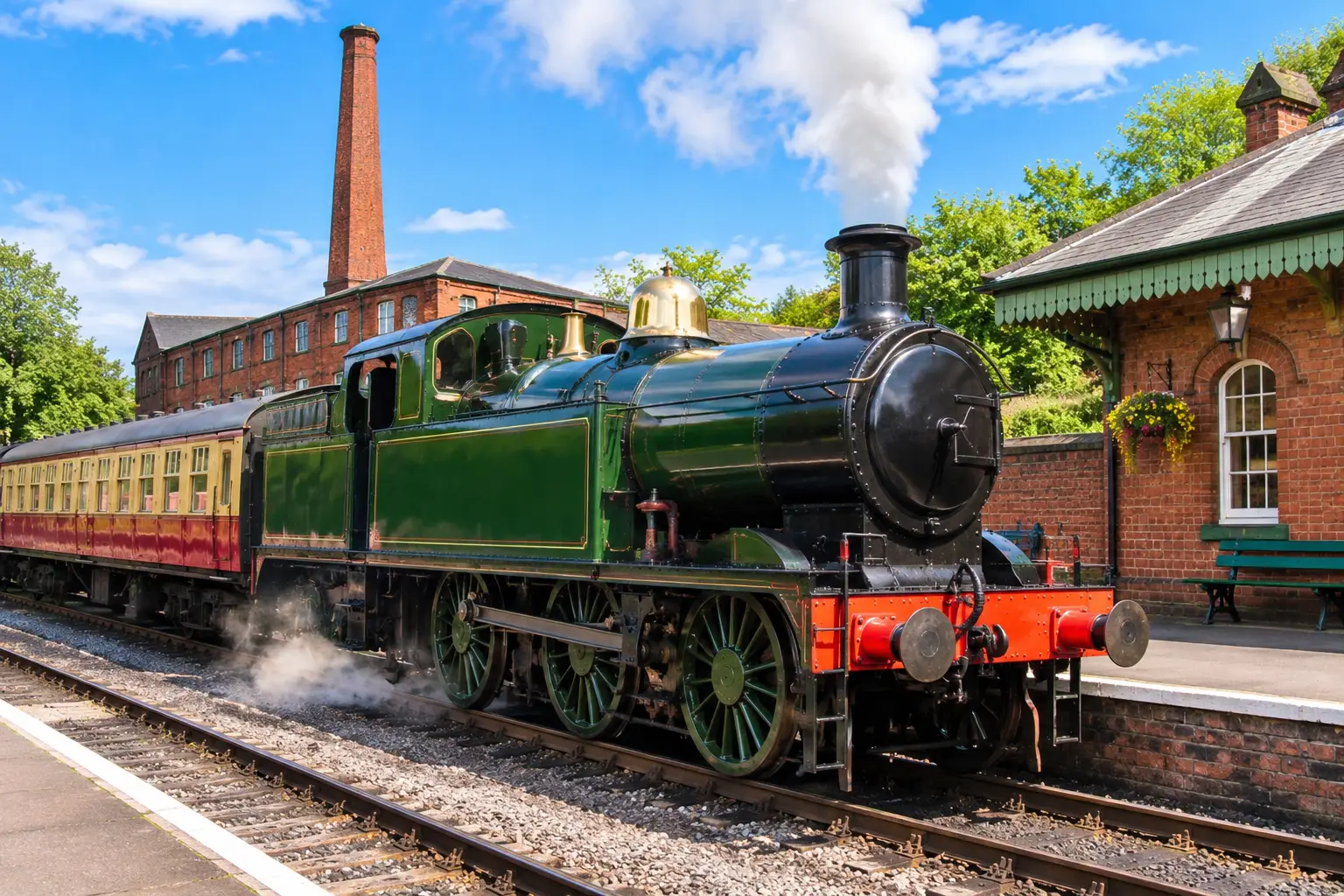
The Stockton and Darlington Railway, opened in 1825 with George Stephenson as engineer, was the first public railway to use steam locomotives. The Liverpool and Manchester Railway, opened in 1830, went further: it linked two major cities, ran to a timetable and relied on steam for all its trains. Its owners chose their engine at the Rainhill Trials of 1829, which the Stephensons' Rocket won.
A railway boom followed in the 1830s and 1840s, and by 1850 Britain had several thousand miles of line. Railways cut journey times from days to hours, created a huge demand for iron and coal, carried fresh food and newspapers to cities and made cheap day trips possible. They even changed time itself: towns had kept their own local time, but railway timetables pushed Britain towards a single national time, which became law in 1880.
Society and the second wave
What were the effects of the Industrial Revolution?
Towns grew at astonishing speed as people moved from the countryside for factory work. By 1851 more than half the population of England and Wales lived in towns, an urban majority that few, if any, countries had reached before. Housing was often crowded, sewage ran into rivers and diseases such as cholera, which first reached Britain in 1831 and 1832, spread quickly. Edwin Chadwick's 1842 report on the sanitary condition of the labouring population helped lead to the Public Health Act of 1848.
Factory and mine work was long, dangerous and poorly paid, and children worked alongside adults. Parliament began to step in. The Factory Act of 1833 banned children under nine from working in textile mills, limited the hours of older children and appointed inspectors. The Mines Act of 1842 banned women, girls and boys under ten from working underground. Workers organised too: the Luddites smashed machines between 1811 and 1816, and the Chartists campaigned for votes for working men from 1838.
Over the long run, industrialisation raised output and, eventually, living standards far beyond anything before it, though historians still argue about how quickly ordinary workers' lives improved. Britain showed off its achievements at the Great Exhibition of 1851, held in the Crystal Palace in Hyde Park. By then other countries, led by Belgium, France, the German states and the United States, were industrialising too.
From about 1870 a second industrial revolution centred on new materials and new forms of power. The Bessemer process, patented in 1856, made cheap steel possible. Electricity, chemicals and oil became major industries, with Germany and the United States taking the lead. Alexander Graham Bell patented the telephone in 1876, Thomas Edison produced a practical electric light bulb in 1879, Karl Benz patented his motor car in 1886 and Henry Ford introduced the moving assembly line in 1913.
| Feature | First Industrial Revolution | Second Industrial Revolution |
|---|---|---|
| Rough dates | c. 1760–1840 | c. 1870–1914 |
| Main power | Water wheels, then steam | Steam, electricity and the internal combustion engine |
| Key materials | Iron, coal, cotton | Steel, oil, chemicals |
| Leading countries | Britain, then Belgium, France and the United States | Germany and the United States, alongside Britain |
| Typical inventions | Spinning machines, Watt's engine, railways | Telephone, light bulb, motor car, assembly line |
Test the Industrial Revolution
Five questions on the guide above. Try them without looking back.
0 / 5 answered
1What was Thomas Newcomen's steam engine of 1712 first used for?
Answer: Pumping water out of mines. Flooding was a major problem in deep mines. Newcomen engines did this job for decades before steam drove factory machines.2Which Birmingham manufacturer went into partnership with James Watt in 1775?
Answer: Matthew Boulton. Boulton's money and workshops at Soho, Birmingham, turned Watt's design into engines sold across Britain. Wedgwood made pottery in Staffordshire and Darby smelted iron at Coalbrookdale.3Which locomotive won the Rainhill Trials in 1829?
Answer: Rocket. George and Robert Stephenson's Rocket was chosen for the Liverpool and Manchester Railway. Flying Scotsman was built much later, in the 1920s.4Who invented the spinning mule in 1779?
Answer: Samuel Crompton. The mule combined features of the spinning jenny and the water frame. Arkwright built the water frame, Hargreaves the jenny and Cartwright the power loom.5What did the Factory Act of 1833 do?
Answer: Banned children under nine from working in textile mills. The Act also limited working hours for older children and appointed factory inspectors to enforce the rules.
Frequently asked questions
What were the main causes of the Industrial Revolution?
Historians point to several linked causes in Britain: plentiful coal and iron, improved farming that freed workers for industry, canals and coastal shipping, capital from trade and empire, a stable government and patent protection. One leading explanation adds that high wages and cheap coal made it profitable to replace workers with machines. Historians still debate how much weight each deserves.
When did the Industrial Revolution start and end?
The first Industrial Revolution is usually dated from about 1760 to about 1840, beginning in Britain. These are conventional dates: some changes, such as Newcomen's engine of 1712, came earlier, and industry kept growing afterwards. A second industrial revolution, built on steel, electricity, chemicals and oil, is usually dated from about 1870 to 1914.
Did James Watt invent the steam engine?
No. Thomas Newcomen built a working steam engine in 1712, and earlier inventors such as Thomas Savery had built steam pumps. Watt's achievement was to make the engine far more efficient. His separate condenser, patented in 1769, kept the main cylinder hot and cut coal use sharply, and later changes let engines drive factory machinery.
How did the Industrial Revolution affect workers?
Many people moved from farms to crowded industrial towns and worked long hours in factories and mines, often in dangerous conditions; children worked too. Disease spread in poorly drained housing. Over time, laws such as the Factory Act of 1833 and the Mines Act of 1842 limited child labour, and trade unions and reformers pushed for better pay and conditions.
How can I revise the Industrial Revolution for a history quiz?
Group the inventions by industry: steam (Newcomen, Watt), textiles (Kay, Hargreaves, Arkwright, Crompton, Cartwright) and railways (Trevithick, Stephenson). Learn one date for each and one effect on society. Then test yourself regularly; the World History Quiz app has rounds on revolutions and the modern world with an explanation after each answer.
Steam, cotton and rails
The Industrial Revolution began in Britain with coal, iron, cotton and steam, gained pace with the railways and reshaped where and how people lived. A second wave after 1870 brought steel, electricity and the motor car.
- Learn the steam engine sequence: Newcomen in 1712, Watt's condenser in 1769.
- Group the textile inventions in order from the flying shuttle to the power loom.
- Practise modern history rounds in the World History Quiz app to keep the dates fresh.
Check the evidence behind the guide
Use these references to check terminology and pursue a topic in more depth. Photo quizzes help you practise observation; a single picture rarely proves a difficult identification.
Dates and causes are often simplified in summaries. Compare two sources for any event you need to remember, and note where historians still disagree.