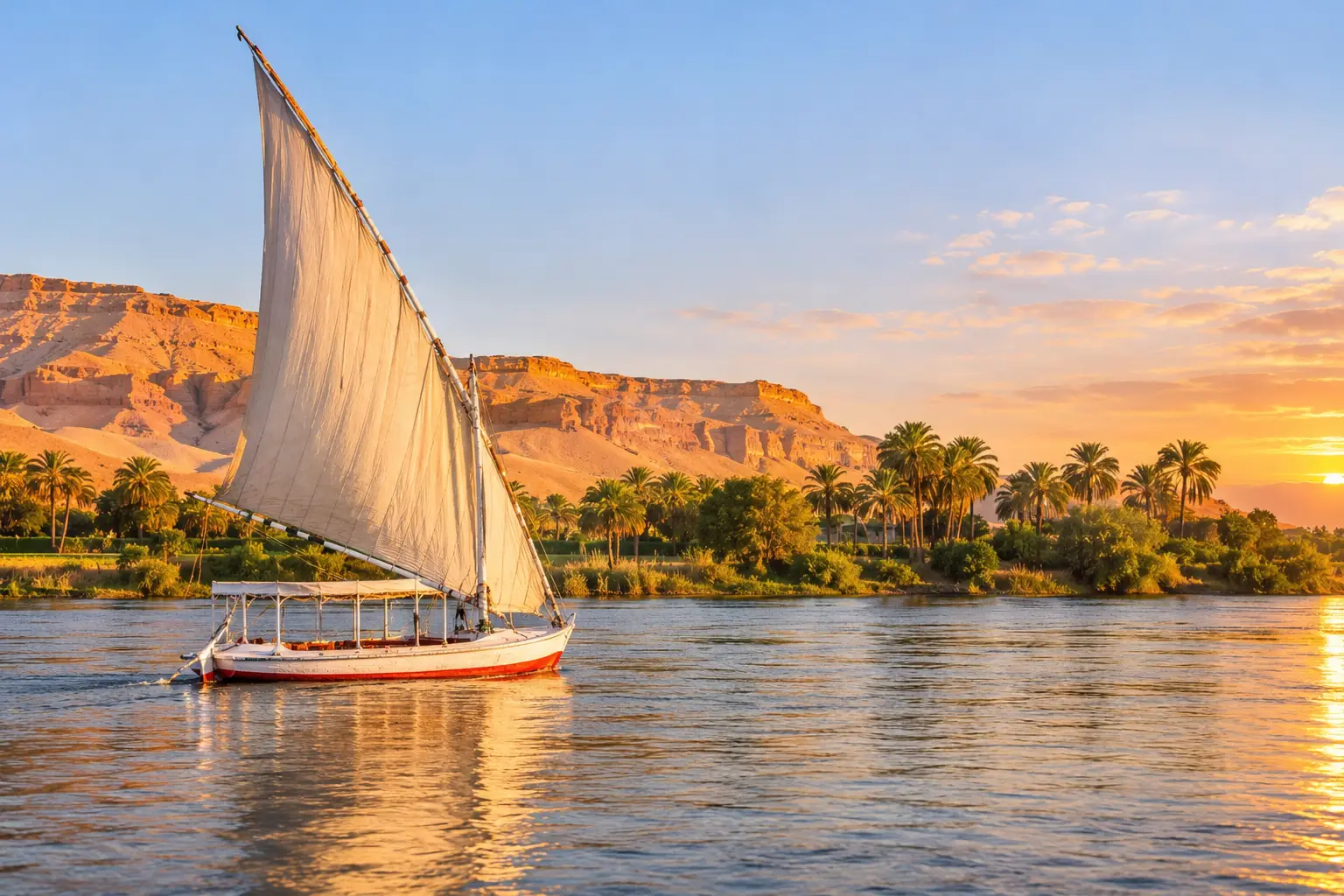
Ancient Egypt was a civilisation that grew up along the River Nile and lasted for about 3,000 years, from the unification of the country around 3100 BC to the death of Cleopatra VII in 30 BC. This quiz has 25 questions on its rulers, pyramids, river, writing and burial customs, each with an explanation.
Dates in Egyptian history are approximate, especially for the early kings, and different books may give slightly different years. Where a date matters, the explanation says so.
Quick takeaways
- Egypt was united around 3100 BC and ruled by pharaohs for about three thousand years.
- The pyramids of Giza were built in the Old Kingdom, more than 4,500 years ago.
- The Rosetta Stone, found in 1799, let scholars decipher hieroglyphs in 1822.
- Cleopatra VII was the last active ruler of the Ptolemaic dynasty; after her death in 30 BC Egypt became a Roman province.
Round 1
Who were the pharaohs?
The pharaoh was both king and a link between the gods and the people. Egyptians believed he kept maat, the order of the universe, by building temples, leading armies and making offerings. Historians group Egypt's rulers into about thirty dynasties, and the dynasties into longer kingdoms separated by periods of division.
Most pharaohs were men, but a few women held full royal power, the best known being Hatshepsut. Some rulers stand out for change rather than tradition: Akhenaten upended Egyptian religion, while Ramesses II reigned for about 66 years and covered the country in monuments.
1Which king is traditionally credited with uniting Upper and Lower Egypt around 3100 BC?
Answer: Narmer. The Narmer Palette shows him wearing the white crown of Upper Egypt on one side and the red crown of Lower Egypt on the other. He is often identified with Menes, the first king in later lists.2What did the word 'pharaoh' originally mean?
Answer: Great house. It comes from the Egyptian per-aa, meaning the royal palace. Only from the New Kingdom onwards was it used for the king himself.3Which woman ruled Egypt as pharaoh in the 18th Dynasty and built a great temple at Deir el-Bahari?
Answer: Hatshepsut. Hatshepsut reigned for about twenty years in the 15th century BC. Statues often show her with the king's false beard and headcloth.4Which pharaoh tried to make the sun disc, the Aten, the centre of Egyptian worship?
Answer: Akhenaten. Akhenaten built a new capital at Amarna. After his death the traditional gods were restored, and his monuments were later attacked.5Which pharaoh fought the Hittites at the Battle of Kadesh, around 1274 BC?
Answer: Ramesses II. Neither side won outright. Years later Ramesses II and the Hittite king agreed one of the earliest peace treaties whose text survives.
| Period | Approximate dates | Known for |
|---|---|---|
| Early Dynastic Period | c. 3100–2686 BC | Unification of Egypt; the first dynasties |
| Old Kingdom | c. 2686–2181 BC | The Step Pyramid and the pyramids of Giza |
| Middle Kingdom | c. 2055–1650 BC | Reunification and classic literature |
| New Kingdom | c. 1550–1069 BC | Hatshepsut, Akhenaten, Tutankhamun, Ramesses II; the Valley of the Kings |
| Ptolemaic Period | 332–30 BC | Greek-speaking rulers from Alexandria, ending with Cleopatra VII |
Round 2
The pyramids of Giza and how they began
Pyramids grew out of earlier flat-topped tombs called mastabas. The first was a stack of them: Djoser's Step Pyramid at Saqqara, built around 2650 BC. Within about a century, builders had learned to make true smooth-sided pyramids.
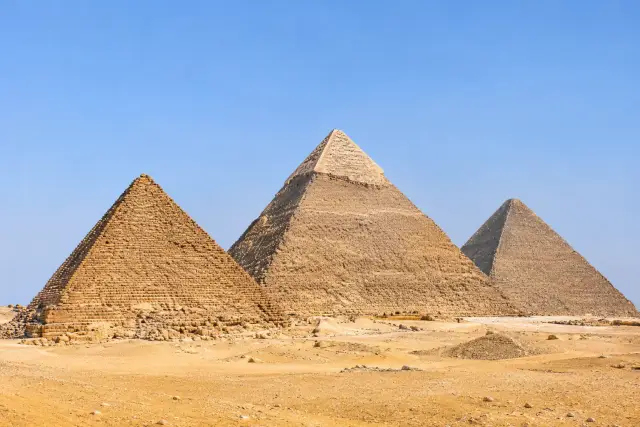
The three main pyramids at Giza belong to Khufu, his son Khafre and Menkaure, probably Khafre's son, all of the 4th Dynasty. Excavations of nearby workers' settlements and cemeteries suggest that organised crews of Egyptian labourers, fed by the state, did the building. The popular idea that slaves built them is not supported by this evidence.
6Which pharaoh built the Step Pyramid at Saqqara, the earliest of Egypt's great pyramids?
Answer: Djoser. The Step Pyramid dates from about 2650 BC. It stacks six flat-topped levels and is credited to the architect Imhotep.7Which is the smallest of the three main pyramids at Giza?
Answer: The Pyramid of Menkaure. Menkaure's pyramid was originally about 65 metres tall, less than half the height of Khufu's. Djoser's Step Pyramid stands at Saqqara, not Giza.8Which pharaoh is the Great Sphinx of Giza usually thought to portray?
Answer: Khafre. The Sphinx sits beside the causeway to Khafre's pyramid, so most Egyptologists link it to him. It was carved from the limestone bedrock of the plateau.9What were the pyramids of Giza built to be?
Answer: Royal tombs. Each pyramid held a burial chamber for the king and stood at the centre of a funerary complex with temples and a causeway. The old story that they were grain stores has no basis in the evidence.10Roughly how tall was the Great Pyramid of Giza when it was completed?
Answer: About 146 metres. It has lost several metres from its top and its smooth outer casing. It remained the tallest structure built by people for more than 3,800 years.
| Pyramid | Pharaoh | Original height |
|---|---|---|
| Great Pyramid | Khufu | About 146 m |
| Second pyramid | Khafre | About 143 m |
| Third pyramid | Menkaure | About 65 m |
Round 3
Why the Nile mattered to ancient Egypt
Almost all of Egypt is desert, and the ancient population lived along a narrow strip of farmland beside the Nile. Every summer the river flooded and left behind a layer of rich black silt. When the water went down, farmers planted wheat, barley and flax in the damp soil.
The flood shaped the calendar, the economy and religion. A low flood could bring famine, and a very high one could wash away villages. The annual flood stopped after the Aswan High Dam was completed in 1970.
11What did the ancient Egyptians call their own land?
Answer: Kemet, the Black Land. Kemet referred to the dark, fertile soil left by the Nile flood. Deshret, the Red Land, was the desert on either side.12What was Akhet in the Egyptian calendar?
Answer: The season of the Nile flood. The year had three seasons of four months: Akhet, the flood; Peret, the growing season; and Shemu, the harvest.13Why is Upper Egypt in the south of the country?
Answer: The Nile flows north, so upstream is south. Upper means upriver. The Nile flows north to the Mediterranean, so Upper Egypt is the southern valley and Lower Egypt is the northern delta.14What was a nilometer used for?
Answer: Measuring the height of the Nile flood. Nilometers were steps or wells marked with levels. A good flood meant a good harvest, so officials used the readings to predict crops and set taxes.15Which reed from the Nile marshes did the Egyptians make into a writing material?
Answer: Papyrus. Strips of the papyrus stem were laid in two layers and pressed into sheets. The English word paper comes from papyrus; flax was used to make linen.
Round 4
Hieroglyphs and the Rosetta Stone
Hieroglyphs were used for more than 3,000 years, mostly on temples, tombs and monuments. Scribes also wrote quicker, joined-up scripts: hieratic and, later, demotic. The last known hieroglyphic inscription was carved at the temple of Philae in AD 394, and the ability to read the script was then lost for over a thousand years.
Hieroglyphs are not just pictures of things. Some signs stand for sounds, some for whole words, and some are silent signs that show what kind of word comes before them. Working this out from the Rosetta Stone and other texts was one of the great feats of scholarship.
16In which year was the Rosetta Stone found?
Answer: 1799. French soldiers found it near the town of Rashid, or Rosetta, during Napoleon's campaign in Egypt. Hieroglyphs were deciphered in 1822, and Tutankhamun's tomb was found in 1922.17Which three scripts are carved on the Rosetta Stone?
Answer: Hieroglyphic, Demotic and ancient Greek. The stone carries the same decree in two languages, Egyptian and Greek, written in three scripts. Scholars could read the Greek, which gave them a key to the Egyptian.18Who announced the decipherment of Egyptian hieroglyphs in 1822?
Answer: Jean-François Champollion. Champollion showed that hieroglyphs mixed signs for sounds with signs for whole words. He set out his findings in a famous letter of 1822.19Where is the Rosetta Stone displayed today?
Answer: The British Museum in London. The stone passed to Britain under the terms of the French surrender in Egypt in 1801. It has been on display at the British Museum since 1802.20What is a cartouche in Egyptian writing?
Answer: An oval loop drawn around a royal name. Cartouches marked out the names of kings and queens. Matching the cartouches of Ptolemy and Cleopatra helped Champollion work out the sounds of several signs.
Round 5
Mummies, Tutankhamun and Cleopatra
Egyptians believed the body had to survive for the spirit to live on in the afterlife. Embalmers removed the internal organs, dried the body with natron, a natural salt, and wrapped it in linen. The whole process could take about seventy days.
Tutankhamun was a fairly minor king who died at about 18 or 19, but his small tomb escaped the large-scale robbery that emptied most royal burials. Cleopatra VII, by contrast, was a major political figure who lived far closer in time to us than to the builders of the Great Pyramid.
21Which organ did embalmers usually leave inside the body during mummification?
Answer: The heart. Egyptians believed the heart held a person's thoughts and deeds. In the afterlife it was weighed against the feather of Maat, the goddess of truth.22Who led the excavation that found Tutankhamun's tomb in the Valley of the Kings in 1922?
Answer: Howard Carter. Carter found the first step of the tomb in November 1922. His sponsor, Lord Carnarvon, was present when the sealed doorway was first opened.23What is the famous funerary mask of Tutankhamun mainly made of?
Answer: Gold. The mask weighs about 10 kilograms and is inlaid with coloured glass and semi-precious stones such as lapis lazuli. It covered the head of the king's mummy.24Which ruling family did Cleopatra VII belong to?
Answer: The Ptolemaic dynasty. The Ptolemies descended from Ptolemy I, a Macedonian general of Alexander the Great. They ruled Egypt from Alexandria for almost three centuries.25Which Roman general was Cleopatra's ally and partner in her final years?
Answer: Mark Antony. Antony and Cleopatra were defeated by Octavian, the future Augustus, at the Battle of Actium in 31 BC. Both died by suicide in Alexandria the following year.
Five more Egypt questions
A quick review with questions you have not seen above.
0 / 5 answered
1Who is credited with designing Djoser's Step Pyramid?
Answer: Imhotep. Imhotep was Djoser's chief official. Much later Egyptians worshipped him as a god of wisdom and medicine.2What were canopic jars used for?
Answer: Holding a mummy's preserved internal organs. Four jars held the lungs, liver, stomach and intestines. Each was protected by one of the four sons of the god Horus.3Which jackal-headed god was linked with embalming and the protection of the dead?
Answer: Anubis. Priests sometimes wore a jackal mask to play Anubis during the rites. Horus had a falcon head and Thoth often an ibis head.4Which ruler is honoured in the decree carved on the Rosetta Stone?
Answer: Ptolemy V. Priests issued the decree at Memphis in 196 BC. Copies were set up in temples across Egypt, in Egyptian for the priests and in Greek, the language of the ruling Ptolemies.5In which year did Cleopatra VII die, after which Egypt became a Roman province?
Answer: 30 BC. She died in Alexandria in 30 BC, the year after her defeat at Actium in 31 BC. Julius Caesar was killed in 44 BC, and Alexander conquered Egypt in 332 BC.
Frequently asked questions
How long did ancient Egypt last?
Pharaonic Egypt lasted roughly 3,000 years, from the unification of Upper and Lower Egypt around 3100 BC to the death of Cleopatra VII in 30 BC. In that time it went through long stable kingdoms, periods of division and rule by foreigners, including Nubians, Persians and Macedonian Greeks, before becoming a Roman province.
Who built the pyramids of Giza?
Most Egyptologists think the pyramids were built by organised crews of Egyptian workers, not slaves. Excavations near Giza found the workers' settlement, bakeries and tombs, which show they were fed by the state and honoured with burials close to the king. Many were probably farmers called up for a period of service.
Why did the ancient Egyptians make mummies?
They believed a person's spirit needed the body to survive in the afterlife. Preserving the body by drying it with natron and wrapping it in linen gave the spirit somewhere to return. Spells, amulets and goods placed in the tomb were meant to help the dead person on the journey to the next world.
Why is the Rosetta Stone so important?
It carries the same decree in hieroglyphs, demotic and ancient Greek. Because scholars could read the Greek, they could compare it with the Egyptian versions. Using the stone and other texts, Jean-François Champollion announced in 1822 how hieroglyphs worked, which opened up thousands of years of Egyptian writing to modern readers.
What is a good way to learn ancient Egypt for a history quiz?
Learn the big periods first: Old Kingdom for pyramids, New Kingdom for the Valley of the Kings, Ptolemaic for Cleopatra. Then attach famous rulers to each. Short daily quizzes help the names stick, and the World History Quiz app covers the ancient world with an explanation after every answer.
River, kings and writing
Ancient Egypt rested on the Nile's yearly flood, the authority of the pharaoh and a writing system that was lost and then recovered through the Rosetta Stone.
- Place each pharaoh in the Old, Middle or New Kingdom or the Ptolemaic period.
- Link the three Giza pyramids to Khufu, Khafre and Menkaure in that order of size.
- Keep practising ancient history rounds in the World History Quiz app.
Check the evidence behind the guide
Use these references to check terminology and pursue a topic in more depth. Photo quizzes help you practise observation; a single picture rarely proves a difficult identification.
Dates and causes are often simplified in summaries. Compare two sources for any event you need to remember, and note where historians still disagree.