An eclipse happens when the Sun, Earth and Moon line up so that one body blocks light from another. In a solar eclipse the Moon passes between the Sun and Earth and casts its shadow on Earth; in a lunar eclipse Earth passes between the Sun and the Moon and its shadow falls on the Moon.
Solar eclipses can happen only at new Moon and lunar eclipses only at full Moon. They come in several types, depending on how exactly the bodies line up and how far the Moon is from Earth at the time.
This guide explains each type of solar and lunar eclipse, why eclipses do not happen every month, and how to watch them safely.
Quick takeaways
- There are four types of solar eclipse: total, annular, partial and hybrid.
- Lunar eclipses are total, partial or penumbral, and a totally eclipsed Moon often turns red.
- The Moon's orbit is tilted by about 5 degrees, so eclipses happen only in eclipse seasons, not every month.
- Solar eclipses need certified eye protection except during totality; lunar eclipses are safe to watch with the naked eye.
How eclipses work: umbra and penumbra
Any object lit by the Sun casts a shadow with two parts. The umbra is the dark inner cone, where the Sun is completely blocked. The penumbra is the paler outer zone, where only part of the Sun is blocked. Which part of the shadow you are in, or which part falls on the Moon, decides the type of eclipse.
Solar eclipses rely on a remarkable coincidence. The Sun is about 400 times wider than the Moon, but also about 400 times farther away. So from Earth the two look almost exactly the same size in the sky, and the Moon can just cover the Sun's bright disc while leaving its faint outer atmosphere, the corona, visible around the edge.
The match is not perfect. The Moon's orbit is slightly oval, so its distance from Earth varies. Near its closest point it looks a little larger than the Sun and can cover it completely. Near its farthest point it looks slightly smaller, and a thin ring of Sun remains. Over hundreds of millions of years the Moon is slowly drifting away from Earth, by about 3.8 centimetres a year, so total solar eclipses will eventually stop happening.
Solar eclipse
The Moon blocks the Sun. It is seen only from the narrow areas where the Moon's shadow falls, and happens at new Moon.
Lunar eclipse
Earth's shadow falls on the Moon. It can be seen from anywhere on Earth where the Moon is up, and happens at full Moon.
Types of solar eclipse: total, annular, partial and hybrid
A total solar eclipse happens when the Moon's umbra reaches Earth. Inside the path of totality, a strip usually no more than a few hundred kilometres wide, the sky darkens to a deep twilight, the temperature drops, bright planets and stars appear and the pearly corona shines around the black Moon. Totality lasts only a few minutes at any one place, never more than about seven and a half. Just before and after, sunlight shining through valleys on the Moon's edge makes bright points called Baily's beads and a single flash known as the diamond ring.
An annular solar eclipse happens when the Moon is too far from Earth to cover the Sun fully. A bright ring, or annulus, of Sun stays visible around the Moon, often called a ring of fire. The sky dims but does not go dark, and the Sun is never safe to look at directly, even at the middle of the eclipse.
A partial solar eclipse is seen from inside the Moon's penumbra, where the Moon covers only part of the Sun and seems to take a bite out of it. Every total or annular eclipse is partial for people outside the central path, and some eclipses are only ever partial. A hybrid eclipse is the rarest kind. Because Earth's surface is curved, the eclipse looks annular from parts of the path and total from others. One example was the hybrid eclipse of 20 April 2023, which was total along a short track over Western Australia, Timor-Leste and Indonesia.
| Eclipse type | What happens | What you see | Eye protection needed? |
|---|---|---|---|
| Total solar | The Moon's umbra reaches Earth | Sun fully covered; corona visible; sky goes dark | Yes, except during the brief totality itself |
| Annular solar | The Moon is too far away to cover the Sun | A bright ring of Sun around the Moon | Yes, at every stage |
| Partial solar | Only the penumbra falls on you | A bite taken out of the Sun | Yes, at every stage |
| Hybrid solar | Earth's curve changes the view along the path | Annular in some places, total in others | Yes, except during totality |
| Total lunar | The whole Moon passes into Earth's umbra | The Moon turns dark coppery red | No, safe with the naked eye |
| Partial lunar | Part of the Moon enters the umbra | A dark curved shadow covers part of the Moon | No, safe with the naked eye |
| Penumbral lunar | The Moon passes only through the penumbra | A slight, easy-to-miss dimming | No, safe with the naked eye |
Types of lunar eclipse, and why the Moon turns red
A total lunar eclipse happens when the whole Moon moves into Earth's umbra. The Moon does not vanish. It usually turns a coppery red, which is why it is sometimes called a blood moon. Sunlight passing through Earth's atmosphere is bent towards the Moon, and on the way the air scatters out most of the blue light, just as it does at sunset. In effect, the Moon is lit by all of Earth's sunrises and sunsets at once. The exact shade depends on how much dust and cloud is in the atmosphere at the time.
In a partial lunar eclipse only part of the Moon enters the umbra, and a dark, curved shadow creeps across its face. The curve of that shadow was one of the clues the ancient Greeks used to argue that Earth is round. In a penumbral lunar eclipse the Moon passes only through the outer shadow. The Moon dims slightly, and many people do not notice anything has happened.
Lunar eclipses are much easier to see than total solar eclipses. Anyone on the night side of Earth can watch, and the whole event, from the first touch of the penumbra to the last, can last several hours, with totality sometimes lasting over an hour. A total solar eclipse, by contrast, is seen only from a narrow path, and any single place sees one on average only once every few centuries.
Why don't eclipses happen every month?
There is a new Moon and a full Moon every month, so you might expect a solar and a lunar eclipse every month too. The reason we do not get them is that the Moon's orbit is tilted by about 5 degrees compared with the plane of Earth's orbit around the Sun. Most months, the new Moon passes a little above or below the Sun in our sky, and the full Moon passes above or below Earth's shadow.
The Moon's tilted orbit crosses the plane of Earth's orbit at two points called nodes. An eclipse can happen only when a new or full Moon falls close to one of these nodes. That lines up roughly twice a year, in periods called eclipse seasons, each lasting a little over a month. Every year has at least two solar eclipses, although many are only partial or are seen mainly over oceans or polar regions.
Eclipses also repeat in a pattern. After a period called the saros, about 18 years and 11 days, the Sun, Earth and Moon return to nearly the same arrangement, and a very similar eclipse happens again. Because the saros includes an extra third of a day, Earth has turned about a third further, so the repeat eclipse is seen from a region shifted roughly 120 degrees of longitude to the west. Ancient astronomers, including the Babylonians, used such cycles to predict eclipses.
How to watch a solar or lunar eclipse safely
Looking at the Sun during a partial or annular eclipse is just as dangerous as on any other day, and perhaps more so, because people stare for longer. The retina has no pain sensors, so damage can happen without any warning and can be permanent. Ordinary sunglasses, even very dark ones, are not safe.
Use eclipse glasses or handheld solar viewers that meet the international ISO 12312-2 standard, from a reputable supplier. Check them for scratches or holes before use and supervise children. Never look through binoculars, a camera or a telescope while wearing eclipse glasses; the focused light will burn straight through them. Optical equipment needs its own certified solar filter fitted over the front.
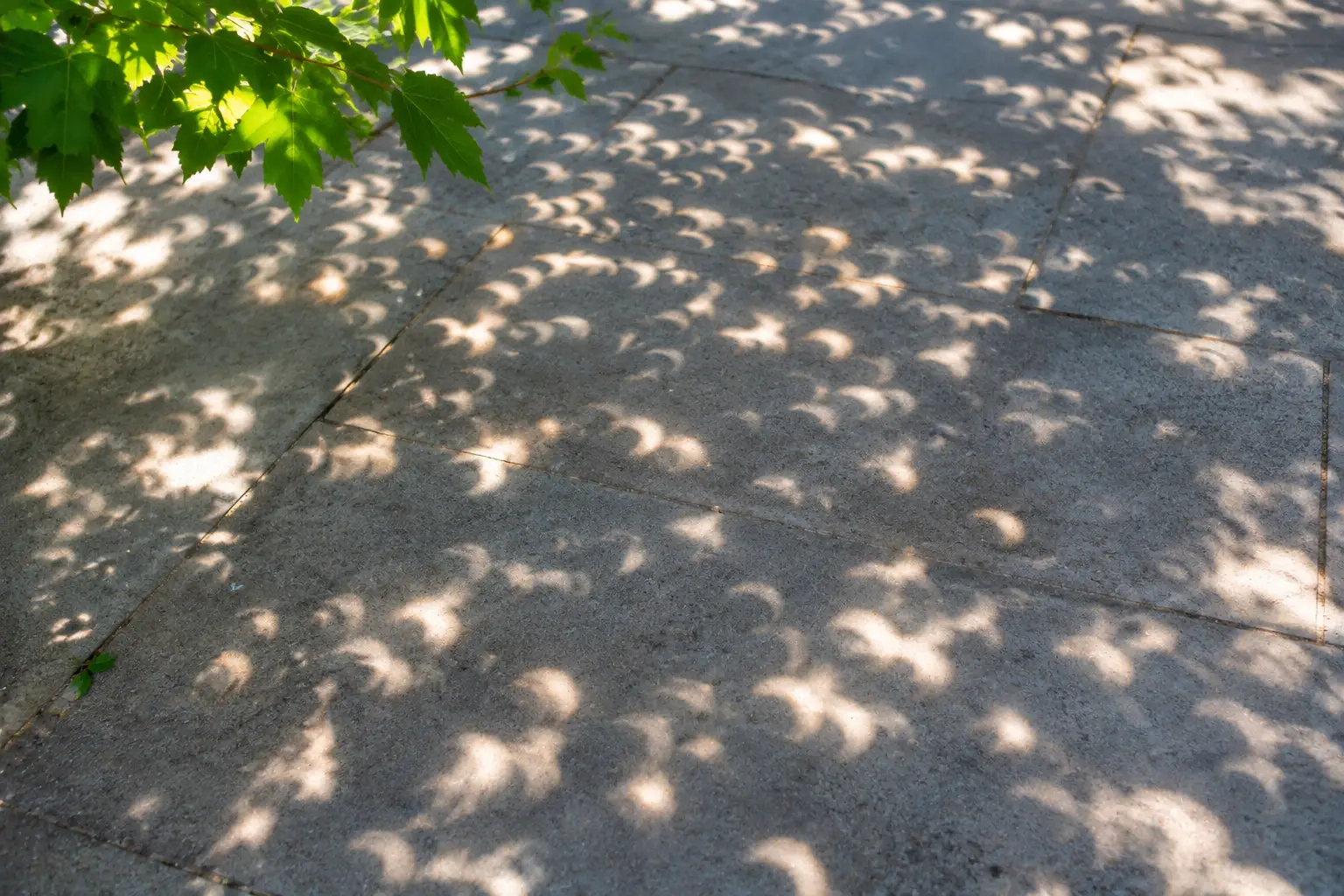
You can also watch without looking at the Sun at all. Make a pinhole projector by poking a small hole in card and letting the sunlight fall on a second sheet; you will see a small image of the eclipsed Sun. The gaps between tree leaves or the holes in a kitchen colander work the same way and scatter little crescents on the ground. Only during totality in a total eclipse, when the Moon covers the Sun completely, is it safe to look with the naked eye. Put your glasses back on the moment the first bright edge of the Sun returns.
Lunar eclipses need no protection. You can watch one with your eyes, binoculars or a telescope, and it makes a good subject for a camera on a tripod. For dates and timings of upcoming eclipses where you live, check a reliable source such as NASA's eclipse pages or your national observatory.
Tip: If you are not in the path of totality, keep your eclipse glasses on the whole time. A Sun that is 99 per cent covered is still bright enough to damage your eyes.
Check your eclipse knowledge
Five questions on the guide above.
0 / 5 answered
1Why do we sometimes see a ring of fire around the Moon during a solar eclipse?
Answer: The Moon is near its farthest point from Earth, so it looks smaller than the Sun. This is an annular eclipse. The Moon cannot cover the whole Sun, so a bright ring remains.2Why does the Moon often turn red during a total lunar eclipse?
Answer: Earth's atmosphere bends reddish sunlight onto it. The air scatters away blue light, as at sunset, and bends the remaining red light into Earth's shadow.3Which kind of eclipse is safe to watch with the naked eye from start to finish?
Answer: A lunar eclipse. A lunar eclipse is just the Moon in Earth's shadow, so it is no brighter than a normal full Moon.4Which standard should solar eclipse glasses meet?
Answer: ISO 12312-2. ISO 12312-2 is the international safety standard for filters used to look directly at the Sun. UV400 is a rating for ordinary sunglasses.5What is the saros?
Answer: A cycle of about 18 years after which similar eclipses repeat. After one saros the Sun, Earth and Moon return to nearly the same arrangement.
Frequently asked questions
What is the difference between a solar and a lunar eclipse?
In a solar eclipse the Moon passes between the Sun and Earth and blocks the Sun, so it happens in the daytime at new Moon and is seen only from parts of Earth. In a lunar eclipse Earth passes between the Sun and the Moon and its shadow falls on the Moon, so it happens at full Moon and is visible from the whole night side of Earth.
How often do solar eclipses happen?
Every year has at least two solar eclipses, and some years have up to five. Many are partial, or are best seen over oceans or polar regions. A total solar eclipse happens somewhere on Earth roughly every 18 months on average, but any single place sees one only about once every few centuries, which is why people travel to see them.
Is it safe to look at a solar eclipse?
Only with proper protection. Use eclipse glasses or solar viewers meeting the ISO 12312-2 standard, or watch indirectly with a pinhole projector. Ordinary sunglasses are not safe. The only time you can look with the naked eye is during totality, when the Moon completely covers the Sun. Partial and annular eclipses are never safe to view without protection.
Why is a total lunar eclipse called a blood moon?
During a total lunar eclipse the Moon often turns a deep red or copper colour. Earth's atmosphere bends sunlight into the shadow, and on the way it scatters out blue light, leaving the reddish light of sunrises and sunsets to fall on the Moon. The colour varies from bright orange to dark brick red, depending on dust and clouds in the atmosphere.
How can I learn more about eclipses and the Moon?
Start by learning the Moon's phases, since solar eclipses happen only at new Moon and lunar eclipses only at full Moon. Then practise the eclipse types in the table above until you can explain each one. The Solar System Quiz app on Android has daily questions on the Sun, Moon and planets for quick, regular revision.
Shadows in line
Eclipses happen when the Sun, Earth and Moon line up near the Moon's orbital nodes. Solar eclipses are total, annular, partial or hybrid; lunar eclipses are total, partial or penumbral. Protect your eyes for every solar eclipse except during totality.
- Use the umbra and penumbra to explain each type of eclipse in your own words.
- Buy ISO 12312-2 eclipse glasses well before any solar eclipse, or make a pinhole projector.
- Keep practising Moon, Sun and planet questions in the Solar System Quiz app.
Check the evidence behind the guide
Use these references to check terminology and pursue a topic in more depth. Photo quizzes help you practise observation; a single picture rarely proves a difficult identification.
When a source describes a broad group, compare its details with the exact species, model or specimen you are studying. Record the feature that supports your answer rather than relying on a name alone.