You can name the eight planets, but can you explain why Venus is hotter than Mercury or why the Moon changes shape in the sky? This quiz starts with the familiar and moves toward the details that make space science interesting.
Answer 30 questions in three rounds. Each choice reveals a short rationale, so a missed answer becomes a fact you can use the next time. The five-question bonus round at the end gives you a separate score.
Quick takeaways
- Round 1 covers the Sun and rocky planets.
- Round 2 moves to giant planets and notable moons.
- Round 3 covers small bodies, eclipses and orbital ideas.
Round 1: the Sun and inner planets
Begin close to the Sun. These questions test position, composition and a few common misconceptions.
1What kind of object is the Sun?
Answer: A star. The Sun is the star whose gravity holds the solar system together.2Which planet orbits closest to the Sun?
Answer: Mercury. Mercury is the innermost of the eight planets.3Which planet has the hottest average surface temperature?
Answer: Venus. Venus's dense atmosphere traps heat, making it hotter than Mercury.4What is Earth's position from the Sun?
Answer: Third. The inner planets are Mercury, Venus, Earth and Mars in that order.5Why does Mars look reddish?
Answer: Iron-rich dust. Iron minerals in Martian dust oxidise and give the surface a rusty appearance.6Which pair of planets has no natural moons?
Answer: Mercury and Venus. Neither Mercury nor Venus has a known natural moon.7Which four planets are rocky terrestrial planets?
Answer: Mercury, Venus, Earth and Mars. The four inner planets have solid rocky surfaces.8Where is the main asteroid belt?
Answer: Between Mars and Jupiter. Most main-belt asteroids orbit between Mars and Jupiter.9Which planet is famous for a very thick carbon-dioxide atmosphere?
Answer: Venus. Venus has a dense atmosphere dominated by carbon dioxide.10What does one Earth year measure?
Answer: One orbit of Earth around the Sun. A year is based on Earth's revolution around the Sun.
Round 2: giant planets and moons
The outer planets are not all alike: Jupiter and Saturn are gas giants, while Uranus and Neptune are ice giants.
11What is the largest planet in our solar system?
Answer: Jupiter. Jupiter is the largest planet by diameter and mass.12On which planet is the Great Red Spot?
Answer: Jupiter. The Great Red Spot is a long-lived storm in Jupiter's atmosphere.13Which planet is best known for its broad bright rings?
Answer: Saturn. All four giant planets have rings, but Saturn's are the most conspicuous.14Which planet rotates with an extreme sideways tilt?
Answer: Uranus. Uranus's rotation axis is tipped so far that it appears to roll around the Sun.15Which planet is farthest from the Sun?
Answer: Neptune. Neptune is the eighth and outermost planet; Pluto is classified as a dwarf planet.16Which pair is classified as gas giants?
Answer: Jupiter and Saturn. Jupiter and Saturn are gas giants; Uranus and Neptune are ice giants.17Which pair is classified as ice giants?
Answer: Uranus and Neptune. Uranus and Neptune have different interiors and compositions from the gas giants.18Which planet does Ganymede orbit?
Answer: Jupiter. Ganymede is Jupiter's largest moon.19Which planet does Titan orbit?
Answer: Saturn. Titan is Saturn's largest moon and has a dense atmosphere.20Which Jovian moon has an icy surface and evidence of an ocean below?
Answer: Europa. Europa is an icy moon of Jupiter with strong evidence for a subsurface ocean.
Round 3: dwarf planets, small bodies and motion
Finish with the objects between and beyond planets, plus what we see from Earth.
21How is Pluto currently classified?
Answer: Dwarf planet. Pluto is one of the solar system's officially recognised dwarf planets.22Which dwarf planet lies in the main asteroid belt?
Answer: Ceres. Ceres orbits in the asteroid belt between Mars and Jupiter.23What is a comet mainly made of?
Answer: Ices, dust and rock. Comets are icy small bodies that can develop comae and tails near the Sun.24What do we call a space rock that reaches the ground?
Answer: Meteorite. A meteoroid is in space, a meteor is the streak of light, and a meteorite reaches the surface.25What causes the Moon's phases as seen from Earth?
Answer: Changing view of its sunlit half. We see different fractions of the Moon's sunlit half as it orbits Earth.26What is between Earth and the Sun during a solar eclipse?
Answer: The Moon. A solar eclipse occurs when the Moon passes between Earth and the Sun.27What is between the Sun and Moon during a lunar eclipse?
Answer: Earth. Earth's shadow can fall on the Moon when the three bodies align.28What does a light-year measure?
Answer: Distance. A light-year is the distance light travels in one year.29What is the name of our galaxy?
Answer: The Milky Way. The solar system lies inside the Milky Way galaxy.30What keeps planets in orbit around the Sun?
Answer: Gravity. The Sun's gravity, combined with planetary motion, keeps planets in orbit.
Five more solar system questions
A short bonus round with fresh clues.
0 / 5 answered
1Which planet is sometimes called the Red Planet?
Answer: Mars. Iron-rich dust gives Mars its reddish look.2Which planet has the moon Enceladus?
Answer: Saturn. Enceladus orbits Saturn and has icy plumes.3What is the name for a rocky object orbiting the Sun that is smaller than a planet?
Answer: Asteroid. Asteroids are small rocky bodies that orbit the Sun.4Which planet is closest in size to Earth?
Answer: Venus. Venus is similar to Earth in diameter, though its conditions are very different.5What object does Earth orbit?
Answer: The Sun. Earth orbits the Sun, while the solar system also travels around the Milky Way.
Frequently asked questions
How many planets are in the solar system?
There are eight planets. Pluto is classified as a dwarf planet under the current definition.
Do all giant planets have rings?
Yes. Jupiter, Saturn, Uranus and Neptune all have ring systems, though Saturn's are by far the easiest to see.
Keep the model in your head
If you miss a question, place the object on a simple sketch of the solar system or explain its relationship to the Sun. A connected picture is easier to use than an isolated fact.
Check the solar system against NASA's map
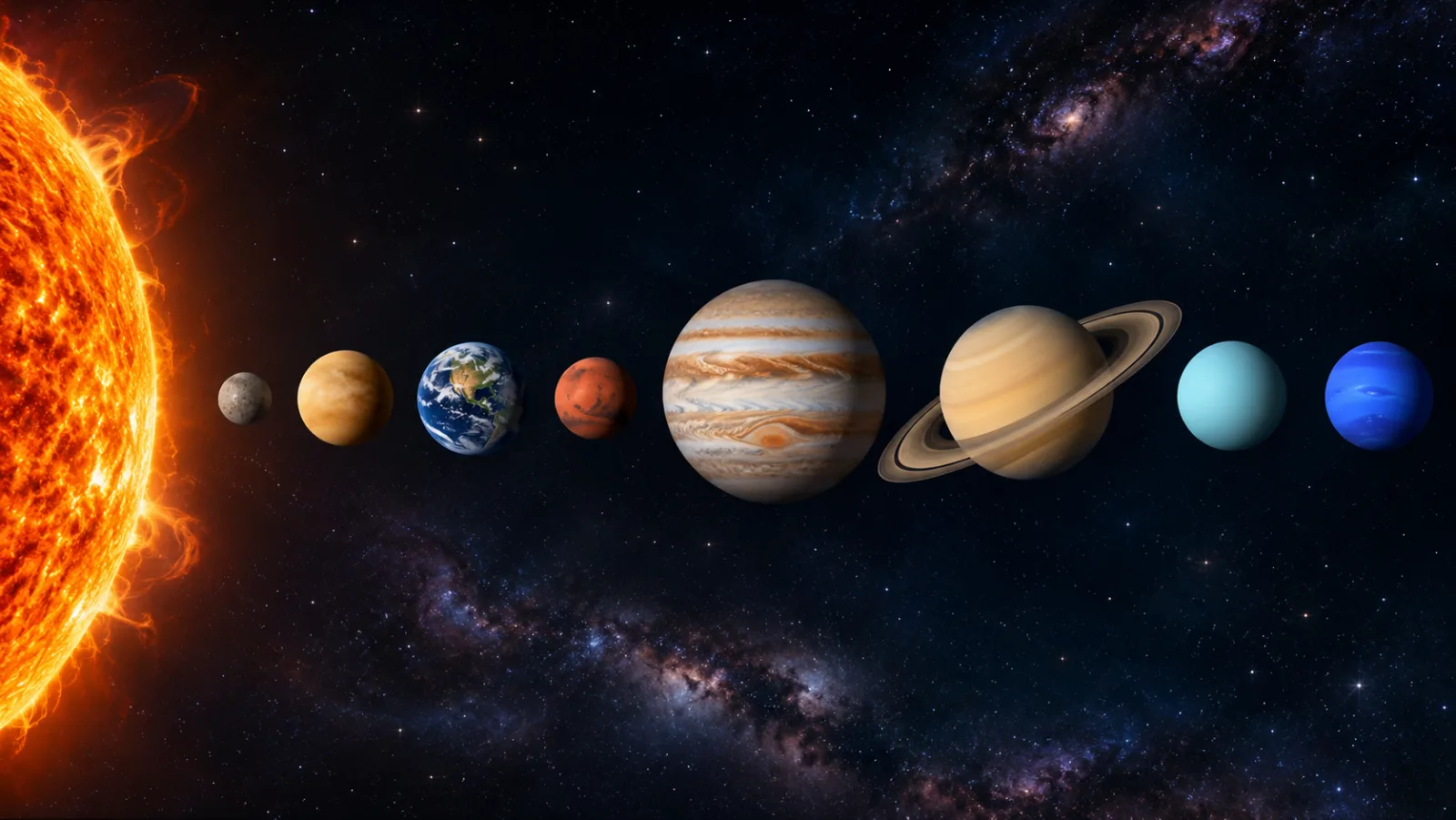
After each missed question, place the object in a simple sketch: Sun, rocky planets, asteroid belt and giant planets. Add moons beneath their parent planets and keep dwarf planets separate from the eight major planets.
The NASA pages below are useful for current definitions and for checking details that short quiz answers cannot cover.