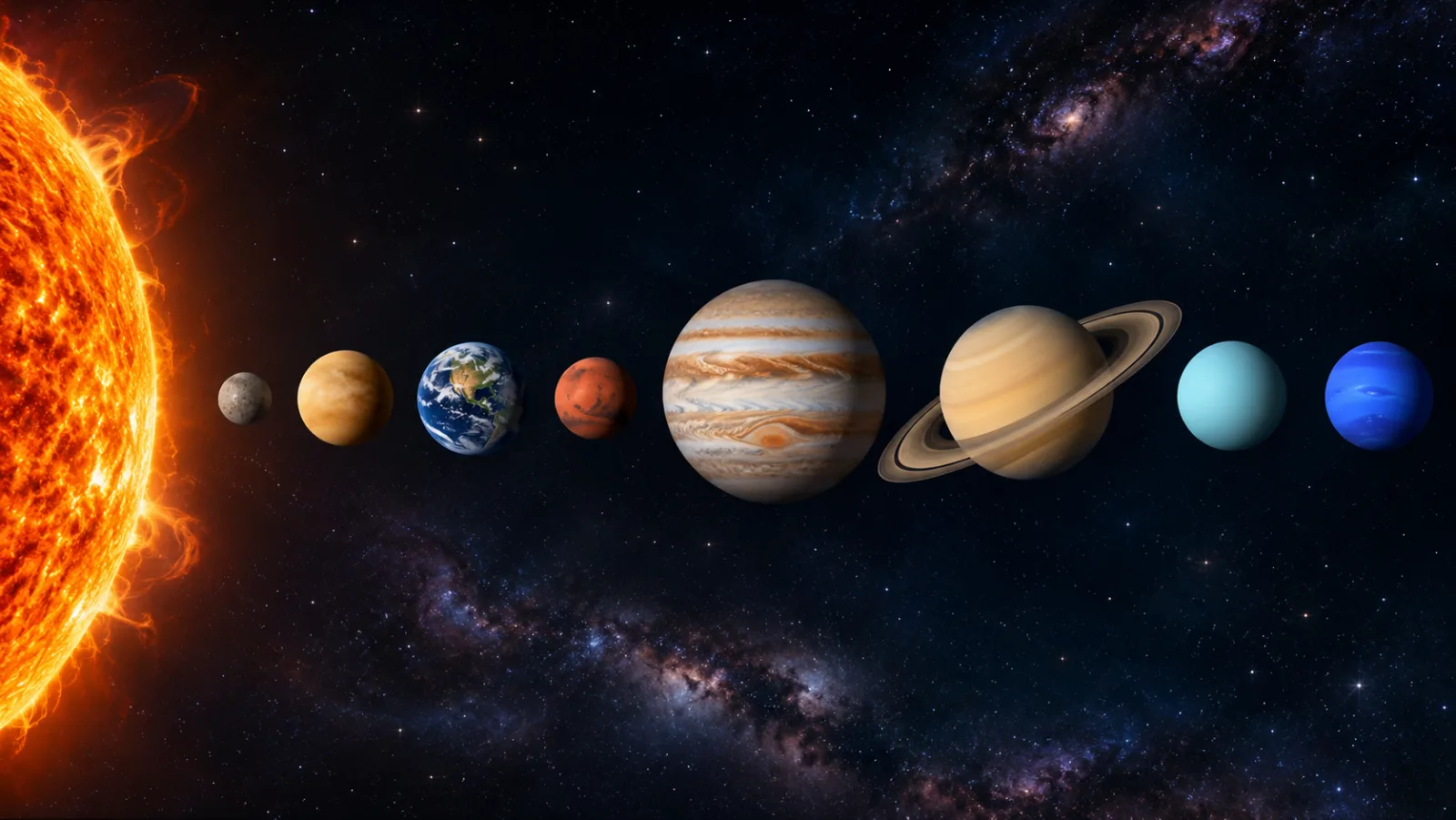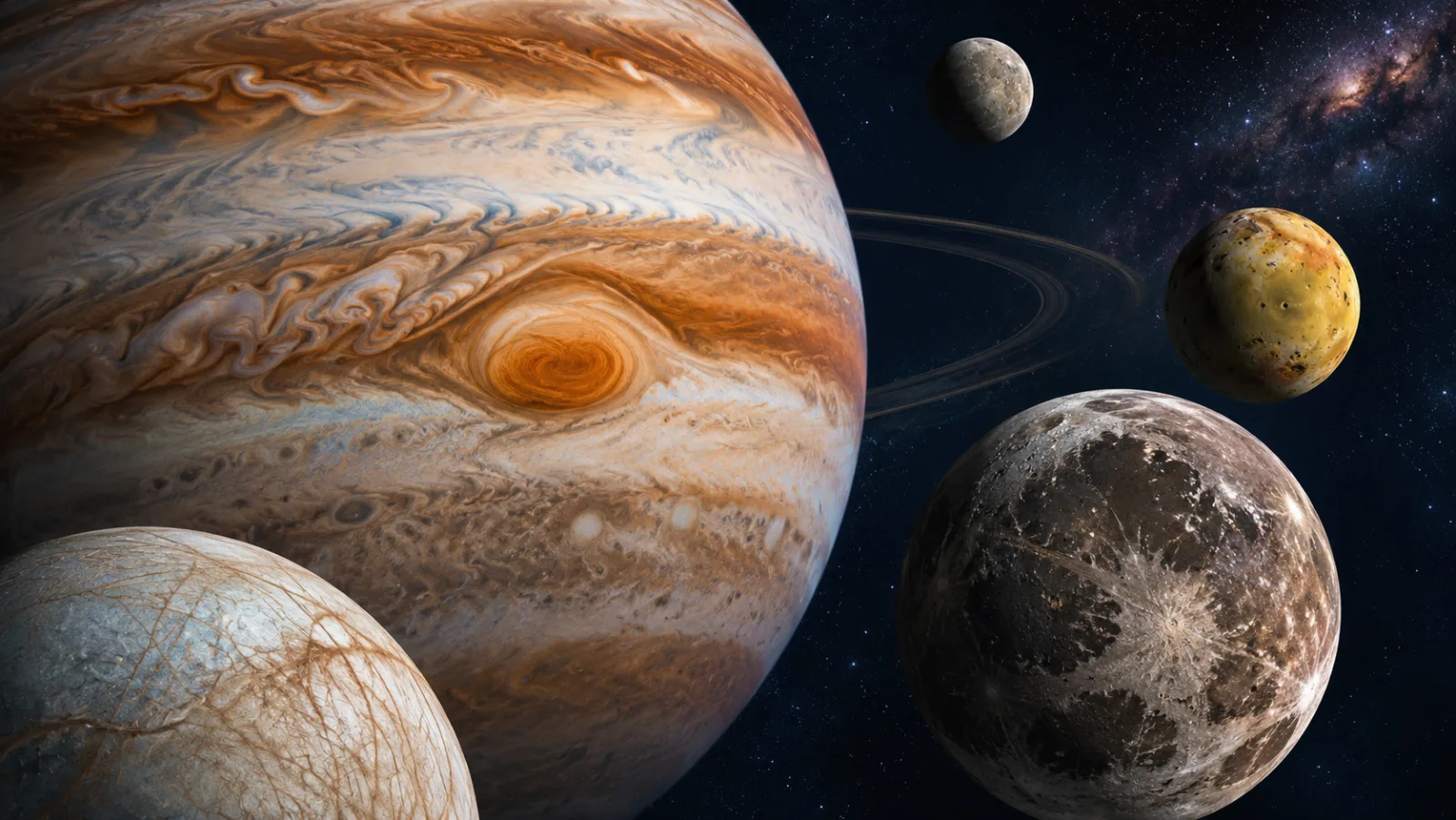
The planets are only half the story. Some moons are larger than planets, some hide oceans beneath ice, and one has lakes on its surface. Knowing which moon belongs to which planet makes the solar system easier to picture.
This quiz has twenty questions in two rounds. First come the rocky planets and Earth's Moon; then the giant planets and their satellites. Every answer includes the reason, so you can use a wrong choice to sharpen your mental map.
Quick takeaways
- Sketch the four rocky planets in order.
- Group moons under their parent planets.
- Use one memorable feature per moon.
Rocky planets and Earth's Moon
Start with the four planets that have solid surfaces, then look at our own Moon.
1Which is the smallest of the eight planets?
Answer: Mercury. Mercury is the smallest major planet, although some moons are larger.2Which planet's thick atmosphere is mostly carbon dioxide?
Answer: Venus. Venus has a dense carbon-dioxide atmosphere and extreme surface heat.3Which planet has the large volcano Olympus Mons?
Answer: Mars. Olympus Mons is a giant shield volcano on Mars.4What are the names of Mars's two small moons?
Answer: Phobos and Deimos. Phobos and Deimos are the two natural moons of Mars.5Which Martian moon orbits closer to Mars?
Answer: Phobos. Phobos has the tighter orbit; Deimos travels farther out.6Why do we usually see the same side of Earth's Moon?
Answer: It rotates once per orbit. The Moon's rotation period matches its orbital period around Earth.7What are the dark lunar maria?
Answer: Ancient lava plains. The maria are dark basaltic plains formed by ancient volcanic activity.8Which planet has one large natural moon named simply the Moon?
Answer: Earth. Earth has one natural moon, usually called the Moon.9Which planet has a global magnetic field and liquid water at its surface?
Answer: Earth. Earth is the only known planet with stable liquid water at its surface today.10Which rocky planet is closest to the asteroid belt?
Answer: Mars. Mars is the outermost terrestrial planet, next to the main asteroid belt.
Giant planets and their remarkable moons
These questions focus on moons with oceans, volcanoes, thick atmospheres and unusual orbits.
11Which is the largest moon in the solar system?
Answer: Ganymede. Ganymede orbits Jupiter and is larger than Mercury.12Which moon of Jupiter is especially volcanically active?
Answer: Io. Io's volcanism is driven by tidal heating from Jupiter and neighbouring moons.13Which moon has evidence for a salty ocean beneath its icy shell?
Answer: Europa. Europa is a Jovian moon with strong evidence for an ocean below its ice.14Which of Jupiter's large moons has a heavily cratered surface?
Answer: Callisto. Callisto's old surface preserves many impact craters.15Which Saturnian moon has a thick atmosphere and methane lakes?
Answer: Titan. Titan has a dense nitrogen-rich atmosphere and surface lakes of methane and ethane.16Which moon sends icy plumes into space from its south pole?
Answer: Enceladus. Enceladus's plumes sample material from an ocean beneath its icy crust.17What are Saturn's visible rings mainly made of?
Answer: Pieces of ice and rock. Saturn's rings contain countless particles, many rich in water ice.18Which planet does Triton orbit?
Answer: Neptune. Triton is Neptune's largest moon and moves in a retrograde orbit.19Which planet has an extreme sideways tilt?
Answer: Uranus. Uranus's spin axis lies close to the plane of its orbit.20Which two giant planets are known as ice giants?
Answer: Uranus and Neptune. Uranus and Neptune are classed separately from the larger gas giants.
Match five moons to their planets
A quick final check, using different moons.
0 / 5 answered
1Which planet does Earth's Moon orbit?
Answer: Earth. The Moon is Earth's natural satellite.2Which planet does Io orbit?
Answer: Jupiter. Io is one of Jupiter's four large Galilean moons.3Which planet does Enceladus orbit?
Answer: Saturn. Enceladus is an icy moon of Saturn.4Which planet does Triton orbit?
Answer: Neptune. Triton is Neptune's largest moon.5Which planet do Phobos and Deimos orbit?
Answer: Mars. Phobos and Deimos are Mars's two small moons.
Frequently asked questions
Does every planet have a moon?
No. Mercury and Venus have no known natural moons; the other six planets have at least one.
Are moons always smaller than planets?
Not always when compared across different systems. Ganymede, a moon of Jupiter, is larger in diameter than the planet Mercury.
Build a parent-planet map
Write each giant planet's name and add one moon with a distinctive clue. Recreate the map from memory tomorrow before taking another round.
Make a parent-planet list
Group Europa, Io, Ganymede and Callisto under Jupiter; Titan and Enceladus under Saturn; and Triton under Neptune. Add one defining feature per moon, then reproduce the list without looking.
NASA's moon and planet guides provide fuller context than a quiz explanation can include.