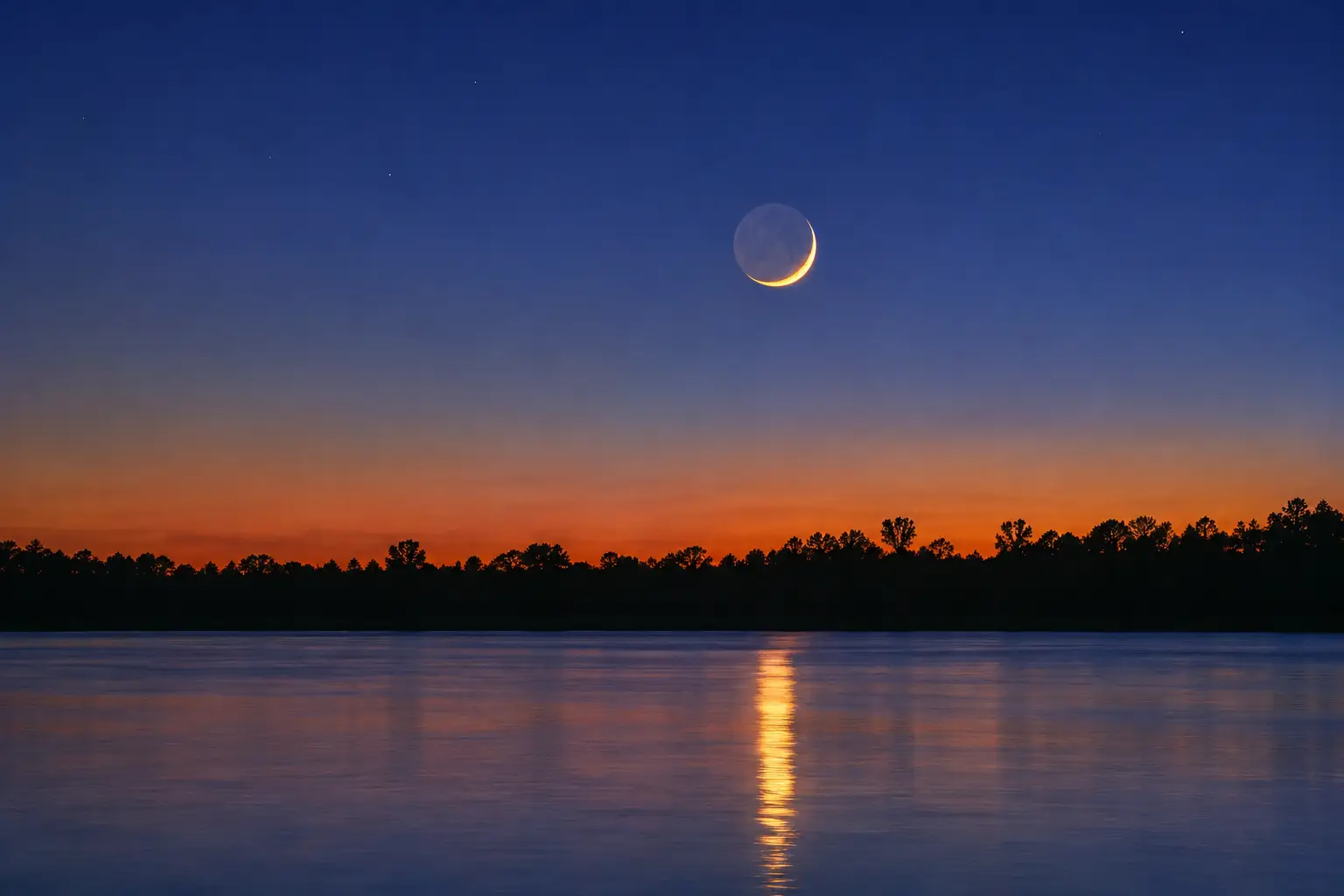
The Moon does not change shape. Half of it is always lit by the Sun, and as it orbits Earth we see different amounts of that sunlit half. Those changing views are the phases.
The Moon gives off no light of its own; it reflects sunlight. One full cycle of phases, from new Moon to new Moon, takes about 29.5 days. This is a little longer than the 27.3 days the Moon takes to orbit Earth, because Earth is moving around the Sun at the same time.
The eight phases
At new Moon, the Moon lies roughly between Earth and the Sun, so its lit side faces away from us and we see almost nothing. Over the next two weeks the lit part grows, or waxes, through crescent, first quarter and gibbous, until the whole face is lit at full Moon.
After full Moon the lit part shrinks, or wanes, through waning gibbous, last quarter and waning crescent, back to new Moon. Gibbous means more than half lit; crescent means less than half.
| Phase | How much is lit | Roughly when it is high in the sky |
|---|---|---|
| New Moon | Almost none | Around midday, lost in the Sun's glare |
| Waxing crescent | A thin sliver, growing | Afternoon; seen in the west after sunset |
| First quarter | Half | Around sunset |
| Waxing gibbous | More than half, growing | Evening |
| Full Moon | All of the face | Around midnight |
| Waning gibbous | More than half, shrinking | After midnight |
| Last quarter | Half | Around sunrise |
| Waning crescent | A thin sliver, shrinking | Morning; seen in the east before sunrise |
Why the names can confuse
A first quarter Moon looks half lit, not a quarter lit. The name refers to the Moon being a quarter of the way through its cycle. Last quarter, also called third quarter, is three quarters of the way through.
In the Northern Hemisphere a waxing Moon is lit on the right and a waning Moon on the left. In the Southern Hemisphere the view is reversed. Near the equator, a crescent can appear to lie on its back.
Eclipses, earthshine and supermoons
A solar eclipse can happen only at new Moon, when the Moon passes in front of the Sun. A lunar eclipse can happen only at full Moon, when the Moon moves into Earth's shadow. Eclipses do not happen every month because the Moon's orbit is tilted by about 5 degrees to Earth's, so the three bodies usually do not line up exactly.
Around a thin crescent you can often see the dark part of the Moon glowing faintly. This is earthshine: sunlight reflected off Earth onto the Moon. A supermoon is a full Moon that happens when the Moon is near the closest point of its slightly oval orbit, so it looks a little bigger and brighter than usual.
Check the cycle
0 / 4 answered
1About how long does one full cycle of Moon phases take?
Answer: 29.5 days. The cycle from new Moon to new Moon is called a synodic month.2What does 'waxing' mean when describing the Moon?
Answer: The lit part is growing. Waxing runs from new Moon to full Moon.3At which phase can a lunar eclipse happen?
Answer: Full Moon. Earth must lie between the Sun and the Moon.4Why is a half-lit Moon called a first quarter Moon?
Answer: It is a quarter of the way through its cycle. The name counts progress through the cycle, not the lit area.
Frequently asked questions
Are the Moon's phases caused by Earth's shadow?
No. Phases come from the angle between the Sun, Earth and Moon, which changes how much of the sunlit half we can see. Earth's shadow falls on the Moon only during a lunar eclipse.
Half lit, seen from different angles
The Moon is always half lit. As it orbits Earth every month we see more of that half, then less, giving the cycle from new Moon to full Moon and back.
Check the evidence behind the guide
Use these references to check terminology and pursue a topic in more depth. Photo quizzes help you practise observation; a single picture rarely proves a difficult identification.
When a source describes a broad group, compare its details with the exact species, model or specimen you are studying. Record the feature that supports your answer rather than relying on a name alone.