There are 18 commonly recognised penguin species, and all of them live in the Southern Hemisphere apart from the Galápagos penguin, which reaches just north of the equator. They range from the little penguin, about 30 cm tall, to the emperor penguin, which stands more than a metre tall.
Only a few penguins live in Antarctica itself. The rest breed on subantarctic islands and along cool coasts of South America, southern Africa, Australia and New Zealand. This guide lists every species with its range and size, then explains how penguins keep warm in icy water and stay cool in hot sun.
Quick takeaways
- 18 penguin species are commonly recognised, though some authorities count 17 to 20.
- The emperor is the largest penguin and the little penguin is the smallest.
- Penguins stay warm with dense waterproof feathers, a layer of fat and blood vessels that save heat.
- Several species are threatened, including the African penguin, now listed as Critically Endangered.
How many species of penguin are there?
Eighteen species are commonly recognised, grouped into six genera. The count is not fixed, because scientists disagree about a few close relatives. Some treat the royal penguin as a pale-faced form of the macaroni penguin. Some split the rockhoppers into two species and others into three, and some divide the little penguin into an Australian and a New Zealand species. That is why you will see totals from 17 to 20.
All penguins share the same basic design: a torpedo-shaped body, stiff flipper-like wings, legs set far back for steering underwater, and dark backs with pale fronts. That colouring, called countershading, makes them hard to see from above against dark water and from below against the bright surface.
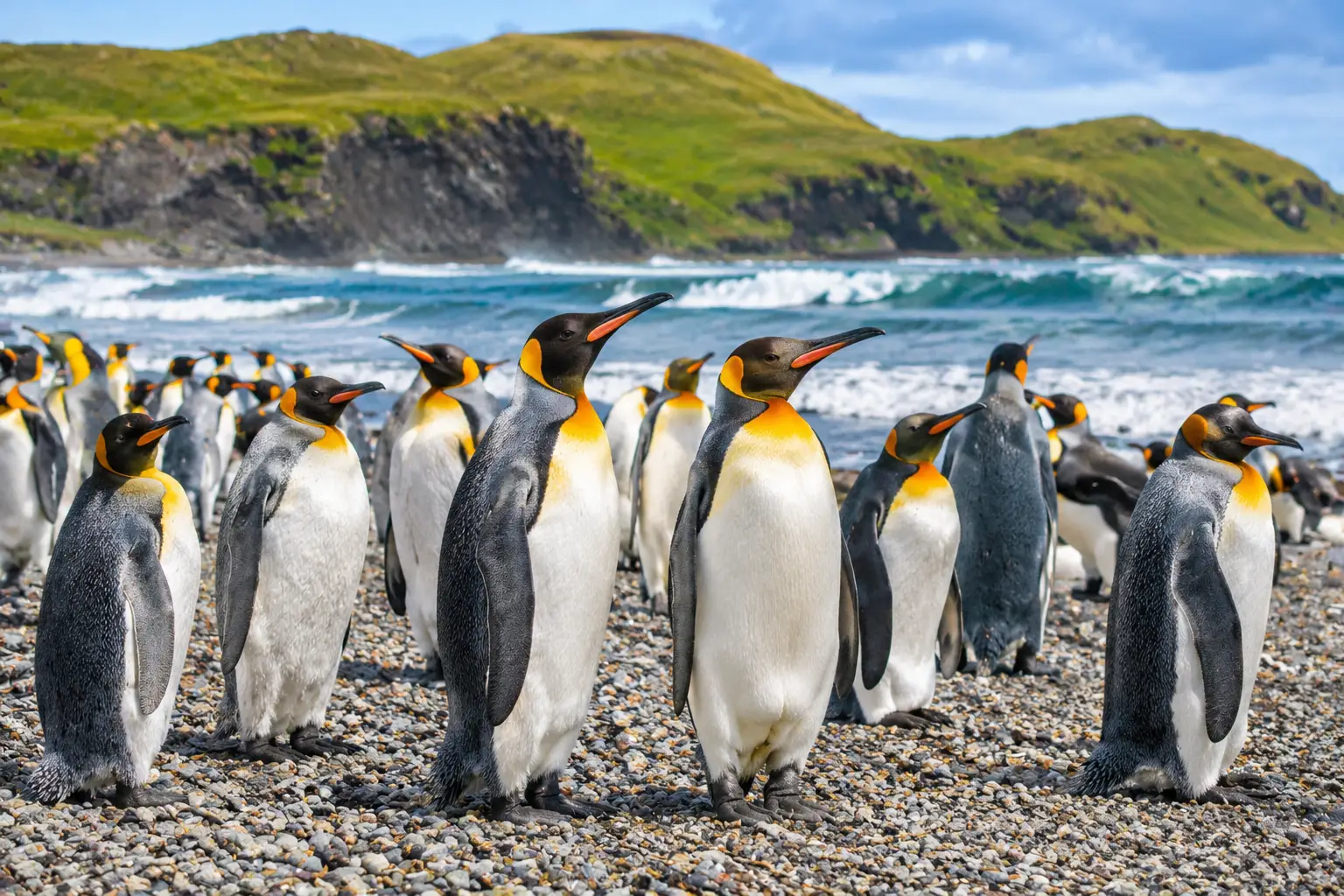
The six groups are easy to learn by their head markings. Great penguins have orange or yellow neck patches, crested penguins have yellow plumes, banded penguins have black and white stripes, and the brush-tailed group has long, stiff tails.
| Group (genus) | Species | How to recognise them |
|---|---|---|
| Great penguins (Aptenodytes) | Emperor, king | Very large, long bills, orange or yellow ear and neck patches |
| Brush-tailed penguins (Pygoscelis) | Adélie, chinstrap, gentoo | Long stiff tails; Antarctic and subantarctic |
| Crested penguins (Eudyptes) | Macaroni, royal, southern rockhopper, northern rockhopper, Fiordland, Snares, erect-crested | Yellow or orange plumes on the head, heavy red-brown bills |
| Banded penguins (Spheniscus) | African, Humboldt, Magellanic, Galápagos | Black and white bands on the head and chest, bare pink skin near the eye |
| Little penguin (Eudyptula) | Little penguin | The smallest penguin, with slate-blue upperparts |
| Yellow-eyed penguin (Megadyptes) | Yellow-eyed penguin | Pale yellow eyes and a yellow band around the head |
Penguin species list: where each one lives and how big it gets
Heights below are approximate standing heights for adults. Penguins vary with age, sex and season, and they look shorter when hunched, so treat the figures as a guide to relative size rather than exact measurements.
The two great penguins are in a size class of their own. An emperor can weigh 22 to 45 kg depending on the time of year, while a little penguin weighs about 1 kg. Most other species fall between 50 and 75 cm.
Several species have very small ranges. The royal penguin breeds only on Macquarie Island, the Snares penguin only on the Snares Islands, and the erect-crested penguin only on the Bounty and Antipodes islands, which makes them vulnerable to any change in those places.
| Penguin | Group | Where it breeds | Approximate height |
|---|---|---|---|
| Emperor penguin | Great | Around the coast of Antarctica, on sea ice | About 1.1 to 1.2 m |
| King penguin | Great | Subantarctic islands such as South Georgia, Crozet, Kerguelen and the Falklands | About 90 cm |
| Gentoo penguin | Brush-tailed | Antarctic Peninsula, the Falklands and subantarctic islands | About 75 to 90 cm |
| Adélie penguin | Brush-tailed | All around the coast of Antarctica | About 60 to 70 cm |
| Chinstrap penguin | Brush-tailed | Antarctic Peninsula and nearby islands such as the South Shetlands and South Sandwich Islands | About 70 cm |
| Macaroni penguin | Crested | Subantarctic islands of the South Atlantic and southern Indian Ocean, including South Georgia | About 70 cm |
| Royal penguin | Crested | Macquarie Island only | About 65 to 75 cm |
| Southern rockhopper penguin | Crested | Falklands, islands off southern Chile and Argentina, and subantarctic islands of the Indian and Pacific oceans | About 50 cm |
| Northern rockhopper penguin | Crested | Tristan da Cunha and Gough Island; Amsterdam and St Paul islands | About 55 cm |
| Fiordland penguin | Crested | South-west coast of New Zealand's South Island and Stewart Island | About 55 to 60 cm |
| Snares penguin | Crested | Snares Islands, New Zealand, only | About 50 to 65 cm |
| Erect-crested penguin | Crested | Bounty and Antipodes islands, New Zealand | About 50 to 70 cm |
| African penguin | Banded | Coasts of South Africa and Namibia | About 60 to 70 cm |
| Humboldt penguin | Banded | Coasts of Peru and Chile | About 55 to 70 cm |
| Magellanic penguin | Banded | Argentina, Chile and the Falklands; winters north to Brazil | About 60 to 75 cm |
| Galápagos penguin | Banded | Galápagos Islands, Ecuador | About 50 cm |
| Little penguin | Little | Southern Australia and New Zealand | About 30 to 33 cm |
| Yellow-eyed penguin | Yellow-eyed | South-east South Island and Stewart Island, New Zealand, and the Auckland and Campbell islands | About 65 to 75 cm |
Where do penguins live?
Penguins live only in the Southern Hemisphere, apart from a few Galápagos penguins on the northern tip of Isabela Island, just north of the equator. No penguins live in the Arctic, so polar bears and penguins never meet in the wild.
Only two species, the emperor and the Adélie, breed mainly on the Antarctic continent and its sea ice. The chinstrap and gentoo breed on the Antarctic Peninsula and nearby islands. Most of the rest live on windswept islands in the Southern Ocean or along temperate coasts.
What penguins really need is cold, food-rich water. The Humboldt Current along Peru and Chile and the Benguela Current off south-west Africa bring cool, nutrient-rich water north, which is why Humboldt and African penguins can live in deserts and warm climates. The Galápagos penguin depends on cool currents that well up around the islands.
Antarctic specialists
Emperor and Adélie penguins breed mainly on the Antarctic continent and its sea ice.
Island breeders
King, macaroni, rockhopper, royal, Snares and erect-crested penguins breed on remote subantarctic islands.
Mainland coasts
African, Humboldt, Magellanic, little and yellow-eyed penguins breed along mainland coasts and nearby islands.
On the equator
The Galápagos penguin is the only penguin found naturally north of the equator.
How do penguins stay warm?
Water draws heat from a body far faster than air, so the first line of defence is the feathers. Penguins have short, stiff, tightly overlapping feathers covering the whole body, with fluffy down at their bases that traps a layer of air. Penguins spread oil from a gland near the tail as they preen, which keeps the coat waterproof.
Under the skin is a layer of fat that insulates the body and stores energy for long fasts. In the flippers and legs, arteries carrying warm blood run right beside veins carrying cold blood back. Heat passes from one to the other, so the feet stay just above freezing while little warmth is lost to the ice. This is called countercurrent heat exchange.
Emperor penguins add teamwork. During the Antarctic winter, males incubating eggs pack into tight huddles of hundreds or thousands of birds. The huddle slowly shuffles so that birds on the cold edge take turns in the warm middle, where the temperature can rise far above the air outside.
Once a year penguins replace all their feathers at once in a catastrophic moult. Until the new coat grows in, they are not waterproof, so they stay ashore and fast for several weeks, living off the fat they built up beforehand.
Tip: Dark backs absorb sunshine. On a still, sunny day in Antarctica, a penguin's black feathers can warm it noticeably, which helps on land but means it must lose heat after hard exercise.
Penguins in hot climates and the threats they face
Overheating is the bigger problem for banded penguins. Humboldt, African, Magellanic and Galápagos penguins have patches of bare pink skin on the face that release heat. They pant, hold their flippers away from the body, shelter in burrows or under bushes, and go to sea during the hottest part of the day.
Many penguins are in trouble. The African penguin was moved to Critically Endangered on the IUCN Red List in 2024 after steep declines linked mainly to a shortage of sardines and anchovies, its main prey. In the past, guano scraping and egg collecting destroyed nesting sites. The yellow-eyed and Galápagos penguins are also endangered.
Other threats include overfishing, oil spills, introduced predators such as dogs and stoats, and climate change. Emperor penguins need stable sea ice that lasts from autumn until their chicks fledge in summer, and in recent years some colonies have failed when the ice broke up too early.
You can see wild penguins without going to Antarctica. African penguins live at Boulders Beach near Cape Town, little penguins come ashore on Phillip Island in Victoria, and Magellanic penguins nest in large colonies on the coast of Argentina. Keep your distance and follow local rules at every colony.
Penguin species check
Five questions to test what you remember.
0 / 5 answered
1Which is the only penguin found naturally north of the equator?
Answer: The Galápagos penguin. A few Galápagos penguins live on the northern tip of Isabela Island, just north of the equator. Every other penguin lives entirely in the Southern Hemisphere.2Which is the smallest penguin?
Answer: The little penguin. Little penguins stand about 30 to 33 cm tall and weigh around 1 kg. They live in southern Australia and New Zealand.3Which group of penguins has yellow or orange plumes on the head?
Answer: The crested penguins. Crested penguins, genus Eudyptes, include the macaroni and rockhopper penguins. Great penguins have neck patches, not plumes.4How do emperor penguins survive winter storms on the sea ice?
Answer: They pack into huddles that slowly shuffle so each bird gets time in the middle. Huddling cuts the heat each bird loses. Birds on the windy edge gradually move inwards as the huddle shifts.5Which penguin breeds only on Macquarie Island?
Answer: The royal penguin. Royal penguins look like macaroni penguins with pale faces. King penguins also breed on Macquarie but on many other islands too.
Frequently asked questions
How many species of penguins are there?
Eighteen penguin species are commonly recognised, in six genera. Some authorities count 17 because they treat the royal penguin as part of the macaroni penguin, while others count 19 or 20 because they split the rockhopper or little penguin into more species. The disagreement is about how to classify close relatives, not about new penguins being found.
What is the biggest penguin in the world?
The emperor penguin is the largest living penguin. Adults stand about 1.1 to 1.2 metres tall and weigh roughly 22 to 45 kg, heaviest before the breeding season and lightest after the long winter fast. The king penguin is second largest, at about 90 cm tall, and looks similar but has brighter orange patches.
Do penguins live at the North Pole?
No. Wild penguins live only in the Southern Hemisphere, except for a few Galápagos penguins just north of the equator. The Arctic has no penguins, although it once had the great auk, a flightless black-and-white seabird that looked like a penguin. It was hunted to extinction in the 1840s.
Where can you see penguins in the wild?
Good places include Boulders Beach near Cape Town for African penguins, Phillip Island in Victoria, Australia, for little penguins, the Otago Peninsula in New Zealand for yellow-eyed penguins, the coast of Argentina for Magellanic penguins, and the Falkland Islands for several species. The Galápagos Islands and Antarctic cruises offer more. Always follow local viewing rules.
Can penguins fly?
Penguins cannot fly in the air. Their wings evolved into stiff, narrow flippers that are excellent for 'flying' underwater, and their solid, heavy bones help them dive. Many species swim fast enough to leap clear of the water. If you want to learn to tell the species apart, the Birds Quiz app includes penguins among its photo rounds.
Eighteen penguins, six groups
Learn penguins by group first: great, brush-tailed, crested, banded, little and yellow-eyed. Then add where each one lives. Their survival in cold seas depends on feathers, fat and clever blood flow, and several species now need protection.
- Memorise the six groups and one species from each.
- Look up which penguin colony is nearest to where you live or travel.
- Test your penguin and seabird knowledge in Birds Quiz.
Check the evidence behind the guide
Use these references to check terminology and pursue a topic in more depth. Photo quizzes help you practise observation; a single picture rarely proves a difficult identification.
When a source describes a broad group, compare its details with the exact species, model or specimen you are studying. Record the feature that supports your answer rather than relying on a name alone.