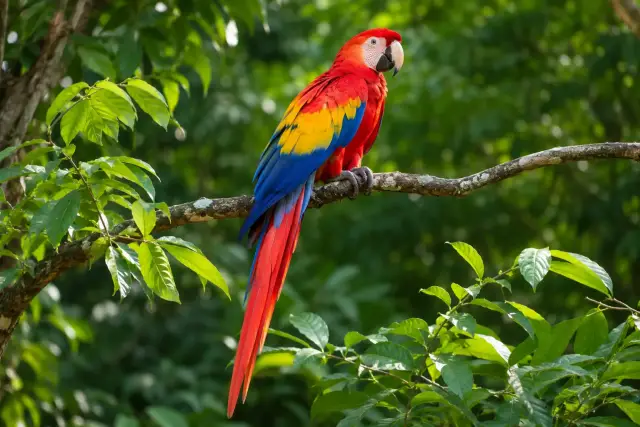
Parrots are a group of around 400 bird species with curved, hooked bills and feet with two toes pointing forwards and two back. They include macaws, cockatoos, African greys, budgerigars and New Zealand's kea and kakapo, and they are among the most intelligent of all birds.
This guide explains how parrots are grouped, what science has found about their intelligence and talking, how long different parrots live, and why so many species are now threatened in the wild.
Quick takeaways
- Parrots fall into three main groups: true parrots, cockatoos and the New Zealand parrots.
- Parrots learn sounds by copying, a rare skill also found in songbirds and hummingbirds.
- Large parrots are very long-lived; some cockatoos and macaws can live for more than 50 years.
- More than a quarter of parrot species are threatened, mainly by habitat loss and trapping for the pet trade.
What makes a parrot a parrot?
Parrots make up the order Psittaciformes, with around 400 species living mainly in the tropics and the Southern Hemisphere. Every parrot has a strong, curved bill and zygodactyl feet, meaning two toes point forwards and two backwards. Many hold food in one foot and bite pieces off, and they use the bill as a third hand when climbing.
The upper bill is hinged to the skull, which gives parrots great control and power for cracking nuts and seeds. Their thick, muscular tongue helps them handle food and shape sounds.
Scientists divide parrots into three main groups. The New Zealand parrots, the kea, kaka and kakapo, split off early from all the others. The cockatoos form a second group in Australasia. Everything else, from macaws to budgerigars, lovebirds and lorikeets, belongs to the true parrots. The smallest are the pygmy parrots of New Guinea, about 8 cm long, and the longest is the hyacinth macaw, at about a metre including its tail.
| Group | Examples | Where they live |
|---|---|---|
| New Zealand parrots | Kea, kaka, kakapo | New Zealand only |
| Cockatoos (about 21 species) | Sulphur-crested cockatoo, galah, palm cockatoo, cockatiel | Australia, New Guinea, eastern Indonesia, the Philippines and the Solomon Islands |
| True parrots (most species) | Macaws, Amazons, African greys, lovebirds, lorikeets, budgerigars | Tropical and southern regions of the Americas, Africa, Asia and Australasia |
Macaws, cockatoos, African greys, kea, kakapo and budgerigars
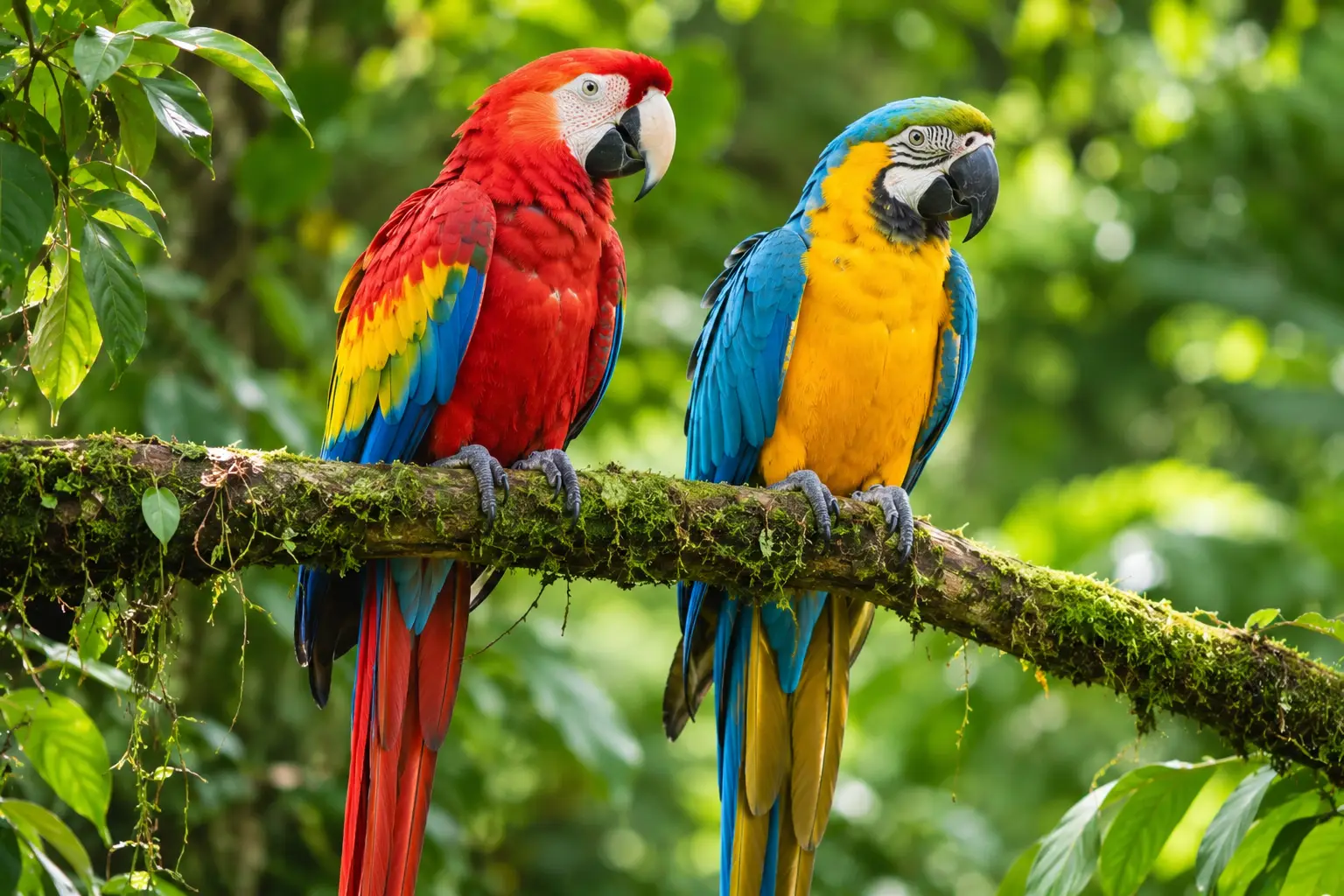
Macaws are the large, long-tailed parrots of Central and South America, with bare skin around the face. Scarlet and blue-and-yellow macaws gather at riverbank clay licks in the Amazon, where they eat mineral-rich soil. The hyacinth macaw, the longest of all parrots, cracks hard palm nuts. Spix's macaw died out in the wild around 2000 and was reintroduced to Brazil from captive-bred birds in 2022.
Cockatoos have a crest they can raise and lower to show mood. They lack the feather structure that produces blue and green in other parrots, so cockatoos are mostly white, black, grey or pink, often with patches of yellow, orange or red. The cockatiel is the smallest cockatoo. Galahs and sulphur-crested cockatoos are common in Australian towns.
The African grey lives in the rainforests of west and central Africa and is famous as a talker. The kea is a large, olive-green parrot of the mountains of New Zealand's South Island, often called the world's only alpine parrot, and it is notoriously curious. The kakapo is a flightless, nocturnal parrot that breeds mainly in years when rimu trees fruit heavily.
The budgerigar is a small parakeet from the dry interior of Australia. Wild budgies are green and yellow and roam in flocks that follow rain and seeding grasses. The blue, white and other colours seen in pets were bred in captivity.
| Parrot | Native range | Size | Known for |
|---|---|---|---|
| Hyacinth macaw | Central South America, including the Pantanal | About 1 m long | The longest parrot; cracks palm nuts |
| Scarlet macaw | Mexico to the Amazon | About 80 to 90 cm long | Red, yellow and blue plumage; clay licks |
| Sulphur-crested cockatoo | Australia and New Guinea | About 45 to 50 cm long | Loud calls and a yellow crest |
| African grey parrot | West and central Africa | About 33 cm long | Exceptional mimicry and problem solving |
| Kea | Mountains of New Zealand's South Island | About 46 cm long | Curiosity and puzzle solving |
| Kakapo | Predator-free islands of New Zealand | About 60 cm long, up to about 4 kg | Flightless, nocturnal, the heaviest parrot |
| Budgerigar | Inland Australia | About 18 cm long | The most popular pet parrot |
How intelligent are parrots, and why can they talk?
Parrots and crows are often called the cleverest birds. A 2016 study found that parrot brains pack neurons much more densely than mammal brains of the same size, which helps explain how a walnut-sized brain can solve hard problems. Goffin's cockatoos have made stick tools in experiments and use sets of tools in the wild. Male palm cockatoos shape sticks or seed pods into drumsticks and beat them against hollow trees in display.
The best-known talking parrot was Alex, an African grey studied by Irene Pepperberg from 1977 until his death in 2007. Alex learned a vocabulary of more than 100 words, including labels for dozens of objects, colours and shapes, could answer questions such as which item was bigger, and used his words to make requests. His work showed that parrots can link sounds to meanings, not only repeat them.
Parrots can talk because they are vocal learners: they copy sounds they hear, a skill shared among birds only with songbirds and hummingbirds. They have no vocal cords; they produce sound with the syrinx, at the base of the windpipe, and shape it with the tongue and throat. In the wild they use this ability to learn the calls of their flock. In Venezuela, green-rumped parrotlet parents give each chick an individual call, which the chick learns and uses like a name.
A pet parrot's flock is its human household, so it copies the voices around it. Talking ability varies a great deal between species and individuals. African greys, Amazon parrots and budgerigars are among the best mimics. A budgerigar called Puck was credited by Guinness World Records with a vocabulary of more than 1,700 words.
Tip: A parrot that talks is not necessarily a happy parrot. Signs of good welfare are a varied diet, daily time out of the cage, things to chew and solve, and plenty of social contact.
How long do parrots live?
Parrots are long-lived for birds of their size. In general, the bigger the parrot, the longer it lives. Large macaws and cockatoos can outlive their owners, which is why parrot charities ask people to plan for a bird's whole life before buying one.
The oldest well-documented parrot was Cookie, a Major Mitchell's cockatoo at Brookfield Zoo near Chicago, who died in 2016 aged 83. Wild lifespans are harder to measure and are usually shorter, because of predators, disease and food shortages.
The figures below are rough guides for birds in good captive care. Poor diet, especially an all-seed diet, and lack of exercise shorten lives considerably.
| Parrot | Typical lifespan in good captive care |
|---|---|
| Budgerigar | About 5 to 10 years, sometimes longer |
| Cockatiel | Often 15 to 20 years |
| Lovebird | Often 10 to 15 years |
| African grey parrot | Often 40 to 60 years |
| Amazon parrots | Often 40 years or more |
| Large macaws | Often 50 years or more |
| Large cockatoos | Often 40 to 60 years; exceptionally over 80 |
Parrot conservation: why so many parrots are threatened
Parrots are one of the most threatened bird groups. A 2016 review found that more than a quarter of parrot species were classed as threatened on the IUCN Red List. The main causes are the clearing of forests, trapping wild birds for the pet trade and, on islands, introduced predators such as rats, cats and stoats.
Trade has hit some species especially hard. The African grey parrot was heavily trapped for decades, and in 2016 international commercial trade in wild-caught birds was banned under CITES. In the United States, the Carolina parakeet, once common in the east, was driven to extinction; the last known bird died in Cincinnati Zoo in 1918.
Recovery is possible. The kakapo fell to just 51 known birds in 1995. New Zealand's Kākāpō Recovery programme moved the survivors to predator-free islands, monitors every nest and has more than quadrupled the population, though there are still only a few hundred birds. Spix's macaw is being returned to the wild in Brazil from captive-bred stock.
The kea faces threats from introduced predators and lead poisoning from old building materials, and many thousands were killed in the past under a government bounty because they were blamed for attacking sheep. It is now protected.
Buy captive-bred only
If you keep a parrot, choose a captive-bred bird from a reputable source, never a wild-caught one.
Check what you buy
Palm oil, timber and beef linked to deforestation remove the forests many parrots depend on.
Never release pets
Escaped and released parrots can form feral colonies, such as the rose-ringed parakeets of London, which may compete with native birds.
Support recovery work
Programmes for the kakapo, Spix's macaw and other species rely on donations and volunteers.
Parrot knowledge check
Five questions on the ideas in this guide.
0 / 5 answered
1Which New Zealand parrot is often called the world's only alpine parrot?
Answer: The kea. Kea live in the mountains of the South Island, where they find food among rocks and snow. The kaka is a forest relative, and the galah is an Australian cockatoo.2Which parrot did Irene Pepperberg study for 30 years, showing it could label objects, colours and shapes?
Answer: An African grey parrot named Alex. Alex learned more than 100 words and could answer questions about colour, shape and size until his death in 2007.3Why are cockatoos never blue or green?
Answer: Their feathers lack the structure that scatters blue light. Other parrots get blue and green from tiny structures in the feather that scatter light. Cockatoos lack them, so they are mostly white, black, grey or pink.4Which parrot breeds mainly in years when rimu trees produce a heavy crop of fruit?
Answer: The kakapo. Kakapo need the rich rimu fruit to raise chicks, so in poor years they may not breed at all.5Which parrot, once common in the eastern United States, went extinct in the early 20th century?
Answer: The Carolina parakeet. The Carolina parakeet was killed for crop damage and feathers and lost its forest habitat. The last known bird died in Cincinnati Zoo in 1918.
Frequently asked questions
Which parrot is the best talker?
African grey parrots are generally considered the best talkers, with clear voices and large vocabularies. Amazon parrots, such as the yellow-headed Amazon, are also excellent mimics, and budgerigars can learn surprisingly many words despite their small size. Ability varies widely between individual birds, and a bird raised with daily conversation usually talks more than one left alone.
How long do parrots live?
It depends mainly on size. Budgerigars typically live about 5 to 10 years and cockatiels 15 to 20, while African greys often reach 40 to 60. Large macaws and cockatoos can live for more than 50 years, and one Major Mitchell's cockatoo, Cookie, lived to 83. Good diet, exercise and veterinary care make a big difference.
How many species of parrots are there?
There are around 400 parrot species. They are grouped into three main lines: the New Zealand parrots (kea, kaka and kakapo), the cockatoos, with about 21 species, and the true parrots, which include everything else, from macaws and Amazons to lovebirds, lorikeets and budgerigars. Exact totals vary slightly as scientists revise species boundaries.
Are parrots endangered?
Many are. More than a quarter of parrot species are classed as threatened, making parrots one of the most at-risk bird groups. Habitat loss and trapping for the pet trade are the biggest problems. Some species, such as the kakapo and Spix's macaw, survive today only because of intensive recovery programmes.
Where do parrots live in the wild?
Most parrots live in tropical and subtropical regions: Central and South America, Africa, South and Southeast Asia, Australia, New Guinea and the Pacific islands. A few live in cooler places, such as the kea in New Zealand's mountains. To learn to recognise wild parrots from photos, try the parrot rounds in the Birds Quiz app.
Clever, long-lived and in need of care
Parrots combine strong bills, grasping feet and unusually dense brains, which make them problem solvers and vocal learners. Their long lives make them demanding pets, and trapping and habitat loss have made many species rare in the wild.
- Learn the three parrot groups and one species from each.
- If you plan to keep a parrot, research its lifespan and needs first.
- Practise recognising parrot species from photos in Birds Quiz.
Check the evidence behind the guide
Use these references to check terminology and pursue a topic in more depth. Photo quizzes help you practise observation; a single picture rarely proves a difficult identification.
When a source describes a broad group, compare its details with the exact species, model or specimen you are studying. Record the feature that supports your answer rather than relying on a name alone.