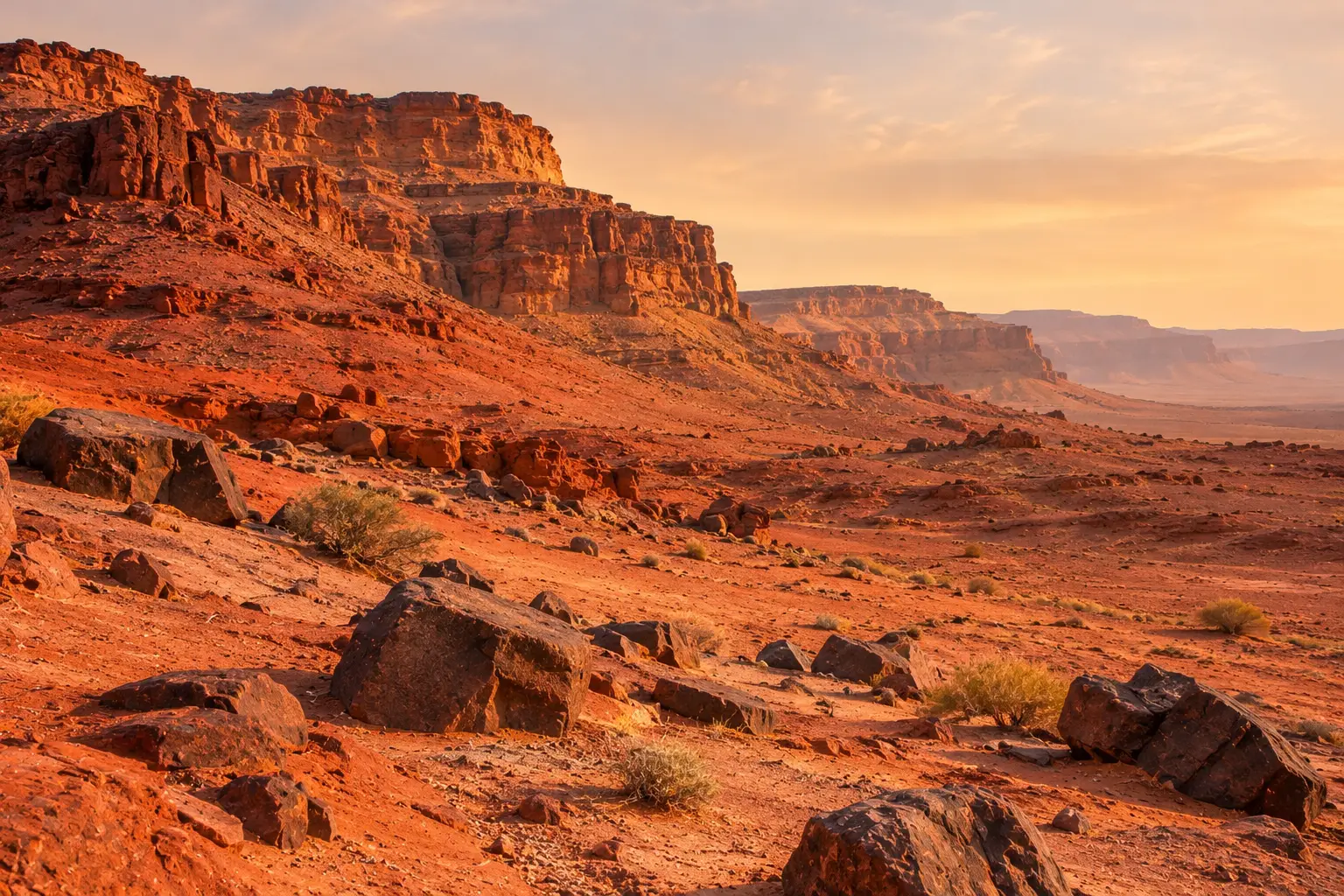
Mars is the fourth planet from the Sun: a cold, dusty desert about half Earth's width, with the tallest volcano and one of the longest canyons in the solar system. These 25 questions and answers cover its size and seasons, its giant landforms, its water and ice, and the moons and rovers that have shaped what we know.
The quiz has four themed rounds. Each opens with a short explanation, and every answer has a note on why it is right, so you finish knowing more than you started with.
Pick an answer before you check. If you miss one, read the note and try to explain the idea in your own words.
Quick takeaways
- A day on Mars lasts about 24 hours 40 minutes, but a year lasts 687 Earth days.
- Olympus Mons and Valles Marineris grew huge partly because Mars has no moving tectonic plates.
- Mars once had rivers and lakes; today its water is mostly locked up as ice.
- Iron oxide, essentially rust, gives Martian dust its red colour.
Round 1
How big is Mars, and how long is a day there?
Mars is a small rocky planet. It is about half Earth's width and has only about a tenth of Earth's mass, which is why its gravity is weaker and why it has held on to only a thin atmosphere.
In some ways it is surprisingly familiar. Its day is close to ours, and its axis is tilted by about 25 degrees, similar to Earth's 23.4, so it has seasons. Each season lasts roughly twice as long, because a Martian year is nearly two Earth years.
1Roughly how long does a solar day on Mars, called a sol, last?
Answer: About 24 hours 40 minutes. Mars spins at almost the same rate as Earth, so a sol is only about 40 minutes longer than our day. That made it easy for rover teams to live on 'Mars time'.2About how many Earth days does Mars take to orbit the Sun once?
Answer: 687. Mars is about one and a half times as far from the Sun as Earth, so its year lasts almost two Earth years. 225 days is a year on Venus and 4,333 days a year on Jupiter.3How wide is Mars compared with Earth?
Answer: About half as wide. Mars is about 6,780 kilometres across, a little over half of Earth's 12,742 kilometres.4How strong is gravity on the surface of Mars compared with Earth?
Answer: About 38 per cent of Earth's. Mars has much less mass than Earth. Someone who could jump half a metre at home could jump well over a metre on Mars.5Which gas makes up most of the thin Martian atmosphere?
Answer: Carbon dioxide. About 95 per cent of the Martian air is carbon dioxide. The air is also very thin, with surface pressure less than 1 per cent of Earth's.6Mars is named after the Roman god of what?
Answer: War. Its blood-red colour reminded ancient observers of war. Neptune was the Roman sea god, Mercury the messenger and Jupiter the god of the sky.
| Feature | Mars | Earth |
|---|---|---|
| Diameter | About 6,780 km | About 12,742 km |
| Length of a solar day | About 24 h 40 min (one sol) | 24 hours |
| Length of a year | About 687 Earth days | About 365 days |
| Surface gravity | About 38% of Earth's | 100% |
| Main gas in the air | Carbon dioxide (about 95%) | Nitrogen (about 78%) |
| Average temperature | About minus 60 °C | About 15 °C |
| Natural moons | Two: Phobos and Deimos | One |
Round 2
Olympus Mons, Valles Marineris and other giant landforms
Mars holds several record-breaking landforms. Olympus Mons sits on the edge of Tharsis, a vast volcanic bulge that also carries three other giant volcanoes. To the east, the canyon system of Valles Marineris cuts across about a fifth of the planet's circumference and is several kilometres deep in places.
These features lasted because Mars cooled faster than Earth and has no plate tectonics, so there is little to recycle or bury its old surface. Its southern highlands are heavily cratered and very old, while the northern plains are lower and smoother.
7About how tall is Olympus Mons above the plains around it?
Answer: More than 20 kilometres. Olympus Mons rises over 20 kilometres, more than twice the height of Mount Everest above sea level. It is the tallest volcano known in the solar system.8What type of volcano is Olympus Mons?
Answer: A shield volcano. Shield volcanoes are built by runny lava flowing out in thin layers, which gives them gentle slopes. Olympus Mons is so wide, about 600 kilometres, that its slopes are hard to notice from the ground.9Why could volcanoes on Mars grow so much larger than those on Earth?
Answer: Mars lacks moving tectonic plates, so lava kept piling up in one place. On Earth, a plate drifts over a hot spot and makes a chain of smaller volcanoes, as in Hawaii. On Mars the crust stayed put, and lower gravity let the pile grow taller.10What is Valles Marineris?
Answer: A huge system of canyons. Valles Marineris runs along the Martian equator. It probably formed as the crust stretched and cracked, then widened through collapse and erosion.11Roughly how long is Valles Marineris?
Answer: About 4,000 kilometres. It would stretch across most of the United States or Australia. The Grand Canyon is about a tenth of its length.12Which spacecraft is Valles Marineris named after?
Answer: Mariner 9. Mariner 9 became the first spacecraft to orbit another planet in 1971 and mapped the canyon system for the first time.13What is Hellas Planitia?
Answer: One of the largest impact basins in the solar system. Hellas is a crater about 2,300 kilometres wide, blasted out by a huge impact early in Mars's history. Its floor is the lowest ground on the planet.
Round 3
Why is Mars red, and where did its water go?
The red colour is only skin deep. Iron-bearing minerals in the rocks reacted with water and oxygen over long periods and formed iron oxides, and winds spread the fine, rusty dust over almost everything. Beneath the dust, many Martian rocks are dark grey basalt.
Billions of years ago Mars was warmer and wetter, with rivers, lakes and perhaps a northern sea. As the planet lost much of its atmosphere to space, the surface dried out. Large amounts of water remain, frozen in the polar caps and in ice buried beneath the ground at middle and high latitudes.
14Mars gets its colour from iron oxide in its dust and rocks. What is the everyday name for iron oxide?
Answer: Rust. Iron in Martian minerals reacted with water and oxygen long ago and turned to rust-like compounds. Fine dust spreads that colour across the whole planet.15What colour do sunsets on Mars look around the Sun?
Answer: Bluish. Fine Martian dust scatters blue light forwards, towards the viewer, so the sky glows blue near the setting Sun. Rovers have photographed this many times.16What are the polar caps of Mars made of?
Answer: Water ice, with a seasonal coating of frozen carbon dioxide. Each winter, carbon dioxide freezes out of the air as dry ice over the poles. In spring and summer most of it turns back to gas, leaving caps made mainly of water ice.17Which features show that liquid water once flowed across Mars?
Answer: Dried-up river channels and deltas. Orbiters have mapped branching valleys, fan-shaped deltas and minerals such as clays that form in water. They point to a wetter Mars billions of years ago.18Why can liquid water not last long on the surface of Mars today?
Answer: The air pressure is so low that water quickly freezes or boils away. With such thin air and an average temperature of about minus 60 °C, any exposed water freezes or evaporates. Today most Martian water is locked up as ice.19What kind of storm on Mars can sometimes cover almost the whole planet?
Answer: A dust storm. Dust storms are common, and every few years one grows to wrap around the globe. A planet-wide storm in 2018 blocked sunlight from the solar-powered Opportunity rover.
Tip: To remember why Mars lost its water, link three ideas: small planet, weak magnetic shield, thin air. The air thinned, and liquid water could no longer survive on the surface.
Round 4
The moons of Mars and the rovers that explored it
Mars has two small, lumpy moons. Phobos is about 22 kilometres across and races around Mars three times a day. Deimos is smaller and farther out. Both may be captured asteroids or pieces thrown up by an ancient impact; scientists are still debating which.
Landing on Mars is hard, and many early attempts failed. The missions that succeeded have moved from fixed landers to rovers the size of a car, each one sent to a site chosen to answer a question about water, climate or the chance of past life.
20What is slowly happening to the orbit of Phobos?
Answer: It is shrinking, so Phobos is spiralling towards Mars. Mars's tides drag Phobos inwards by about 2 metres every century. In tens of millions of years it will break apart or crash into the planet.21Which astronomer discovered both moons of Mars in 1877?
Answer: Asaph Hall. Hall found the two moons with a large telescope at the US Naval Observatory in Washington. They are so small and close to Mars that they are lost in its glare.22Which was NASA's first spacecraft to land successfully on Mars, in 1976?
Answer: Viking 1. Viking 1 touched down in July 1976, followed by Viking 2. The landers photographed the surface and tested the soil for signs of life.23Which was the first wheeled rover to drive on Mars, in 1997?
Answer: Sojourner. Sojourner was about the size of a microwave oven and arrived with the Mars Pathfinder lander. It explored rocks close to the landing site.24In which crater did the Curiosity rover land in 2012?
Answer: Gale Crater. Curiosity has climbed the layered mountain in Gale Crater, reading its rocks like pages of Mars's history. Spirit landed in Gusev and Perseverance in Jezero.25What powers the Curiosity and Perseverance rovers?
Answer: A nuclear power source that turns heat from decaying plutonium into electricity. This radioisotope power system works day and night and through dust storms. Earlier rovers such as Spirit and Opportunity relied on solar panels.
Five more Mars questions
A quick review on details that were not in the rounds above.
0 / 5 answered
1Why was Jezero Crater chosen as the landing site for Perseverance?
Answer: It once held a lake fed by a river delta. River deltas build up layers of mud that can preserve signs of ancient life, so Jezero is a good place to collect rock samples.2The Opportunity rover was planned to work for about 90 sols. How long did it actually keep working?
Answer: About 14 years. Opportunity landed in January 2004 and sent its last signal in June 2018, during a planet-wide dust storm that blocked its solar panels.3Which NASA lander dug up water ice near the north pole of Mars in 2008?
Answer: Phoenix. Phoenix scraped trenches in the soil and watched bright chunks of ice slowly vanish as they turned to vapour.4Why can't a rover on Mars be steered live with a joystick from Earth?
Answer: Radio signals take several minutes to travel each way. Depending on where the planets are, a one-way signal takes between about 3 and 22 minutes, so rovers follow commands sent in advance and drive partly by themselves.5What is the name of the largest crater on Phobos?
Answer: Stickney. Stickney is about 9 kilometres wide, very large for a moon only about 22 kilometres across. Tycho is on Earth's Moon.
Frequently asked questions
Why is Mars called the Red Planet?
Mars looks red because its surface is covered in fine dust rich in iron oxide, the same family of compounds as rust. Iron minerals in Martian rocks reacted with water and oxygen over billions of years, and winds spread the rusty dust across the planet. Underneath, many rocks are dark grey, and the sky near the setting Sun can look blue.
Is there water on Mars?
Yes, but almost all of it is frozen. Mars has water ice in its polar caps and buried beneath the surface across large areas. Dry river valleys, deltas and water-formed minerals show that liquid water once flowed there. Today the air is so thin and cold that liquid water cannot last long on the surface before freezing or evaporating.
How tall is Olympus Mons compared with Mount Everest?
Olympus Mons rises more than 20 kilometres above the plains around it, which is over twice the height of Mount Everest above sea level. It is a shield volcano about 600 kilometres wide, so its slopes are gentle. It could grow so large because Mars has no moving tectonic plates and weaker gravity than Earth.
Could humans breathe on Mars?
No. The Martian air is about 95 per cent carbon dioxide and has less than 1 per cent of the pressure of Earth's atmosphere, so astronauts would need pressurised suits and habitats. Mars is also very cold, averaging about minus 60 °C, and its surface gets more radiation than Earth's because it lacks a thick atmosphere and a global magnetic field.
How can I practise more Mars and planet questions?
Work through the quiz above, then retest yourself a few days later on the questions you missed, because spaced practice helps facts stick. The Solar System Quiz app on Android has topic rounds and daily questions on Mars, the other planets, moons and the wider sky, so you can keep revising in short sessions.
A small planet with giant features
Mars is half Earth's width, with a thin carbon dioxide atmosphere, rusty dust and landforms far larger than Earth's. Its dry channels and buried ice tell the story of a planet that was once much wetter.
- Learn the Mars-versus-Earth table, since many quiz questions come from it.
- Link each big landform to its cause: no plate tectonics, a giant impact or stretching crust.
- Keep practising planets and moons in the Solar System Quiz app.
Check the evidence behind the guide
Use these references to check terminology and pursue a topic in more depth. Photo quizzes help you practise observation; a single picture rarely proves a difficult identification.
When a source describes a broad group, compare its details with the exact species, model or specimen you are studying. Record the feature that supports your answer rather than relying on a name alone.