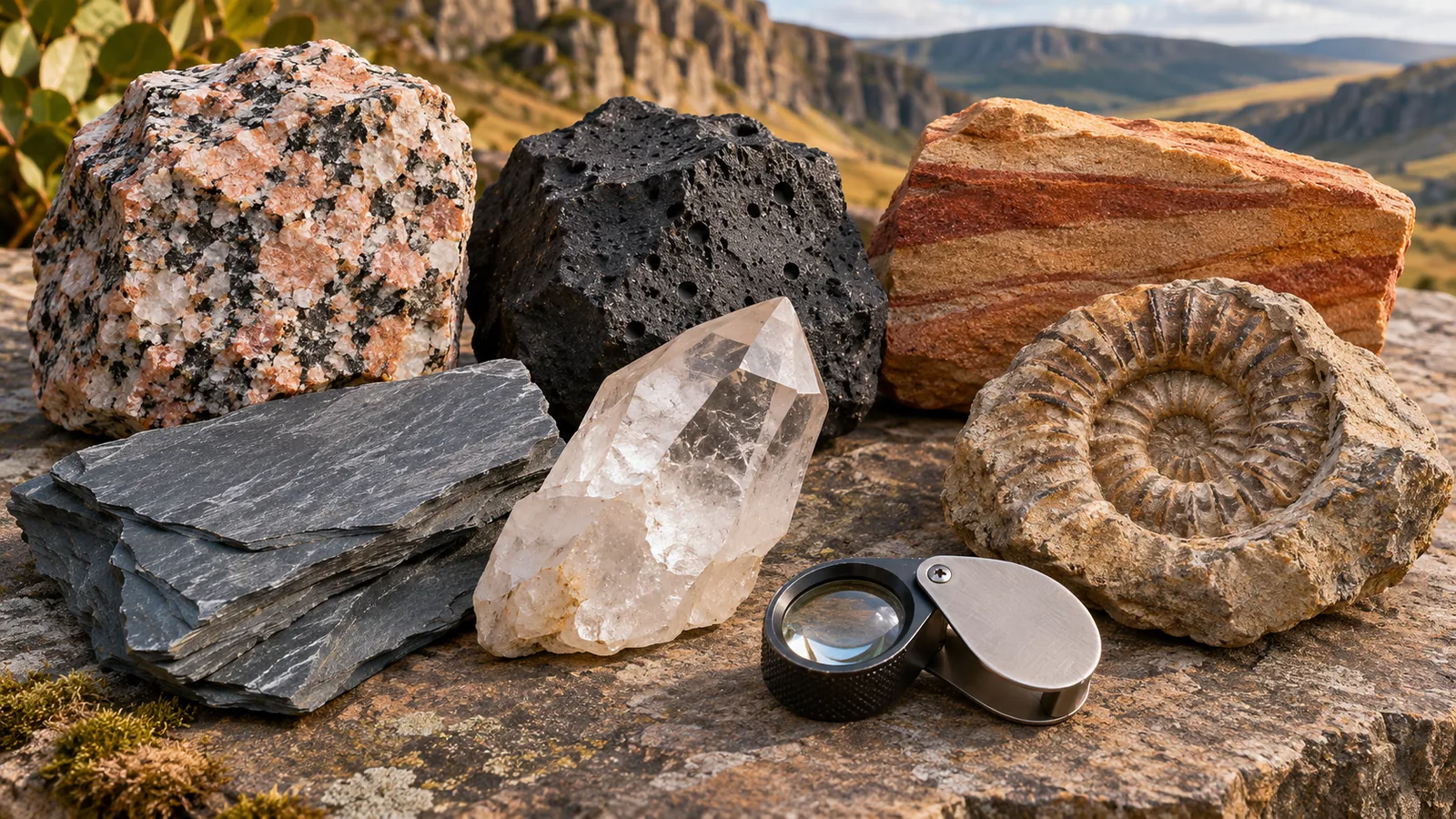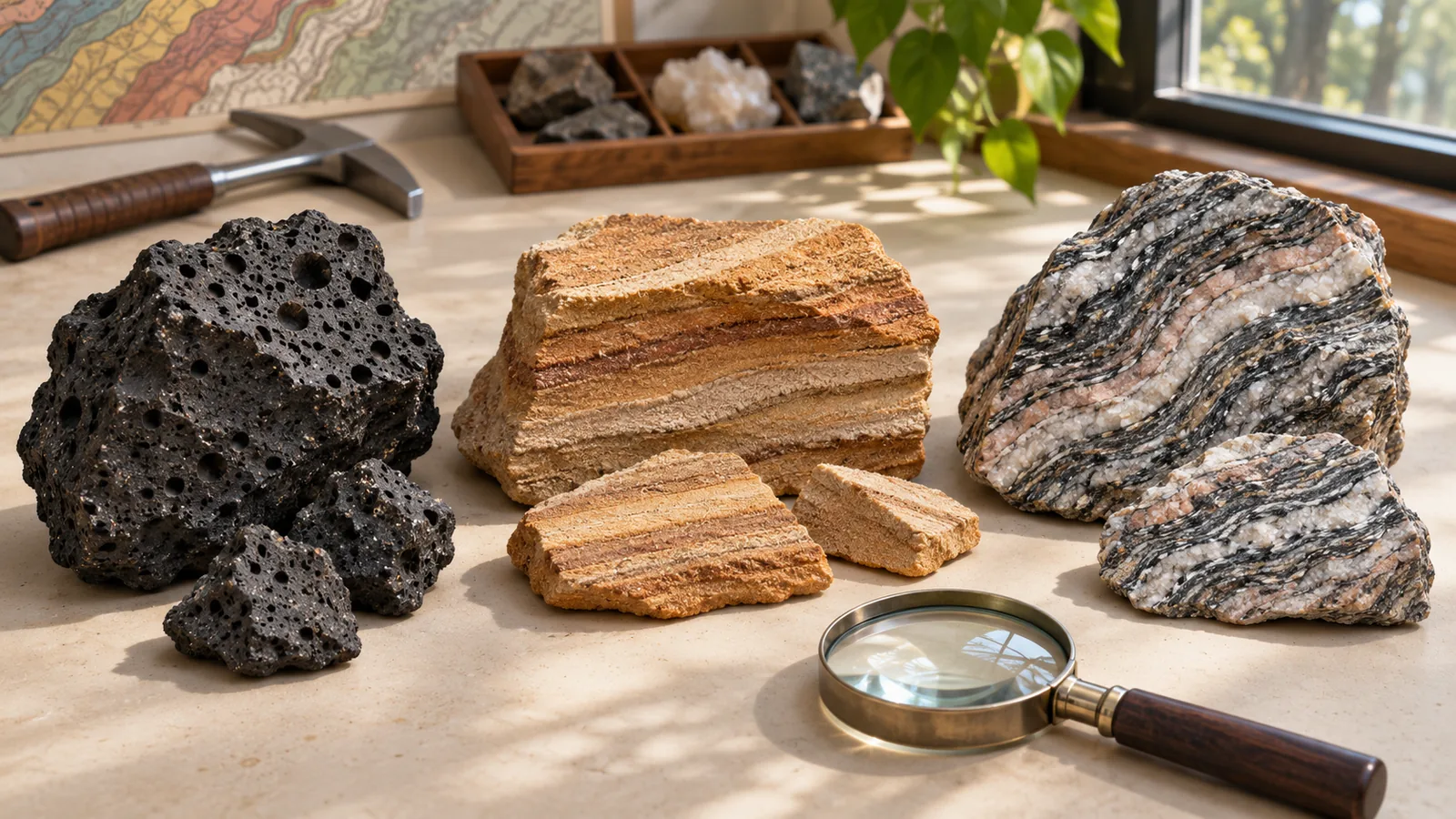
The fastest useful question about a rock is not 'what color is it?' but 'what process could leave this texture?' Cooling melt, deposited sediment and solid-state transformation make the three major rock groups.
A hand sample gives clues, not a complete history. Weathering can hide grains, and some rocks require a thin section or laboratory test. Still, a careful first pass can narrow the group.
Igneous: cooled melt
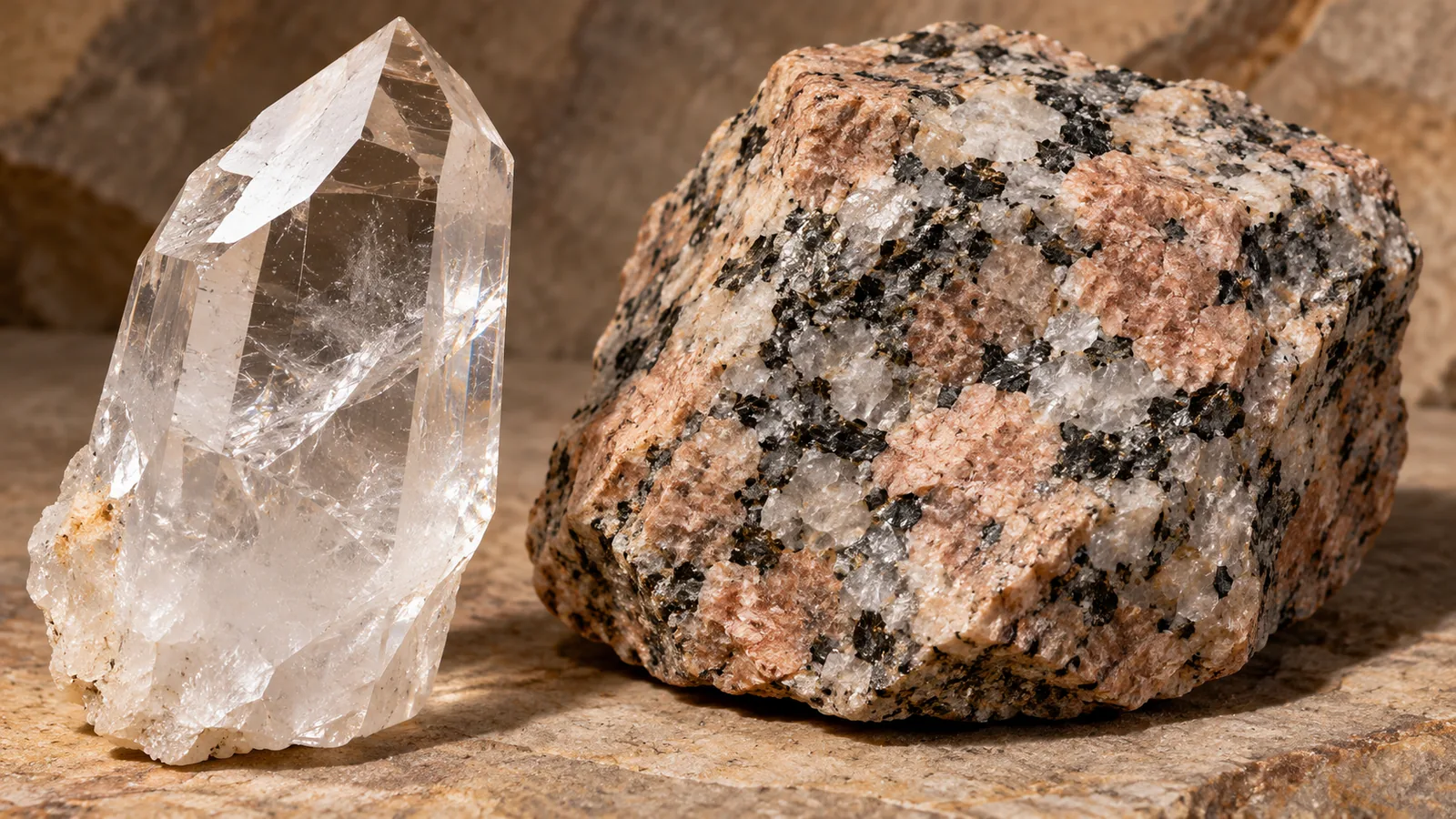
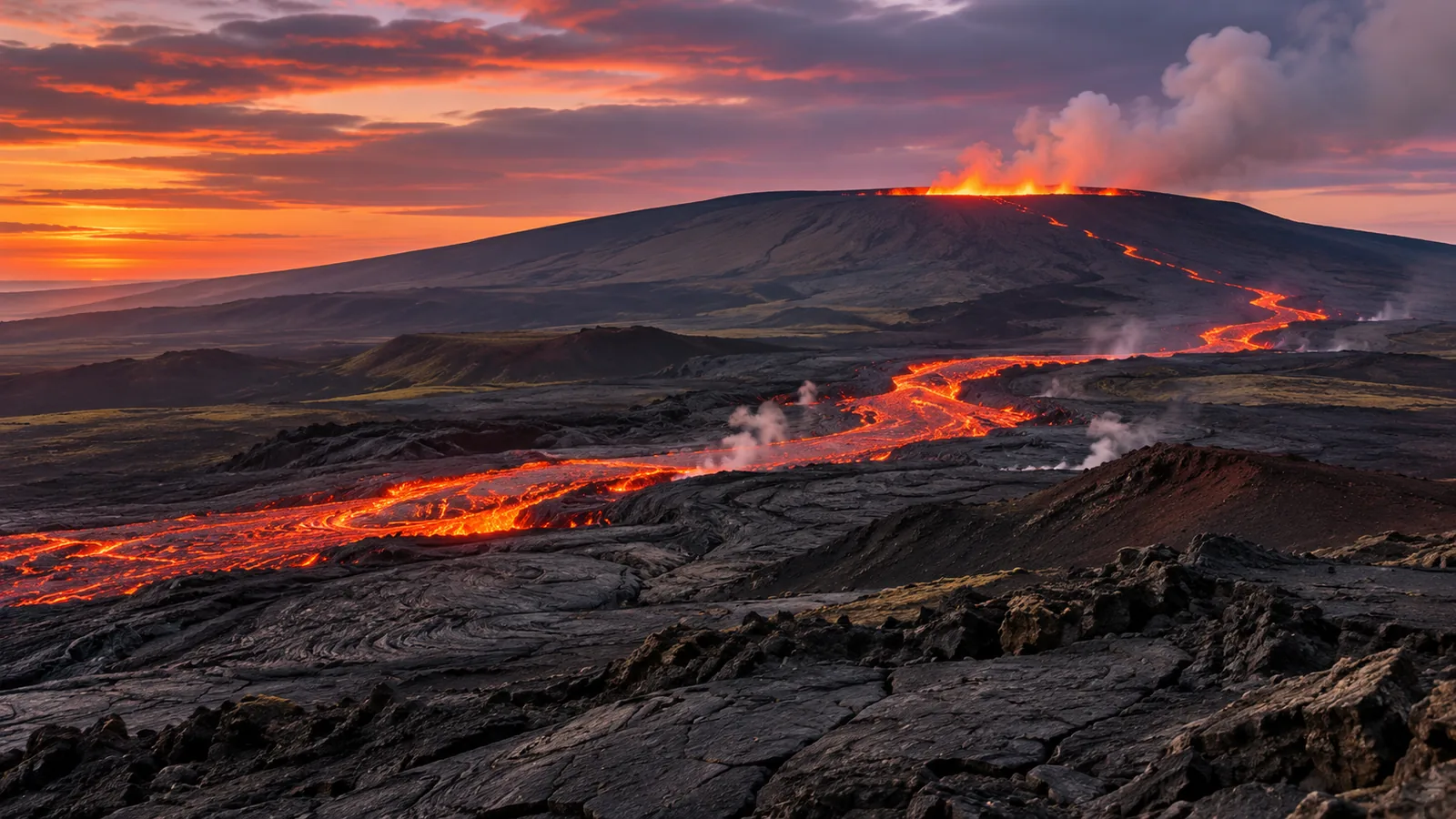
Magma that cools below ground can form coarse interlocking crystals because it cools slowly. Granite is a familiar example. Lava at the surface may cool quickly into fine-grained basalt or volcanic glass. Gas bubbles can leave holes called vesicles, as in pumice.
Look for interlocking crystals, a fine uniform groundmass, glassy surfaces or vesicles. A dark rock is not automatically basalt; describe the texture too.
Sedimentary: deposited material
Weathered fragments can be transported, deposited, buried and cemented. Sandstone preserves sand-size grains; shale forms from finer mud; conglomerate contains rounded larger clasts. Some sedimentary rocks form chemically or from biological material.
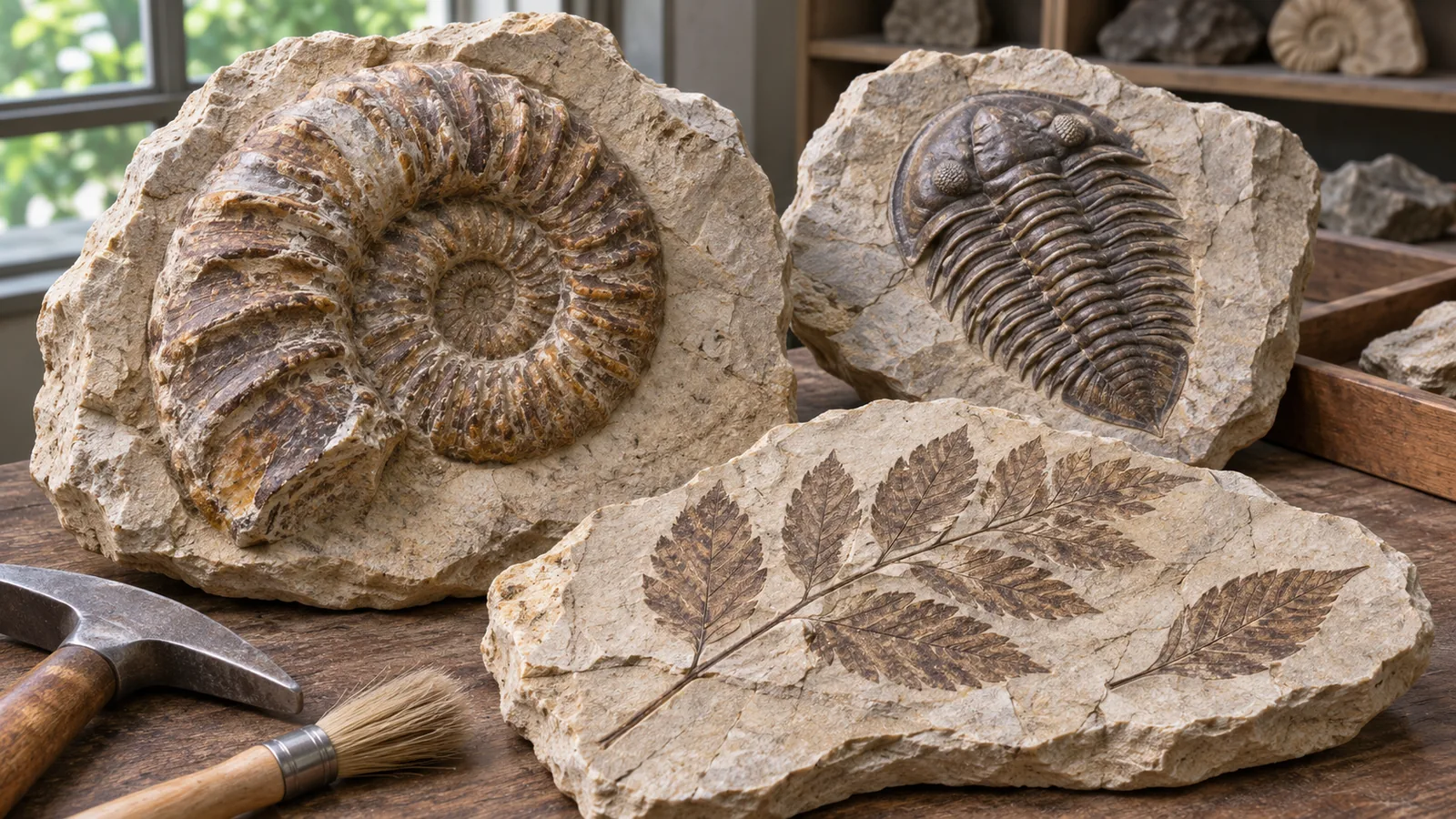
Layers and fossils often point toward sedimentary processes. A layer may be subtle, and not every sedimentary rock contains a visible fossil.
Metamorphic: transformed while solid
Heat, pressure and fluids can change an existing rock without melting it. Limestone can become marble; sandstone can become quartzite; mud-rich rock can become slate and eventually more strongly metamorphosed rocks.
Mineral alignment can make foliation or banding, as in gneiss. Marble and quartzite may lack obvious bands, so absence of stripes does not rule out metamorphism.
| Group | Process | First clues |
|---|---|---|
| Igneous | Melt cools | Interlocking crystals, glass or vesicles |
| Sedimentary | Material deposits | Grains, layers or fossils |
| Metamorphic | Solid rock changes | Recrystallization, cleavage or banding |
Classify the process
0 / 4 answered
1Melt cools below ground into coarse crystals. Which group?
Answer: Igneous. Slow cooling below ground can produce coarse igneous crystals.2Sand grains are cemented together. Which group?
Answer: Sedimentary. Cemented sediment forms a sedimentary rock.3Limestone recrystallizes without melting. What can it become?
Answer: Marble. Marble is metamorphosed carbonate rock.4Which clue may suggest gneiss?
Answer: Light-dark mineral bands. Mineral separation into bands is characteristic of many gneisses.
Frequently asked questions
Can one rock change groups?
Yes. The rock cycle describes pathways between groups: a sedimentary rock can be metamorphosed, melted and later cooled as an igneous rock.
Keep the process in view
Write one observation and one possible formation process for each specimen. That pairing is more useful than a bare name.
Check the evidence behind the guide
Use these references to check terminology and pursue a topic in more depth. Photo quizzes help you practise observation; a single picture rarely proves a difficult identification.
When a source describes a broad group, compare its details with the exact species, model or specimen you are studying. Record the feature that supports your answer rather than relying on a name alone.