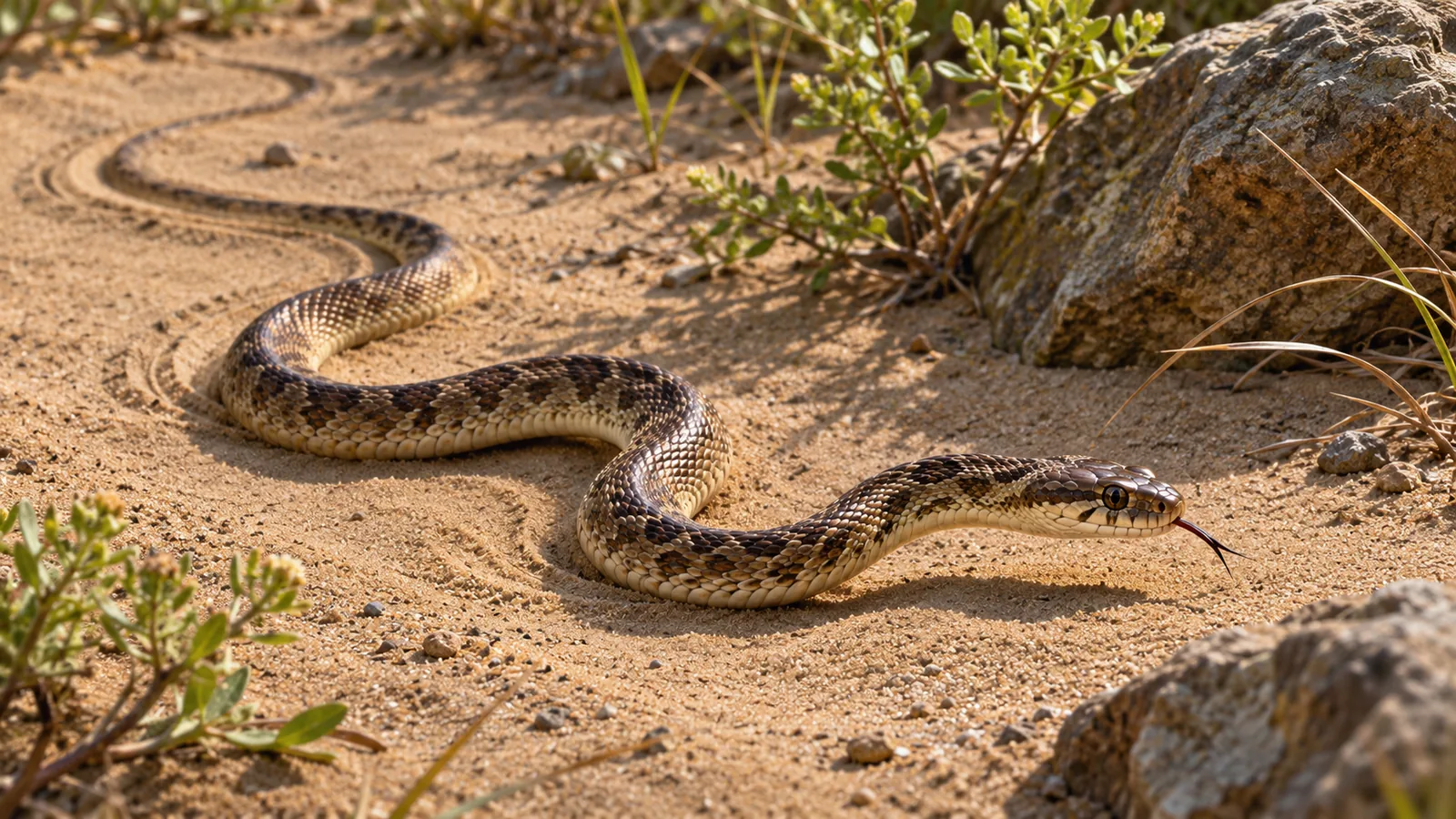
A snake has no legs, yet it can cross sand, climb a branch or move quietly through grass. Muscles, ribs and belly scales push against the ground or nearby surfaces in different ways.
Four movement labels help describe what you see. A single snake may switch methods with terrain, speed and body position.
Lateral undulation: pushing against bends
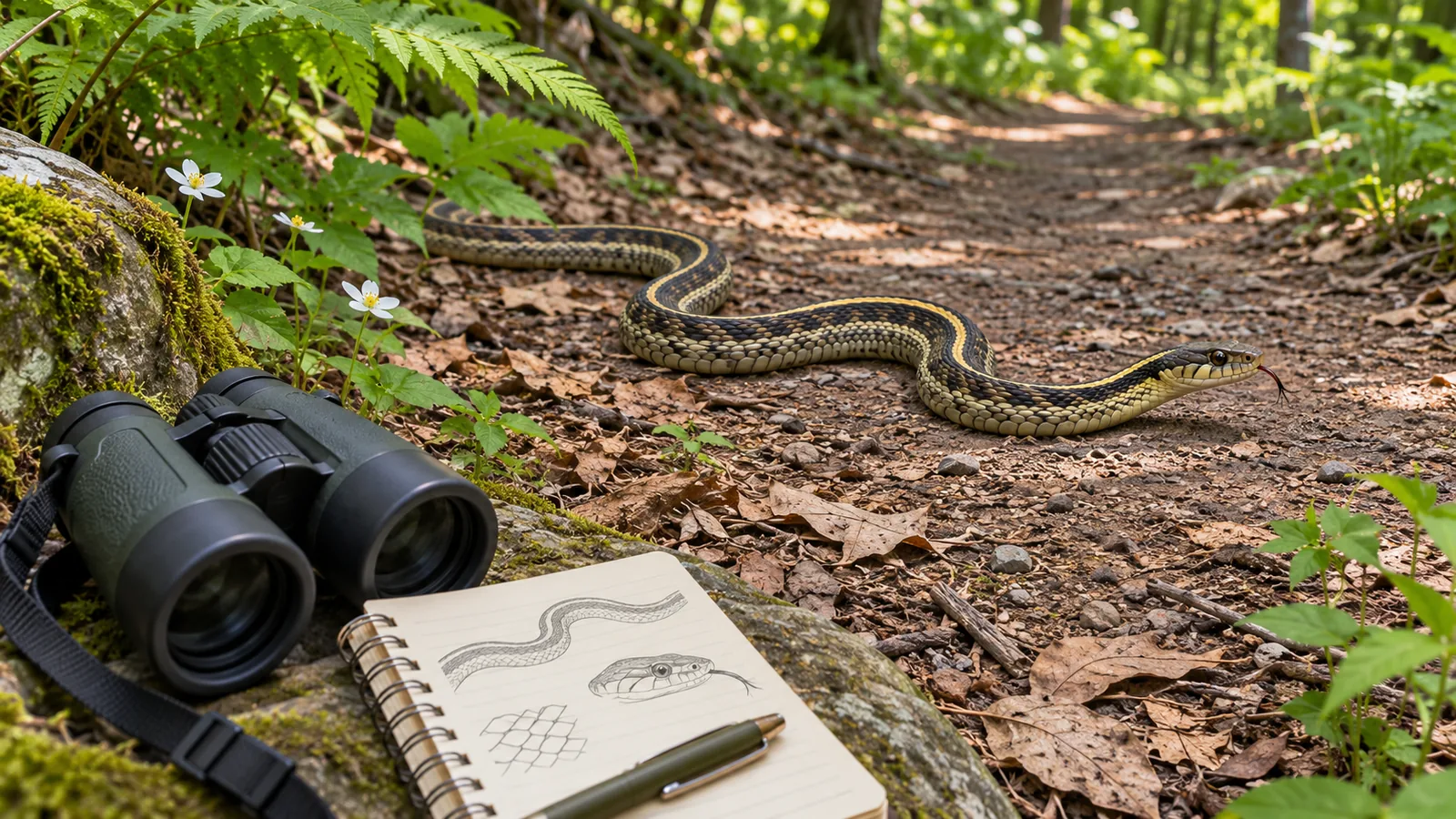
The familiar S-shaped movement uses the body's curves to push against uneven ground, vegetation or water. The snake travels forward as bends pass along its body.
A very smooth surface can offer too little purchase; movement depends on contact points, not just waving the body.
Rectilinear and concertina movement
In rectilinear movement, parts of the belly grip while other parts advance, creating a slow, straighter crawl with little side-to-side bending. Large-bodied snakes can use it to move quietly.
Concertina movement alternates anchoring and extending sections of the body. It is useful in narrow passages or on branches where broad curves cannot form.
Sidewinding and hunting strategies
Sidewinding lifts portions of the body while other portions contact loose, hot or slippery ground. Its tracks can show separate diagonal impressions rather than one continuous line.
Hunting is equally varied. Some snakes wait for prey, some actively search, some use venom and others constrict. Constriction interferes with circulation rather than simply crushing prey. Never approach a wild snake to test a movement pattern.
| Movement | What to watch | Typical setting |
|---|---|---|
| Lateral undulation | Traveling S-curves | Ground or water |
| Rectilinear | Slow straight advance | Open ground |
| Concertina | Anchor, extend, pull | Narrow spaces or branches |
| Sidewinding | Alternating contact patches | Loose sand |
Name the motion
0 / 4 answered
1Which movement creates traveling S-curves?
Answer: Lateral undulation. The snake pushes against contact points as body bends pass along it.2Which motion is slow and relatively straight?
Answer: Rectilinear. Belly scales and muscles support a nearly straight crawl.3Which motion alternates anchoring and extending?
Answer: Concertina. Concertina motion suits constrained spaces.4Why can sidewinding help on loose sand?
Answer: It limits contact to moving patches. Different body sections alternately support and advance the snake.
Frequently asked questions
Do all snakes move the same way?
No. Species, body shape and terrain influence which movement patterns a snake uses.
Watch the contact points
A movement name becomes easier to remember when you ask which part of the body is anchored and which part advances.
Check the evidence behind the guide
Use these references to check terminology and pursue a topic in more depth. Photo quizzes help you practise observation; a single picture rarely proves a difficult identification.
When a source describes a broad group, compare its details with the exact species, model or specimen you are studying. Record the feature that supports your answer rather than relying on a name alone.