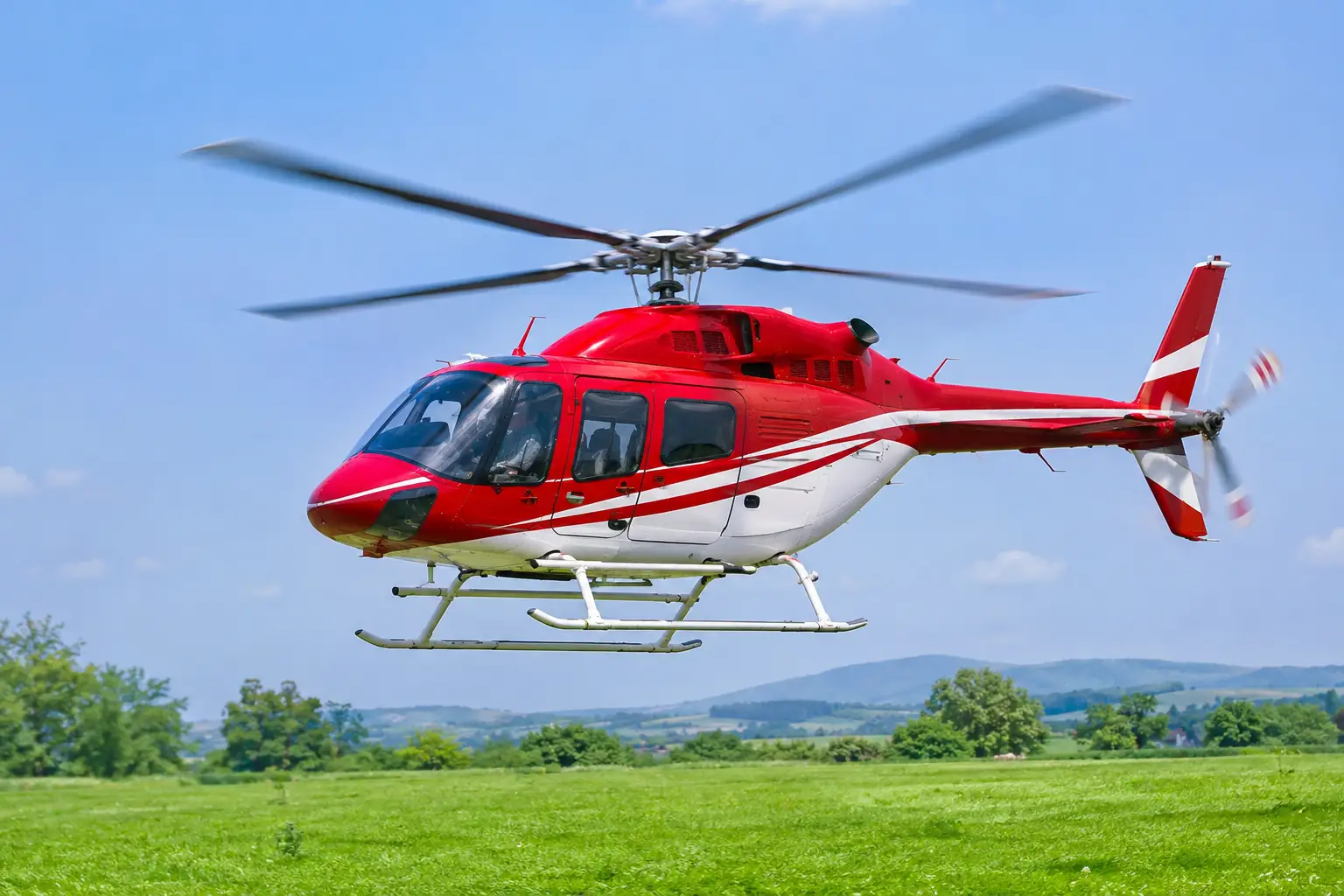
An aeroplane needs forward speed to keep air flowing over its wings. A helicopter makes its own airflow by spinning its wings, which is why it can hover in one place.
The FAA's Helicopter Flying Handbook explains the controls in detail. This guide covers the four ideas you need to understand what you see when a helicopter flies.
The rotor is a set of spinning wings
Each main rotor blade is a long, narrow wing. As the blades turn, air flows over them and produces lift, just as it does on an aeroplane wing. The faster the rotor turns and the steeper the blade angle, the more lift it makes.
Most helicopters keep the rotor at a nearly constant speed. The pilot changes lift by changing the angle, or pitch, of the blades.
Collective, cyclic and pedals
The collective lever changes the pitch of all main rotor blades at once. Raising it increases lift, so the helicopter climbs; lowering it makes the helicopter descend.
The cyclic stick tilts the rotor disc. Tilting it forward makes the helicopter move forward; tilting it sideways makes it move sideways. The pedals change the pitch of the tail rotor blades to point the nose left or right.
Tail rotors, tandem rotors and autorotation
When an engine turns the main rotor one way, the body tends to turn the other way. A tail rotor pushes sideways to stop this. Tandem-rotor helicopters such as the Chinook, and coaxial designs with two rotors stacked on one mast, use rotors turning in opposite directions instead.
If the engine fails, a helicopter does not simply drop. The pilot lowers the collective so that air flowing up through the rotor keeps it turning. This is called autorotation, and it lets the pilot make a controlled landing.
| Control | What it changes | Result |
|---|---|---|
| Collective | Pitch of all main blades | Climb or descend |
| Cyclic | Tilt of the rotor disc | Move forward, back or sideways |
| Pedals | Tail rotor pitch | Turn the nose left or right |
Check the controls
0 / 4 answered
1Which control makes a helicopter climb or descend?
Answer: Collective. The collective changes the pitch of all main rotor blades together.2Which control tilts the rotor disc to move the helicopter forward?
Answer: Cyclic. Tilting the rotor disc tilts its lift, which moves the helicopter.3Why do most helicopters need a tail rotor?
Answer: To counter the main rotor's torque. Without it, the body would spin opposite to the rotor.4What lets a helicopter land safely after an engine failure?
Answer: Autorotation. Air flowing up through the rotor keeps it turning for a controlled descent.
Frequently asked questions
Can a helicopter fly backwards?
Yes. Tilting the rotor disc backwards with the cyclic moves the helicopter backwards, though forward flight is faster and more efficient.
Three controls, one spinning wing
The collective sets lift, the cyclic sets direction and the pedals set heading. Everything else a helicopter does builds on those three.
Check the evidence behind the guide
Use these references to check terminology and pursue a topic in more depth. Photo quizzes help you practise observation; a single picture rarely proves a difficult identification.
When a source describes a broad group, compare its details with the exact species, model or specimen you are studying. Record the feature that supports your answer rather than relying on a name alone.