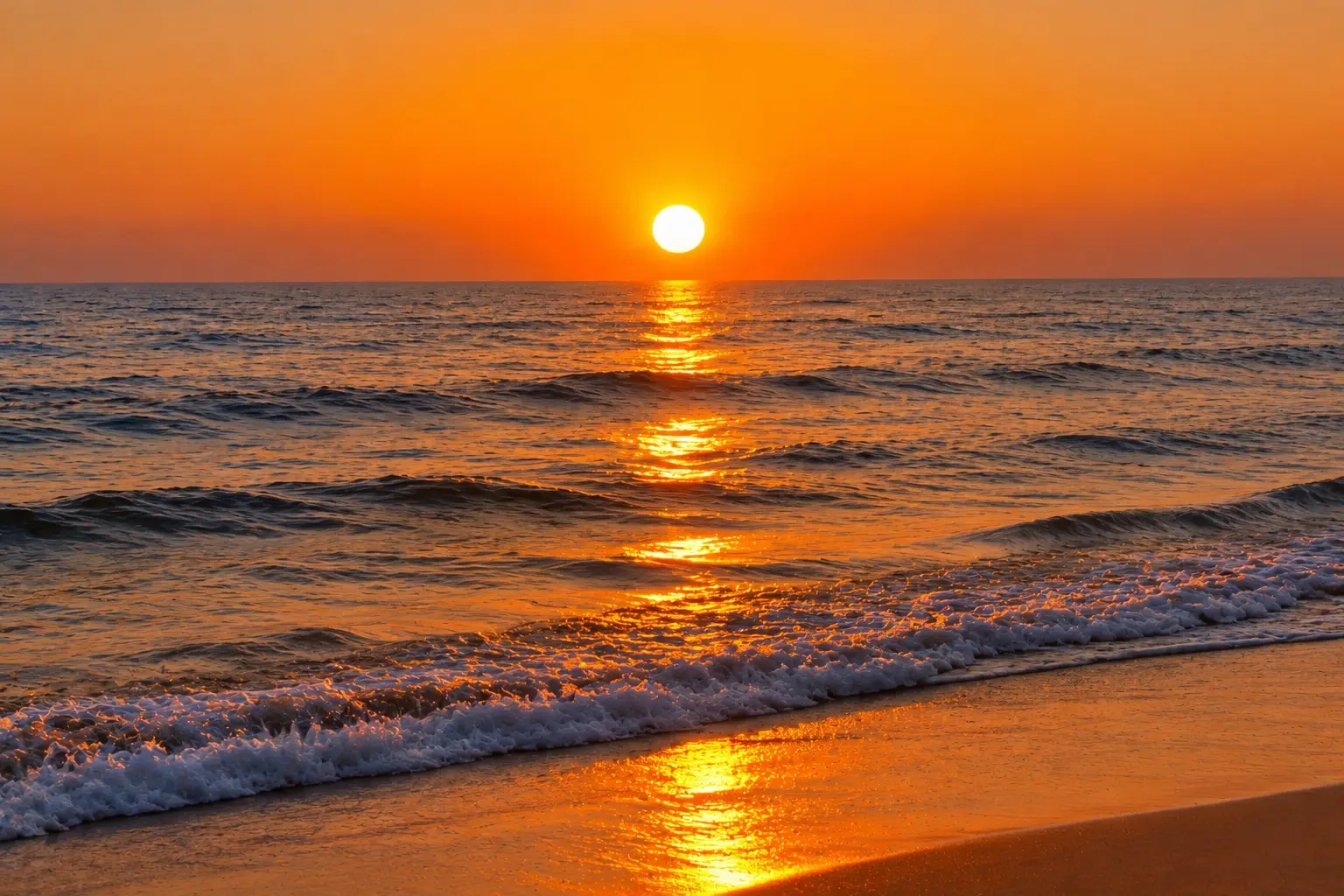
The Sun is a star about 4.6 billion years old: a ball of hot, electrically charged gas about 1.39 million kilometres wide, roughly 109 times the width of Earth. Its core reaches about 15 million °C, its visible surface about 5,500 °C, and it has enough fuel to keep shining much as it does now for around another 5 billion years.
The Sun holds about 99.8 per cent of all the mass in the solar system, and its gravity keeps everything from Mercury to the distant comets in orbit. It lies about 150 million kilometres from Earth, a distance light covers in about 8 minutes 20 seconds.
This guide covers the Sun's size and make-up, its layers and their temperatures, sunspots and the solar cycle, the solar wind and auroras, and what will happen to the Sun in the far future.
Quick takeaways
- The Sun is about 109 times as wide as Earth, and about 1.3 million Earths would fit inside it.
- Its outer atmosphere, the corona, is far hotter than its visible surface: over a million degrees.
- Sunspot numbers rise and fall in a cycle of about 11 years.
- Never look directly at the Sun, and never through binoculars or a telescope without a proper solar filter.
How big is the Sun, and what is it made of?
The Sun is about 1.39 million kilometres across. If it were a hollow ball, about 1.3 million Earths could fit inside. It has about 333,000 times Earth's mass. Even so, it is a fairly ordinary star. Astronomers class it as a G-type main-sequence star, sometimes called a yellow dwarf, and many stars in the Milky Way are larger and brighter.
By mass, the Sun is about three-quarters hydrogen and about a quarter helium, with small amounts of heavier elements such as oxygen, carbon and iron. It is not solid, liquid or gas in the everyday sense. It is made of plasma, gas so hot that its atoms have lost electrons and become electrically charged. That is why magnetic fields shape so much of what happens on the Sun.
The Sun shines because of nuclear fusion in its core. There, hydrogen nuclei are forced together to make helium, and a little mass is turned into a great deal of energy. Every second the Sun converts about 4 million tonnes of matter into energy, yet it is so massive that it has used only a small fraction of its fuel in 4.6 billion years.
Its light looks yellow from Earth because our atmosphere scatters some of the blue light out of the direct beam. Seen from space, sunlight is white: a mix of all the colours.
Distance
On average the Sun is about 150 million kilometres from Earth. This distance is called one astronomical unit.
Age
The Sun formed about 4.6 billion years ago from a collapsing cloud of gas and dust, along with the planets.
Spin
The Sun rotates faster at its equator, about once every 25 days, than near its poles, where a turn takes more than 30 days.
Galactic orbit
The Sun and its planets circle the centre of the Milky Way roughly once every 230 million years.
The layers of the Sun and how hot each one is
The Sun has no solid surface, but it does have distinct layers. Three lie inside: the core, the radiative zone and the convection zone. Above them sits the solar atmosphere: the photosphere, the chromosphere and the corona, with a thin transition region between the last two.
Energy made in the core first travels out through the radiative zone, where it is passed slowly from particle to particle as light. That journey is a slow zigzag that can take many thousands of years. In the convection zone, hot plasma rises like water boiling in a pan, cools at the top and sinks again. The tops of these rising cells give the photosphere a grainy look, called granulation.
You might expect the Sun to get cooler the farther you go from the core. It does, as far as the photosphere. Then the temperature climbs again: the corona is hundreds of times hotter than the surface below it. Why this happens is one of the big unsolved questions in solar science. Magnetic waves and countless tiny explosions called nanoflares are leading explanations, and NASA's Parker Solar Probe was sent partly to find out.
| Layer | Where it is | Approximate temperature | What happens there |
|---|---|---|---|
| Core | Centre, out to about a quarter of the radius | About 15 million °C | Hydrogen fuses into helium, producing the Sun's energy |
| Radiative zone | Outside the core, to about 70% of the radius | Millions of °C, falling outwards | Energy travels outwards slowly as light |
| Convection zone | The outer 30% of the interior | From about 2 million °C down to about 5,500 °C | Hot plasma rises, cools and sinks in huge cells |
| Photosphere | The visible surface | About 5,500 °C | Sunlight escapes into space; sunspots appear here |
| Chromosphere | Thin layer above the photosphere | From a few thousand to tens of thousands of °C | Glows reddish; seen briefly in a total solar eclipse |
| Corona | Outer atmosphere, extending millions of kilometres | Over 1 million °C | Source of the solar wind; seen as a pearly halo during totality |
Sunspots and the 11-year solar cycle
Sunspots are dark patches on the photosphere. They are not holes. They are regions where strong magnetic fields block some of the heat rising from below, so they are cooler than their surroundings, often by more than 1,000 °C. They are still very hot and bright; they only look dark by contrast. A large sunspot can be several times wider than Earth.
Galileo and other astronomers observed sunspots with early telescopes in the 1610s, and their movement showed that the Sun rotates. In the 19th century the German astronomer Heinrich Schwabe noticed that the number of sunspots rises and falls in a regular pattern. That pattern, the solar cycle, lasts about 11 years on average, though single cycles can be a little shorter or longer.
At solar maximum the Sun has many sunspots and frequent solar flares, sudden bursts of radiation, and coronal mass ejections, huge clouds of plasma thrown into space. At solar minimum there may be days or weeks with no spots at all. The Sun's magnetic field also flips its north and south poles about every 11 years, so the full magnetic cycle takes about 22 years. Scientists number the cycles; Solar Cycle 25 began in December 2019.
Tip: Sunspots are cooler, not colder. Think of them as the Sun's shade: still thousands of degrees, but less bright than the plasma around them.
The solar wind, solar storms and auroras
The corona is so hot that the Sun cannot hold all of it by gravity. A steady stream of charged particles, mostly protons and electrons, flows out in every direction. This is the solar wind. It usually travels at around 400 kilometres per second, with faster streams reaching roughly twice that. It blows a vast bubble around the solar system called the heliosphere. Voyager 1 crossed its edge into interstellar space in 2012.
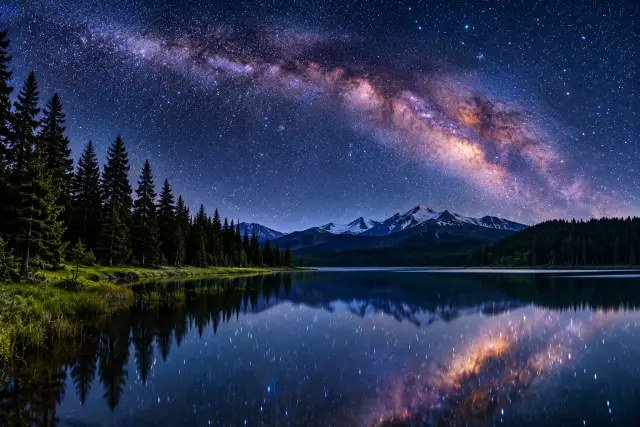
Earth's magnetic field shields us from most of the solar wind and steers the particles around the planet. Some are channelled down towards the polar regions, where they collide with gases high in the atmosphere and make them glow. These are the auroras: the northern lights, or aurora borealis, and the southern lights, or aurora australis. Oxygen gives the common green colour and sometimes red; nitrogen adds blue and purple.
When a coronal mass ejection hits Earth, it can cause a geomagnetic storm. Auroras then spread much closer to the equator than usual, but the storm can also disturb satellites, radio communication, GPS and power grids. The largest storm on record, the Carrington Event of 1859, produced auroras seen in the tropics and sparks in telegraph lines. Forecasters now watch the Sun constantly so that operators get warnings.
How long will the Sun last, and how to view it safely
The Sun is roughly halfway through the main part of its life, the stage when it fuses hydrogen in its core. In around 5 billion years the hydrogen in the core will run low. The core will shrink and heat up, the outer layers will swell, and the Sun will become a red giant, large enough to swallow Mercury and Venus and possibly Earth.
Later it will shed its outer layers into space as a glowing shell of gas, known as a planetary nebula, leaving behind its hot, dense core as a white dwarf about the size of Earth. The Sun does not have enough mass to explode as a supernova or become a black hole. Long before the red giant stage, the slowly brightening Sun will make Earth too hot for oceans, in roughly a billion years.
Closer to home, the most important Sun fact is a safety one. Never look directly at the Sun, even briefly and even when it is low or partly covered. Sunlight can burn the retina without any pain, causing permanent damage. Ordinary sunglasses are not safe. Use only certified solar viewers that meet the ISO 12312-2 standard, or project the Sun's image through a pinhole onto card. Never look at the Sun through binoculars, a camera or a telescope unless a proper solar filter covers the front of the instrument.
Test your Sun facts
Five questions on the guide above.
0 / 5 answered
1Which layer of the Sun is the visible surface we see?
Answer: The photosphere. The photosphere is where sunlight finally escapes into space. It is about 5,500 °C.2Why do sunspots look dark?
Answer: They are cooler than the surface around them. Strong magnetic fields block some rising heat, so sunspots are cooler and less bright than their surroundings.3About how long is the sunspot cycle?
Answer: About 11 years. Sunspot numbers rise to a maximum and fall to a minimum over about 11 years on average.4What will the Sun finally become after its red giant stage?
Answer: A white dwarf. The Sun has too little mass to become a black hole or neutron star. Its leftover core will cool slowly as a white dwarf.5Which is hotter: the Sun's visible surface or its corona?
Answer: The corona. The corona exceeds a million degrees, while the photosphere is about 5,500 °C. Explaining this is the coronal heating problem.
Frequently asked questions
How hot is the Sun?
It depends on where you measure. The core, where fusion happens, is about 15 million °C. The visible surface, the photosphere, is about 5,500 °C. Strangely, the outer atmosphere, the corona, is far hotter than the surface, at more than a million degrees. Scientists are still working out exactly what heats the corona so much.
How big is the Sun compared with Earth?
The Sun is about 1.39 million kilometres wide, roughly 109 times the width of Earth. About 1.3 million Earths could fit inside it, and it has about 333,000 times Earth's mass. It holds about 99.8 per cent of the mass in the whole solar system, yet it is only a medium-sized star compared with many others.
How long will the Sun last?
The Sun is about 4.6 billion years old and has enough hydrogen in its core to keep shining steadily for around another 5 billion years. After that it will swell into a red giant, then shed its outer layers and leave a white dwarf. It will slowly brighten long before then, making Earth too hot for oceans in roughly a billion years.
What causes the northern lights?
The northern lights are caused by charged particles from the Sun. The solar wind and solar storms carry these particles to Earth, where the magnetic field funnels some of them towards the polar regions. There they hit oxygen and nitrogen high in the atmosphere and make them glow green, red, blue or purple. Strong solar storms push auroras farther from the poles.
Where can I test myself on Sun and solar system facts?
Try the five-question review above, then cover the layers table and see whether you can name each layer and its temperature from memory. For more practice, the Solar System Quiz app on Android has daily questions and topic rounds on the Sun, the planets and the wider sky, which suits short, regular revision.
An ordinary star that runs our world
The Sun is a 4.6-billion-year-old ball of plasma powered by fusion in a 15-million-degree core. Its magnetic activity drives sunspots, the 11-year cycle, the solar wind and auroras, and it will keep shining for billions of years.
- Learn the six layers in order, from the core out to the corona.
- Never look at the Sun directly; use certified solar viewers or a pinhole projector.
- Revise Sun and planet facts with the daily questions in the Solar System Quiz app.
Check the evidence behind the guide
Use these references to check terminology and pursue a topic in more depth. Photo quizzes help you practise observation; a single picture rarely proves a difficult identification.
When a source describes a broad group, compare its details with the exact species, model or specimen you are studying. Record the feature that supports your answer rather than relying on a name alone.