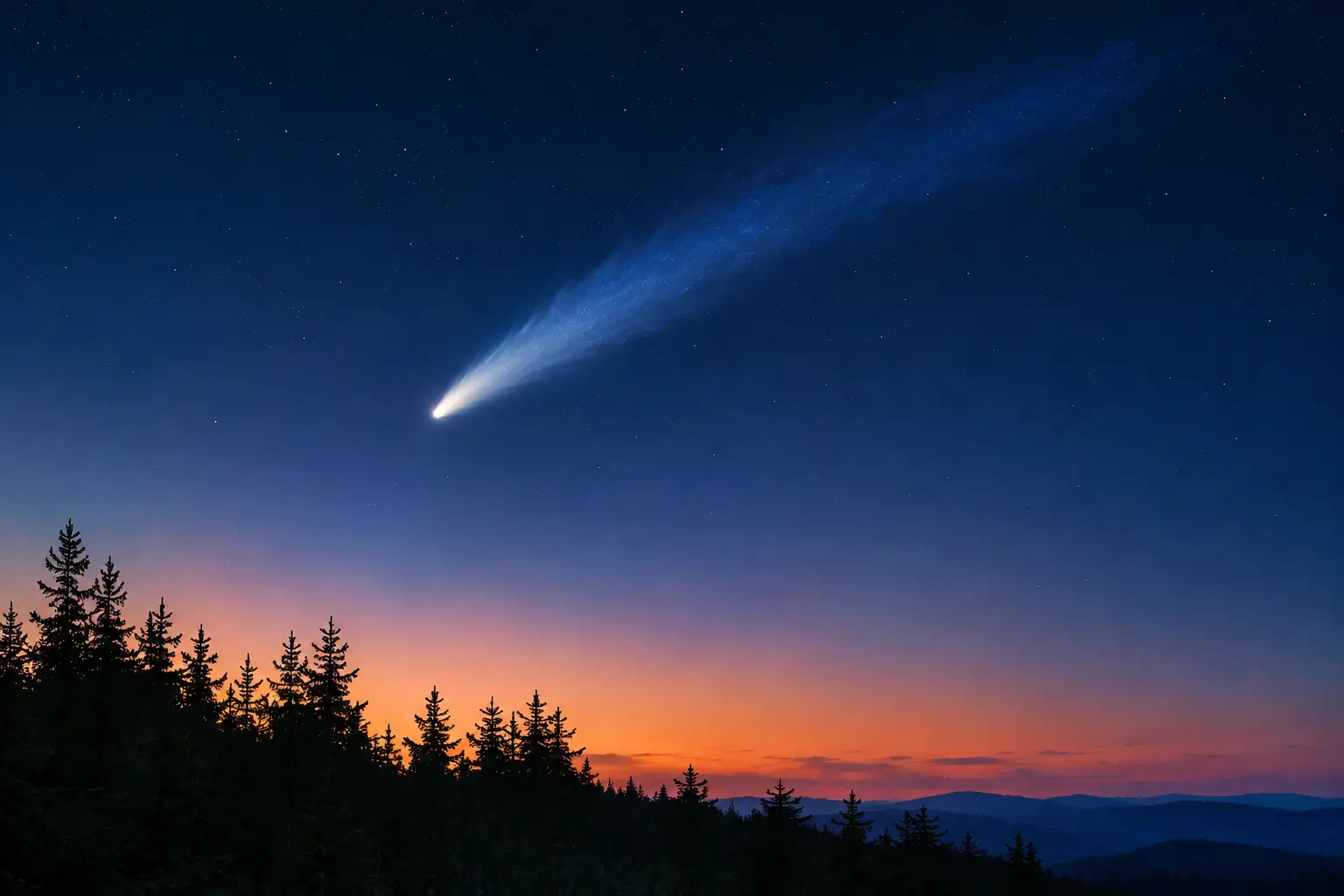
Comets, asteroids and meteors are all small bodies, or the effects of small bodies, in the solar system. The names describe what an object is made of and where it is, so one piece of rock can have different names at different stages.
A useful rule: asteroids are mostly rock and metal, comets are mostly ice and dust, and the three 'meteor' words describe a small piece of space debris before, during and after it meets Earth.
Asteroids and comets
Asteroids are rocky or metallic bodies left over from the formation of the solar system. Most orbit in the main asteroid belt between Mars and Jupiter, and some, the near-Earth asteroids, have orbits that come close to ours.
Comets are icy bodies, often described as dirty snowballs, that spend most of their time far from the Sun. As a comet approaches the Sun, its ice turns to gas and releases dust, forming a glowing cloud called a coma and, often, tails. Halley's Comet returns about every 76 years; it last passed close to the Sun in 1986 and is due back in 2061.
Meteoroid, meteor or meteorite?
A meteoroid is a small piece of rock or metal in space, ranging from dust grains up to small boulders. When a meteoroid enters Earth's atmosphere at high speed, the air in front of it heats up and glows, producing a streak of light. That streak is a meteor, often called a shooting star. A very bright meteor is called a fireball.
Most meteoroids burn up completely. A piece that survives the fall and lands on the ground is a meteorite. Meteorites are grouped into stony, iron and stony-iron types; stony meteorites are the most common.
| Name | What it is | Where it is |
|---|---|---|
| Asteroid | Rocky or metallic body | Space, mostly the main belt |
| Comet | Icy body that grows a coma and tails near the Sun | Space, often from the outer solar system |
| Meteoroid | Small rock or dust grain | Space |
| Meteor | Streak of light from a meteoroid burning up | Earth's atmosphere |
| Meteorite | Piece that survives the fall | Earth's surface |
Comet tails and meteor showers
Many comets show two tails. The dust tail is curved and yellowish-white. The ion tail is straight and bluish, and is pushed directly away from the Sun by the solar wind. Because both tails point away from the Sun, a comet leaving the inner solar system travels tail-first.
Comets leave trails of dust along their orbits. When Earth passes through one of these trails, many meteors appear to fan out from one point in the sky, called the radiant. Earth crosses the same trails on about the same dates each year, so showers repeat: the Perseids peak in mid-August, from Comet Swift-Tuttle, and the Geminids peak in mid-December, from the asteroid Phaethon.
Name the space rock
0 / 4 answered
1What is a meteor?
Answer: A streak of light made by a meteoroid burning up in the atmosphere. A piece that reaches the ground is a meteorite.2Which comet tail is straight and points directly away from the Sun?
Answer: The ion tail. The solar wind pushes the ion tail straight outward.3Which meteor shower peaks in mid-August?
Answer: The Perseids. The Perseids come from dust left by Comet Swift-Tuttle.4When is Halley's Comet next expected near the Sun?
Answer: 2061. It returns about every 76 years and last came by in 1986.
Frequently asked questions
Can we change an asteroid's path?
Yes, at least a little. In 2022 NASA's DART spacecraft deliberately crashed into Dimorphos, a small moon of the asteroid Didymos, and shortened its orbit by about half an hour. Neither asteroid was a threat to Earth; the test showed the method can work.
Rock, ice, then a streak of light
Asteroids are rock and metal, comets are ice and dust, and a meteoroid becomes a meteor as it burns in the sky and a meteorite if it reaches the ground.
Check the evidence behind the guide
Use these references to check terminology and pursue a topic in more depth. Photo quizzes help you practise observation; a single picture rarely proves a difficult identification.
When a source describes a broad group, compare its details with the exact species, model or specimen you are studying. Record the feature that supports your answer rather than relying on a name alone.