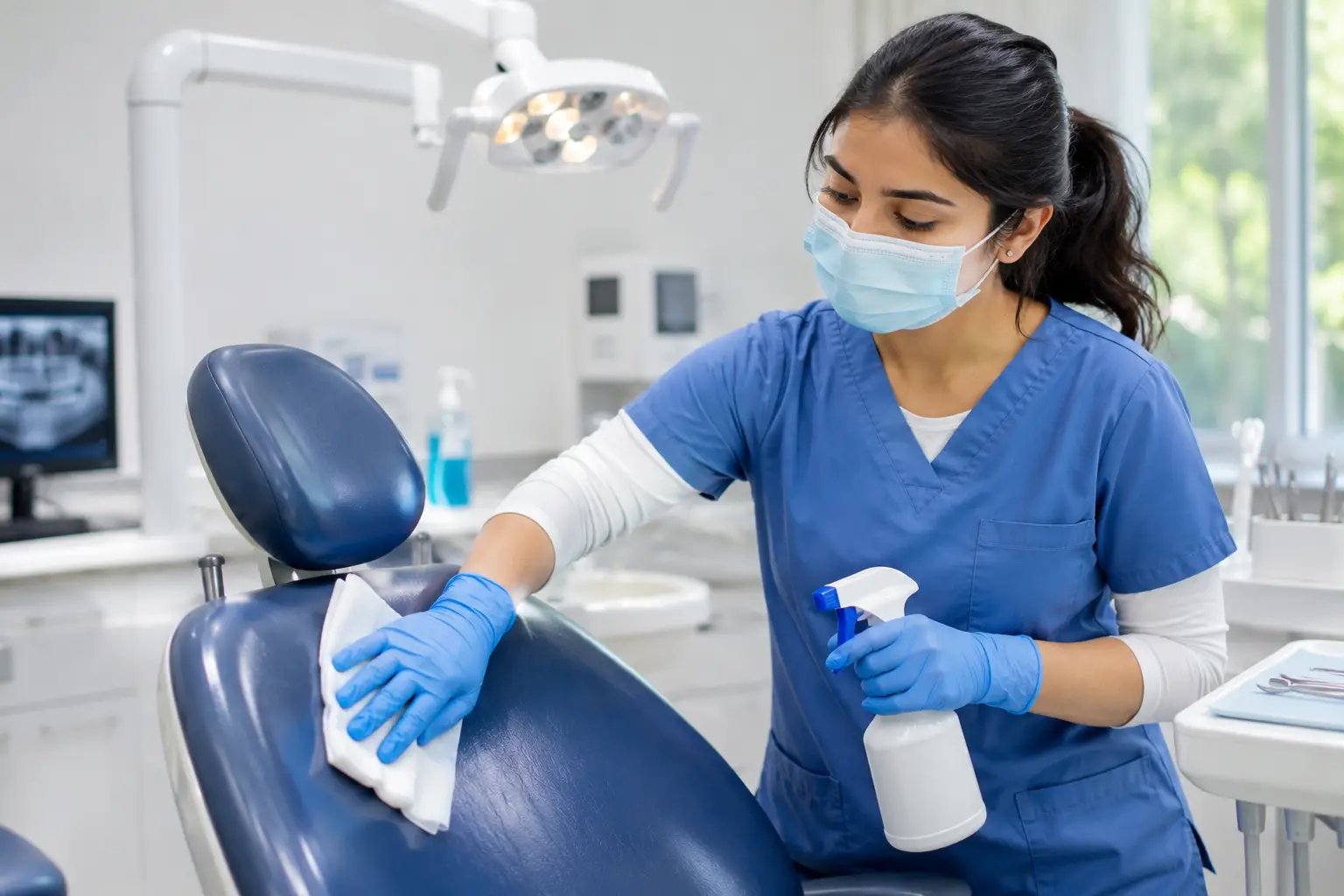
Infection control is the part of dental assisting where small slips can hurt people: a missed spore test, a recapped needle, a surface that was wiped but not cleaned. The DANB Infection Control (ICE) exam tests whether you know the rules well enough to follow them without thinking, and why they exist.
This article starts with a quick map of the topics and the Spaulding classification, which decides how each item is processed. Then come five rounds of five questions: hand hygiene and standard precautions, PPE and OSHA rules, instrument processing and sterilization, disinfection, and finally waterlines, sharps and exposures.
The questions are original practice items based on CDC dental infection-control guidance and the OSHA Bloodborne Pathogens Standard. Each answer comes with an explanation of why it is right and why the most tempting wrong option is wrong.
Quick takeaways
- Standard precautions apply to every patient, every time, whatever their known infection status.
- Critical and semicritical items are heat-sterilized; noncritical items are cleaned and disinfected.
- Monitor sterilizers mechanically, chemically and biologically, with spore tests at least weekly.
The basics
What the ICE exam covers
The Infection Control exam is one of the three CDA components. It draws on CDC guidance for dental settings and on OSHA rules that protect workers. Expect questions on standard precautions, hand hygiene, personal protective equipment, instrument processing and sterilization monitoring, cleaning and disinfecting surfaces, dental unit water quality, sharps safety and what to do after an exposure. Check DANB's current ICE content outline for the exact topics and their weight.
Much of the exam rests on one idea: how an item is processed depends on what it touches. The Spaulding classification sorts patient-care items into three groups, and it is worth learning by heart.
| Category | What it touches | Examples | Processing |
|---|---|---|---|
| Critical | Penetrates soft tissue or contacts bone | Surgical instruments, periodontal scalers, scalpel blades, surgical burs | Heat sterilization |
| Semicritical | Contacts mucous membranes or nonintact skin, without penetrating | Mouth mirrors, amalgam condensers, reusable impression trays, handpieces | Heat sterilization; high-level disinfection only if the item is heat-sensitive |
| Noncritical | Contacts intact skin only | Blood pressure cuff, x-ray tube head, pulse oximeter | Low-level disinfection, or intermediate-level if visibly soiled with blood |
Tip: CDC guidance says handpieces and other intraoral instruments that can be removed from the air and waterlines should be cleaned and heat-sterilized between patients, following the manufacturer's instructions.
Round 1
Standard precautions and hand hygiene
Hand hygiene questions usually turn on one detail: whether hands are visibly soiled, or whether the procedure is surgical.
1Your hands are visibly soiled after cleaning up a spill. Which form of hand hygiene should you use?
Answer: Wash with soap and water. When hands are visibly dirty, washing with soap and water is needed to remove the soil. An alcohol-based hand rub is tempting because it is fast and usually preferred, but it isn't effective at removing visible dirt or organic material.2What is the correct way to use an alcohol-based hand rub?
Answer: Rub it over all surfaces of the hands and fingers until they are dry. The rub works as the alcohol is spread over every surface and left to dry. Drying with a paper towel is tempting because it feels quicker, but it removes the product before it has done its job.3Which gloves are appropriate for a surgical extraction that involves cutting bone?
Answer: Sterile surgeon's gloves. Oral surgical procedures call for surgical hand antisepsis and sterile surgeon's gloves. Nonsterile exam gloves are tempting because they are used for most dental care, but they aren't meant for surgical procedures where bone or deep tissue is exposed.4A patient in the waiting room is coughing. Under respiratory hygiene and cough etiquette, what should staff do?
Answer: Offer a mask and tissues and seat the patient away from others if possible. Respiratory hygiene and cough etiquette, part of standard precautions, means helping people who are coughing contain their secretions with masks and tissues and, where possible, keeping them apart from others. Hand hygiene is tempting because it is part of the routine, but on its own it doesn't stop droplets from a cough.5Why does CDC advise against artificial fingernails for staff who have direct patient contact?
Answer: They can carry more microorganisms, even after hand hygiene. Artificial nails and extenders have been linked to carrying more germs, and hand hygiene doesn't remove them reliably. Making gloving impossible is tempting because long nails can tear gloves, but gloves can still be worn; the main concern is the germs under and around the nails.
Round 2
PPE and OSHA rules
OSHA's Bloodborne Pathogens Standard puts duties on the employer: an exposure control plan, training, the hepatitis B vaccine, PPE and records. Know which duty belongs to whom.
6Following CDC's common sequence for removing PPE, which item do you take off first?
Answer: Gloves. Gloves are usually the most contaminated item, so they come off first, followed by eyewear, the gown and finally the mask, with hand hygiene at the end. The mask is tempting, but it is removed last so it keeps protecting your nose and mouth while the other items come off.7When should a face mask be changed during patient care?
Answer: Between patients, or sooner if it becomes wet. A mask should be changed for each patient and whenever it becomes wet, because a damp mask filters poorly. Once a day is tempting because masks can look clean all day, but a mask worn across several patients collects contamination you can't see.8Who is responsible for laundering contaminated protective clothing such as clinic gowns?
Answer: The employer, at no cost to the employee. Under the OSHA standard, the employer must clean, launder or dispose of protective clothing at no cost to the worker. Washing it at home is tempting because it seems convenient, but taking contaminated clothing home can spread contamination outside the office.9How often must an office's written exposure control plan be reviewed and updated?
Answer: At least once a year, and whenever tasks change exposure. OSHA requires the plan to be reviewed and updated at least annually, and whenever new or changed tasks affect exposure, including a review of safer devices. Every 3 years is tempting because 3 years is the retention period for training records, which is a different rule.10How long must an employer keep an employee's medical records related to occupational exposure?
Answer: For the length of employment plus 30 years. OSHA requires exposure-related medical records to be kept for the duration of employment plus 30 years. Three years is the tempting answer, but that is how long training records must be kept, not medical records.
Round 3
Instrument processing and sterilization monitoring
Instrument processing follows a set order: transport, cleaning, packaging, sterilization and storage. Sterilization monitoring has three parts: mechanical (time, temperature and pressure readings), chemical indicators and biological indicators.
11Why is an ultrasonic cleaner or instrument washer preferred over hand scrubbing?
Answer: It lowers the risk of cuts and needlestick-type injuries to staff. Automated cleaning removes debris with less handling of sharp, contaminated instruments, which reduces percutaneous injuries. It is tempting to think the cleaner sterilizes, but cleaning only removes debris; the instruments still need to be packaged and sterilized.12Which spores are used in biological indicators for steam sterilizers?
Answer: Geobacillus stearothermophilus. Steam and unsaturated chemical vapor sterilizers are tested with Geobacillus stearothermophilus spores, which are highly resistant to moist heat. Bacillus atrophaeus is the tempting choice because it is also used in spore tests, but it is the organism for dry heat and ethylene oxide sterilizers.13The tape on a sterilized package has changed color. What does this tell you?
Answer: The package went through a sterilization cycle. An external chemical indicator, such as indicator tape, only shows that the package was exposed to the process. Assuming the contents are sterile is tempting, but a color change can't prove sterility; that is why biological monitoring with spore tests is also needed.14Which sterilization method is most likely to rust or corrode carbon-steel instruments?
Answer: Steam autoclave. Steam exposes instruments to moisture, which can rust and dull carbon steel. Dry heat is tempting because it uses very high temperatures, but it doesn't use water, which is why it and unsaturated chemical vapor are known for causing little corrosion.15A spore test from a steam sterilizer comes back positive. What should happen first?
Answer: Take the sterilizer out of service, review procedures and retest it. CDC guidance is to remove the sterilizer from service, check loading, packaging and operation, and retest; if the repeat test is also positive, the unit isn't used until it is repaired, and items processed since the last negative test are recalled and reprocessed where possible. Waiting for the next scheduled test is tempting if the sterilizer seems to work, but it would let possibly unsterile instruments reach patients.
Round 4
Spaulding categories and surface disinfection
Clinical contact surfaces, such as light handles and switches, are either covered with barriers or cleaned and disinfected between patients. Cleaning comes first, because disinfectants work poorly on surfaces still covered in debris.
16Under the Spaulding classification, a periodontal scaler is:
Answer: Critical. A periodontal scaler can penetrate soft tissue, so CDC lists it as a critical item that must be sterilized. Semicritical is tempting because scalers are used inside the mouth like mirrors, but an item that can enter soft tissue is critical.17An amalgam condenser touches mucous membranes but doesn't penetrate tissue. How should a heat-tolerant one be processed between patients?
Answer: Heat-sterilize it. Semicritical items that can tolerate heat should be heat-sterilized; high-level disinfection is only for heat-sensitive semicritical items. Wiping with an intermediate-level disinfectant is tempting because the item doesn't break tissue, but surface disinfectants aren't meant for items that go in the mouth.18An uncovered clinical contact surface is visibly contaminated with blood. What should you use after cleaning it?
Answer: An EPA-registered hospital disinfectant with a tuberculocidal (intermediate-level) claim. CDC calls for an intermediate-level, tuberculocidal hospital disinfectant when a surface is visibly contaminated with blood. A low-level disinfectant is tempting because it is acceptable for routine surfaces without visible blood, but visible blood calls for the stronger product.19Why is a tuberculocidal claim used to mark an intermediate-level disinfectant?
Answer: Mycobacterium tuberculosis is hard to kill, so killing it shows broad strength. Mycobacteria resist disinfectants better than most bacteria and viruses, so a product that kills them is expected to handle many other germs. The tempting idea that TB spreads mainly by surfaces is wrong; it spreads through the air, and the claim is simply a benchmark of strength.20A plastic barrier covers the dental light handle. What should happen to it?
Answer: Remove and replace it between patients. Barriers are removed and replaced between patients, ideally while still wearing gloves, then hands are cleaned and a new barrier is placed. Leaving it all day is tempting because it looks intact, but its outer surface is contaminated after each patient.
Round 5
Waterlines, sharps and exposure incidents
Dental unit waterlines grow biofilm, and sharps injuries are one of the main ways bloodborne infections reach dental staff. These questions cover the standards and the right responses.
21What quality standard does CDC recommend for water used in routine, nonsurgical dental procedures?
Answer: It should meet EPA drinking water standards (no more than 500 CFU/mL of heterotrophic bacteria). CDC recommends that water for nonsurgical care meet EPA drinking water standards, which means no more than 500 colony-forming units per milliliter of heterotrophic bacteria. Sterile water is the tempting choice, but it is required for surgical procedures, not routine care.22Which irrigating solution should be used during an oral surgical procedure that exposes bone?
Answer: Sterile water or sterile saline, from a sterile delivery device. Surgical procedures need sterile water or sterile saline delivered through a device such as a sterile syringe or a sterile irrigation system. Flushed unit water is tempting because flushing lowers bacteria counts, but dental unit water isn't sterile and isn't suitable for surgery.23How long does CDC recommend running water and air through handpieces and other waterline devices after each patient?
Answer: At least 20 to 30 seconds. Discharging water and air for at least 20 to 30 seconds after each patient helps flush out material that may have entered the lines. A couple of seconds is tempting because it clears the visible water, but it isn't long enough to flush the line.24If a used needle has to be recapped, what method is acceptable?
Answer: A one-handed scoop technique or a mechanical recapping device. OSHA prohibits two-handed recapping because it is a common cause of needlesticks, so only a one-handed scoop or a recapping device is allowed. Careful two-handed recapping is tempting because it feels controlled, but the hand holding the cap is exactly where injuries happen.25You get a needlestick from a used anesthetic needle. What should you do first?
Answer: Wash the area with soap and water, then report the injury right away. CDC advises washing needlesticks and cuts with soap and water and reporting the exposure at once so medical evaluation and any post-exposure treatment can start quickly. Squeezing and bleach are tempting because they feel like they would remove germs, but there is no evidence that squeezing helps, and caustic agents such as bleach are not recommended.
Tip: DANB and CDA are registered trademarks of the Dental Assisting National Board, Inc. This article is an independent study aid and is not affiliated with or endorsed by DANB. Questions here are original practice items, not real exam questions.
Quick quiz: infection control basics
Five quick review questions. Tap an answer; each question locks after your first pick.
0 / 5 answered
1Which of these is a noncritical item?
Answer: Blood pressure cuff. A blood pressure cuff touches only intact skin, so it is noncritical and is cleaned and disinfected. The others enter the mouth or tissue and must be sterilized.2Which three kinds of monitoring does CDC recommend for sterilizers?
Answer: Mechanical, chemical and biological. Mechanical monitoring checks cycle readings, chemical indicators show exposure to the process, and biological indicators (spore tests) show whether the process killed resistant spores.3What must a sharps container be?
Answer: Puncture resistant, leakproof, closable and labeled or color-coded. OSHA requires sharps containers that are closable, puncture resistant, leakproof on the sides and bottom, and labeled or color-coded. They are never emptied by hand.4How long must bloodborne pathogens training records be kept?
Answer: 3 years from the training date. OSHA requires training records to be kept for 3 years. The 30-year rule applies to exposure-related medical records, which are kept for the length of employment plus 30 years.5Standard precautions grew out of and expanded which earlier approach?
Answer: Universal precautions. Standard precautions combine and expand universal precautions, applying protections to all patients and to all body fluids except sweat, whether or not blood is visible.
Frequently asked questions
What is on the DANB ICE exam?
The Infection Control exam covers standard precautions, hand hygiene, PPE, instrument processing and sterilization monitoring, surface disinfection, dental unit waterlines, sharps safety, exposure incidents and OSHA rules. DANB publishes a content outline with the current topics and weights on danb.org.
What is the difference between cleaning, disinfection and sterilization?
Cleaning removes visible debris and many germs, and it must come first. Disinfection kills many or most germs on surfaces and items, at low, intermediate or high level. Sterilization kills all microorganisms, including bacterial spores, and is used for critical and heat-tolerant semicritical items.
How often should a dental office run spore tests?
CDC recommends testing each sterilizer with a biological indicator at least weekly, and with every load that contains an implantable device. Some states set stricter rules, so check your state dental board as well.
How can I practice for the ICE exam?
Learn the Spaulding categories and the main OSHA duties first, then practice questions on each topic until you can explain why each wrong option is wrong. CDA Exam Practice: Dental MCQ has an infection control group with explained answers, along with radiation safety and chairside topics for the other CDA components.
Learn the reasons, and the rules stick
Most ICE questions make sense once you know why the rule exists: clean before you disinfect, sterilize anything that enters tissue, monitor every sterilizer, and treat every patient with the same precautions. Use the rounds above to find the areas you are unsure of, then go back to the CDC and OSHA sources to fill the gaps.
- Write out the Spaulding table from memory until you can do it without mistakes.
- Make a one-page list of OSHA employer duties and record-keeping periods.
- Practice the infection control group in CDA Exam Practice: Dental MCQ and review every explanation.
Check DANB and the source guidelines
DANB sets the eligibility pathways, content outlines and testing rules for the CDA and its component exams, and it updates them from time to time. Read the current exam page and candidate handbook on danb.org before you register or plan your study.
Use practice questions to find your weak topics, then go back to your dental assisting textbook, the CDC dental infection-control guidance and the OSHA Bloodborne Pathogens Standard to learn the reasoning behind each answer.
Sources and further reading
Keep reading
 CDA Exam Practice Test: 25 Questions and Answers From GC, RHS and ICE
 CDA Radiation Health and Safety (RHS) Practice Questions: 25 Questions and Answers
 CDA General Chairside Assisting (GC) Practice Questions: 25 Questions and Answers
 CDA Dental Anatomy and Tooth Numbering Practice Questions: 25 Questions and Answers