
The Certified Dental Assistant (CDA) credential from the Dental Assisting National Board (DANB) is built from three separate exams: General Chairside Assisting, Radiation Health and Safety, and Infection Control. Each tests a different part of the job, so the quickest way to see where you stand is to try a few questions from all three. That is what this practice test gives you.
We start with what each component covers, then work through five rounds of five questions: two on chairside work, one on radiation safety, one on infection control and a mixed final round. Each round opens with a short note on what to watch for.
Every question is an original practice item written for this article, not a real exam question. Tap an option to see the answer and an explanation of why it is right and why the most tempting wrong answer is wrong.
Quick takeaways
- The CDA has three component exams: General Chairside Assisting (GC), Radiation Health and Safety (RHS) and Infection Control (ICE).
- You earn the CDA after passing all three and meeting DANB's eligibility requirements, which you should confirm on danb.org.
- Practice all three areas, because a strong score in one component doesn't make up for a weak one.
The basics
The three exams that make up the CDA
DANB's CDA certification combines three component exams. General Chairside Assisting covers the clinical side of the job: helping the dentist during procedures, dental materials, patient care, records and medical emergencies. Radiation Health and Safety covers how x-rays are produced, how to take and process images, and how to protect patients and staff. Infection Control covers standard precautions, instrument processing, surface disinfection and the OSHA rules that protect workers.
The exams are multiple choice. Question counts, time limits, delivery and eligibility pathways are set by DANB and can change, so check the current CDA page and candidate handbook on danb.org rather than relying on numbers you read elsewhere. Many states also use DANB exams, especially RHS and ICE, within their own requirements for dental assistants, so check your state dental board too.
| Component | Short name | Main topics |
|---|---|---|
| General Chairside Assisting | GC | Four-handed dentistry, instruments, dental materials, isolation, charting, patient care, medical emergencies |
| Radiation Health and Safety | RHS | X-ray production, exposure factors, technique, image errors, processing and digital imaging, radiation protection |
| Infection Control | ICE | Standard precautions, hand hygiene, PPE, instrument processing and sterilization monitoring, surface disinfection, waterlines, OSHA |
Round 1
Chairside: patient care and records
These questions cover the routine work of seating a patient: vital signs, the medical history and consent. They look simple, but the wrong options are common mix-ups.
1What is the normal resting pulse range for a healthy adult?
Answer: 60 to 100 beats per minute. A resting adult pulse of 60 to 100 beats per minute is considered normal. The range of 40 to 60 is tempting because very fit people can have a slower pulse, but below 60 is generally described as slow (bradycardia), not the normal range.2Which pulse site is used most often when a dental assistant takes a conscious patient's vital signs?
Answer: Radial artery at the wrist. The radial pulse on the thumb side of the wrist is easy to reach while the patient sits in the chair. The carotid pulse is the tempting choice, but it is the site used to check an unresponsive patient, such as during CPR, not the routine site for vital signs.3How often should a patient's medical history be reviewed and updated?
Answer: At every appointment. Medications and health conditions can change between visits, so the history should be reviewed and updated at every appointment. Once a year is tempting because some offices take a full new history yearly, but a quick update is still needed at each visit in between.4If a blood pressure cuff is too small for the patient's arm, the reading is likely to be:
Answer: Falsely high. A cuff that is too small needs more pressure to squeeze the artery closed, so it gives a falsely high reading. Falsely low is the tempting mix-up, but that is the usual effect of a cuff that is too large.5The dentist explains a procedure's risks, benefits and alternatives, and the patient agrees to it. What is this called?
Answer: Informed consent. Informed consent is permission given after the patient understands what will be done, its risks, benefits and alternatives. Implied consent is tempting, but it is shown by actions, such as sitting in the chair and opening the mouth for an exam, and isn't enough for treatment that carries significant risk.
Round 2
Chairside: dental materials and emergencies
GC questions on materials often ask what a material is, or what it shouldn't be combined with. Emergency questions usually ask for the first, simplest correct action.
6Which material should not be placed under a composite resin restoration because it can interfere with the resin's set?
Answer: Zinc oxide-eugenol. Eugenol inhibits the polymerization of resin, so zinc oxide-eugenol materials are kept away from composites. Calcium hydroxide is the tempting choice because it is also a sedative-type liner, but it doesn't contain eugenol and is commonly used under composites.7Which medical emergency happens most often in the dental office?
Answer: Syncope (fainting). Fainting, often triggered by anxiety or fear, is the most common medical emergency in dental settings. Anaphylaxis is tempting because dental offices use latex and drugs, but it is far less common, although it is much more dangerous when it happens.8A conscious patient with diabetes becomes shaky, sweaty and confused during a long appointment. What should the team give first?
Answer: A fast source of sugar, such as orange juice or glucose gel. These are signs of low blood sugar, and a conscious patient who can swallow should be given quick sugar. Insulin is the tempting choice because it is the diabetes drug most people know, but it lowers blood sugar further and would make the problem worse.9In the United States, what color are medical oxygen cylinders?
Answer: Green. Medical oxygen cylinders in the US are color-coded green. Blue is the tempting choice because it is the color used for nitrous oxide, and confusing the two tanks is a known safety risk.10Alginate impression material is classed as:
Answer: An irreversible hydrocolloid. Alginate sets by a chemical reaction that can't be undone, so it is an irreversible hydrocolloid. Reversible hydrocolloid is tempting, but that term describes agar, which turns to a gel when cooled and back to a liquid when heated.
Round 3
Radiation Health and Safety
RHS questions reward knowing what each exposure setting does and how to protect people from the beam. Keep two ideas in mind: kVp controls how penetrating the beam is, and mA and time control how many x-rays are produced.
11What does ALARA stand for in radiation safety?
Answer: As Low As Reasonably Achievable. ALARA means keeping radiation exposure as low as reasonably achievable while still getting a useful image. As Low As Radiographically Acceptable is tempting because it sounds similar, but the principle is about what is reasonably achievable, not what image is merely acceptable.12If no protective barrier is available, where should the operator stand during an exposure?
Answer: At least 6 feet from the tube head, at a 90 to 135 degree angle to the primary beam. Distance and position both matter: at least 6 feet away and at a 90 to 135 degree angle to the beam keeps the operator out of the primary beam and in the area of least scatter. The first wrong option is tempting because it has the right distance, but standing in line with the primary beam is the most dangerous place to be.13With all other settings unchanged, increasing the milliamperage (mA) mainly changes:
Answer: The number of x-rays produced, making the image darker. mA controls the quantity of x-rays, so more mA means more x-rays and a darker (denser) image. A more penetrating beam is the tempting answer, but beam energy and penetration are controlled by kVp, not mA.14On a dental radiograph, radiolucent structures such as the pulp appear:
Answer: Dark or black. Radiolucent structures let x-rays pass through easily, so more radiation reaches the receptor and the area looks dark. White or light gray is tempting, but that describes radiopaque structures such as enamel and metal restorations, which block x-rays.15What is the main purpose of a bitewing image?
Answer: To detect decay between teeth and show the bone crest. Bitewings show the crowns of upper and lower teeth together, which makes them the standard image for finding decay between teeth and checking the alveolar bone crest. Showing the root tip is tempting, but that is the job of a periapical image.
Round 4
Infection Control
ICE questions come from CDC dental infection-control guidance and the OSHA Bloodborne Pathogens Standard. When in doubt, pick the answer that treats every patient the same way and protects the worker.
16Standard precautions apply to which patients?
Answer: All patients, whether or not they are known to have an infection. Standard precautions are used with every patient, because many people with infections don't know it or don't say so. Limiting them to patients with a known bloodborne disease is the tempting answer, but that approach would miss most infected patients.17Under the OSHA Bloodborne Pathogens Standard, how is saliva in dental procedures classed?
Answer: As other potentially infectious material (OPIM). The OSHA standard names saliva in dental procedures as other potentially infectious material, so the same protections apply as for blood. Non-infectious unless visibly bloody is tempting because blood isn't always visible, but OSHA doesn't make that exception for dental procedures.18After a needlestick from an infected source patient, which virus carries the highest risk of transmission to an unvaccinated worker?
Answer: Hepatitis B virus. Hepatitis B is far more easily spread by a needlestick than HIV or hepatitis C, which is why the hepatitis B vaccine is so important for dental staff. HIV is the tempting choice because it is the virus people fear most, but its average risk after a needlestick is much lower.19Under OSHA rules, when must an employer offer the hepatitis B vaccine to a worker with occupational exposure?
Answer: Free of charge, within 10 working days of initial assignment. OSHA requires employers to make the vaccine series available at no cost within 10 working days of initial assignment, and a worker who declines must sign a declination form. Offering it only after an exposure is tempting because post-exposure care is also required, but the vaccine must be offered up front.20How often must employees with occupational exposure receive bloodborne pathogens training?
Answer: At initial assignment and at least once a year after that. OSHA requires training when a worker is first assigned to tasks with exposure and at least annually after that, during working hours and at no cost. Training only at hire is tempting because that is when most orientation happens, but the yearly refresher is required too.
Round 5
Mixed review
The last round mixes all three components, the way your study should. Tooth numbering, sterilization monitoring and image errors come up again and again in dental assisting work.
21In the Universal Numbering System, tooth #8 is the:
Answer: Maxillary right central incisor. The Universal system starts at the maxillary right third molar (#1) and counts forward, so the maxillary right central incisor is #8. The maxillary left central incisor is the tempting choice because it sits right next to it, but it is #9, the first tooth on the left side.22How often does CDC recommend testing each sterilizer with a biological indicator (spore test)?
Answer: At least weekly. CDC recommends spore testing each sterilizer at least weekly, and with every load that contains an implantable device. Monthly is tempting because it sounds like enough for a routine check, but CDC's guidance is weekly, and you should also follow any stricter state rule.23A film packet is placed in the mouth backward and exposed. How does the processed image usually look?
Answer: Light, with a herringbone or tire-track pattern. When the packet is backward, the x-rays pass through the lead foil first, so the image is light and shows the foil's embossed pattern. A normal but reversed image is tempting because the film is turned around, but the lead foil blocks much of the beam and leaves its pattern on the film.24Where is a dental dam clamp usually placed?
Answer: On a tooth distal to the tooth or teeth being treated. The clamp anchors the dam, so it usually goes on a tooth distal to the treatment area, leaving the working tooth fully exposed. Placing it on the tooth being prepared is tempting, but the clamp would then get in the way of the dentist's access.25When putting on PPE before patient care, which item goes on last?
Answer: Gloves. Gloves go on last so they are clean and cover the cuffs of the gown when you begin treatment. Eyewear is the tempting choice because it is the last item that touches your face, but putting it on after gloves would contaminate the gloves before you start.
Tip: DANB and CDA are registered trademarks of the Dental Assisting National Board, Inc. This article is an independent study aid and is not affiliated with or endorsed by DANB. Questions here are original practice items, not real exam questions.
Quick quiz: know the CDA
Five quick questions on how the CDA is put together. Tap an answer; each question locks after your first pick.
0 / 5 answered
1Which three component exams make up DANB's CDA certification?
Answer: GC, RHS and ICE. The CDA combines General Chairside Assisting (GC), Radiation Health and Safety (RHS) and Infection Control (ICE). CPR and OSHA are related topics, but they aren't CDA component exams.2Which organization grants the CDA credential?
Answer: Dental Assisting National Board (DANB). The CDA is a DANB credential. The CDC and OSHA write the infection-control guidance and rules the ICE exam draws on, but they don't award the certification.3Which component covers x-ray production, technique and patient protection?
Answer: Radiation Health and Safety. Radiation Health and Safety (RHS) covers how x-rays are made, how images are taken and processed, and how patients and staff are protected.4Which component covers instrument processing and sterilizer monitoring?
Answer: The ICE exam. Instrument processing, sterilization monitoring and environmental infection control are core ICE topics.5Where should you confirm the current exam length, timing and eligibility pathways?
Answer: DANB's website and current candidate handbook. DANB sets and updates these details, so its own website and handbook are the reliable sources. Practice tests, including this one, can't stay current with every rule change.
Frequently asked questions
What are the three parts of the CDA exam?
DANB's CDA certification is made up of three component exams: General Chairside Assisting (GC), Radiation Health and Safety (RHS) and Infection Control (ICE). Each covers a different part of the job, from chairside procedures to x-ray safety to sterilization.
Can I take the CDA component exams separately?
DANB lets candidates take the components separately, and RHS and ICE are also used on their own in many states. You earn the CDA once you have passed all three and met DANB's eligibility requirements. Check danb.org for the current rules, including any time limit for completing all three.
How many questions are on the CDA exam?
Each component has its own question count and time limit, and DANB can change them. Check the current CDA exam page and candidate handbook on danb.org for the numbers that apply when you test.
How should I study for the CDA exam?
Start with a practice test that samples all three components, note where you lose points, and spend most of your time on those topics. CDA Exam Practice: Dental MCQ has 2,300+ questions across 10 groups, including chairside, radiation safety and infection control, with an explanation after every answer and a daily quiz to keep you practicing.
Do I need the CDA to work as a dental assistant?
It depends on your state and the duties you will perform. Some states require or recognize DANB exams for certain duties, such as taking x-rays, while others set their own rules. Check your state dental board and danb.org for what applies to you.
Practice all three components, then target your weak spots
The CDA asks you to know chairside work, radiation safety and infection control well enough to pass three separate exams. A mixed practice test like this one shows which component needs the most work. Give that area most of your study time, read the explanation for every miss, and keep the other two components fresh with short daily practice.
- Score each round of this test separately and write down your weakest component.
- Read DANB's current content outline for that component and study the topics you missed.
- Practice daily with topic quizzes and explained answers in CDA Exam Practice: Dental MCQ.
Check DANB and the source guidelines
DANB sets the eligibility pathways, content outlines and testing rules for the CDA and its component exams, and it updates them from time to time. Read the current exam page and candidate handbook on danb.org before you register or plan your study.
Use practice questions to find your weak topics, then go back to your dental assisting textbook, the CDC dental infection-control guidance and the OSHA Bloodborne Pathogens Standard to learn the reasoning behind each answer.
Sources and further reading
Keep reading
 CDA Infection Control (ICE) Practice Questions: 25 Questions and Answers
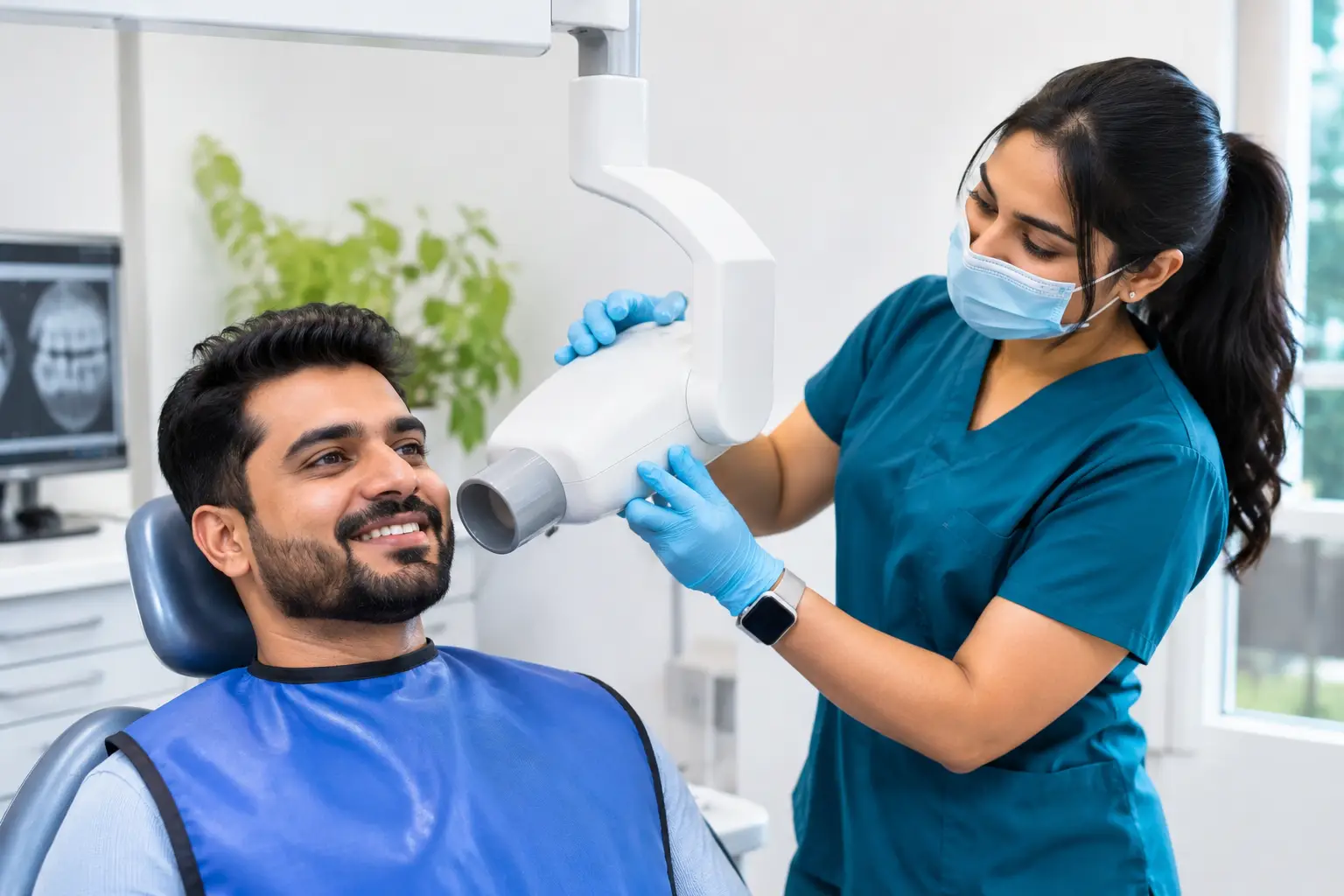 CDA Radiation Health and Safety (RHS) Practice Questions: 25 Questions and Answers
 CDA General Chairside Assisting (GC) Practice Questions: 25 Questions and Answers
 CDA Dental Anatomy and Tooth Numbering Practice Questions: 25 Questions and Answers