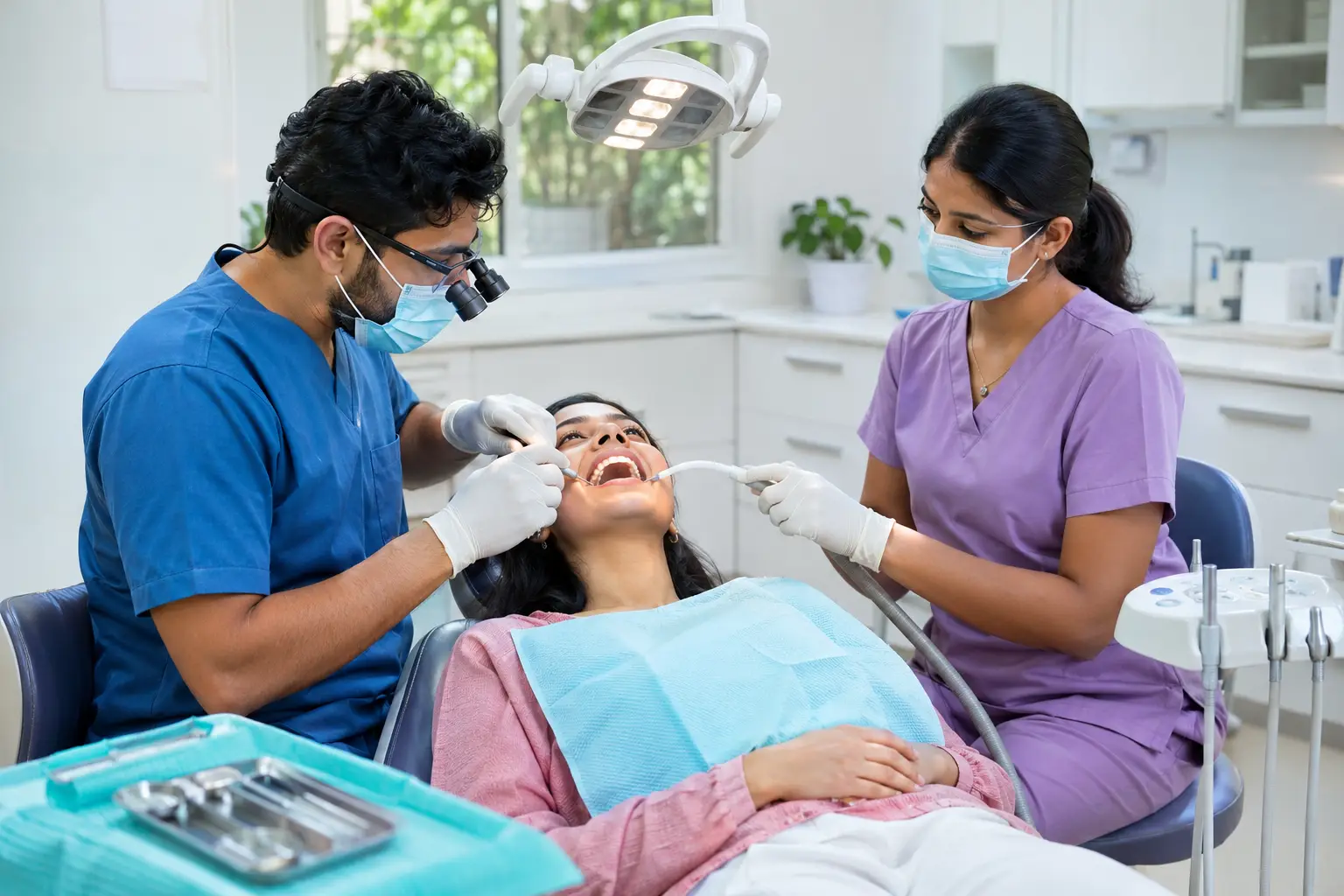
General Chairside Assisting is the broadest of the three CDA components. It covers what you do beside the dentist all day: passing instruments, keeping the field dry and visible, mixing and handling materials, charting, caring for the patient and responding when someone becomes ill in the chair.
We start with the operating zones used in four-handed dentistry, then work through five rounds: instrument transfer and ergonomics, isolation and moisture control, dental materials, restorative assisting and cavity classes, and patient management and medical emergencies.
The questions are original practice items, not real exam questions. Each answer explains why it is right and why the most tempting wrong option is wrong, so you learn the reasoning as well as the fact.
Quick takeaways
- For a right-handed dentist, the assistant usually transfers instruments with the left hand and keeps the right hand for suction and the air-water syringe.
- Good isolation and HVE placement keep the field dry and visible and protect the patient's airway.
- Emergency questions usually ask for the first, simplest correct action, such as positioning or giving the patient's own medication.
The basics
What the GC exam covers and the operating zones
The General Chairside Assisting exam covers collecting and recording clinical data, chairside procedures, chairside and lab materials, patient education, emergencies and office operations. DANB publishes a content outline with the current topics and their weight, so use it to check your study plan.
Four-handed dentistry is easiest to picture with the clock concept. Imagine the patient's face as a clock with the top of the head at 12 o'clock. For a right-handed operator, each zone has a job. For a left-handed operator, the zones are mirrored. Textbooks give slightly different hour ranges, so learn the idea rather than memorizing one exact number.
| Zone (right-handed operator) | Clock position | What it is for |
|---|---|---|
| Operator's zone | About 7 to 12 o'clock | Where the dentist sits and moves |
| Transfer zone | About 4 to 7 o'clock | Where instruments and materials are passed, below the patient's chin |
| Assistant's zone | About 2 to 4 o'clock | Where the assistant sits |
| Static zone | About 12 to 2 o'clock | Behind the patient, for items that shouldn't pass in front of the face, such as a rear-delivery cart |
Round 1
Instrument transfer and ergonomics
Smooth transfers save time and keep the dentist's eyes on the mouth. Ergonomic questions ask how to keep both team members comfortable and safe over a full day.
1For a right-handed dentist, in which zone are instruments passed?
Answer: About 4 to 7 o'clock. Instruments are passed in the transfer zone, below the patient's chin, at about 4 to 7 o'clock for a right-handed operator. 12 to 2 o'clock is tempting because it is a named zone, but it is the static zone behind the patient, where items are kept out of the patient's view.2How should an instrument be positioned when you hand it to the dentist?
Answer: With its working end pointed toward the arch being treated, ready to use. The instrument should arrive in the dentist's fingers ready for use, angled toward the arch being worked on, so the dentist doesn't have to look away or turn it. Pointing the working end toward the assistant is tempting because it sounds safe, but the dentist would then have to reposition it before using it.3In a one-handed instrument exchange, how does the assistant usually retrieve the used instrument?
Answer: With the little finger, tucking it into the palm before delivering the new one. The assistant hooks the used instrument with the little finger and tucks it into the palm, leaving the thumb and first fingers free to deliver the new one. Using the thumb and index finger for both is tempting, but those fingers are already holding the new instrument, so the exchange wouldn't stay one-handed.4On a preset tray, instruments are usually arranged:
Answer: In the order they will be used, from left to right. Placing instruments in the order of use, usually from left to right, lets the assistant anticipate each step. Arranging by size is tempting because it looks neat, but it doesn't help the assistant predict what comes next.5Which classes of motion should the dental team try to limit themselves to?
Answer: Class I to III: fingers, wrist and elbow movements. Classes I to III use the fingers, wrist and elbow, which keep the body stable and reduce fatigue. Class IV and V are tempting because they increase reach, but moving the shoulder or twisting the torso repeatedly causes strain and breaks concentration.
Round 2
Isolation and moisture control
A dry, visible field is needed for bonding and for safety. These questions cover the high-volume evacuator (HVE), the dental dam and other isolation aids.
6During a cavity preparation, how should the HVE tip be positioned?
Answer: With the bevel parallel to the buccal or lingual surface, just distal to the tooth being prepared. Placing the bevel parallel to the tooth surface and slightly distal to the tooth being prepared catches spray and debris without blocking the view. Pointing it straight at the bur is tempting because that is where the water comes from, but it blocks the dentist's view and can draw the spray away from cooling the tooth.7Why are the edges of a dental dam inverted around each tooth?
Answer: To seal the dam and prevent saliva from leaking into the field. Tucking the dam edges into the sulcus creates a seal, so saliva can't seep around the teeth. Preventing tears is tempting because dams do tear, but inverting the edges is about the seal; tearing is prevented by correct punching and careful placement.8Why is dental floss tied to the bow of a dam clamp before it is placed?
Answer: So the clamp can be retrieved if it breaks or slips off. A floss ligature lets the team pull the clamp out quickly if it breaks or comes loose, so the patient doesn't swallow or inhale it. Holding the frame is tempting because the frame is nearby, but the frame is held by the dam itself.9A dry angle (triangular absorbent pad) is placed on the cheek to cover the opening of which duct?
Answer: The parotid (Stensen's) duct. The parotid duct opens on the inside of the cheek opposite the maxillary second molar, and a dry angle placed over it reduces saliva flow into the field. The submandibular duct is tempting because it is also a major salivary duct, but it opens under the tongue, not on the cheek.10Why should patients be told not to close their lips tightly around the saliva ejector?
Answer: It can cause backflow from the suction line into the mouth. CDC notes that backflow can occur when a patient seals their lips around the saliva ejector, drawing fluid from the line back toward the mouth. Bruising the lips is tempting because a tight seal sounds forceful, but the real concern is contamination from backflow.
Round 3
Dental materials
Materials questions often ask what a material does best, or what can go wrong when it is handled incorrectly. Learn each material's main use and its main warning.
11Why is calcium hydroxide used for pulp capping?
Answer: It stimulates the formation of reparative dentin. Calcium hydroxide encourages the pulp to form reparative dentin and helps protect it, which is why it is used in pulp capping. High fluoride release is tempting, but that is a property of glass ionomer, not calcium hydroxide.12Which cement is valued for releasing fluoride and bonding chemically to tooth structure?
Answer: Glass ionomer. Glass ionomer bonds chemically to enamel and dentin and releases fluoride over time. Zinc phosphate is tempting because it is a well-known luting cement, but it doesn't bond chemically or release fluoride, and its acidity can irritate the pulp.13After enamel is etched, rinsed and dried for a sealant, saliva touches the tooth. What should happen?
Answer: Rinse, re-etch for the recommended time, rinse and dry again. Saliva coats etched enamel and blocks the tiny pores the sealant needs to grip, so the tooth must be re-etched. Drying with air is tempting because the tooth looks dry again, but drying doesn't remove the saliva film, and the sealant may fail.14Which impression material can be prevented from setting by sulfur compounds in some latex gloves?
Answer: Polyvinyl siloxane (addition silicone). Sulfur compounds in some latex gloves can inhibit the set of polyvinyl siloxane, so many offices handle it with nonlatex gloves. Alginate is tempting because it is the most common impression material, but its setting is affected mainly by water temperature, not gloves.15Which gypsum product is the strongest and is used for dies in crown and bridge work?
Answer: Die stone. High-strength die stone is the hardest gypsum product, so it is used where fine margins must survive handling. Model plaster is tempting because it is used for study models, but it is the weakest of these products.
Round 4
Restorative assisting and cavity classes
Charting uses G.V. Black's cavity classes, and Class II restorations need a matrix to rebuild the missing wall. These questions cover both.
16When assembling a Tofflemire matrix for a Class II restoration, which way does the diagonal slot of the retainer face?
Answer: Toward the gingiva. The diagonal slot faces the gingiva, and the retainer is usually placed on the buccal side, so the band can be removed easily toward the occlusal. The occlusal surface is tempting because it is the open side of the tooth, but a slot facing that way puts the band in the wrong position.17What is the main purpose of a wedge placed with a matrix band?
Answer: To hold the band tightly against the tooth at the gingival margin. The wedge presses the band against the gingival margin, which prevents an overhang of material, and slightly separates the teeth for a good contact. Keeping the mouth open is tempting because wedges look like small props, but that is the job of a bite block.18Decay on the mesial surface of a maxillary first premolar is which G.V. Black class?
Answer: Class II. Class II covers the proximal (mesial or distal) surfaces of premolars and molars. Class III is tempting because it is also a proximal class, but it applies to incisors and canines, not posterior teeth.19Decay along the gumline on the facial surface of a mandibular canine is which G.V. Black class?
Answer: Class V. Class V covers the gingival (cervical) third of the facial or lingual surface of any tooth. Class III is tempting because the tooth is anterior, but Class III is for proximal surfaces, not the cervical area of the facial surface.20Which bur shape is commonly used to create undercuts for retention in a cavity preparation?
Answer: Inverted cone. An inverted cone bur is wider at the tip than at the neck, which lets the dentist cut small undercuts that hold the restoration in place. The round bur is tempting because it is used at the start of many preparations, but it is mainly used to open the tooth and remove decay.
Round 5
Patient management and medical emergencies
In an emergency, the assistant's first jobs are usually to stop treatment, position the patient, call for help and bring the emergency kit and oxygen. These questions ask what to do next for specific conditions.
21A patient feels faint and becomes pale and sweaty. How should the patient be positioned?
Answer: Lying back (supine) with the feet raised slightly. Placing the patient supine with the feet slightly raised helps blood flow to the brain, which usually brings a fainting patient around quickly. Head between the knees is tempting because it is common advice outside healthcare, but in the dental chair the supine position is easier and more effective.22A patient with a history of angina has chest pain during treatment. Which medication is usually given first?
Answer: Nitroglycerin under the tongue. Nitroglycerin widens blood vessels and usually relieves angina within minutes. Aspirin is tempting because it is given for a suspected heart attack, but for known angina the first step is nitroglycerin, with emergency services called if the pain doesn't ease.23A patient with asthma starts wheezing and is short of breath. What should be done first?
Answer: Have the patient use their fast-acting bronchodilator inhaler, such as albuterol. A fast-acting bronchodilator opens the airways and is the first treatment for an asthma attack. The paper bag is tempting because it is linked with breathing problems, but it is an old remedy for hyperventilation and would make an asthma attack worse.24Minutes after latex exposure, a patient develops hives, wheezing and swollen lips. What is the first-line drug for this anaphylactic reaction?
Answer: Epinephrine. Epinephrine reverses the airway swelling and drop in blood pressure of anaphylaxis, so it is given first and emergency services are called. An antihistamine is tempting because it treats mild allergic reactions, but it acts too slowly to stop a life-threatening one.25A patient has a seizure in the dental chair. What should the team do?
Answer: Remove nearby instruments, protect the patient from injury and don't restrain them. During a seizure, the team clears the area, protects the patient from hitting anything, times the seizure and calls for help if needed. A bite block is tempting because people fear tongue biting, but forcing anything into the mouth can break teeth or injure fingers.
Tip: DANB and CDA are registered trademarks of the Dental Assisting National Board, Inc. This article is an independent study aid and is not affiliated with or endorsed by DANB. Questions here are original practice items, not real exam questions.
Quick quiz: chairside review
Five quick review questions. Tap an answer; each question locks after your first pick.
0 / 5 answered
1What is the tell-show-do technique used for?
Answer: Introducing a child to a procedure one step at a time. Tell-show-do explains a step, shows it, and then does it, which helps children and anxious patients feel in control.2What compression rate is recommended for adult CPR?
Answer: 100 to 120 compressions per minute. Current American Heart Association guidance is 100 to 120 compressions per minute, pressing at least 2 inches deep in adults.3What color are nitrous oxide cylinders in the United States?
Answer: Blue. Nitrous oxide cylinders are blue in the US, and oxygen cylinders are green.4Which instrument is used to measure periodontal pocket depth?
Answer: Periodontal probe. A periodontal probe has millimeter markings for measuring the depth of the sulcus or pocket.5Which part of a hand instrument connects the handle to the working end?
Answer: The shank. The shank joins the handle to the working end, and its angles help the instrument reach different areas of the mouth.
Frequently asked questions
What does the DANB GC exam cover?
General Chairside Assisting covers collecting and recording clinical data, chairside procedures and instruments, chairside and lab materials, patient education, medical emergencies and office operations. DANB's current GC content outline on danb.org lists the topics and their weight.
What is four-handed dentistry?
It is a way of working where the dentist and assistant sit in set positions and share the work smoothly, with the assistant passing instruments, keeping the field clear and anticipating each step. It saves time and reduces strain for both team members.
Do I need CPR certification for the CDA?
DANB's CDA eligibility pathways have included a current CPR, BLS or ACLS credential from an accepted provider. Requirements can change, so confirm the current rule on danb.org before you apply.
How should I study for the GC exam?
Because GC is broad, study one topic group at a time, such as materials or emergencies, and finish each session with mixed questions. CDA Exam Practice: Dental MCQ has chairside, restorative, specialty and emergencies groups with an explanation after every answer, plus bookmarks for the questions you want to review.
Think like the person beside the dentist
GC questions reward practical thinking: what keeps the dentist working without interruption, what keeps the field dry and safe, what each material is for, and what to do first when a patient becomes ill. Use the rounds above to see which of those areas needs the most work.
- Draw the operating zones for right- and left-handed dentists from memory.
- Make a one-line note for each dental material: its main use and its main warning.
- Practice the chairside and emergencies groups in CDA Exam Practice: Dental MCQ.
Check DANB and the source guidelines
DANB sets the eligibility pathways, content outlines and testing rules for the CDA and its component exams, and it updates them from time to time. Read the current exam page and candidate handbook on danb.org before you register or plan your study.
Use practice questions to find your weak topics, then go back to your dental assisting textbook, the CDC dental infection-control guidance and the OSHA Bloodborne Pathogens Standard to learn the reasoning behind each answer.
Sources and further reading
Keep reading
 CDA Exam Practice Test: 25 Questions and Answers From GC, RHS and ICE
 CDA Infection Control (ICE) Practice Questions: 25 Questions and Answers
 CDA Radiation Health and Safety (RHS) Practice Questions: 25 Questions and Answers
 CDA Dental Anatomy and Tooth Numbering Practice Questions: 25 Questions and Answers