This garden birds quiz has 25 questions on the birds people see most often in backyards and gardens in North America and Europe. It starts with the most common mix-up of all: the American robin and the European robin are two different birds from two different families.
After the robins, the quiz covers feeder favourites in North America, garden birds of Britain and Europe, and the birds that live on both sides of the Atlantic, some of them because people carried them across. Each answer explains the field mark or habit that settles it.
Quick takeaways
- The American robin is a thrush; the European robin is a much smaller Old World flycatcher.
- Male and female birds often look different: compare cardinals, blackbirds and house sparrows.
- European starlings and house sparrows were introduced to North America in the 1800s.
- Never put out salted peanuts; plain foods and clean water help garden birds most.
Round 1
American robin vs European robin: are they the same bird?
No. The European robin, Erithacus rubecula, is a small, round bird about 14 cm long with an orange-red face and breast. It belongs to the Old World flycatcher family. British gardeners know it as the bird that follows the spade, waiting for worms.
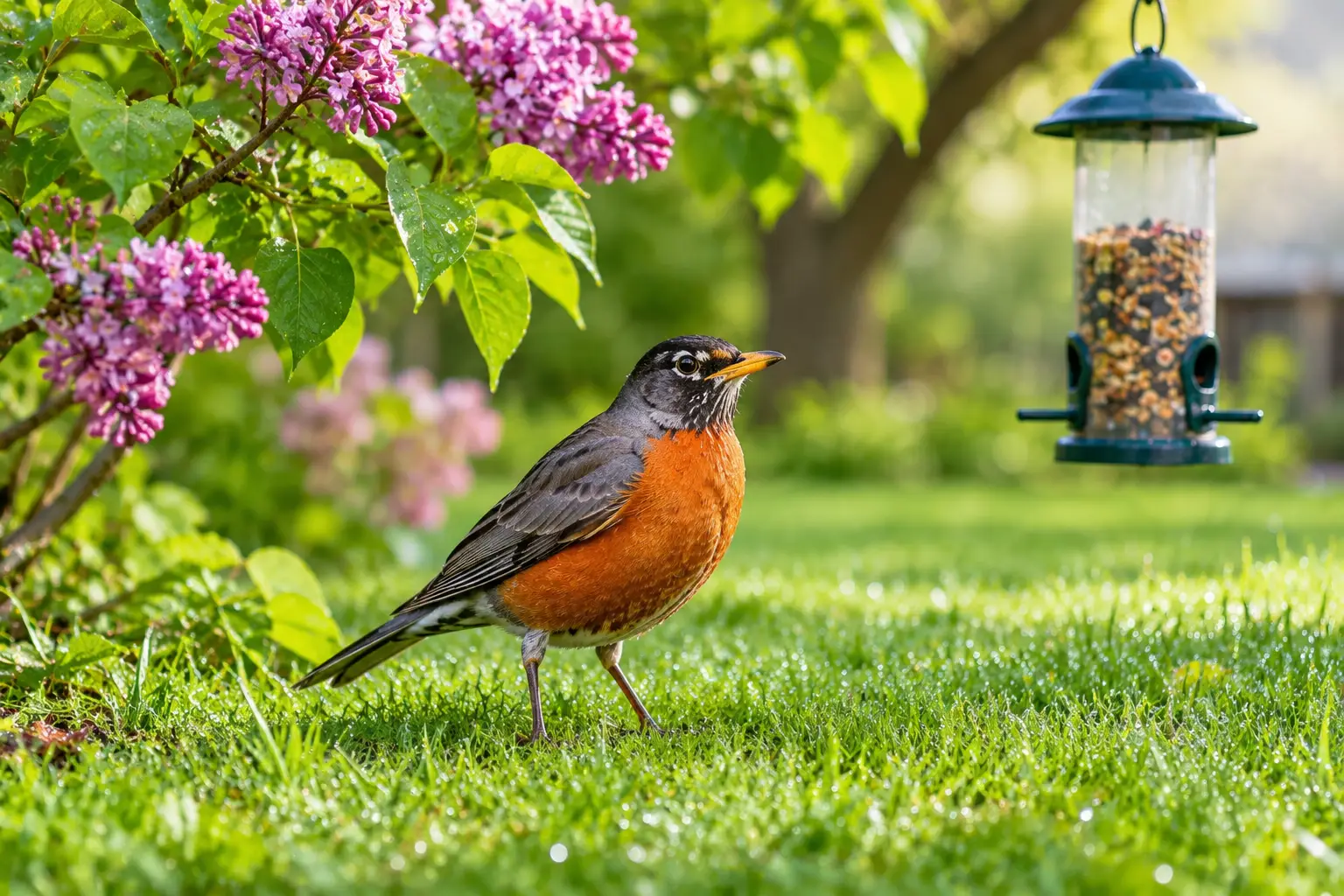
The American robin, Turdus migratorius, is a thrush, nearly twice the length and about four times the weight. Early English-speaking settlers gave it the old name because of its orange breast. Its real relatives in Europe are the blackbird and the song thrush.
1Which bird family does the American robin belong to?
Answer: The thrushes. The American robin is a thrush, in the same genus, Turdus, as the European blackbird. The European robin belongs to a different family, the Old World flycatchers.2Why did English-speaking settlers call the American bird a robin?
Answer: Its orange-red breast reminded them of the robin back home. Settlers reused a familiar name for a bird with a similar coloured breast. The two birds are not closely related and look quite different side by side.3Which is the larger bird, the American robin or the European robin?
Answer: The American robin. An American robin is roughly 20 to 28 cm long, about the size of a European blackbird. A European robin is only about 14 cm, small and round.4In Britain, the European robin is a familiar symbol of which time of year?
Answer: Christmas. Robins have appeared on British Christmas cards since Victorian times. They are easy to see in winter, when they sing and defend feeding territories.5Which of these European birds is the American robin's closest relative?
Answer: The common blackbird. The common blackbird and the American robin are both Turdus thrushes. Watch a blackbird running and pausing on a lawn and you will see the same hunting style.
| Feature | American robin | European robin |
|---|---|---|
| Scientific name | Turdus migratorius | Erithacus rubecula |
| Family | Thrushes (Turdidae) | Old World flycatchers (Muscicapidae) |
| Length | About 20 to 28 cm | About 14 cm |
| Colour | Grey-brown back, dark head, orange breast | Olive-brown back, orange-red face and breast, grey border |
| Where it lives | North America, wintering south to Mexico and Central America | Europe, western Asia and North Africa |
| Nest | A cup of grass and mud, often in a tree or on a ledge | A cup in a hollow, bank, wall or shed, often near the ground |
Round 2
Common backyard birds of North America
A typical feeder in the eastern United States or southern Canada might bring cardinals, chickadees, blue jays, mourning doves, American goldfinches and, in winter, dark-eyed juncos. Most of these stay all year, which is why feeders are busiest in the cold months.
Many North American songbirds differ by sex. Learning which partner is the brighter one, and how birds change colour between seasons, solves a lot of backyard puzzles.
6In northern cardinals, which bird is bright red all over?
Answer: The adult male. The male is red with a black face. The female is mostly warm brown with reddish tinges on the wings, tail and crest, and both have a thick orange-red bill.7Which small North American feeder bird is named after its call?
Answer: The chickadee. The black-capped chickadee calls a clear 'chick-a-dee-dee-dee'. Adding more 'dee' notes is thought to signal a bigger threat, such as a perched owl.8Which is the only hummingbird that regularly breeds in eastern North America?
Answer: The ruby-throated hummingbird. East of the Great Plains, nearly every breeding hummingbird is a ruby-throat. Anna's and rufous hummingbirds are western birds, and the bee hummingbird lives in Cuba.9What does a male American goldfinch look like in summer?
Answer: Bright yellow with black wings and a black forehead. In winter the male moults into dull olive-brown, so many people think their goldfinches have left. The European goldfinch is a different bird with a red face.10Which grey-brown bird gives a soft, sad-sounding cooing song and makes its wings whistle on take-off?
Answer: The mourning dove. The mourning dove's slow 'coo-OO-oo-oo-oo' is often mistaken for an owl. The whistle on take-off comes from its wings, not its voice.11Which crested blue North American bird is known for loud calls and for burying acorns?
Answer: The blue jay. Blue jays carry acorns away and bury them to eat later. The ones they never dig up can grow into new oak trees.12Which grey-and-white bird is nicknamed the snowbird because it turns up at many US feeders in winter?
Answer: The dark-eyed junco. Many juncos breed in northern and mountain forests and move south or downhill for winter. Look for the white outer tail feathers that flash when one flies off.
Tip: In summer, a sugar-water feeder (one part white sugar to four parts water, no dye) may bring hummingbirds. Change it every few days so it does not ferment.
Round 3
Common garden birds of Britain and Europe
In British and European gardens the regulars are blue tits, great tits, blackbirds, robins, wrens, dunnocks, chaffinches, goldfinches, house sparrows and starlings. Tits use nest boxes readily, which makes them easy to watch in spring.
Some of the most familiar birds have become less common. House sparrows and starlings have both declined in many British towns since the 1970s, so a garden count of either is still worth recording.
13Which small European garden bird has a blue cap, a yellow belly and white cheeks?
Answer: The blue tit. Blue tits are acrobats at feeders and nest boxes. The goldcrest is smaller still but olive-green, with a yellow or orange stripe on its crown.14How can you tell a great tit from a blue tit?
Answer: It has a black head and a black stripe down its yellow breast. Great tits are larger, with glossy black heads, white cheeks and a black 'tie' down the middle of the breast. Males have a wider tie than females.15Male common blackbirds are black with an orange-yellow bill. What colour is the female?
Answer: Brown. Female blackbirds are dark brown, often with a slightly mottled breast. Young blackbirds are brown and spotty too, which confuses many beginners.16Which tiny, loud European garden bird is brown and often cocks its short tail upright?
Answer: The wren. The Eurasian wren is one of Britain's smallest birds, yet its song is remarkably loud for its size. The upright tail is its best field mark.17Which European garden bird has a red face, a black-and-white head and bright yellow wing bars?
Answer: The European goldfinch. European goldfinches love seed heads such as teasel and thistle. They are a different species from the yellow American goldfinch.18How can you tell a male house sparrow from a female?
Answer: He has a grey crown and a black bib. Male house sparrows have a grey cap, chestnut sides to the head and a black bib. Females are plain brown with a pale stripe behind the eye.19What is the name for a huge, swirling evening flock of starlings?
Answer: A murmuration. In autumn and winter, thousands of starlings can twist across the sky before settling to roost. A charm is the word for a group of goldfinches.
Round 4
Birds on both sides of the Atlantic: starlings, sparrows and woodpeckers
Two of North America's commonest backyard birds are European in origin. House sparrows were introduced in the 1850s and European starlings in 1890, and both now compete with native birds for nest holes.
Woodpeckers live on both continents, but the species differ. North American yards get downy, hairy and red-bellied woodpeckers and northern flickers, while British gardens mainly get the great spotted woodpecker. The round ends with a feeding rule that applies everywhere.
20The European starling was released in which US city in 1890, starting its spread across North America?
Answer: New York City. About 100 starlings were released in Central Park in 1890 and 1891. Their descendants spread across the continent and are now among its most numerous birds.21Where is the house sparrow originally from?
Answer: Europe, Asia and North Africa. House sparrows were introduced to North America in the 1850s and spread quickly around farms and towns. They are not closely related to the native American sparrows.22Why do woodpeckers drum loudly on trees, and sometimes on metal gutters, in spring?
Answer: To claim a territory and attract a mate. Drumming is a woodpecker's song. A hollow branch or a metal gutter makes the message carry further, which is why some birds choose noisy surfaces.23Which is the smallest woodpecker in North America, and a common feeder visitor?
Answer: The downy woodpecker. Downy woodpeckers often visit suet feeders. The hairy woodpecker looks almost the same but is larger, with a much longer bill.24Which woodpecker is most often seen at garden feeders in Britain?
Answer: The great spotted woodpecker. The great spotted is black and white with red under the tail, and males have a red patch on the back of the head. Green woodpeckers feed on lawns, and black woodpeckers do not live in Britain.25Which bird food should never be put out for garden birds?
Answer: Salted or dry-roasted peanuts. Salt is harmful to birds. Plain peanuts should go in a mesh feeder in spring and summer so that chicks are not fed whole nuts they could choke on.
Tip: Clean feeders and bird baths regularly. Crowded, dirty feeders can spread diseases between birds.
Five more garden bird questions
A short review with new birds and new clues.
0 / 5 answered
1Which North American bird has a song often written as 'drink-your-tea'?
Answer: The eastern towhee. The eastern towhee is a large sparrow that scratches noisily in leaf litter. Its song is a clear 'drink-your-tea', with the last note trilled.2Which streaky brown European garden bird is often mistaken for a sparrow but has a thin bill?
Answer: The dunnock. The dunnock is sometimes called the hedge sparrow, but it is not a true sparrow. Its thin, insect-eater's bill is the quickest clue.3Which European garden bird has a pinkish breast, a blue-grey cap and two bold white wing bars in the male?
Answer: The chaffinch. The white wing bars show well when a chaffinch flies. Male bullfinches also have a rosy breast, but they have a black cap and a stubby bill.4What is the most reliable way to tell a hairy woodpecker from a downy woodpecker?
Answer: The hairy's bill is nearly as long as its head. The two are almost identical in pattern, and the males of both have a red patch. The downy's bill is much shorter, well under half the length of its head.5Why do American robins often vanish from lawns in winter even where they have not migrated?
Answer: They switch to eating fruit and gather in trees. Worms are hard to reach in frozen ground, so many robins form flocks that roam woods and berry bushes. They return to lawns when the soil softens in spring.
Frequently asked questions
Is the American robin the same as the European robin?
No. The American robin is a thrush, about 20 to 28 cm long, related to the European blackbird. The European robin is a much smaller Old World flycatcher, about 14 cm long. Settlers in North America simply reused the name because both birds have an orange breast. They differ in size, shape, song and nesting habits.
What are the most common backyard birds in North America?
Across much of the United States and southern Canada, the most widespread feeder visitors include the northern cardinal, mourning dove, American robin, dark-eyed junco, house finch, American goldfinch, blue jay, black-capped or Carolina chickadee, downy woodpecker and the introduced house sparrow and European starling. Exactly which ones you see depends on your region, habitat and the season.
What are the most common garden birds in the UK?
House sparrows, starlings, blue tits, woodpigeons, blackbirds, robins, goldfinches, great tits, magpies and long-tailed tits are regularly among the most counted birds in the RSPB's Big Garden Birdwatch. The house sparrow has topped that count for many years in a row, even though its numbers have fallen since the 1970s.
How can I attract more birds to my garden?
Offer a mix of foods, such as sunflower hearts, nyjer seed and suet, and keep feeders clean. Provide fresh water in a shallow bath. Plant native shrubs and leave some seed heads and leaf litter for insects. Put up nest boxes before spring, and place feeders where cats cannot ambush birds from cover.
How do I identify the birds in my backyard?
Note the bird's size against a familiar bird, its shape, its bill and its main colours, then where and how it feeds. Compare these with a regional field guide or a site such as the Cornell Lab's All About Birds. To get faster, practise with real photos: the Birds Quiz app has rounds that train you to recognise common garden birds at a glance.
Know the regulars first
Most garden birdwatching starts with ten or fifteen common species. Learn the robin mix-up, which sex is brighter, and the few introduced birds, and the unusual visitors will stand out when they arrive.
- Spend ten minutes a week counting the birds at your feeder or on your lawn.
- Learn one look-alike pair at a time, such as downy and hairy woodpeckers or blue and great tits.
- Test yourself with the photo rounds in Birds Quiz.
Check the evidence behind the guide
Use these references to check terminology and pursue a topic in more depth. Photo quizzes help you practise observation; a single picture rarely proves a difficult identification.
When a source describes a broad group, compare its details with the exact species, model or specimen you are studying. Record the feature that supports your answer rather than relying on a name alone.