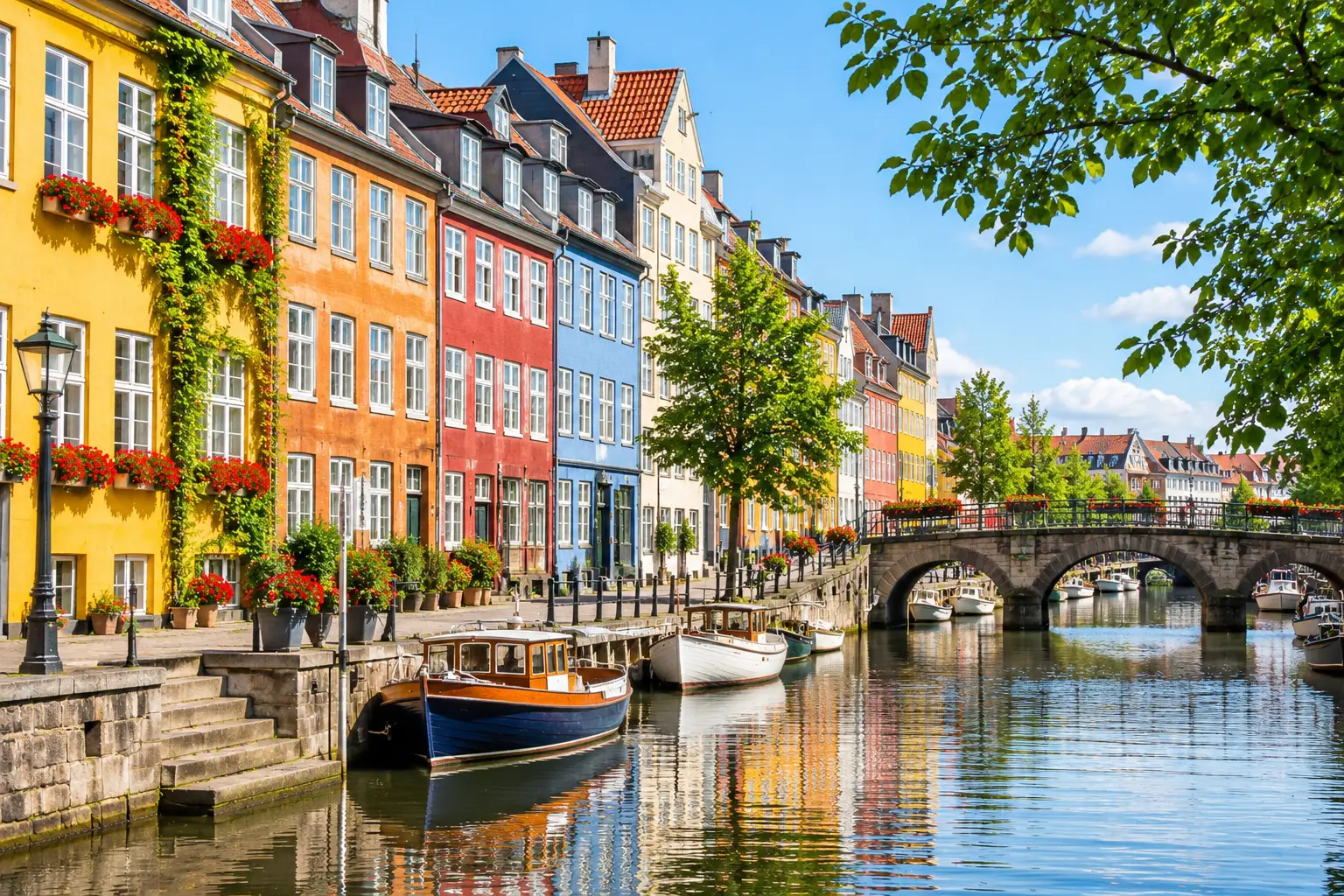
Europe has a large share of the World Heritage List, and its best-known sites are old town centres, palaces, cathedrals and a few spectacular landscapes. Famous examples include Venice, the Historic Centre of Rome, the Alhambra in Granada, Versailles, Prague, the Acropolis and the West Norwegian Fjords.
This guide picks 20 highlights and gives the year each was inscribed. It groups them by type so you can see why UNESCO listed them, and it ends with tips for visiting. Years come from the World Heritage List; where a site was later extended, the first year is shown.
Quick takeaways
- Many European listings cover a whole historic centre rather than a single building.
- Kraków, Poland's old royal capital, was among the first twelve sites ever inscribed, in 1978.
- Europe's natural sites include glaciers, fjords, lakes and basalt coasts as well as mountains.
- New sites are still added: Ludwig II's Bavarian palaces joined in 2025 and Mount Olympus in 2026.
Old towns
Which European cities are World Heritage Sites?
In Europe, UNESCO often lists an entire historic centre. The Historic Centre of Rome, inscribed in 1980 and extended in 1990 to the Holy See's properties in the city, takes in the Forum, the Colosseum, the Pantheon and many churches. Vatican City is a separate World Heritage Site. Florence followed in 1982, recognised as the city where the Renaissance took shape, with Brunelleschi's cathedral dome, the Uffizi and the Ponte Vecchio.
Venice and its Lagoon, inscribed in 1987, is unusual because the listing includes the water as well as the city. Venice is built on more than a hundred small islands linked by bridges, and the lagoon's islands, marshes and channels are part of the site. Prague's historic centre, inscribed in 1992, keeps Prague Castle, the Charles Bridge and an Old Town Square lined with medieval and baroque buildings.
Kraków was one of the very first sites ever inscribed, in 1978, alongside the nearby Wieliczka Salt Mine. Its main square is one of the largest medieval town squares in Europe. Dubrovnik, on the Croatian coast, was inscribed in 1979 for its complete ring of city walls. It was damaged by shelling in 1991 and has since been restored.
Other cities on the list include Budapest (1987), Edinburgh's Old and New Towns (1995), the City of Bath (1987) and Amsterdam's canal ring, added in 2010. The Amsterdam listing covers the semicircle of canals dug in the 17th century, when the city was one of the richest ports in the world.
Whole cities, not single buildings
Listing a historic centre protects streets, squares and skylines as well as the famous monuments.
Vatican City is separate
Vatican City has its own listing from 1984, while Holy See properties elsewhere in Rome were added to the Rome site in 1990.
Palaces and churches
Famous palaces, castles and cathedrals
The Palace and Park of Versailles, inscribed in 1979, was the seat of French royal power from 1682 until the Revolution. Louis XIV turned his father's hunting lodge into a palace with the Hall of Mirrors and formal gardens laid out by André Le Nôtre. Its style was copied by courts across Europe.
The Alhambra in Granada, inscribed in 1984, was the palace city of the Nasrid dynasty, the last Muslim rulers in Spain. The listing was extended in 1994 to include the Albayzín, the old Moorish quarter on the facing hill. Gaudí's buildings in Barcelona, first listed in 1984 and extended in 2005, include Park Güell, Casa Milà, Casa Batlló and the Nativity facade and crypt of the Sagrada Família.
Cologne Cathedral, inscribed in 1996, took more than 600 years to finish: work began in 1248 and the towers were completed in 1880, following the medieval plans. The Palace of Westminster and Westminster Abbey (1987) and the Tower of London (1988) are two of the United Kingdom's best-known cultural sites.
The newest palace listing is The Palaces of King Ludwig II of Bavaria, added in 2025. It covers Neuschwanstein, Linderhof, Herrenchiemsee and the royal house on the Schachen, all built in the late 19th century as romantic stage sets for a king who preferred dreams to politics.
| Site | Country | Inscribed |
|---|---|---|
| Historic Centre of Kraków | Poland | 1978 |
| Palace and Park of Versailles | France | 1979 |
| Mont-Saint-Michel and its Bay | France | 1979 |
| Old City of Dubrovnik | Croatia | 1979 |
| Plitvice Lakes National Park | Croatia | 1979 |
| Historic Centre of Rome | Italy and the Holy See | 1980 |
| Historic Centre of Florence | Italy | 1982 |
| Alhambra, Generalife and Albayzín, Granada | Spain | 1984 |
| Works of Antoni Gaudí | Spain | 1984 |
| Giant's Causeway and Causeway Coast | United Kingdom | 1986 |
| Venice and its Lagoon | Italy | 1987 |
| Acropolis, Athens | Greece | 1987 |
| Meteora | Greece | 1988 |
| Paris, Banks of the Seine | France | 1991 |
| Historic Centre of Prague | Czechia | 1992 |
| Cologne Cathedral | Germany | 1996 |
| Swiss Alps Jungfrau-Aletsch | Switzerland | 2001 |
| West Norwegian Fjords: Geirangerfjord and Nærøyfjord | Norway | 2005 |
| Seventeenth-century canal ring area of Amsterdam | Netherlands | 2010 |
| The Palaces of King Ludwig II of Bavaria | Germany | 2025 |
Ancient sites
Ancient and sacred sites in Europe
Greece has some of the oldest sites in Europe. The Acropolis of Athens was inscribed in 1987, the same year as Delphi, the sanctuary of Apollo where Greeks came to consult the oracle. Meteora, inscribed in 1988, is a mixed site: Orthodox monasteries perch on top of huge sandstone pillars in Thessaly, combining remarkable geology with centuries of monastic life.
Mont-Saint-Michel and its Bay, inscribed in 1979, is a Benedictine abbey on a rocky tidal island off Normandy. The bay has some of the largest tides in Europe, and for centuries pilgrims had to time their crossing of the sands carefully. Chartres Cathedral, inscribed the same year, is famous for its medieval stained glass.
In Italy, Pisa's Piazza del Duomo (1987) groups the cathedral, the baptistery, the cemetery and the leaning bell tower on one lawn. Pompeii and Herculaneum, buried by Vesuvius in AD 79, were inscribed together with Torre Annunziata in 1997.
Some sacred sites are still in active use. Mount Athos in northern Greece, inscribed in 1988 as a mixed site, is a self-governing community of Orthodox monasteries that women are not allowed to enter. The Routes of Santiago de Compostela in Spain, listed in 1993 and extended since, follow the medieval pilgrim paths to the shrine of St James, and thousands of walkers still finish the Camino in Santiago each year.
Tip: Mont-Saint-Michel's tides change daily. Check the tide times before you walk out on the sands, and never cross the bay without a guide.
Natural sites
Natural World Heritage Sites in Europe
Plitvice Lakes National Park in Croatia, inscribed in 1979, is a chain of lakes stepped down a valley and joined by waterfalls. The barriers between the lakes are made of travertine, a rock that builds up as minerals settle out of the water around moss and algae, so the landscape is still slowly changing.
The Giant's Causeway in Northern Ireland, inscribed in 1986, is a coast of roughly 40,000 interlocking basalt columns, most of them six-sided. They formed as a thick lava flow cooled and cracked about 50 to 60 million years ago. Legend says the giant Finn McCool built them as a path to Scotland.
Switzerland's Jungfrau-Aletsch area, inscribed in 2001 and enlarged in 2007, contains the Aletsch Glacier, the largest glacier in the Alps. Norway's Geirangerfjord and Nærøyfjord, inscribed in 2005, are classic fjords: deep, narrow inlets carved by glaciers, with steep walls and waterfalls dropping straight into the sea. The Dolomites in northern Italy were listed in 2009 for their pale, jagged limestone peaks.
Europe's newest mixed site is the wider area of Mount Olympus in Greece, inscribed in 2026. It is listed both for its mountain landscape and plant life and for its place in Greek myth as the home of the gods.
Travertine dams
Plitvice's lakes are held back by natural mineral barriers that keep growing.
Basalt columns
The Giant's Causeway formed when lava cooled and cracked into mostly six-sided columns.
Glaciers and fjords
Jungfrau-Aletsch shows glaciers at work today; the Norwegian fjords show what they carved in the past.
Planning a visit
How to visit Europe's heritage sites well
The busiest sites, such as Venice, the Alhambra, Versailles and the Acropolis, are crowded in summer. Book timed tickets where they exist; the Alhambra's Nasrid Palaces in particular admit visitors only at set times. Early mornings and the shoulder seasons of spring and autumn are calmer and cooler.
Many listed old towns are lived-in cities, not museums. Respect local rules on where to walk, sit and photograph, and use public transport where you can. Several cities, including Venice, now charge day-trippers fees or limit tour groups at peak times, so check the rules before you go.
To learn the sites rather than just tick them off, read the short description on each site's UNESCO page. It explains which criteria the site meets and what UNESCO thinks makes it outstanding, which is often not the thing tourists photograph.
If you have limited time, cluster sites that sit close together. Florence, Pisa and Siena are all short train rides apart in Tuscany. Prague, Český Krumlov and Kutná Hora can be combined in a few days in Czechia, and Dubrovnik, Split and Plitvice make a natural route down the Croatian coast.
Check your European heritage
Four questions on the sites in this guide.
0 / 4 answered
1Which Polish city was among the first twelve World Heritage Sites in 1978?
Answer: Kraków. Kraków's historic centre was inscribed in the first group, along with the nearby Wieliczka Salt Mine.2Which glacier, the largest in the Alps, is part of a Swiss World Heritage Site?
Answer: The Aletsch Glacier. It lies in the Swiss Alps Jungfrau-Aletsch site, inscribed in 2001.3What are the Giant's Causeway's columns made of?
Answer: Basalt. They formed when a lava flow cooled and cracked about 50 to 60 million years ago.4Which Greek site has monasteries on top of huge rock pillars?
Answer: Meteora. Meteora is a mixed site, inscribed in 1988 for both its geology and its monastic heritage.
Frequently asked questions
What was the first World Heritage Site in Europe?
Europe had several sites in the very first group inscribed in 1978. They included the Historic Centre of Kraków and the Wieliczka Salt Mine in Poland, and Aachen Cathedral in Germany. Twelve sites worldwide were listed that year, also including the Galápagos Islands, Yellowstone and the rock-hewn churches of Lalibela in Ethiopia.
Is Venice a UNESCO World Heritage Site?
Yes. Venice and its Lagoon was inscribed in 1987. The site covers the historic city and the surrounding lagoon, with its islands, marshes and channels, because UNESCO sees the city and its watery setting as one landscape. The main pressures on the site include mass tourism, rising water levels and large ships.
Is Neuschwanstein Castle a World Heritage Site?
Yes, since 2025. Neuschwanstein was inscribed together with Linderhof, Herrenchiemsee and the royal house on the Schachen as The Palaces of King Ludwig II of Bavaria. The king built them in the late 19th century as romantic retreats. Before 2025 Neuschwanstein was famous but not on the list.
Can a whole city be a World Heritage Site?
Usually it is a historic part of a city rather than the whole modern city. Listings such as the Historic Centre of Rome, Prague and Florence protect old streets, squares and skylines as well as single monuments. Venice is unusual because the lagoon around it is included too. Modern suburbs and new districts are normally outside the boundary.
How can I remember Europe's World Heritage Sites?
Group them by type: old towns, palaces, cathedrals, ancient sites and natural landscapes. Then attach one detail to each, such as Cologne Cathedral taking more than 600 years to finish or Plitvice's lakes being held back by travertine. Practising with photos helps too, and World Heritage Sites Quiz has landmark rounds for testing yourself.
Old towns, palaces and wild places
Europe's World Heritage Sites are dominated by historic cities and great buildings, but its natural sites, from Plitvice to the Norwegian fjords, are just as remarkable. Learning each site's type and one key detail makes the list manageable.
- Pick the five sites in this guide you know least and read their UNESCO pages.
- Sort the 20 highlights into cities, buildings, ancient sites and natural sites.
- Test your recognition of European landmarks in World Heritage Sites Quiz.
Check the evidence behind the guide
Use these references to check terminology and pursue a topic in more depth. Photo quizzes help you practise observation; a single picture rarely proves a difficult identification.
Each UNESCO listing page gives the year of inscription, the criteria it meets and a short description. Check those details rather than relying on a travel photo alone.