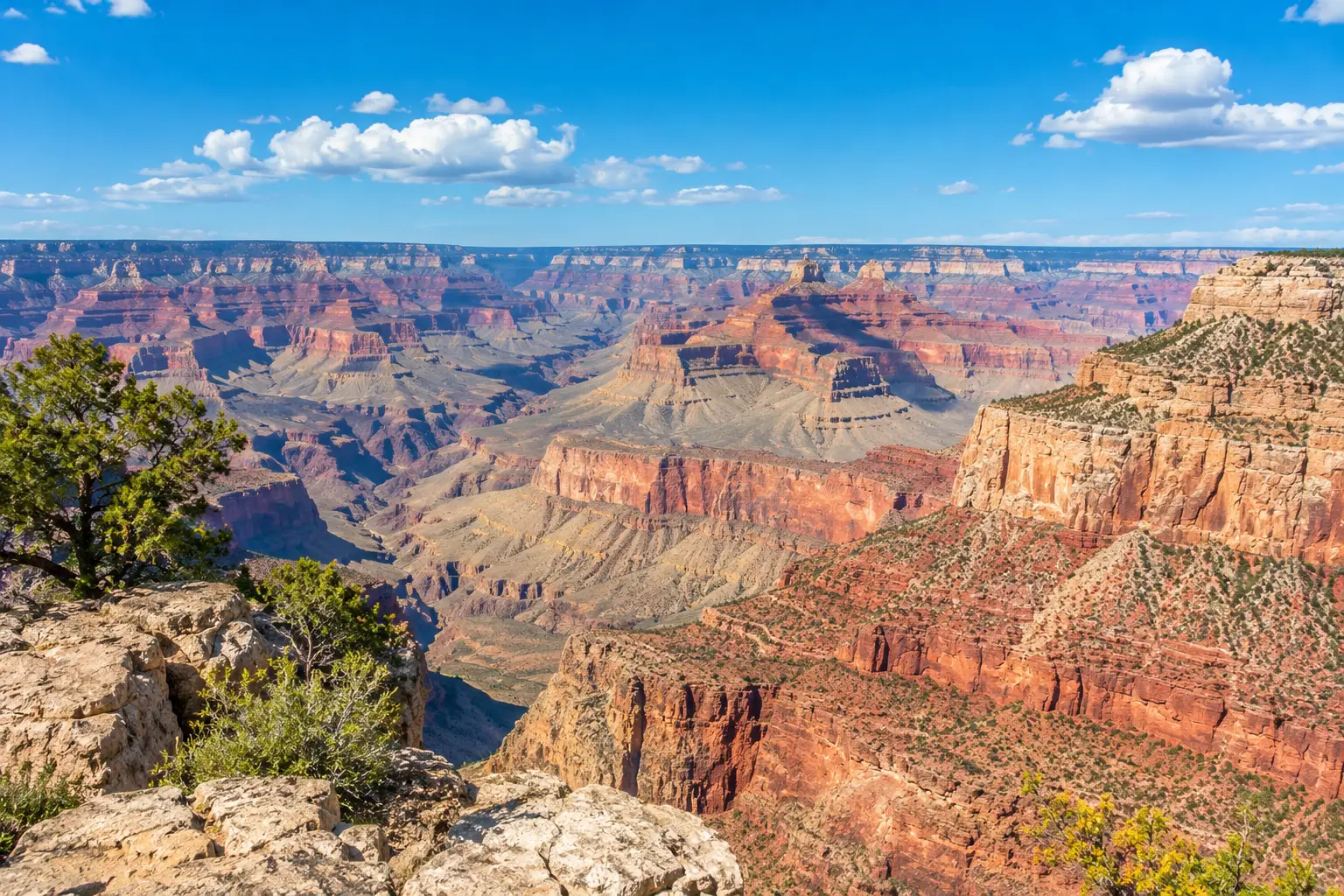
About a fifth of World Heritage Sites are listed for their nature rather than their buildings. They include reefs, canyons, volcanoes, forests and wild islands.
Natural sites must meet at least one of four criteria: exceptional natural beauty, a record of Earth's history, important ongoing ecological processes or vital habitat for biodiversity.
The first natural sites
The Galápagos Islands of Ecuador and Yellowstone National Park in the United States were both among the first sites inscribed in 1978.
The Galápagos helped Charles Darwin develop his ideas about evolution. Yellowstone, the world's first national park, sits on a vast volcanic system with geysers and hot springs.
Canyons, falls and bays
The Grand Canyon, inscribed in 1979, exposes nearly two billion years of rock layers carved by the Colorado River.
Victoria Falls on the Zambezi, inscribed in 1989, is one of the world's greatest waterfalls. Ha Long Bay in Vietnam, inscribed in 1994, has around 1,600 limestone islands and islets.
Reefs, plains and mixed sites
The Great Barrier Reef in Australia, inscribed in 1981, is the largest coral reef system on Earth. The Serengeti National Park in Tanzania, inscribed the same year, hosts the great migration of wildebeest and zebra.
Some places are listed for both nature and culture. Uluru-Kata Tjuta in Australia is a mixed site, sacred to the Anangu people and remarkable for its rock formations.
| Site | Country | Known for |
|---|---|---|
| Galápagos Islands | Ecuador | Unique wildlife, evolution |
| Yellowstone | United States | Geysers, volcanic system |
| Grand Canyon | United States | Rock layers, erosion |
| Great Barrier Reef | Australia | Coral reef system |
| Serengeti | Tanzania | Wildebeest migration |
| Ha Long Bay | Vietnam | Limestone islands |
Name the natural site
0 / 4 answered
1Which river carved the Grand Canyon?
Answer: Colorado River. The Colorado has cut down through the rock for millions of years.2Which park was the world's first national park?
Answer: Yellowstone. Yellowstone was established in 1872.3Which Tanzanian site is known for the great wildebeest migration?
Answer: Serengeti National Park. Over a million wildebeest move through the Serengeti each year.4Which Australian site is listed for both nature and culture?
Answer: Uluru-Kata Tjuta. It is sacred to the Anangu people.
Frequently asked questions
Are natural sites under threat?
Yes. Climate change, mining, tourism and poaching threaten many natural sites. The Great Barrier Reef, for example, has suffered repeated coral bleaching.
Four natural criteria
Beauty, Earth's history, living processes and biodiversity. Matching each natural site to one of those four makes it easier to remember why it was listed.
Check the evidence behind the guide
Use these references to check terminology and pursue a topic in more depth. Photo quizzes help you practise observation; a single picture rarely proves a difficult identification.
Each UNESCO listing page gives the year of inscription, the criteria it meets and a short description. Check those details rather than relying on a travel photo alone.