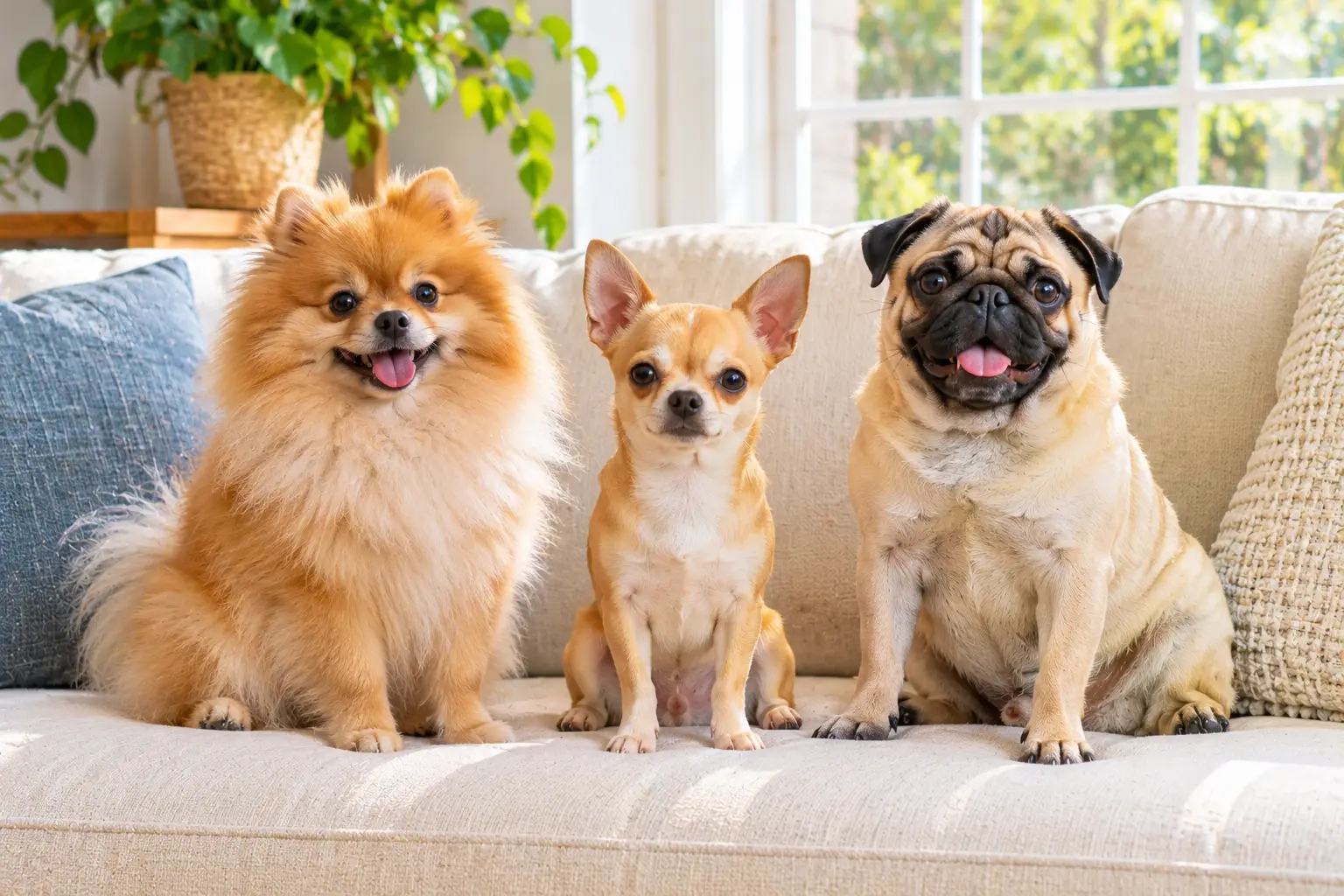
Small dog breeds are those that usually weigh under about 10 to 13 kg (22 to 30 lb) as adults, from the tiny Chihuahua at no more than about 2.7 kg to the sturdier French Bulldog and Dachshund. The most popular include the Chihuahua, Pomeranian, Yorkshire Terrier, Shih Tzu, Dachshund, Pug, Cavalier King Charles Spaniel, Maltese, Papillon and French Bulldog.
This guide compares twelve of them by where they come from, how much they weigh under the American Kennel Club (AKC) breed standard and what kind of coat they have. It also covers the health points that matter most in small breeds, and how to choose one that suits your home.
Quick takeaways
- Many toy breeds weigh under 4 kg; small breeds from other groups can reach 10 to 14 kg.
- Flat-faced breeds such as the Pug and French Bulldog are prone to breathing problems and overheating.
- Long-backed Dachshunds are at risk of spinal disc disease, and Cavaliers of heart valve disease.
- Small dogs generally live longer than large dogs, often well into their teens.
What counts as a small dog breed?
There is no official cut-off for a small dog. Most guides count breeds that weigh up to roughly 10 to 13 kg (22 to 30 lb) as small, and the very smallest as toy breeds. The AKC places many of these in its Toy Group, which was created for dogs bred mainly as companions.
Plenty of small breeds sit in other groups, though, because they were bred for a job. The Dachshund is in the Hound Group because it hunted badgers. The Miniature Schnauzer is a terrier, bred to catch rats on farms. The French Bulldog and Boston Terrier are in the Non-Sporting Group, which holds breeds that fit nowhere else.
The weights in this guide come from AKC breed standards. Standards describe the ideal show dog, so real pet dogs can fall outside the range, and other kennel clubs, such as the UK Kennel Club and the FCI, sometimes give different figures. Treat the numbers as a guide to the breed's usual size, not a target for your dog.
Small dog breeds at a glance: origin, weight and coat
The table lists twelve popular small breeds. Origins are where the breed was developed; some, like the Pug and Maltese, have histories so old that the exact starting point is uncertain. Weights are AKC standard figures, with metric conversions rounded.
Coat type matters as much as size when you live with a dog. A smooth coat needs a quick weekly brush, while a long silky coat like the Maltese's or Yorkshire Terrier's needs daily care or regular clipping.
Four of the breeds in the table have no section of their own below. The Shih Tzu, the lion dog of Chinese palaces, is calm and affectionate and was bred purely as a companion. The Cavalier King Charles Spaniel is gentle and eager to please. The Boston Terrier, one of the few breeds developed in the United States, is lively, friendly and nicknamed the American Gentleman for its black and white tuxedo coat. The Miniature Schnauzer, a farm ratter from Germany, is alert, sturdy and quick to bark at visitors.
| Breed | Origin | Typical weight (AKC) | Coat | AKC group |
|---|---|---|---|---|
| Chihuahua | Mexico | Not more than 6 lb (about 2.7 kg) | Smooth or long | Toy |
| Pomeranian | Pomerania region (now Germany and Poland); miniaturised in Britain | 3 to 7 lb (about 1.4 to 3.2 kg) | Thick double coat with a fluffy ruff | Toy |
| Yorkshire Terrier | Yorkshire, England | Up to 7 lb (about 3.2 kg) | Long, silky, hair-like; steel blue and tan | Toy |
| Maltese | Mediterranean, linked with Malta | Under 7 lb (about 3.2 kg) | Long, silky, white single coat | Toy |
| Papillon | France and Belgium | 5 to 10 lb (about 2.3 to 4.5 kg) | Long, silky single coat; fringed ears | Toy |
| Shih Tzu | China | 9 to 16 lb (about 4 to 7.3 kg) | Long, dense double coat | Toy |
| Pug | China | 14 to 18 lb (about 6.4 to 8.2 kg) | Short, smooth; fawn or black | Toy |
| Cavalier King Charles Spaniel | England | 13 to 18 lb (about 5.9 to 8.2 kg) | Silky, medium length with feathering | Toy |
| Dachshund | Germany | Miniature 11 lb and under (about 5 kg); standard 16 to 32 lb (about 7.3 to 14.5 kg) | Smooth, wirehaired or longhaired | Hound |
| French Bulldog | France, from English toy bulldogs | Under 28 lb (about 12.7 kg) | Short, smooth | Non-Sporting |
| Boston Terrier | Boston, United States | 12 to 25 lb (about 5.4 to 11.3 kg) | Short, smooth; tuxedo markings | Non-Sporting |
| Miniature Schnauzer | Germany | 11 to 20 lb (about 5 to 9 kg) | Wiry double coat | Terrier |
The tiniest toy breeds: Chihuahua, Pomeranian, Yorkie, Maltese and Papillon
The Chihuahua is the smallest recognised breed, named after the Mexican state of Chihuahua. It is thought to descend from an older Mexican dog called the Techichi. Chihuahuas come in smooth and long coats and almost any colour, and they tend to bond closely with one person. Their small size makes them sensitive to cold and easy to injure if dropped or stepped on.
The Pomeranian is a spitz breed, a miniature cousin of larger sled and herding spitz dogs from the Baltic region of Pomerania. Queen Victoria helped make small Pomeranians fashionable in the 1800s. The Yorkshire Terrier was developed in northern England in the same century, partly to catch rats in mills and mines. Under its silky coat it is still a bold, busy terrier.
The Maltese is one of the oldest toy breeds, kept as a lapdog around the Mediterranean since ancient times. Its pure white coat has no undercoat, so it sheds little but mats easily. The Papillon takes its name from the French word for butterfly, after its large fringed ears. Papillons with drooping ears are called Phalènes, French for moths. Papillons are lively and quick to learn, and often do well in agility.
Smallest breed
The Chihuahua's AKC standard sets a maximum of 6 lb (about 2.7 kg).
Butterfly ears
Papillon means butterfly in French; the drop-eared form is the Phalène.
Spitz in miniature
The Pomeranian shares its curled tail and thick coat with large spitz breeds.
No undercoat
The Maltese and Yorkshire Terrier have hair-like coats that shed little but need regular grooming.
Flat faces, long backs and other health points to know
Some of the most popular small breeds have short muzzles and flat faces. Vets call them brachycephalic. The Pug, French Bulldog, Shih Tzu and Boston Terrier all fall into this group to some degree. Their shortened airways can cause snoring, noisy breathing and, in more severe cases, a condition called brachycephalic obstructive airway syndrome (BOAS). These dogs overheat quickly, so they need shade, water and gentle exercise in warm weather.
The Pug came from China and was brought to Europe by Dutch traders. The French Bulldog was developed in France in the 1800s from small English bulldogs taken there by lace workers. Both are cheerful, comic companions, but buyers should look for breeders who health-test and choose dogs with more open nostrils.
The Dachshund's long back and short legs, bred so it could follow badgers underground, put it at risk of intervertebral disc disease (IVDD), where a spinal disc bulges or ruptures. Keeping a Dachshund lean and limiting jumping off furniture helps. The Cavalier King Charles Spaniel, a gentle breed named after King Charles II and rebuilt in the 1920s from old painting types, has a high rate of mitral valve disease, a heart condition, so regular heart checks matter.
Across almost all toy breeds, dental disease is common because many teeth are packed into a small jaw. Small kneecaps that slip out of place, called luxating patellas, also turn up often. Daily tooth brushing and a vet check before buying help with both.
Tip: Ask a breeder for the health tests used for that breed, such as heart checks for Cavaliers or breathing assessments for flat-faced breeds, and ask to see the results.
How to choose a small breed for your home
Start with energy, not looks. Papillons, Miniature Schnauzers and Yorkshire Terriers are active and enjoy long walks and games. Pugs, Shih Tzus and Cavaliers are happier with shorter outings and plenty of company. A Dachshund was bred to hunt and can be stubborn and vocal.
Think about grooming next. Smooth coats such as the Chihuahua's, Pug's and French Bulldog's need little more than a weekly brush, although Pugs shed a lot. Long coats on the Maltese, Shih Tzu and Yorkshire Terrier need daily brushing or a short clip every few weeks. No breed is truly hypoallergenic, but low-shedding coats leave less hair around the house.
Small does not always mean good with small children. The tiniest toy breeds can be hurt by rough handling, and a frightened small dog may snap. Sturdier small breeds such as the Cavalier, Boston Terrier and Miniature Schnauzer often cope better in busy homes. Whatever you choose, training and early socialising matter just as much for a 3 kg dog as for a 30 kg one.
Finally, plan for a long life. Small dogs generally live longer than large breeds, and many reach their mid-teens, so a small dog is a commitment of well over a decade.
Check your small breed knowledge
Four quick questions on the breeds in this guide.
0 / 4 answered
1What does the French word 'papillon' mean?
Answer: Butterfly. The Papillon is named after its large fringed ears. The drop-eared form is called the Phalène, meaning moth.2Which small breed is in the AKC Hound Group?
Answer: Dachshund. The Dachshund was bred to hunt badgers, so the AKC places it with the hounds rather than the toy breeds.3What does 'brachycephalic' describe in breeds such as the Pug and French Bulldog?
Answer: A short muzzle and flattened face. The shortened skull and airway can make breathing harder and cause dogs to overheat in warm weather.4Which king is the Cavalier King Charles Spaniel named after?
Answer: Charles II. Charles II was famous for his toy spaniels, which appear in many paintings from his reign.
Frequently asked questions
What is the smallest dog breed?
The Chihuahua is generally regarded as the smallest dog breed. The AKC breed standard says a Chihuahua should weigh no more than 6 lb, about 2.7 kg, and many stand only around 13 to 20 cm at the shoulder. Other very small breeds include the Pomeranian, Yorkshire Terrier and Maltese, which all usually weigh under about 3.2 kg.
Which small dog breeds shed the least?
Low-shedding small breeds include the Maltese and Yorkshire Terrier, whose hair-like coats have no undercoat, and the Shih Tzu and Miniature Schnauzer, whose coats hold loose hair until brushed. They still need regular brushing and trimming because loose hair stays in the coat and can mat. No breed is completely hypoallergenic, so anyone with allergies should spend time with the breed before deciding.
Are small dogs good with children?
Some are. Sturdier small breeds such as the Cavalier King Charles Spaniel, Boston Terrier and Miniature Schnauzer often do well with sensible children. The tiniest toy breeds, such as the Chihuahua, can be injured by rough play or a fall and may snap when frightened. Adults should supervise and teach children to sit on the floor to hold small dogs.
Do small dogs live longer than big dogs?
Generally, yes. Small breeds often live into their mid-teens, while many giant breeds live under ten years. Lifespan still varies by breed and health. Flat-faced breeds and Cavaliers face specific health risks, so choosing a breeder who health-tests matters as much as choosing a small breed if you want a long-lived companion.
How can I tell similar small breeds apart?
Look at the coat and the face first. A Maltese is pure white with a silky coat, while a Shih Tzu has a flatter face and comes in many colours. A Pomeranian has a fox-like face and fluffy ruff, and a Papillon has large fringed butterfly ears. Dogs Quiz lets you practise with real photos until the differences become automatic.
Small size, big differences
Small breeds range from 2 kg Chihuahuas to 14 kg standard Dachshunds, with very different coats, energy levels and health risks. Compare those three things, not just size, before choosing one.
- Use the table to shortlist breeds by weight and coat.
- Check the main health risk for each breed and ask breeders for test results.
- Practise telling small breeds apart from photos in Dogs Quiz.
Check the evidence behind the guide
Use these references to check terminology and pursue a topic in more depth. Photo quizzes help you practise observation; a single picture rarely proves a difficult identification.
When a source describes a broad group, compare its details with the exact species, model or specimen you are studying. Record the feature that supports your answer rather than relying on a name alone.