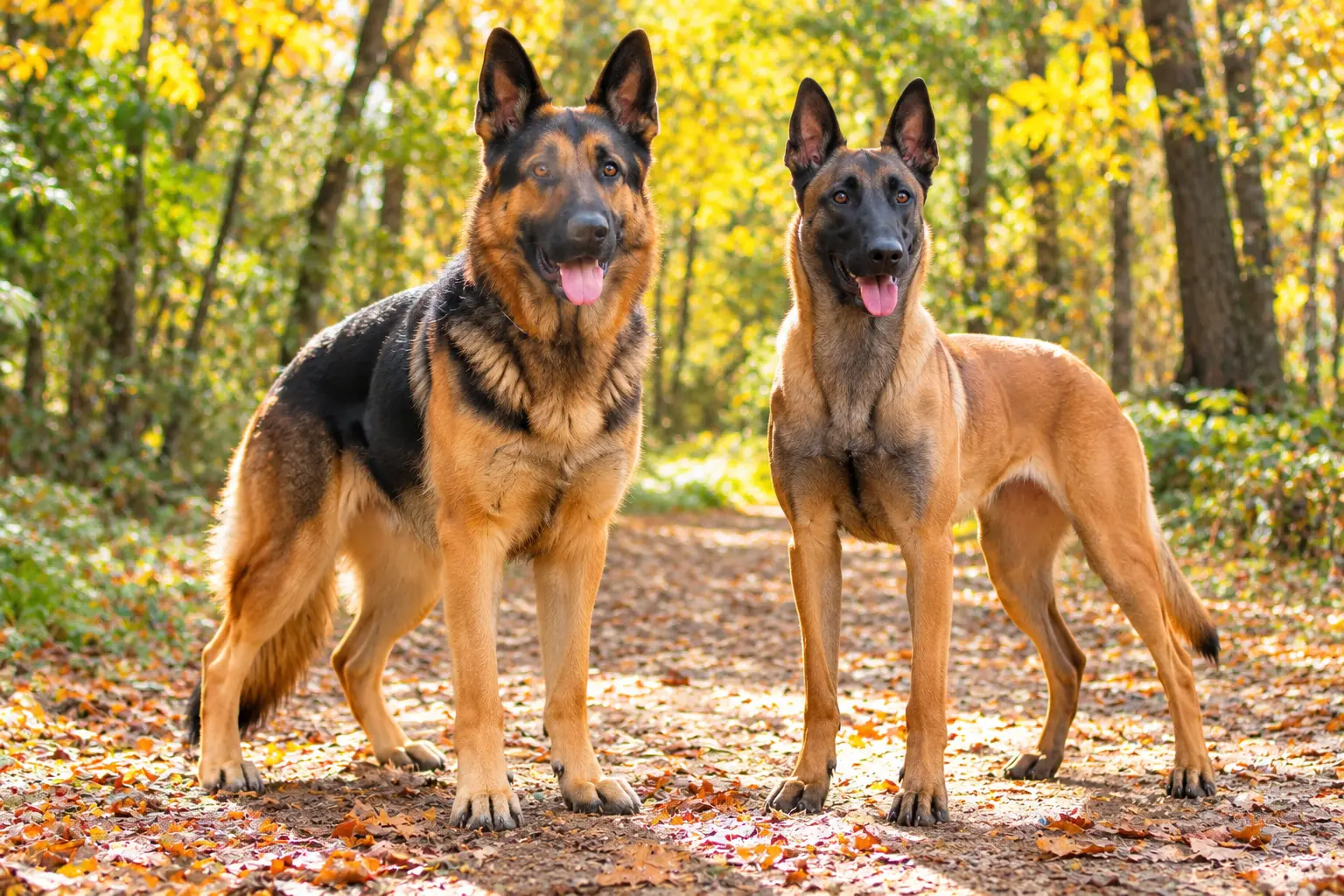
The German Shepherd and Belgian Malinois are both shepherd dogs with upright ears and similar heights, but the Malinois is lighter, squarer and short-coated, while the German Shepherd is heavier, longer in the body and has a thicker double coat. The Malinois also has even more energy and drive, which is why it suits experienced handlers and working roles better than most family homes.
The two breeds are often confused because a fawn Malinois with a black mask can look like a short-coated German Shepherd. They are separate breeds from different countries, and the differences matter if you are thinking of living with one.
Quick takeaways
- Both breeds stand about 22 to 26 inches at the shoulder, but the Malinois is lighter.
- The Malinois has a short fawn to mahogany coat with a black mask; the German Shepherd has a medium-length double coat, often black and tan.
- The Malinois has extreme drive and is now the favourite of many police and military units.
- The German Shepherd usually adapts better to family life, given enough training and exercise.
Where do the German Shepherd and Belgian Malinois come from?
The German Shepherd was created as a breed in 1899, when cavalry officer Max von Stephanitz registered a dog called Horand von Grafrath and founded the breed club. He wanted one ideal working shepherd dog for Germany, combining intelligence, strength and obedience. As farming changed, he promoted the breed for police and military work, and it spread fast.
The Belgian Malinois takes its name from Malines, the French name for the city of Mechelen in Belgium, where the short-coated type was common. In the 1890s Belgian breeders sorted their local shepherd dogs into types by coat. Four emerged: the Malinois, the Groenendael, the Tervuren and the Laekenois. The FCI still treats them as one breed in four varieties, while the AKC recognises each as a separate breed.
So the Malinois is not a type of German Shepherd, and it is not a cross. The two breeds are cousins in the sense that both come from the working shepherd dogs of north-west Europe, but each was developed separately.
How to tell a Malinois from a German Shepherd: looks and size
The quickest clue is the coat. A Belgian Malinois has a short, straight, weather-resistant coat in fawn to mahogany, with black tips to the hairs and a black mask on the face and black ears. A German Shepherd has a medium-length double coat with a dense undercoat. Black and tan and black and red saddle patterns are the most familiar, but sable and solid black are common too. Some German Shepherds have a long coat, and white coats are a disqualification under the AKC standard.
Next, look at the outline. The Malinois is square, with its body length about equal to its height, and it looks light, elegant and springy. The German Shepherd is longer than it is tall, with more bone and a heavier head. Many show-line German Shepherds also have a sloping back and deeply angled hind legs, while working lines tend to be straighter.
Height is not much help: AKC standards give both breeds the same range, 24 to 26 inches (61 to 66 cm) for males and 22 to 24 inches (56 to 61 cm) for females. Weight is where they differ. The AKC gives about 65 to 90 lb (29 to 41 kg) for male German Shepherds against about 60 to 80 lb (27 to 36 kg) for male Malinois, and females of both breeds are lighter still.
| Feature | German Shepherd | Belgian Malinois |
|---|---|---|
| Origin | Germany, founded 1899 | Belgium, around Mechelen (Malines), 1890s |
| Height at shoulder | Males 24 to 26 in; females 22 to 24 in | Males 24 to 26 in; females 22 to 24 in |
| Weight | Males about 65 to 90 lb; females about 50 to 70 lb | Males about 60 to 80 lb; females about 40 to 60 lb |
| Build | Longer than tall, heavier bone | Square, lighter and leaner |
| Coat | Medium-length double coat; some long-coated | Short, straight coat |
| Common colours | Black and tan, black and red, sable, black | Fawn to mahogany with black mask and ears |
| Energy and drive | High | Very high |
| Typical lifespan (AKC) | 7 to 10 years | 14 to 16 years |
| Best suited to | Active families and working roles | Experienced handlers and demanding work |
Energy, drive and temperament
Both breeds are intelligent, loyal and protective, and both need training and daily exercise. The difference is intensity. A Belgian Malinois is typically more driven, faster to react and more relentless in play and work. Handlers describe it as a dog that never seems to switch off. Without a real outlet it can become destructive, frantic or obsessive about chasing and biting toys.
The German Shepherd is still a high-energy dog, but most can settle at home once their needs are met. It tends to be calmer and steadier, and many are more reserved with strangers until they know them. That steadiness is one reason it has been so widely used as a guide dog and family guardian.
Both breeds bond closely with their people and dislike being left alone for long periods. Both also need early socialising with people, dogs and new places, because protective instincts without confidence can turn into fearful or defensive behaviour.
Training styles differ a little too. German Shepherds usually respond well to calm, consistent obedience work and enjoy having a routine. A Malinois learns just as fast but reacts more quickly and with more intensity, so handlers lean heavily on reward-based methods, games of tug and clear rules about when play starts and stops. With either breed, short daily sessions and plenty of mental work, such as scent games and tracking, matter as much as running off energy.
Tip: Meet adult dogs from the breeder's lines, not just puppies. Working lines of either breed can be far more intense than show or pet lines.
Police, military and other working roles
For most of the 20th century the German Shepherd was the classic police and military dog. Rin Tin Tin, a German Shepherd rescued from a First World War battlefield in France by an American soldier, became a Hollywood film star in the 1920s. Buddy, a German Shepherd, became the first guide dog of The Seeing Eye school in the United States in 1929. In Britain the breed was renamed the Alsatian after the First World War, and the UK Kennel Club did not restore the name German Shepherd Dog until 1977.
Since the late 20th century many police and military units have switched to the Belgian Malinois, or use it alongside German Shepherds and Dutch Shepherds. Its lighter frame makes it agile, easier to lift and carry, and able to work hard in heat. A Malinois named Cairo was widely reported to have been part of the 2011 US raid on Osama bin Laden's compound in Pakistan.
Both breeds still do detection work, finding explosives, drugs and missing people, and both compete in protection sports, obedience and herding. German Shepherds remain more common as assistance dogs and family guardians, where a steadier temperament is an advantage.
Which is better as a family dog? Health and care
For most families, the German Shepherd is the easier choice, provided it gets daily exercise, consistent training and plenty of company. It is protective of children it knows and usually settles in the house. A Malinois can be a loving family dog too, but only with an experienced owner who can give it hours of structured work each day. Many Malinois that end up in rescue were bought for their looks by people unprepared for their drive.
German Shepherds shed a lot, especially twice a year when they drop their undercoat, so expect frequent brushing. The Malinois coat is easier to care for, though it still sheds seasonally. Neither breed suits a home where it would be left alone all day.
Health is another difference. German Shepherds are prone to hip and elbow dysplasia, degenerative myelopathy, a spinal cord disease of older dogs, and bloat, a dangerous twisting of the stomach. The AKC gives a typical lifespan of 7 to 10 years. The Malinois is generally sturdier, with a longer typical lifespan of 14 to 16 years in AKC figures, although hip and elbow dysplasia and some eye conditions do occur. Choose a breeder who screens hips, elbows and other breed-specific problems.
Grooming
German Shepherds need brushing several times a week; Malinois need less, except when shedding.
Exercise
Plan on at least two hours a day for a Malinois, including training, and well over an hour for a German Shepherd.
Health tests
Ask for hip and elbow scores for either breed, and a degenerative myelopathy DNA result for German Shepherds.
Rescue
Breed rescues often have adult dogs whose energy level is already known, which can make matching easier.
Shepherd or Malinois?
Four quick checks on the differences between these two breeds.
0 / 4 answered
1The name Malinois comes from the French name of which Belgian city?
Answer: Mechelen. Malines is the French name for Mechelen, where the short-coated Belgian shepherd type was common.2Which of these coats is typical of a Belgian Malinois?
Answer: Short fawn to mahogany with a black mask. A long black coat belongs to the Groenendael, and the black and tan saddle is typical of the German Shepherd.3What was the German Shepherd called in Britain after the First World War?
Answer: The Alsatian. The UK Kennel Club began restoring the name German Shepherd Dog in 1977.4How do the AKC height standards for the two breeds compare?
Answer: They give both breeds the same height range. Both breeds share a height range; the German Shepherd is heavier and longer, while the Malinois is lighter and square.
Frequently asked questions
Is a Belgian Malinois a type of German Shepherd?
No. The Belgian Malinois is a separate breed from Belgium, one of four Belgian shepherd dog types sorted by coat in the 1890s. The German Shepherd was founded in Germany in 1899. Both come from the working shepherd dogs of north-west Europe, which explains the resemblance, but they were developed independently and have different standards.
Which is better for a family, a German Shepherd or a Belgian Malinois?
For most families, a German Shepherd is the better fit. It still needs daily exercise and training, but it usually settles at home and is steady with children it knows. A Malinois has more intense drive and needs hours of structured work each day, so it suits experienced owners who train regularly or do dog sports with it.
Why do police and the military use Belgian Malinois?
The Malinois combines a strong drive to work, speed and agility with a lighter frame than the German Shepherd. That makes it easier to carry, quicker over obstacles and better at working in heat. It also has a reputation for fewer inherited joint problems. Many units now use Malinois alongside German Shepherds and Dutch Shepherds for patrol and detection.
Which is bigger, a German Shepherd or a Belgian Malinois?
They are about the same height, as AKC standards give both breeds 24 to 26 inches for males and 22 to 24 inches for females. The German Shepherd is heavier and longer in the body, with males around 65 to 90 lb against about 60 to 80 lb for male Malinois. A German Shepherd's thicker coat also makes it look bigger.
How can you tell a Malinois from a German Shepherd in a photo?
Look at the coat and outline. A Malinois has a short fawn to mahogany coat with a black mask and a square, light build. A German Shepherd has a thicker, medium-length coat, often black and tan, and a longer body, sometimes with a sloping back. Practising on real photos in Dogs Quiz is a quick way to make the difference stick.
Similar height, different dogs
German Shepherds and Belgian Malinois share a height range and a working shepherd heritage, but the Malinois is lighter, short-coated and more intense. For most homes the German Shepherd is easier to live with; the Malinois suits handlers who can give it real work.
- Use coat, build and colour, not height, to tell the breeds apart.
- Be honest about how much daily training and exercise you can give before choosing either breed.
- Test yourself on shepherd breeds with real photos in Dogs Quiz.
Check the evidence behind the guide
Use these references to check terminology and pursue a topic in more depth. Photo quizzes help you practise observation; a single picture rarely proves a difficult identification.
When a source describes a broad group, compare its details with the exact species, model or specimen you are studying. Record the feature that supports your answer rather than relying on a name alone.