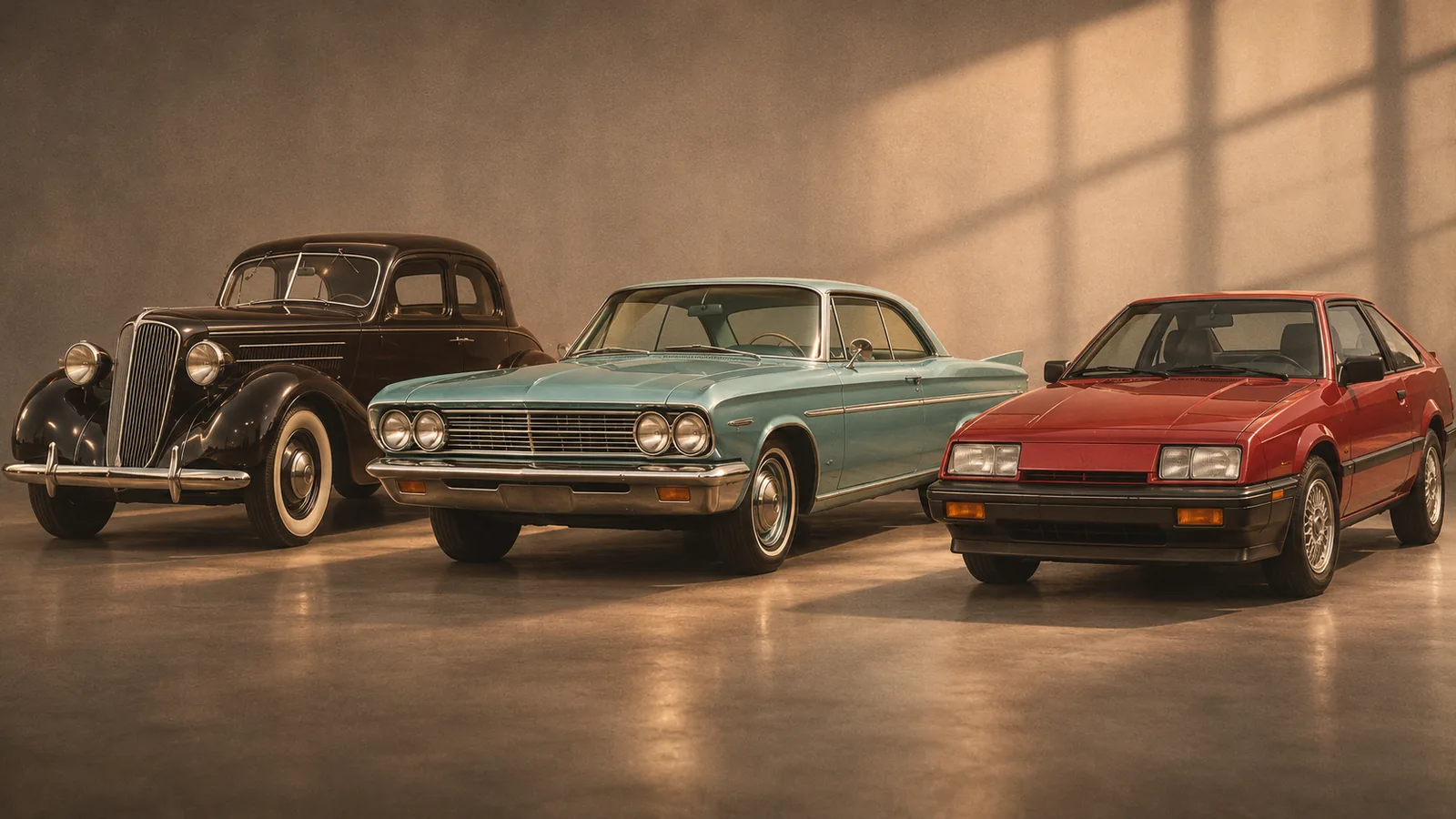
You may not know the badge on an old car, but you can often place its design in a broad era. Start with the relationship between body, fenders, headlights and roof rather than a single decorative detail.
These are approximate visual patterns, not a date decoder. Models sold in one decade can carry design ideas from the previous one, and restorations can add later parts.
Prewar: separate parts become one body
Many 1920s and early-1930s cars show upright cabins, tall grilles, running boards, lamps mounted apart from the body and fenders that look like distinct pieces. Later in the 1930s, streamlining begins to integrate these parts into smoother shapes.
Ask whether the front wheels seem wrapped by prominent external fenders. That can be a stronger era clue than paint or a modern replacement wheel.
Tip: A museum label or chassis number is needed for an exact year.
Postwar: lower and wider
After World War II, many cars grew lower and wider, with fenders blended into the body. In the 1950s, chrome details and tailfins became especially visible in some American designs, although European small cars followed different priorities.
The 1960s brought cleaner surfaces, longer hood proportions on many performance cars and less exaggerated fins. A muscle coupe from the late 1960s looks different from a family sedan of the same year, so compare like with like.
1970s and 1980s: changing proportions
Safety rules, fuel concerns and manufacturing methods changed the look of many cars. Bumpers became more prominent in the 1970s. Angular rooflines, flatter panels and rectangular lamps are common 1980s clues.
A wedge-shaped exotic and a boxy family hatchback can both belong to the 1980s. Era recognition works best as a set of features, not a single silhouette.
| Broad era | First look | Check next |
|---|---|---|
| Prewar | External fenders and upright grille | Separate lamps and running boards |
| 1950s | Lower, wider body | Chrome and possible tailfins |
| 1960s | Cleaner side surfaces | Roof and hood proportions |
| 1980s | Angular surfaces | Rectangular lighting and integrated bumpers |
Place the visual clue
0 / 4 answered
1Separate fenders and running boards suggest which broad period?
Answer: Prewar. These elements are common on early automotive bodies.2Large tailfins are most associated with which US design era?
Answer: 1950s. Tailfins became a prominent styling feature of some 1950s American cars.3Angular panels and rectangular lamps often suggest which decade?
Answer: 1980s. Many 1980s designs favored crisp, geometric surfaces.4What is the best way to date an exact car model?
Answer: Check manufacturer or museum records. Visual clues narrow an era; records establish an exact model and year.
Frequently asked questions
Can a design feature prove an exact year?
Usually not. Styling transitions overlap, parts are replaced, and different markets changed at different times.
Estimate before naming
Place the car in a broad era from its body structure, then confirm the specific model against a reliable archive or manufacturer record.
Check the evidence behind the guide
Use these references to check terminology and pursue a topic in more depth. Photo quizzes help you practise observation; a single picture rarely proves a difficult identification.
When a source describes a broad group, compare its details with the exact species, model or specimen you are studying. Record the feature that supports your answer rather than relying on a name alone.