The hazmat (H) endorsement lets you haul hazardous materials in amounts that need placards. Its knowledge test is detailed: hazard classes, shipping papers, placard tables, loading rules and what to do when something leaks. This practice test gives you 25 original questions across all of those areas, with an explanation for each answer.
First we explain what the endorsement involves and list the nine hazard classes. Then come five rounds of five questions: hazard classes, shipping papers, placards and the hazardous materials table, loading and driving rules, and emergencies.
Each explanation says why the right answer is right and why the most tempting wrong answer is wrong. The rules here come from the federal hazardous materials regulations; your state manual covers the same ground.
Quick takeaways
- You need an H endorsement to drive a vehicle carrying hazardous materials that need placards.
- Shipping papers must be within reach while you drive, and on your seat or in the driver's door pouch when you leave the vehicle.
- Table 2 materials need placards at 1,001 pounds or more in total; Table 1 materials need placards in any amount.
- In an emergency, keep people away and upwind, don't touch the material, and give your shipping papers to emergency responders.
The basics
What the hazmat endorsement involves
To get an H endorsement, you pass a hazmat knowledge test at your state licensing agency and clear a security threat assessment run by the Transportation Security Administration (TSA), which includes fingerprinting and a background check. If you are getting the endorsement for the first time, you must also complete entry-level driver training theory for hazmat with a provider on FMCSA's Training Provider Registry before the knowledge test.
The test is multiple choice, with a federal minimum score of 80%; your state sets the number of questions. It is based on the hazardous materials section of your state's CDL manual, which follows the federal hazardous materials regulations in 49 CFR Parts 171 to 180.
Hazardous materials are grouped into nine classes, some split into divisions. Learning the classes first makes the rest of the test easier, because placards, loading rules and emergency steps all depend on them.
| Class | Name | Divisions or examples |
|---|---|---|
| 1 | Explosives | Divisions 1.1 to 1.6, from mass explosion hazard to extremely insensitive |
| 2 | Gases | 2.1 flammable gas, 2.2 non-flammable gas, 2.3 poison gas |
| 3 | Flammable liquids | Gasoline, many paints and solvents |
| 4 | Flammable solids | 4.1 flammable solid, 4.2 spontaneously combustible, 4.3 dangerous when wet |
| 5 | Oxidizers and organic peroxides | 5.1 oxidizer, 5.2 organic peroxide |
| 6 | Poisons and infectious substances | 6.1 poison (toxic), 6.2 infectious substance |
| 7 | Radioactive materials | Placards depend on the package label |
| 8 | Corrosives | Battery acid, many cleaning chemicals |
| 9 | Miscellaneous hazardous materials | Materials that are hazardous in transport but fit no other class |
Tip: You also need a tank (N) endorsement to haul hazmat in a tank vehicle; a combined tank and hazmat endorsement appears on the license as X.
Round 1
Hazard classes and packing groups
These questions test whether you can match a material to its class or division, and read a packing group. Use the table above if you get stuck, then try again without it.
1Gasoline belongs to which hazard class?
Answer: Class 3, flammable liquids. Gasoline is a liquid that burns easily, so it is Class 3. Class 4 is tempting because its name also includes flammable, but it covers solids such as matches and some metal powders, not liquids.2What does Division 4.3 mean?
Answer: Dangerous when wet. Division 4.3 materials give off flammable or toxic gas when they contact water, so they must be kept dry. Spontaneously combustible is tempting because it is in the same class, but that is Division 4.2.3Which division covers poison gases?
Answer: Division 2.3. Division 2.3 is poison gas, one of the most dangerous groups and one that needs placards in any amount. Division 6.1 is tempting because it also means poison, but it covers poisonous liquids and solids, not gases.4Which explosives division has a mass explosion hazard?
Answer: Division 1.1. Division 1.1 explosives can explode all at once, affecting almost the entire load. Division 1.4 is tempting because it is a common explosives division, but it has only a minor explosion hazard; 1.5 and 1.6 are very and extremely insensitive.5Which packing group shows the greatest danger?
Answer: Packing Group I. Packing groups run from I, great danger, through II, medium, to III, minor danger. Packing Group III is tempting because a higher number often means more, but here it means the least danger.
Round 2
Shipping papers
Shipping papers describe the hazardous materials you are carrying. In a crash, emergency responders rely on them, so the rules on where you keep them and how hazmat is shown on them are strict.
6While you are driving, where must the hazmat shipping papers be?
Answer: Within your reach while your seat belt is fastened and easy to see, or in a pouch on the driver's door. Papers within reach or in the driver's door pouch can be found quickly by you or by responders. The glove box is tempting because it keeps them tidy, but a locked or closed compartment is not where the rules say they must be and may not be checked in an emergency.7You leave the cab of your placarded truck to eat. Where should the shipping papers be?
Answer: On the driver's seat or in the driver's door pouch. Leaving them on the seat or in the door pouch means responders can find them if something happens while you are away. Taking them with you is tempting because it feels secure, but it means anyone dealing with an emergency at the truck won't know what is in it.8When a shipping paper lists hazardous and non-hazardous materials, how must the hazardous materials stand out?
Answer: Listed first, highlighted in a contrasting color, or marked with an X (or RQ) in the HM column. The rules allow any of three ways: list hazmat first, highlight it in a contrasting color, or mark it with an X, or RQ where it applies, in a column headed HM. Capital letters are tempting because they look prominent, but they are not one of the permitted methods.9In what order does the basic description of a hazardous material appear on shipping papers?
Answer: Identification number, proper shipping name, hazard class or division, packing group. The basic description runs ID number (such as UN1203), proper shipping name, hazard class or division, then packing group. Starting with the proper shipping name is tempting because it is the easiest part to read, but the ID number comes first.10What does RQ on a shipping paper mean?
Answer: Reportable quantity: a spill of this amount must be reported. RQ marks a hazardous substance in a reportable quantity, so a spill must be reported to the authorities. Radioactive quantity is tempting because R suggests radioactive, but radioactive materials are shown by their Class 7 description, not by RQ.
Round 3
Placards and the hazardous materials table
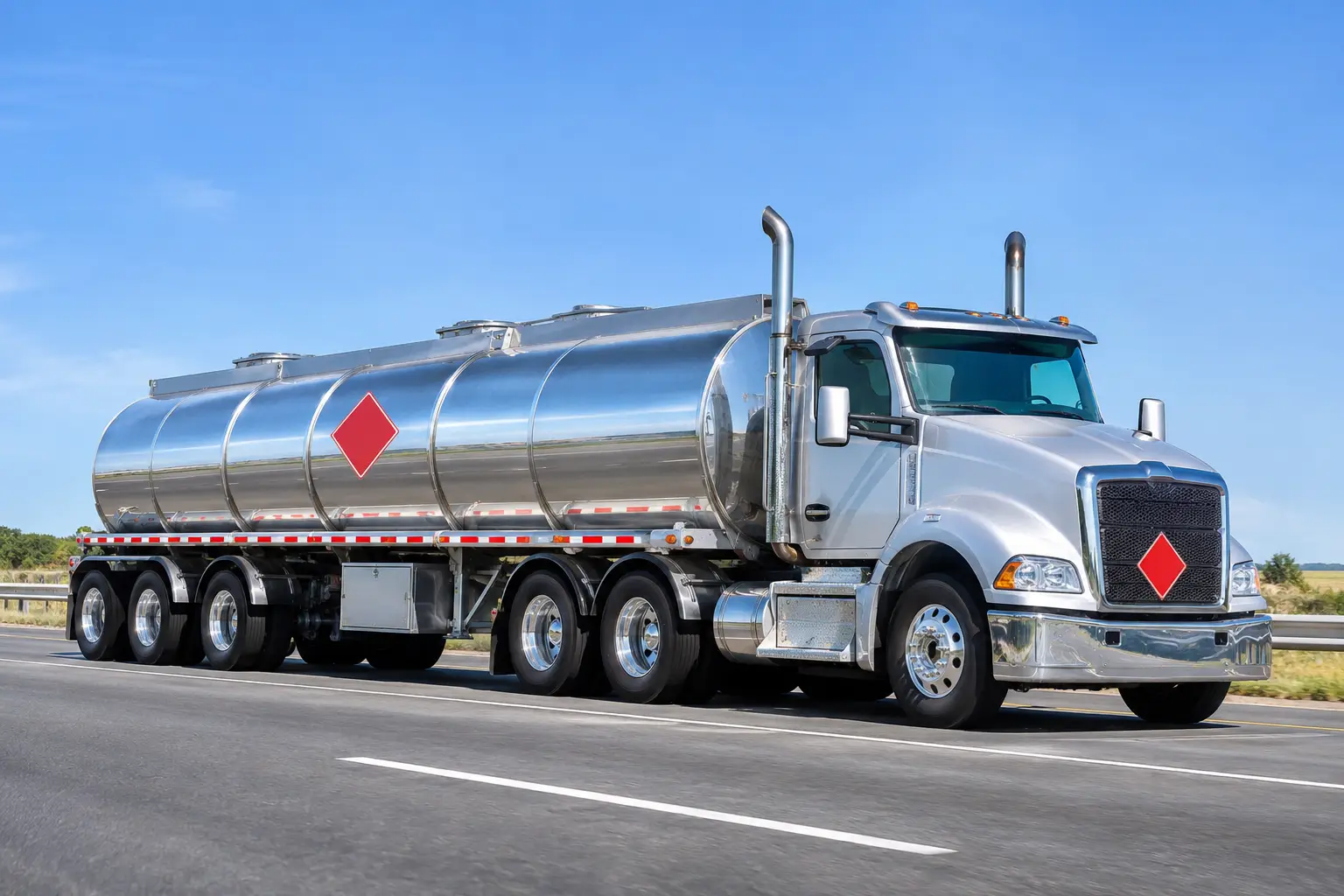
Placards are the diamond-shaped signs that warn others what you are hauling. Table 1 materials need placards in any amount; Table 2 materials need them once the total weight of Table 2 hazmat reaches 1,001 pounds, though bulk packagings follow stricter rules.
11Where must placards go on a vehicle that needs them?
Answer: On the front, the rear and both sides. Placards must be on each side and each end so they can be read from all four directions. Front and rear only is tempting because those are the views of following and oncoming traffic, but responders may approach from either side.12You carry 900 pounds of Class 8 corrosives in non-bulk packages and no other hazardous materials. Do you need placards?
Answer: No, because Table 2 materials need placards only at 1,001 pounds or more. Class 8 is a Table 2 class, so 900 pounds in non-bulk packages is below the placard threshold, though you still need shipping papers and labeled packages. Saying any amount needs placards is tempting, but that rule applies only to Table 1 materials.13Which of these needs placards in any amount?
Answer: Division 2.3 poison gas. Division 2.3 is on Table 1, along with Divisions 1.1 to 1.3, 4.3 and some others, so even a small amount needs placards. Class 3 flammable liquid is tempting because gasoline feels very dangerous, but it is a Table 2 class with the 1,001-pound threshold.14When can you NOT use the DANGEROUS placard in place of separate placards for Table 2 materials?
Answer: When 2,205 pounds or more of one Table 2 category is loaded at one facility. The DANGEROUS placard may replace separate placards for a mixed load of Table 2 materials, but once 2,205 pounds or more of one category is loaded at one facility, you must use that category's placard. Two or more categories is tempting, but that is exactly when DANGEROUS is allowed; it can never be used for Table 1 materials.15In the hazardous materials table, what does the letter A in the first column mean?
Answer: The material is regulated only when shipped by air, unless it is a hazardous substance or hazardous waste. An A limits the rules to air shipments, so the material is not regulated as hazmat on the highway unless it is a hazardous substance or hazardous waste; W does the same for water shipments. Always forbidden is tempting because A looks like a warning, but forbidden materials are shown as forbidden in a different column.
Round 4
Loading, driving and parking rules
Most of these rules exist because a spark, flame or crash near the load could be catastrophic. Learn the numbers, but also the reason behind each one.
16How close may you smoke to a vehicle carrying Class 3 flammable liquids or Class 1 explosives?
Answer: Not on the vehicle or within 25 feet of it. Federal rules ban smoking or carrying anything lit on or within 25 feet of a vehicle with explosives, oxidizers or flammable materials. Closed cargo doors are tempting because the load seems sealed off, but fumes and small leaks can still reach a flame.17What must be true while you fuel a vehicle carrying hazardous materials?
Answer: The engine is off and someone is at the nozzle controlling the fuel flow. Turning off the engine removes an ignition source, and a person at the nozzle can stop the flow at once if something goes wrong. Leaving the engine running for air pressure is tempting, but the parking brakes hold the vehicle without the engine running.18How often do the federal rules require a hazmat driver to check the vehicle's tires?
Answer: At the start of each trip and each time the vehicle is parked. Hot or flat tires can start fires, so you check them at the start of each trip and every time you park. Once a day is tempting because that is when the full pre-trip inspection happens, but the hazmat rules require more frequent checks.19Except for brief stops when operations require it, how far must a vehicle carrying Division 1.1, 1.2 or 1.3 explosives be parked from a bridge, tunnel, building or place where people gather?
Answer: More than 300 feet. These explosives must not be parked within 300 feet of a bridge, tunnel, dwelling, building or place where people work or gather, or within 5 feet of the traveled part of the road. 100 feet is tempting because it shows up in warning triangle placement, but it is not the parking rule for explosives.20What fire extinguisher rating must a power unit carrying placarded hazardous materials have?
Answer: 10 B:C or more. A placarded hazmat vehicle needs an extinguisher rated 10 B:C or more. 5 B:C is tempting because it is the minimum for many other trucks, but hazmat loads need the larger rating.
Round 5
Emergencies and the Emergency Response Guidebook
If a hazmat load leaks, burns or is in a crash, your first jobs are to keep people away, call for help and give responders the information they need. The Emergency Response Guidebook (ERG), published by the U.S. Department of Transportation, is the reference responders use in the first minutes.
21In the Emergency Response Guidebook, which colored pages list materials by their ID number?
Answer: The yellow pages. Yellow pages list materials in order of their four-digit ID number and point to a guide. Blue pages are tempting because they also list materials, but they list them in alphabetical order by name; orange pages hold the guides and green pages give isolation distances.22A hazardous material is leaking from your vehicle. Where should you and others move?
Answer: Upwind and uphill, well away from the leak. Staying upwind keeps you out of fumes, and staying uphill keeps you away from spreading liquid. Downwind is tempting because it sounds like the material is blowing away, but downwind is exactly where vapors and smoke travel.23You notice a wet stain on a package of hazardous materials. How should you find out what is leaking?
Answer: Read the shipping papers and package labels; don't touch or smell the material. Shipping papers and labels tell you what the material is without exposing you to it. Smelling it is tempting because it seems harmless, but some dangerous chemicals have no smell, and even a small breath of others can injure you.24Your placarded truck is in a minor crash and a package is leaking. What should you do with the truck?
Answer: Move it only as far as safety requires, and keep people away. Moving a leaking vehicle can spread the material and expose more people, so move it only if staying put is more dangerous. Driving to a truck stop is tempting because help is there, but it carries the leak into a busy area full of people.25When emergency responders arrive at a hazmat incident, what should you give them?
Answer: The shipping papers and emergency response information. The shipping papers tell responders exactly what is on board, and the emergency response information tells them how to handle it. Relying on placards alone is tempting because placards show the hazard class, but they don't name the exact material or quantity.
Tip: This article is an independent study aid and is not affiliated with or endorsed by FMCSA, AAMVA or any state licensing agency. Questions here are original practice items, not real test questions. Rules vary by state, so always study your own state's CDL manual.
Quick quiz: hazmat basics
Five quick review questions on hazmat rules. Tap an answer; each question locks after your first pick.
0 / 5 answered
1Which prefix does a hazmat identification number carry on U.S. shipping papers?
Answer: UN or NA. Identification numbers start with UN or NA followed by four digits, such as UN1203. RQ and PG mean reportable quantity and packing group.2Which federal agency runs the security threat assessment for the hazmat endorsement?
Answer: The Transportation Security Administration (TSA). TSA runs the security threat assessment, including fingerprinting and a background check. FMCSA sets the CDL rules, and your state issues the endorsement.3How many hazard classes are there in the U.S. system?
Answer: 9. There are nine hazard classes, numbered 1 to 9, and several are split into divisions.4What is the difference between labels and placards?
Answer: Labels go on packages; placards go on vehicles and bulk containers. Shippers put diamond-shaped labels on packages, and placards on the vehicle warn people outside it.5Which endorsement code shows that a driver holds both tank and hazmat endorsements?
Answer: X. X combines the tank (N) and hazmat (H) endorsements. T is doubles and triples, P is passenger and S is school bus.
Frequently asked questions
When do I need a hazmat endorsement?
You need an H endorsement to drive a commercial vehicle carrying hazardous materials in an amount that requires placards. If you haul hazmat in a tank vehicle, you also need the tank endorsement, shown together as X.
Does the hazmat endorsement need a background check?
Yes. Before your state can issue the endorsement, you must pass a TSA security threat assessment, which includes fingerprinting and a background check. Check TSA and your state licensing agency for the current steps.
How many questions are on the CDL hazmat test?
Your state sets the number; many states use about 30 questions. The federal minimum passing score is 80%. Check your state's CDL manual for the exact format.
What should I study for the hazmat test?
Learn the nine hazard classes, how shipping papers are laid out and where to keep them, the placard tables, loading and parking rules, and emergency steps. CDL Exam - Practice Test has a Hazardous Materials section with short topics and an explanation after every answer.
Know the classes and the rest follows
The hazmat test asks a lot of detail, but most of it hangs on a few ideas: the nine hazard classes, the difference between Table 1 and Table 2 materials, shipping papers that responders can always find, and keeping ignition sources and people away from the load. Learn those well and the specific rules become easier to remember.
- Learn the nine hazard classes and the Table 1 materials that need placards in any amount.
- Practice reading a shipping paper's basic description in the right order: ID number, proper shipping name, class, packing group.
- Take the Hazardous Materials section practice test in CDL Exam - Practice Test and review each explanation.
Check your state's CDL manual
Your state's CDL manual is the official study source for the knowledge tests. Details such as the number of questions, how you book a test and any state-only rules vary, so read the manual for the state that will issue your license.
The federal rules behind the manual are in Title 49 of the Code of Federal Regulations. Use the links below to check the licensing, driving, inspection and hours-of-service rules mentioned in this article.
Sources and further reading
- FMCSA: commercial driver's license program
- FMCSA: entry-level driver training
- eCFR: 49 CFR Part 383, CDL standards
- eCFR: 49 CFR Part 392, driving of commercial vehicles
- eCFR: 49 CFR Part 395, hours of service
- eCFR: 49 CFR Part 172, hazardous materials table and placarding
- eCFR: 49 CFR Part 397, driving and parking rules for hazmat
- PHMSA: Emergency Response Guidebook