If you will drive a truck or bus with air brakes, you need to pass the air brakes knowledge test. It is one of the most number-heavy CDL tests: governor pressures, warning levels, leak rates and build-up times. This practice test gives you 25 original questions that follow the system from the compressor to the brake drum, then through the checks you make before a trip and the way you use the brakes on the road.
First comes a short guide to the test and a table of the pressures worth memorizing. Five rounds of five questions follow: system parts, gauges and spring brakes, dual systems and ABS, inspection and testing, and braking on the road.
Each explanation says why the right answer is right and why the most tempting wrong answer is wrong. The figures are the typical values in the model CDL manual; the manufacturer of the vehicle you drive may specify slightly different ones.
Quick takeaways
- The governor typically stops the compressor at about 125 psi and starts it again at about 100 psi.
- A low-air warning must come on before tank pressure falls below 60 psi.
- Spring brakes come on automatically when air pressure drops to somewhere between 20 and 45 psi.
- Air brakes take about half a second or more to apply after you press the pedal, which adds to stopping distance.
The basics
What the CDL air brakes test covers
The air brakes test is based on the air brakes section of your state's CDL manual. You need it to drive a commercial vehicle with air brakes. If you don't pass it, or you take your skills test in a vehicle without air brakes, the state puts an air brake restriction on your CDL.
Like every CDL knowledge test, it is multiple choice, and federal rules require a score of at least 80%. Your state sets the number of questions, so check your manual.
The test checks three things: how the parts of the system work, how to inspect and test the brakes, and how to use them safely on the road. An air brake system is really three systems in one: the service brakes you use with the pedal, the parking brakes, and the emergency brakes, which use parts of the other two when the system fails.
| Setting | Typical figure in the model CDL manual |
|---|---|
| Governor cut-in (compressor starts pumping) | About 100 psi |
| Governor cut-out (compressor stops pumping) | About 125 psi |
| Safety relief valve opens | Usually 150 psi |
| Low-air warning comes on | Before pressure falls below 60 psi |
| Spring brakes come on automatically | Somewhere between 20 and 45 psi |
Tip: Always follow the manufacturer's figures for the vehicle you drive. The values above are the typical ones used in the model manual and on the test.
Round 1
Parts of the air brake system
Air brakes use compressed air to push the brake shoes against the drums. The compressor fills the tanks, the governor controls the compressor, and the brake pedal sends air from the tanks to the brake chambers at each wheel.
1What does the governor do in an air brake system?
Answer: Controls when the compressor pumps air into the tanks. The governor starts the compressor at the cut-in pressure, about 100 psi, and stops it at the cut-out pressure, about 125 psi. Releasing excess pressure is the tempting choice, but that is the job of the safety relief valve, which usually opens at 150 psi.2Why do the air tanks need to be drained?
Answer: Water and compressor oil collect in them and can make the brakes fail. Compressed air carries water and some compressor oil, which settle in the tanks; water can freeze in cold weather and cause brake failure. Releasing pressure overnight is tempting, but the tanks are built to hold pressure, and draining is about removing water and oil.3What is the purpose of an alcohol evaporator?
Answer: To reduce the risk of ice forming in air brake valves in cold weather. An alcohol evaporator puts alcohol into the air system so that moisture is less likely to freeze in valves and other parts. The tempting idea that it replaces draining is wrong: you still need to drain the tanks to get rid of water and oil, unless the system has automatic drains.4In an S-cam drum brake, what happens when you press the brake pedal?
Answer: Air pushes the pushrod out, which moves the slack adjuster and twists the S-cam to force the shoes against the drum. Air enters the brake chamber and pushes out the pushrod, which turns the slack adjuster and the brake camshaft; the S-shaped cam spreads the shoes against the drum. The spring option is tempting because spring brakes do work that way, but those are the parking and emergency brakes, not the service brakes you apply with the pedal.5In an air brake system, what happens as you press the brake pedal further down?
Answer: More air pressure is sent to the brakes, so braking force increases. The brake pedal, or foot valve, meters air: the harder you press, the more air pressure reaches the brake chambers, and letting up releases some of that air. The compressor option is tempting, but the compressor's pumping is controlled by the governor based on tank pressure, not by the pedal.
Round 2
Gauges, warnings and spring brakes
Your gauges and warning signals tell you how much air you have and how much you are using. Spring brakes are the safety net: strong springs that apply the brakes when air pressure is lost.
6On most vehicles, the low air pressure warning must come on before tank pressure falls below what level?
Answer: 60 psi. The warning, a light and often a buzzer, must come on before pressure in the tanks falls below 60 psi; on some older vehicles the figure is half the governor cut-out pressure. 100 psi is tempting because it is the governor cut-in, the point where the compressor starts pumping, which is normal and not a warning.7What does the application pressure gauge show?
Answer: How much air pressure you are applying to the brakes. The application gauge shows the pressure going to the brakes as you press the pedal; if you need more and more pressure to hold the same speed, the brakes are fading. The tempting choice describes the supply pressure gauge, which shows how much air is in the tanks.8What applies the spring brakes on a truck or tractor?
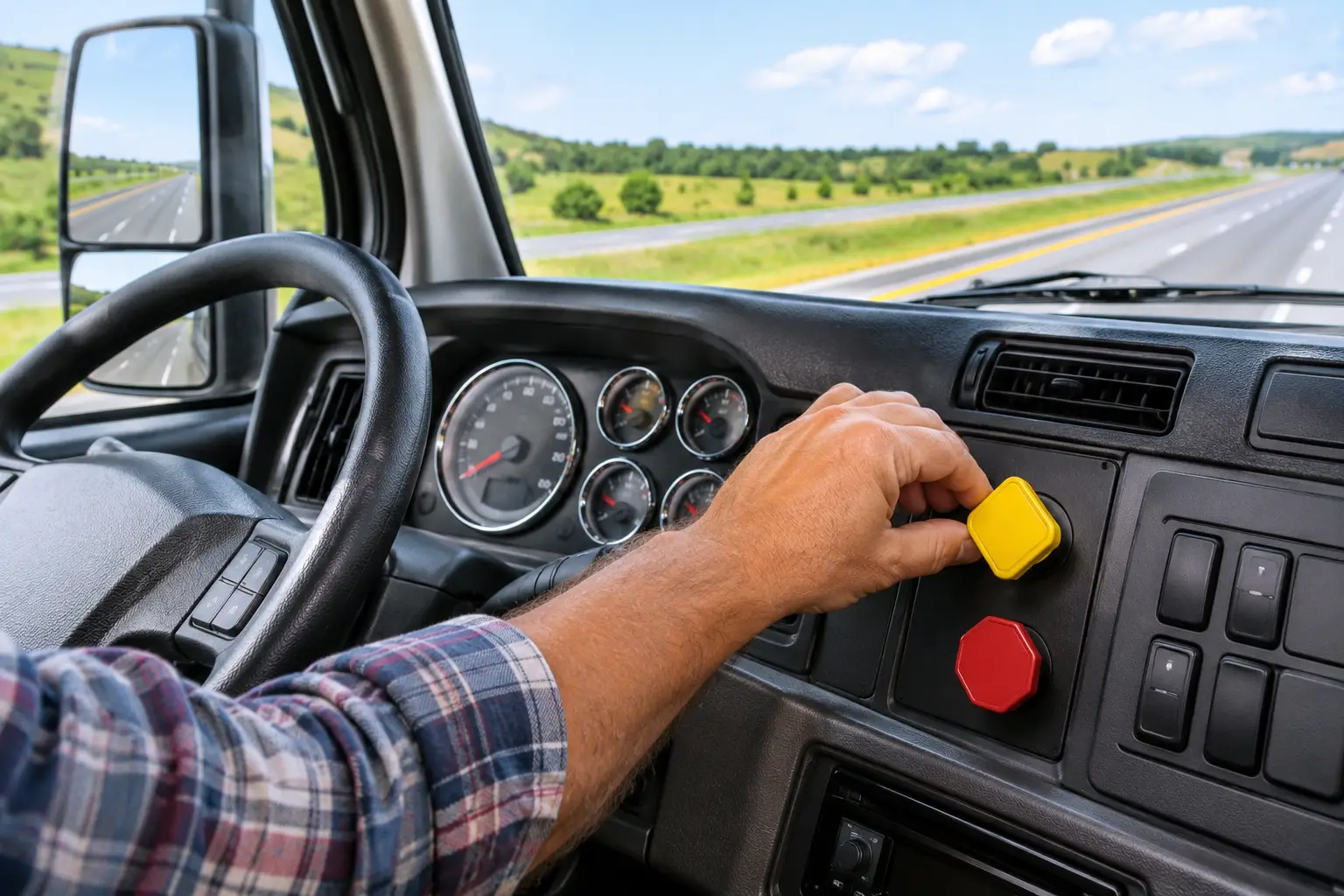
Answer: Powerful springs, which air pressure normally holds back. Air pressure holds the springs back while you drive; when you set the parking brake or pressure drops to about 20 to 45 psi, the air is let out and the springs apply the brakes. Air pressure is the tempting choice because it applies the service brakes, but spring brakes work the opposite way.9On a newer vehicle, how do you use the yellow, diamond-shaped parking brake knob?
Answer: Pull it out to put the parking brakes on and push it in to release them. Pulling the yellow diamond knob out lets the air out of the spring brake chambers so the springs apply; pushing it in sends air back to release them. The reverse is tempting because many push buttons switch things on, but on this control pushing in releases the brakes.10Why shouldn't you press the brake pedal hard while the spring brakes are on?
Answer: The combined force of the springs and the air pressure can damage the brakes. With the spring brakes applied, pressing the pedal adds air pressure on top of the spring force, and the two together can damage the brake parts. Releasing the spring brakes is the tempting answer, but the pedal controls the service brakes and does not release the parking brakes.
Round 3
Dual air systems and antilock brakes
Most heavy vehicles have a dual air brake system: two separate systems that share one set of brake controls, each with its own tanks and hoses. If one fails, the other still gives you some braking. This round also covers antilock brakes (ABS), which prevent wheel lockup when you brake hard.
11In a typical dual air brake system, which brakes does the primary system usually operate?
Answer: The brakes on the rear axle or axles. The primary system usually works the regular brakes on the rear axle or axles, and the secondary system works the front axle and possibly one rear axle. The front axle is tempting because it is first in line, but that is the secondary system's job.12Before you drive a vehicle with a dual air system, what should you wait for?
Answer: At least 100 psi in both the primary and the secondary systems. You need a minimum of 100 psi in both systems before you move. Waiting only for the primary system is tempting because it works the rear brakes, but a low secondary system leaves you with weak front brakes and can trigger the warning or spring brakes.13While driving, one of the two systems in a dual air brake system starts losing air. What should you do?
Answer: Stop and park safely as soon as you can and have it repaired, since only part of your braking is left. The second system gives you some braking, but not the full braking you are used to, and the low-air warning will tell you something is wrong. Carrying on is tempting because the brakes still work, but you could lose more air and the spring brakes could come on suddenly.14How do you know the ABS on a truck or tractor has a fault?
Answer: The yellow ABS malfunction lamp on the instrument panel stays on. The yellow ABS lamp lights briefly as a bulb check when you start; if it stays on, or comes on while you drive, the ABS isn't working. The low-air buzzer is tempting because it is a brake warning, but it reports low air pressure, not an ABS fault.15If the ABS on your vehicle stops working, what happens to your brakes?
Answer: You still have normal braking; you only lose the antilock function. ABS is an addition to your normal brakes, so if it fails you can still drive and brake as you normally would; get it fixed soon. The tempting idea that the brakes stop working is wrong, as is the belief that ABS lets you brake harder or stop shorter: it just helps you keep control.
Round 4
Inspecting and testing air brakes
The model CDL manual adds air brake checks to the pre-trip inspection. Learn the order and the pass or fail figures, because they come up on the knowledge test and you may have to explain them in the vehicle inspection part of the skills test.
16With the engine off, wheels chocked and parking brakes released, you pull hard on each slack adjuster you can reach. When does one probably need adjusting?
Answer: When it moves more than about one inch where the pushrod attaches. More than about one inch of movement where the pushrod attaches means the brake is probably out of adjustment and will not apply fully. Any movement at all is the tempting answer, but a small amount of free play is normal; also note that automatic slack adjusters that go out of adjustment point to a problem that needs a mechanic.17In a dual air system with the engine at operating rpm, how quickly should pressure build from 85 to 100 psi?
Answer: Within about 45 seconds. The model manual says pressure should build from 85 to 100 psi within 45 seconds in dual air systems, though vehicles with larger tanks may take longer per the manufacturer. Two minutes is tempting because older single-system vehicles were given more time, but that is too slow for a typical dual system.18In a combination vehicle with a fully charged system, engine off and brakes released, pressure drops 4 psi in one minute. What does this mean?
Answer: The leak rate is too high, so the leak must be found and fixed before driving. With the brakes released, a combination vehicle should lose less than 3 psi in one minute, so 4 psi is too much. Calling it normal is tempting because 4 psi is the limit for combinations in the brakes-applied test, but that is a different test with a different limit.19How do you test the low air pressure warning?
Answer: With the engine off and electrical power on, fan the brake pedal to lower tank pressure and note when the warning comes on. Shut the engine off with enough air that the warning is off, turn the power on and step on and off the pedal; the warning must come on before pressure falls below 60 psi. Pulling the parking brake knob is tempting, but it applies the spring brakes and does not test the warning signal.20When you test that the spring brakes come on automatically, what should happen as you fan the brake pedal with the engine off?
Answer: The parking brake knob pops out when pressure falls to the manufacturer's figure, usually between 20 and 45 psi. With the wheels chocked and parking brake released, lowering the pressure should make the parking brake knob pop out in the 20 to 45 psi range, showing the spring brakes have come on. The governor option is tempting, but with the engine off the compressor is not running, so the governor cannot add air.
| Leakage test (engine off) | Single vehicle | Combination vehicle |
|---|---|---|
| Brakes released, fully charged system | Less than 2 psi in one minute | Less than 3 psi in one minute |
| Pedal held at 90 psi or more, after the first drop | No more than 3 psi in one minute | No more than 4 psi in one minute |
Round 5
Using air brakes on the road
Air brakes are powerful, but they need time to apply and can overheat on long grades. These questions cover stopping distance, brake fade, emergency braking and parking.
21Why does a vehicle with air brakes need extra stopping distance compared with one that has hydraulic brakes?
Answer: Air takes time, about half a second or more, to flow through the lines after you press the pedal. This delay is called brake lag, and the vehicle keeps moving at full speed while it happens, adding to your stopping distance. The compressor option is tempting, but the brakes use air already stored in the tanks, so they don't wait for the compressor.22What causes brake fade on a long downgrade?
Answer: Overheating from heavy use, which makes the drums expand away from the linings. Constant braking heats the drums and linings; the drums expand, the linings lose grip, and you have to press harder to get the same braking. Air leaks are tempting because they also weaken the brakes, but fade comes from heat, which is why the right low gear, not the brakes, should hold your speed.23In an emergency stop in a vehicle without ABS, how does stab braking work?
Answer: Brake fully, release when the wheels lock, then brake fully again as soon as the wheels start rolling. Releasing the brakes lets locked wheels roll and regain steering control, and braking again as soon as they roll keeps you slowing down. Holding the pedal down is tempting because it feels like maximum braking, but locked wheels skid and can't steer.24You have just come down a long, steep grade and your brakes are very hot. How should you park?
Answer: Don't use the parking brakes; chock the wheels instead. Very hot brakes can be damaged by the parking brakes, and very cold, wet brakes can freeze, so in both cases use wheel chocks on a level surface. Setting the parking brakes is the usual habit, which is why it is tempting, but it is the wrong choice when the brakes are very hot.25The low air pressure warning comes on while you are driving. What should you do?
Answer: Stop and safely park as soon as possible, because the spring brakes may come on. A low-air warning means you are losing air, and if pressure keeps falling the spring brakes can come on suddenly, maybe where it isn't safe to stop. Driving on to a service area is tempting, but the brakes may not last that long, and pumping the pedal only uses more air.
Tip: This article is an independent study aid and is not affiliated with or endorsed by FMCSA, AAMVA or any state licensing agency. Questions here are original practice items, not real test questions. Rules vary by state, so always study your own state's CDL manual.
Quick quiz: air brake figures
Five quick review questions on air brake basics. Tap an answer; each question locks after your first pick.
0 / 5 answered
1Which three braking systems make up an air brake system?
Answer: Service, parking and emergency brakes. Air brakes combine service brakes, parking brakes and emergency brakes. The emergency system uses parts of the other two when the main system fails.2At about what pressure does the governor usually stop the compressor?
Answer: 125 psi. Cut-out is typically about 125 psi, and cut-in about 100 psi. 150 psi is where the safety relief valve usually opens.3What does the safety relief valve protect against?
Answer: Air pressure in the tanks rising too high. The safety relief valve, usually set to open at 150 psi, lets air out if tank pressure gets too high. Water is removed by draining the tanks.4What is the main purpose of antilock brakes?
Answer: To keep the wheels from locking when you brake hard, so you keep steering control. ABS prevents wheel lockup so you can steer while braking hard. It doesn't always shorten stopping distance.5In the service brake test, you brake firmly at about 5 mph. What can it mean if the vehicle pulls to one side?
Answer: There may be a brake problem. Pulling to one side, or an odd feel or delay when you brake, can point to brake trouble that should be fixed before you drive.
Frequently asked questions
How many questions are on the CDL air brakes test?
It depends on your state. Many states use about 25 multiple-choice questions, and federal rules require at least 80% correct. Check your state's CDL manual for the exact format.
What happens if I don't take the air brakes test?
Your state will put an air brake restriction on your CDL, which means you can't drive a commercial vehicle with air brakes. The same restriction applies if you take the skills test in a vehicle without air brakes.
What air pressure numbers should I memorize for the test?
The usual ones are governor cut-in about 100 psi and cut-out about 125 psi, safety valve about 150 psi, low-air warning before 60 psi, spring brakes between 20 and 45 psi, build-up from 85 to 100 psi within 45 seconds in a dual system, and the leakage limits for single and combination vehicles.
What is the best way to study for the air brakes test?
Read the air brakes section of your state's CDL manual, learn the key figures, and practice explaining the brake check out loud. CDL Exam - Practice Test has an Air Brakes section with short topics and an explanation after every answer.
Know the system, then the numbers
Most air brake questions are easier once you can picture the system: the compressor fills the tanks, the governor controls it, the pedal sends air to the brakes, and springs take over when the air is gone. Learn that flow, then the handful of pressures and leak rates, and practice the brake check until you can do it from memory.
- Write out the governor, warning and spring brake pressures until you can recall them without looking.
- Walk through the air brake check step by step and explain what a pass and a fail look like at each step.
- Take the Air Brakes section practice test in CDL Exam - Practice Test and review every explanation.
Check your state's CDL manual
Your state's CDL manual is the official study source for the knowledge tests. Details such as the number of questions, how you book a test and any state-only rules vary, so read the manual for the state that will issue your license.
The federal rules behind the manual are in Title 49 of the Code of Federal Regulations. Use the links below to check the licensing, driving, inspection and hours-of-service rules mentioned in this article.