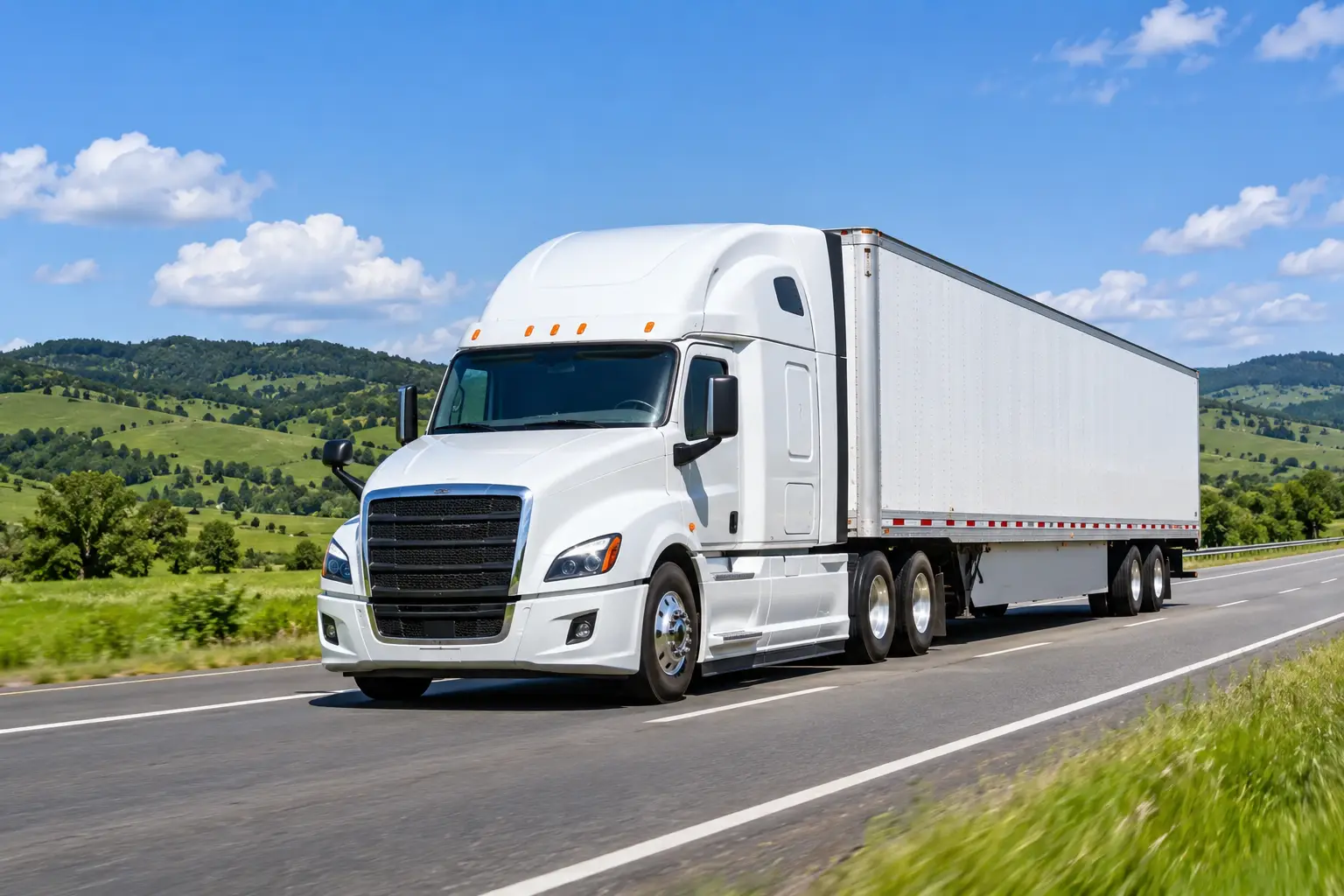
A tractor-trailer handles very differently from a straight truck. It can roll over at speeds that would be safe in a car, the trailer can swing out in a skid, and the rear wheels cut corners. The combination vehicles test checks that you understand these risks, the trailer's air brakes and how to couple and uncouple safely. This practice test gives you 25 original questions across all of them.
We begin with what the test covers and a table of the trailer air controls you need to know. Five rounds of five questions follow: driving safely, skids and jackknifes, off-tracking and turns, trailer air brakes, and coupling and uncoupling.
Each explanation tells you why the right answer is right and why the most tempting wrong answer is wrong. The procedures follow the model CDL manual; your state manual may word them slightly differently.
Quick takeaways
- Most rollovers happen when a driver takes a curve, ramp or turn too fast; steer gently and slow down before the turn.
- If the trailer starts to skid, release the brakes to let the wheels regain traction; don't use the trailer hand valve to straighten out.
- The rear wheels of a combination follow a shorter path than the front wheels on a turn, so turn wide as you complete a tight turn.
- After coupling, do a tug test and then get out and look: the locking jaws must close around the shank of the kingpin.
The basics
What the combination vehicles test covers
You take the combination vehicles test if you want a Class A CDL, the license for tractor-trailers and other combinations where the towed unit is rated over 10,000 pounds. It is based on the combination vehicles section of your state's CDL manual and is taken alongside the general knowledge test, and usually the air brakes test.
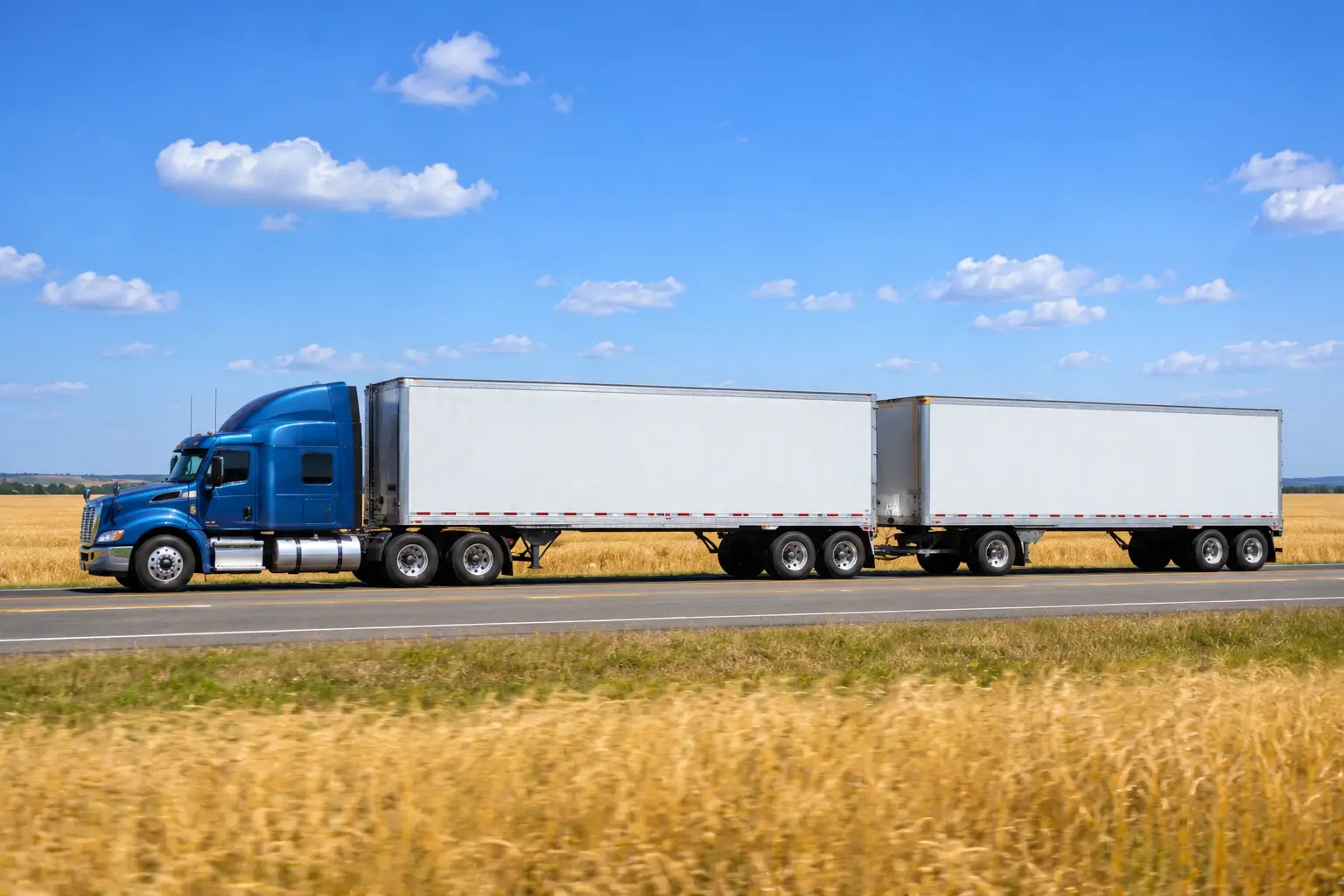
The test covers driving combinations safely, combination vehicle air brakes, coupling and uncoupling, and inspecting a combination. Like other CDL knowledge tests it is multiple choice with a federal minimum score of 80%. Doubles and triples need a separate T endorsement test.
| Control or part | What it does |
|---|---|
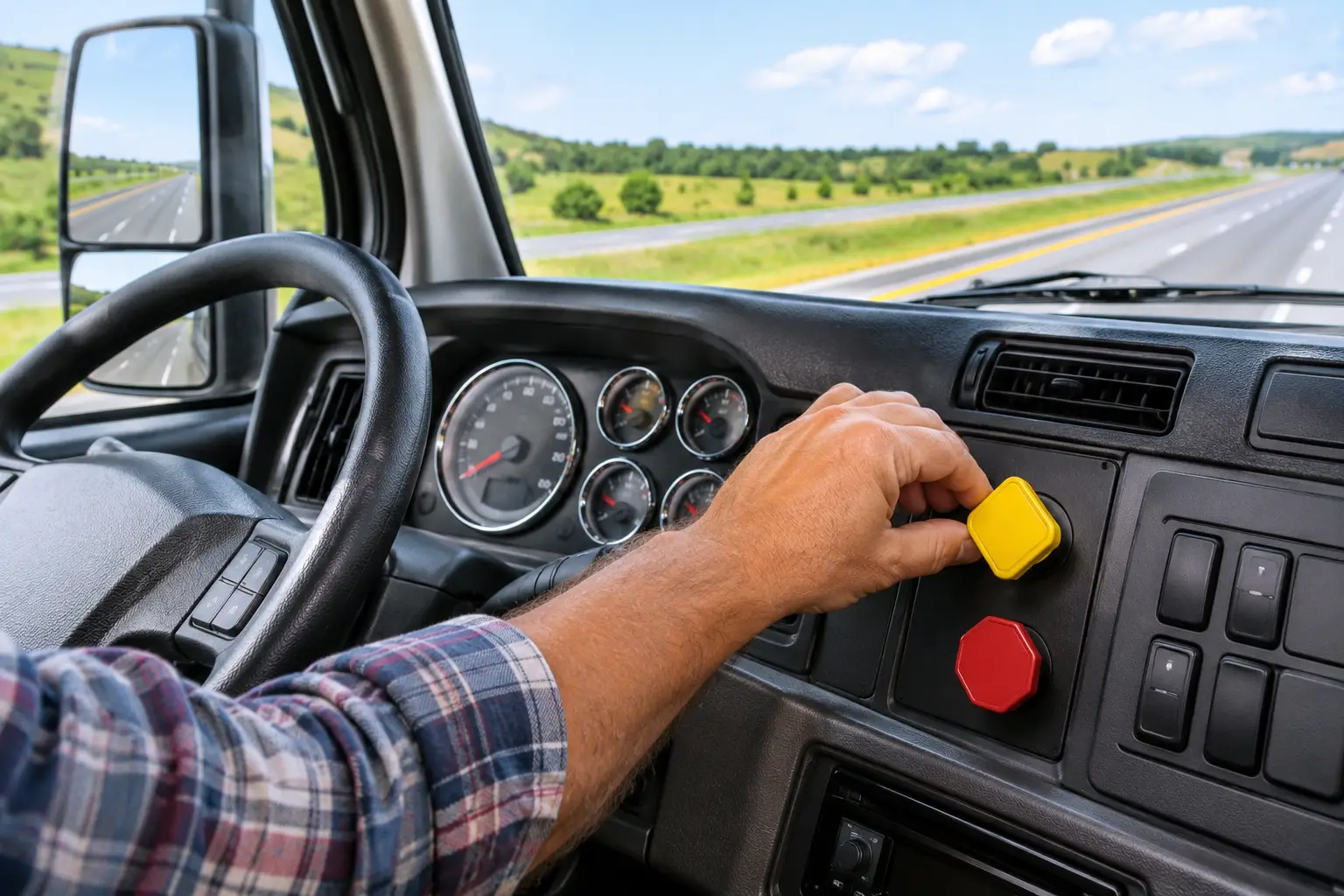
| Trailer air supply control (red, eight-sided knob) | Supplies air to the trailer and controls the tractor protection valve |
| Trailer hand valve (trolley valve or Johnson bar) | Applies the trailer brakes only; used for testing them |
| Tractor protection valve | Keeps air in the tractor if the trailer breaks away or develops a bad leak |
| Emergency (supply) line | Carries air to the trailer's tanks and controls the trailer's emergency brakes |
| Service (control) line | Carries the braking signal from the pedal or hand valve to the trailer brakes |
| Glad hands | Couplers that join the tractor's air lines to the trailer's |
Round 1
Driving combinations safely
A loaded trailer carries its weight high, so combinations are much easier to roll over than cars. Gentle steering, slower turns and extra stopping distance are the main defenses.
1Most combination vehicle rollovers happen when the driver does what?
Answer: Takes a curve, ramp or turn too fast. Turning too fast is the main cause of rollovers, especially on ramps and curves with a high or heavy load. Hard braking in a straight line is tempting because it is dangerous too, but its usual risk is a skid or jackknife, not a rollover.2Why should you avoid quick lane changes in a fully loaded combination?
Answer: A sudden steering move can tip the trailer over. A loaded trailer has a high center of gravity, so a quick swerve can roll it over, and the trailer reacts more sharply than the tractor. The tractor protection valve option is tempting because it is a combination vehicle part, but it responds to air pressure, not to steering.3In a set of triples, which trailer is most likely to roll over after a sudden steering move?
Answer: The last trailer. Rearward amplification, the crack-the-whip effect, means each trailer swings more than the one in front of it, so the last trailer is most likely to tip. The first trailer is tempting because it is closest to the steering input, but it moves the least of the three.4Compared with a loaded combination, how does an empty truck or a bobtail tractor stop?
Answer: It can take longer to stop, because there is less weight on the tires for traction. With little weight pressing the tires to the road, an empty vehicle has less traction, so the wheels lock more easily and stopping distance can be longer; bobtail tractors can be very hard to stop smoothly. The lighter-is-shorter idea is tempting, but the brakes and suspension are built for a full load.5Which of these trailers is most at risk of getting stuck on a raised railroad crossing?
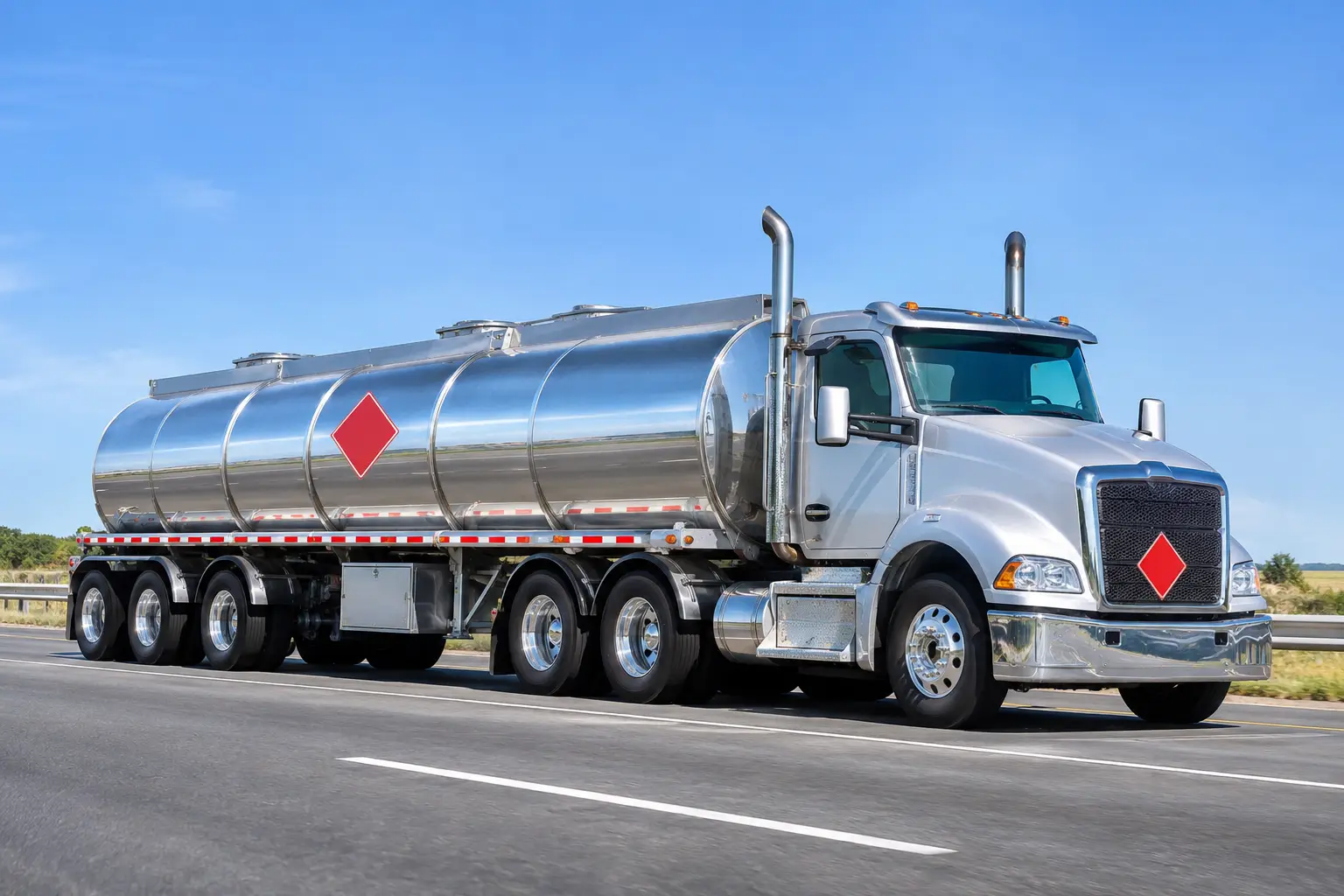
Answer: A low-slung trailer such as a lowboy or car carrier. Low-slung units can hang up on raised crossings, and a stuck trailer on the tracks is deadly, so check clearance before you cross. The tanker is tempting because tankers carry special risks, but it is not one of the low-slung units the model manual warns about at raised crossings.
Round 2
Skids and jackknifes
A jackknife happens when the tractor and trailer fold toward each other. A tractor jackknife starts when the tractor's drive wheels lose traction; a trailer jackknife starts when the trailer's wheels lock and the trailer swings out. Both start with locked or spinning wheels, so the cure starts with getting them rolling again.
6You brake hard on a slippery road and see in your mirror that the trailer is starting to swing out. What should you do?
Answer: Release the brakes so the trailer wheels can roll and regain traction. The trailer is skidding because its wheels have locked, so releasing the brakes lets them grip again and the trailer will start to straighten out. Braking harder is the instinct, which is why it is tempting, but it keeps the wheels locked and lets the trailer swing further.7Why shouldn't you use the trailer hand valve to straighten out a skidding trailer?
Answer: The trailer brakes caused the skid, so applying them makes it worse. A trailer skid comes from the trailer wheels locking, and the hand valve applies only the trailer brakes, so it adds to the problem. The idea that the valve only works when stopped is tempting because you use it mostly for testing, but it does work while moving, which is why using it in a skid is dangerous.8A tractor jackknife usually starts when what happens?
Answer: The tractor's drive wheels lock or lose traction. When the drive wheels lock or spin, the back of the tractor can slide sideways and the trailer pushes it around into a jackknife. A full trailer is tempting because it adds weight, but trailer skids are actually more likely when the trailer is empty or lightly loaded.9When is a trailer more likely to lock its wheels and swing out under braking?
Answer: When it is empty or lightly loaded. With little weight on its tires, an empty or light trailer has less traction, so its wheels lock more easily when you brake. A full load is the tempting choice because heavy loads feel harder to control, but the extra weight actually gives the trailer tires more grip.10What is the earliest and best way to notice that your trailer has started to skid?
Answer: Seeing it move out of line in your mirrors. Checking your mirrors whenever you brake hard lets you see the trailer start to swing before it is too late to correct. Pedal vibration is tempting because you might feel something through the pedal, but by the time you feel a trailer skid it may already be far out of line.
Round 3
Off-tracking, turns and backing
On a turn, the rear wheels of a combination follow a different path from the front wheels. This is called off-tracking or cheating, and the longer the vehicle, the bigger the difference. It is why trucks hit curbs, poles and cars on tight turns.
11What is off-tracking?
Answer: The rear wheels following a shorter path than the front wheels on a turn. On a normal turn the trailer's rear wheels cut inside the path of the tractor's front wheels, so you have to steer the front wide enough for the back to clear. A wider path is the tempting choice because the trailer seems to swing out, but on a tight turn it is the inside of the turn that gets hit.12You are making a tight right turn in a tractor-trailer. What does the model CDL manual recommend?
Answer: Go straight ahead into the intersection and turn wide as you complete the turn. Turning wide as you complete the turn keeps your rear wheels off the curb while keeping the right side closed off. Swinging left first is tempting because it seems to give more room, but it leaves a gap on your right that invites cars to squeeze in.13When making a left turn at an intersection in a combination vehicle, when should you start turning?
Answer: After you have reached the center of the intersection. Waiting until you reach the center gives the trailer room to clear the vehicles on your left. Starting as you cross the stop line is tempting because that is how you turn in a car, but off-tracking can then swing the left side of your trailer into waiting traffic.14There are two left-turn lanes. Which one should you use in a combination vehicle?
Answer: The right-hand of the two lanes. Starting from the right-hand turn lane gives you room to swing through the turn without cutting across the other turn lane, and drivers on your left are easier to see. The left-hand lane is tempting because it feels like the natural lane for a left turn, but you may have to swing right to make it.15When backing a tractor-trailer straight back and you want the rear of the trailer to go left, which way do you turn the steering wheel?
Answer: To the right, the opposite way from where you want the trailer to go. Turning the wheel right pushes the front of the trailer right, so its rear swings left; one easy method is to put your hand at the bottom of the wheel and move it toward where you want the trailer to go. Turning left is tempting because that is how you back a car, but in a trailer it sends the trailer the wrong way.
Round 4
Combination vehicle air brakes
A combination has two air lines running to the trailer: the emergency line, which supplies air and controls the trailer's emergency brakes, and the service line, which carries the braking signal. The tractor protection valve keeps the tractor's air safe if something goes wrong at the trailer.
16The trailer breaks away and the emergency line snaps. What should happen?
Answer: The trailer's emergency brakes come on and the tractor protection valve closes to keep air in the tractor. Losing pressure in the emergency line applies the trailer's emergency brakes, and the tractor protection valve closes to protect the tractor's air. Losing all the tractor's air is the tempting answer, but preventing exactly that is the job of the tractor protection valve.17If air pressure falls low, at about what range does the tractor protection valve close automatically?
Answer: Between 20 and 45 psi. The tractor protection valve closes, and the trailer air supply knob pops out, when pressure falls to somewhere between 20 and 45 psi. 60 psi is tempting because it is linked to the low-air warning, but the warning comes on first; the valve closes later, at a lower pressure.18Why should you never use the trailer hand valve to park?
Answer: Air can leak away and release the trailer brakes, letting the rig roll. The hand valve holds the trailer brakes with air, and if that air leaks out the brakes can release on trailers without spring brakes; always use the parking brakes. Wearing out the spring brakes is tempting because it sounds technical, but the real danger is the trailer rolling away.19After coupling, you push in the trailer air supply control but the trailer's spring brakes won't release. What is a likely cause?
Answer: The service and emergency lines were crossed when the glad hands were connected. Crossed lines send the supply air into the service line instead of charging the trailer's tanks, so there is no air to release the trailer's spring brakes. The hand valve is tempting because it controls trailer brakes, but leaving it off would not stop the spring brakes from releasing.20How do you test the trailer service brakes?
Answer: Move forward slowly and apply the trailer brakes with the hand valve; you should feel them slow the rig. After checking you have normal air pressure and releasing the parking brakes, a slow roll with the hand valve applied shows the trailer brakes are working. Pulling the trailer air supply control is tempting because it also applies trailer brakes, but it is how you test the trailer emergency brakes, with the rig stopped, and it should never be done at highway speed.
Round 5
Coupling and uncoupling
A trailer that comes loose on the road is one of the worst things that can happen in a combination. The model CDL manual sets out a step-by-step method for coupling and uncoupling; follow it every time, including the visual check at the end.
21Before you back under a trailer, what position should the fifth wheel be in?
Answer: Tilted down toward the rear of the tractor, with the jaws open and the release handle in the lock position. The fifth wheel should tilt down at the rear so the trailer's front can slide onto it, with the jaws open and ready to close on the kingpin. Level with the jaws closed is tempting because it looks tidy, but closed jaws can't accept the kingpin, and you may damage them or push the trailer back.22When you back the tractor under the trailer, how high should the trailer be?
Answer: Low enough that the tractor raises it slightly as it backs under. The trailer should sit slightly lower than the fifth wheel, so the tractor lifts it a little as it backs under. Having it high enough to miss the fifth wheel is tempting, but then the kingpin may pass over the jaws or the trailer may drop and hit the tractor.23After backing under the trailer, how do you check that the coupling is secure before you get out to look?
Answer: With the trailer brakes locked, pull forward gently in low gear. This tug test confirms the kingpin is locked in the jaws without risking the trailer pulling free. Releasing the trailer brakes is tempting because it feels like a real-driving test, but if the coupling is bad the trailer could roll away or drop.24When you get out to inspect the coupling, what should you see?
Answer: The locking jaws closed around the shank of the kingpin, with no space between the upper and lower fifth wheel. The jaws must close around the shank, the narrower part of the kingpin, and the trailer's upper fifth wheel must sit flat on the lower one, with the locking lever locked. Closing around the head is tempting because it is the part you can see, but jaws closed on the head mean the trailer is not properly locked and can come loose.25When uncoupling, where should you stop the tractor as you pull out from under the trailer?
Answer: With the tractor frame still under the trailer, so the trailer can't fall if the landing gear sinks. Stopping with the frame under the trailer gives you a safety margin while you check that the landing gear is holding the weight. Pulling fully clear is tempting because it gives you more room, but if the landing gear collapses or sinks, the trailer will drop to the ground.
Tip: This article is an independent study aid and is not affiliated with or endorsed by FMCSA, AAMVA or any state licensing agency. Questions here are original practice items, not real test questions. Rules vary by state, so always study your own state's CDL manual.
Quick quiz: combination checks
Five quick review questions on trailer air lines and doubles. Tap an answer; each question locks after your first pick.
0 / 5 answered
1Glad hands and air lines are often color coded. What do the colors usually mean?
Answer: Blue for the service line and red for the emergency line. Blue marks the service line and red the emergency, or supply, line, which helps you avoid crossing them.2How far should the landing gear be raised after coupling?
Answer: All the way up, with the crank handle secured. Landing gear left partway up can catch on railroad tracks or other objects, so raise it fully and secure the handle.3When pulling doubles, where should the heavier trailer go?
Answer: First, right behind the tractor. Put the heavier trailer first, behind the tractor, and the lighter one at the rear.4In a set of doubles, which air line shut-off valves should be closed?
Answer: The ones at the rear of the last trailer. Shut-off valves let air pass through to the next trailer, so they must be open except at the rear of the last trailer, where they are closed to keep air in.5What does the trailer air supply control look like in most tractors?
Answer: A red, eight-sided knob. The trailer air supply control is a red, eight-sided knob. The yellow diamond is the parking brake control.
Frequently asked questions
Who needs to pass the CDL combination vehicles test?
Anyone applying for a Class A CDL, which covers combinations with a GCWR of 26,001 pounds or more where the towed unit is rated over 10,000 pounds. You take it with the general knowledge test and, if your vehicle has air brakes, the air brakes test.
How many questions are on the combination vehicles test?
Your state decides the number and format; many states use about 20 questions. The federal minimum passing score is 80%. Check your state's CDL manual before you book the test.
Is the doubles and triples test the same as the combination vehicles test?
No. Doubles and triples is a separate knowledge test for the T endorsement, covering pulling more than one trailer, converter dollies and coupling a second trailer. The combination vehicles test is for Class A.
What is a tug test?
After backing under a trailer, you lock the trailer brakes and pull forward gently in low gear. If the trailer stays put, the kingpin is held by the jaws. You then get out and look to confirm the jaws are closed around the shank of the kingpin.
How can I practice combination vehicle questions on my phone?
CDL Exam - Practice Test on iPhone has a Combination Vehicles section among its 14 handbook sections, with short topics, section practice tests and an explanation after every answer.
Respect the trailer behind you
Most combination vehicle questions come down to how the trailer behaves: it rolls over if you turn too fast, swings out if its wheels lock, cuts corners on tight turns and can come loose if you couple carelessly. Learn the trailer air controls and the coupling steps in order, and the rest of the test makes sense.
- Learn the trailer air controls and what each one does when air pressure is lost.
- Practice the coupling and uncoupling steps in order, including the tug test and the visual check.
- Take the Combination Vehicles section practice test in CDL Exam - Practice Test and reread the explanations you miss.
Check your state's CDL manual
Your state's CDL manual is the official study source for the knowledge tests. Details such as the number of questions, how you book a test and any state-only rules vary, so read the manual for the state that will issue your license.
The federal rules behind the manual are in Title 49 of the Code of Federal Regulations. Use the links below to check the licensing, driving, inspection and hours-of-service rules mentioned in this article.