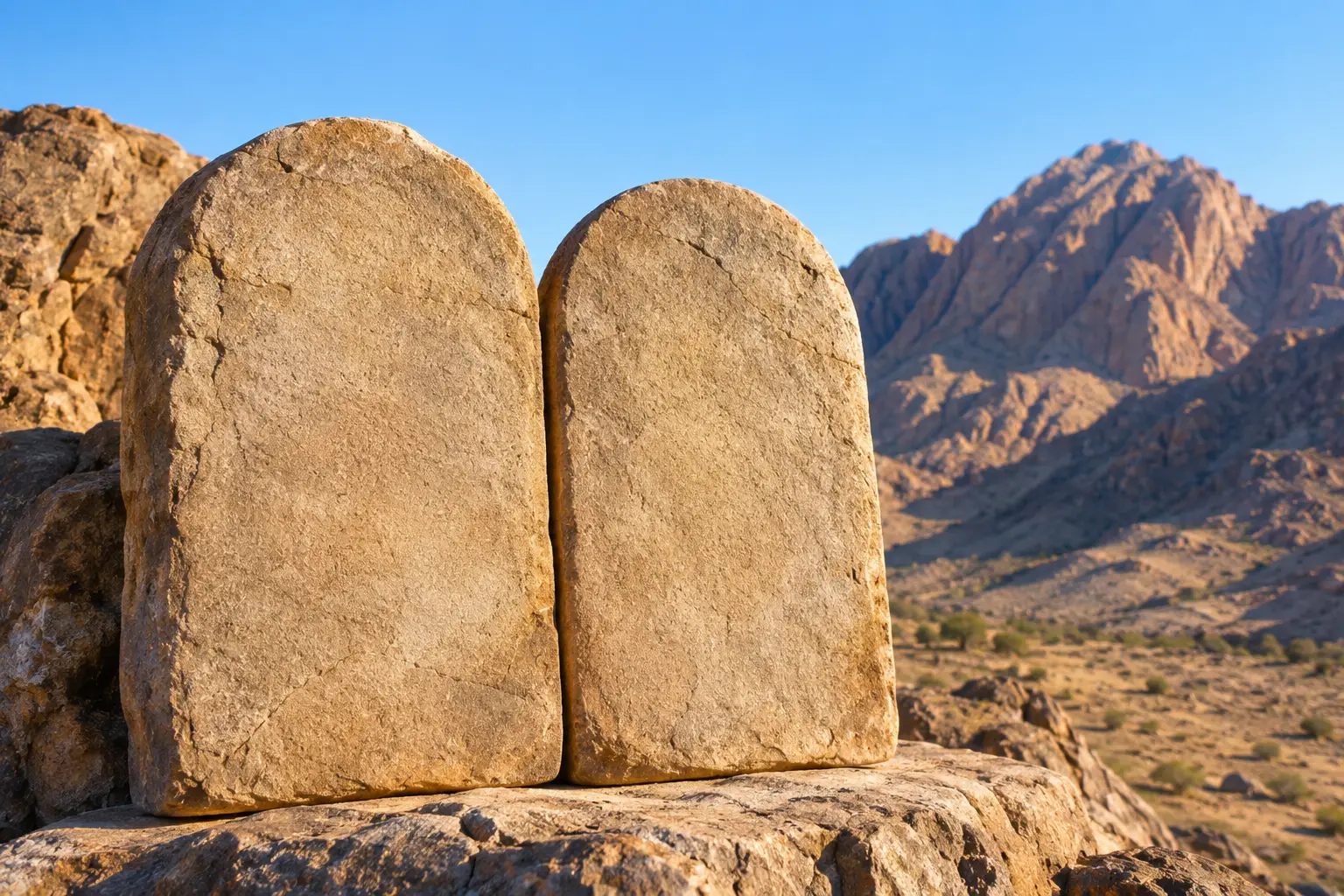
The Ten Commandments are the laws God gave Israel at Mount Sinai, listed in Exodus 20:1-17 and again in Deuteronomy 5:6-21. In short: worship no other gods, make no idols, do not misuse God's name, keep the Sabbath, honour your parents, and do not murder, commit adultery, steal, give false testimony or covet.
The Bible calls them the 'ten words' (Exodus 34:28; Deuteronomy 4:13), which is where the Greek name Decalogue comes from. It does not number them, so Jewish, Catholic, Lutheran, Orthodox and Reformed traditions divide the same verses in slightly different ways. This guide sets out the text, what each commandment means and how the numbering works.
Quick takeaways
- The commandments appear twice, in Exodus 20 and Deuteronomy 5, with small differences in wording.
- They begin with a reminder of rescue: 'I am the LORD your God, who brought you out of Egypt.'
- The first group concerns God and the second concerns other people.
- Traditions agree on the content but count the ten differently.
Where are the Ten Commandments in the Bible?
The Israelites reached the Desert of Sinai in the third month after leaving Egypt (Exodus 19:1). After three days of preparation, the mountain was covered in smoke, there was thunder and lightning and a loud trumpet blast, and God spoke the commandments to the people (Exodus 19:16-20:1). They were so frightened that they asked Moses to speak to them instead (Exodus 20:18-19).
Moses later received two stone tablets 'inscribed by the finger of God' (Exodus 31:18). When he came down and found the people worshipping a golden calf, he broke them, and God told him to cut two new ones (Exodus 32:19; 34:1). The second set was kept inside the ark of the covenant (Deuteronomy 10:1-5).
Forty years later, on the plains of Moab, Moses repeated the commandments to a new generation in Deuteronomy 5. The two lists are nearly identical, and the differences are set out in the last section of this guide.
The Bible does not say how the commandments were divided between the two tablets. A common tradition, especially in Christian art, puts the commandments about God on one tablet and those about other people on the other. Some scholars suggest instead that each tablet held a full copy, as in ancient treaties where each party kept one. Either way, Exodus calls them 'the tablets of the covenant law' (Exodus 31:18), a sign that they were the heart of the covenant between God and Israel.
Exodus 20:1-17
The first list, spoken at Sinai.
Deuteronomy 5:6-21
The second list, repeated by Moses before Israel entered Canaan.
Exodus 31:18
The tablets are written by 'the finger of God'.
Exodus 34:28
The first place the Bible calls them the 'ten words', usually translated Ten Commandments.
Commandments about God
What do the first commandments mean?
The list begins with a statement, not an order: 'I am the LORD your God, who brought you out of Egypt, out of the land of slavery' (Exodus 20:2). The commandments are presented as the response to a rescue that has already happened. Israel was not told to obey in order to be freed; it was freed and then told how to live.
'You shall have no other gods before me' (Exodus 20:3) asks for exclusive loyalty in a world where most nations worshipped many gods. The ban on idols (Exodus 20:4-6) goes further: Israel was not to make an image of anything and bow down to it, even an image meant to represent the LORD. The golden calf, made only weeks later, broke this command head on.
'You shall not misuse the name of the LORD your God' (Exodus 20:7), translated 'take the name in vain' in older Bibles, covers more than swearing. It includes making false promises in God's name or using his name to support a lie. The Sabbath command (Exodus 20:8-11) set aside the seventh day as a day of rest for everyone in the household, including servants, foreigners and animals.
Christians apply the Sabbath command in different ways. Most worship on Sunday, the day of Jesus' resurrection, and treat it as a day of rest and worship, while Seventh-day Adventists and Seventh Day Baptists keep Saturday. Jewish practice keeps the Sabbath from Friday evening to Saturday evening.
Commandments about other people
What do the later commandments mean?
'Honour your father and your mother' (Exodus 20:12) comes with a promise attached, long life in the land, and Paul calls it 'the first commandment with a promise' in Ephesians 6:2-3. In Israel it applied to adult children too, including caring for parents in old age.
'You shall not murder' (Exodus 20:13) is translated 'Thou shalt not kill' in the King James Version. The Hebrew verb is generally understood to mean unlawful killing, which is why most modern translations say 'murder'. The next three protect marriage, property and truth: do not commit adultery, do not steal, and do not give false testimony against your neighbour (Exodus 20:14-16). The last of these first applied to witnesses in court, where a lie could cost someone their life.
The final commandment, 'You shall not covet' (Exodus 20:17), is different from the rest. It deals with desire rather than action: wanting your neighbour's house, wife, servants, animals or 'anything that belongs to your neighbour'. Paul says this was the commandment that showed him his own sin (Romans 7:7).
Tip: An easy way to remember the order of the second group: family, life, marriage, property, truth, then the heart.
Why are the Ten Commandments numbered differently?
Exodus 20:2-17 contains more than ten instructions, and the Bible does not say where one 'word' ends and the next begins. Different traditions settled the question differently, and the result is that the same commandment can have a different number depending on who is counting. None of the traditions leaves anything out.
Jewish tradition counts the opening statement, 'I am the LORD your God', as the first word, then joins 'no other gods' and 'no idols' as the second. Catholics and Lutherans follow a division associated with Augustine: 'no other gods' and 'no idols' form one commandment, and coveting is split into two. Orthodox, Reformed, Anglican and most other Protestant churches follow an older division found in the Jewish writers Philo and Josephus, which treats the idol ban as a separate second commandment and keeps coveting as one.
Catholics and Lutherans also split the coveting command differently. The Catholic catechism follows Deuteronomy 5:21, which puts the neighbour's wife first, so the ninth is about a neighbour's wife and the tenth about his goods. Luther's Small Catechism follows Exodus 20:17, so the ninth is about a neighbour's house and the tenth about his wife, workers and animals.
The difference matters mostly when someone refers to a commandment by number. A Catholic speaking of 'the fifth commandment' means 'Do not murder', while a Baptist or Presbyterian means 'Honour your father and mother'. When in doubt, quote the words rather than the number.
| Commandment | Jewish | Catholic | Lutheran | Orthodox, Reformed and most Protestants |
|---|---|---|---|---|
| I am the LORD your God, who brought you out of Egypt (20:2) | 1 | Part of 1 | Part of 1 | Preface |
| No other gods before me (20:3) | 2 | 1 | 1 | 1 |
| No idols (20:4-6) | Part of 2 | Part of 1 | Part of 1 | 2 |
| Do not misuse God's name (20:7) | 3 | 2 | 2 | 3 |
| Keep the Sabbath holy (20:8-11) | 4 | 3 | 3 | 4 |
| Honour your father and mother (20:12) | 5 | 4 | 4 | 5 |
| Do not murder (20:13) | 6 | 5 | 5 | 6 |
| Do not commit adultery (20:14) | 7 | 6 | 6 | 7 |
| Do not steal (20:15) | 8 | 7 | 7 | 8 |
| Do not give false testimony (20:16) | 9 | 8 | 8 | 9 |
| Do not covet your neighbour's house or goods (20:17) | 10 | 10 | 9 | 10 |
| Do not covet your neighbour's wife (20:17) | Part of 10 | 9 | 10 | Part of 10 |
Exodus 20 and Deuteronomy 5 compared, and the commandments in the New Testament
The two lists agree on all ten, but a few details change. The most striking is the reason given for the Sabbath. Exodus points back to creation, when God rested on the seventh day (Exodus 20:11). Deuteronomy points back to slavery: 'Remember that you were slaves in Egypt', so Israel's servants should rest too (Deuteronomy 5:15).
In the New Testament, Jesus quotes several commandments to the rich man who asks how to inherit eternal life (Mark 10:19). When asked which commandment is the greatest, he answers with two from elsewhere in the Law: love God with all your heart, soul and mind (Deuteronomy 6:5), and love your neighbour as yourself (Leviticus 19:18). 'All the Law and the Prophets hang on these two commandments' (Matthew 22:37-40).
Paul makes the same link, listing the commandments on adultery, murder, stealing and coveting and calling love 'the fulfilment of the law' (Romans 13:9-10). Christians differ on how the Old Testament law applies today, but almost all traditions teach the Ten Commandments as a summary of how to love God and neighbour.
| Detail | Exodus 20 | Deuteronomy 5 |
|---|---|---|
| Sabbath verb | 'Remember the Sabbath day' (20:8) | 'Observe the Sabbath day' (5:12) |
| Reason for the Sabbath | God rested after creation (20:11) | Israel was rescued from slavery (5:15) |
| Honouring parents | So that you may live long (20:12) | Adds 'that it may go well with you' (5:16) |
| Coveting | Neighbour's house listed first (20:17) | Neighbour's wife listed first (5:21) |
Check what you learned
Five quick questions on the Ten Commandments.
0 / 5 answered
1Which chapter of Exodus contains the Ten Commandments?
Answer: Exodus 20. Exodus 20:1-17 gives the list. Exodus 3 is the burning bush, Exodus 12 the Passover and Exodus 32 the golden calf.2What reason does Deuteronomy 5:15 give for keeping the Sabbath?
Answer: Israel had been slaves in Egypt. Deuteronomy ties the Sabbath to the rescue from slavery, while Exodus 20:11 ties it to creation.3Which commandment does Ephesians 6:2 call 'the first commandment with a promise'?
Answer: Honour your father and mother. The promise is that 'it may go well with you and that you may enjoy long life on the earth' (Ephesians 6:3).4What does the word Decalogue mean?
Answer: Ten words. It comes from the Greek for 'ten words', the Bible's own name for the commandments (Exodus 34:28; Deuteronomy 10:4).5Where were the second set of stone tablets kept?
Answer: In the ark of the covenant. Moses put the tablets in the ark he had made, as the LORD commanded (Deuteronomy 10:5).
Frequently asked questions
What are the Ten Commandments in order?
In the Protestant and Orthodox numbering they are: have no other gods; make no idols; do not misuse God's name; keep the Sabbath holy; honour your father and mother; do not murder; do not commit adultery; do not steal; do not give false testimony; do not covet. Catholics and Lutherans join the first two and split coveting into two, so the numbers shift but the content is the same.
Why are there two versions of the Ten Commandments?
The commandments appear in Exodus 20, when God spoke them at Sinai, and again in Deuteronomy 5, when Moses repeated them to the next generation forty years later. The wording is almost the same. The main differences are the reason for the Sabbath, a few added words on honouring parents, and the order of the coveting clauses.
What is the greatest commandment?
When an expert in the law asked Jesus this question, he quoted Deuteronomy 6:5, 'Love the Lord your God with all your heart and with all your soul and with all your mind', and called it the first and greatest. He added a second like it, 'Love your neighbour as yourself', from Leviticus 19:18, and said the whole Law and the Prophets hang on these two (Matthew 22:37-40).
Do Christians still follow the Ten Commandments?
Almost all Christian traditions teach the Ten Commandments, often in catechism classes, as a summary of God's moral will. Christians differ on details, especially the Sabbath: most worship on Sunday, the day of the resurrection, while some churches keep Saturday. The New Testament repeats the moral content of the commandments and sums them up in love for God and neighbour.
How can I memorise the Ten Commandments?
Learn them in two groups: four about God and six about other people, in the Protestant numbering. Link the second group to a simple chain: family, life, marriage, property, truth and desire. Saying them aloud daily for a week works for most people. Bible Quiz Trivia, a free Android app, also has Old Testament questions that help you recall them.
Ten words, two directions
The Ten Commandments start with God's rescue of Israel and then describe the life that follows: loyalty to God, and respect for family, life, marriage, property and truth. Traditions number them differently, but they read the same verses.
- Read Exodus 20:1-17 and Deuteronomy 5:6-21 side by side.
- Learn the numbering your own church uses, using the table above.
- Practise Old Testament questions on the law and Sinai in Bible Quiz Trivia.
Check the evidence behind the guide
Use these references to check terminology and pursue a topic in more depth. Photo quizzes help you practise observation; a single picture rarely proves a difficult identification.
Wording, names and verse numbers differ slightly between Bible translations. Check a passage in the translation you use before quoting it.