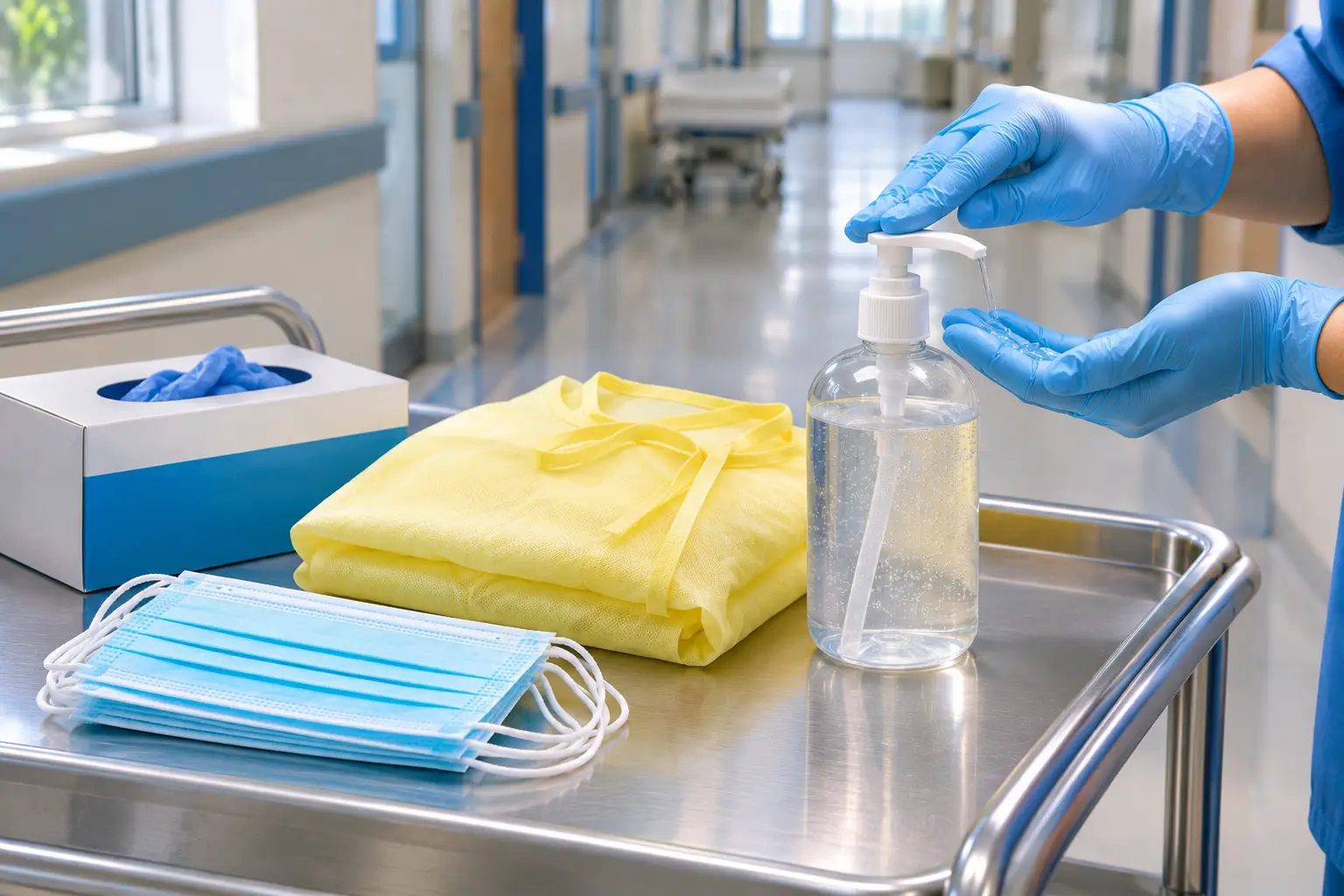
NCLEX infection control questions test whether you can match an infection to the right precautions, put on and take off PPE in the right order, and assign rooms safely. Standard precautions apply to every client; contact, droplet and airborne precautions are added on top for specific infections. Know which diseases go with which precautions and most of these questions are quick wins.
We start with a table of the three types of transmission-based precautions. Then come five rounds of five questions: hand hygiene and standard precautions, contact precautions and C. diff, droplet and airborne precautions, PPE order and room assignments, and a mixed round on sharps, sterile technique and the chain of infection.
Every question is an original practice item written in NCLEX style, not a real exam question. Tap an option to see the answer and a rationale that explains why it is right and why the most tempting wrong option is wrong.
Quick takeaways
- Standard precautions apply to every client, every time; transmission-based precautions are added on top.
- Put PPE on in the order gown, mask or respirator, goggles or face shield, then gloves.
- Airborne infections such as measles, chickenpox and TB need a negative-pressure room and an N95 or higher respirator.
- C. diff spores resist alcohol: use soap and water for hands and a sporicidal disinfectant for surfaces.
The basics
How the NCLEX tests infection control
Infection control sits in the Safety and Infection Prevention and Control category of the NCLEX-RN test plan. The questions are practical: which precautions to use, which PPE to wear, which client can share a room, and what to do after an exposure.
The rules on the exam follow CDC guidance. Standard precautions treat blood, all body fluids except sweat, broken skin and mucous membranes as potentially infectious for every client. Transmission-based precautions add extra steps based on how an infection spreads: by touch, by large droplets, or by tiny particles that stay in the air.
| Precaution | How it spreads | Common examples | PPE and room |
|---|---|---|---|
| Contact | Direct touch or contaminated surfaces | MRSA, VRE, C. diff, scabies, RSV in infants | Gown and gloves; private room or cohort; dedicated equipment |
| Droplet | Large droplets from coughing or sneezing, within about 6 feet | Influenza, pertussis, mumps, meningococcal meningitis | Surgical mask; private room or cohort; client wears a mask to leave the room |
| Airborne | Tiny particles that stay in the air | Tuberculosis, measles, chickenpox, disseminated shingles | Fit-tested N95 or higher respirator; negative-pressure airborne infection isolation room |
Tip: Chickenpox and disseminated shingles need contact precautions as well as airborne precautions, because the skin lesions are infectious too.
Round 1
Hand hygiene and standard precautions
Alcohol-based hand rub is the preferred method for routine hand hygiene when hands aren't visibly dirty. It is faster and kinder to skin than soap and water and kills most germs. Soap and water is needed when hands are visibly soiled and after caring for clients with spore-forming organisms such as C. diff.
Under standard precautions, the PPE you wear depends on the task, not the diagnosis. Ask yourself what you might touch or what might splash, and protect that part of your body.
1When should a nurse wash hands with soap and water instead of using an alcohol-based hand rub?
Answer: When the hands are visibly soiled. Alcohol rub doesn't work well through visible dirt or body fluids, so visibly soiled hands need soap and water. Before putting on gloves is tempting because it is a key moment for hand hygiene, but an alcohol rub is the preferred method there.2A nurse uses an alcohol-based hand rub. For how long should the nurse rub the hands together?
Answer: Until the hands are completely dry. The rub should cover all surfaces of the hands and fingers and be rubbed in until dry, which usually takes about 20 seconds. Wiping off the extra is tempting because it is quicker, but the alcohol needs that contact time to kill germs.3A nurse removes gloves after emptying a urinary drainage bag. What should the nurse do next?
Answer: Perform hand hygiene. Gloves can have tiny holes, and hands can become contaminated while taking them off, so hand hygiene is needed every time gloves come off. Skipping it is tempting because the gloves seemed intact, but gloves never replace hand hygiene.4Under standard precautions, which task calls for a mask and eye protection as well as gloves?
Answer: Irrigating a draining wound where splashing is likely. Standard precautions call for a mask and eye protection whenever blood or body fluid could splash or spray, as during wound irrigation. Taking a blood pressure is tempting because it involves touching the client, but contact with intact skin doesn't call for any PPE.5A nurse has just started an IV. How should the nurse handle the used needle?
Answer: Place it in a sharps container straight away without recapping. Placing a used needle straight into a sharps container, without recapping, is the safest way to prevent needlestick injuries. Recapping is tempting because it seems to cover the sharp point, but two-handed recapping is a common cause of needlesticks.
Round 2
Contact precautions, MRSA and C. diff
Contact precautions protect against germs that spread by touch, directly or through equipment and surfaces. They call for a gown and gloves when entering the room, and for equipment such as stethoscopes and blood pressure cuffs that stays in the room.
C. diff deserves extra attention because its spores survive on surfaces for months and resist alcohol. It usually follows antibiotic use, which disrupts the normal gut bacteria.
6A client has MRSA in a wound and is on contact precautions. Which PPE should the nurse put on to enter the room?
Answer: A gown and gloves. Contact precautions call for a gown and gloves on entering the room, because MRSA can be on the client's skin, bedding and surfaces. A surgical mask is tempting because masks are linked with infection control, but a mask alone doesn't protect against germs spread by touch.7Which product should be used to clean surfaces in the room of a client with C. diff?
Answer: A sporicidal disinfectant, such as a bleach-based product. C. diff spores resist alcohol and many common disinfectants, so a sporicidal product such as a bleach-based cleaner is needed. An alcohol wipe is tempting because it is used for most routine cleaning, but it doesn't kill C. diff spores.8A client on contact precautions needs regular vital signs. Which action is correct?
Answer: Keep a dedicated stethoscope and blood pressure cuff in the client's room. Dedicated equipment that stays in the room stops germs being carried to other clients. Using shared equipment and cleaning it at the end of the shift is tempting because cleaning sounds safe, but the equipment would spread germs to every client seen before then.9A client is admitted with scabies. Which precautions should the nurse put in place?
Answer: Contact precautions. Scabies mites spread through skin-to-skin contact and contact with bedding and clothing, so contact precautions are used until effective treatment has been given. Standard precautions alone are tempting because scabies isn't a serious infection, but standard precautions don't call for a gown on every entry.10A client who has been taking clindamycin for a week now has frequent watery stools. What should the nurse do first?
Answer: Place the client on contact precautions and notify the provider. New diarrhea after antibiotics raises concern for C. diff, so the client is placed on contact precautions while testing is arranged. An antidiarrheal is tempting because it relieves the symptom, but it can keep the toxin in the bowel and delay diagnosis.
Round 3
Droplet vs airborne precautions
The difference between droplet and airborne precautions is particle size. Large droplets fall within about 6 feet, so a surgical mask is enough. Tiny airborne particles float and travel on air currents, so they need a negative-pressure room and a fit-tested N95 or higher respirator.
A memory aid for airborne infections is 'My Chicken Hez TB': measles, chickenpox (varicella), herpes zoster when disseminated, and tuberculosis. Most other respiratory infections you will meet on the exam, such as influenza and pertussis, need droplet precautions.
11A client is admitted with influenza. Which precautions should the nurse add to standard precautions?
Answer: Droplet precautions. Influenza spreads mainly through large droplets from coughing and sneezing, so droplet precautions with a surgical mask are used. Airborne precautions are tempting because influenza is a respiratory virus, but they are reserved for infections spread by tiny particles, such as TB and measles.12A child is admitted with chickenpox. Which room should the nurse request?
Answer: A negative-pressure airborne infection isolation room. Varicella spreads through the air, so the child needs a negative-pressure room that pulls air in and vents it safely outside. A positive-pressure room is tempting because it is also a special room, but it pushes air out into the hallway and is used to protect clients with very weak immune systems.13Which statement about N95 respirators is correct?
Answer: The nurse must be fit-tested and do a seal check each time it is put on. An N95 only protects if it seals tightly to the face, so staff need a fit test and should check the seal every time they put one on. A surgical mask is tempting because it looks similar, but it fits loosely and doesn't filter tiny airborne particles reliably.14A client is admitted with suspected meningococcal meningitis. Which precautions should the nurse use?
Answer: Droplet precautions. Neisseria meningitidis spreads through respiratory droplets, so droplet precautions are used until the client has had about 24 hours of effective antibiotics. Airborne precautions are tempting because meningitis is serious and spreads between people, but the bacteria travel in large droplets, not tiny airborne particles.15A client on droplet precautions must go to radiology for a chest x-ray. Which action is correct?
Answer: Have the client wear a surgical mask during transport. A surgical mask on the client contains the droplets at the source and protects everyone along the way. An N95 on the client is tempting because it sounds more protective, but respirators are meant to protect the wearer, and a surgical mask is what CDC guidance calls for on the client.
Round 4
PPE donning and doffing order and room assignments
CDC's order for putting on PPE is gown, mask or respirator, goggles or face shield, then gloves. Taking it off follows the logic of removing the most contaminated items first: gloves, goggles or face shield, gown, then mask or respirator. Clean your hands as soon as you take off all your PPE, and between steps if your hands become contaminated.
Room assignment questions test whether you can keep the vulnerable apart from the infectious. Clients with the same infection can share a room, called cohorting. Clients with weak immune systems should never share a room with anyone who has an infection.
Putting on
Gown, mask or respirator, goggles or face shield, gloves.
Taking off
Gloves, goggles or face shield, gown, mask or respirator; then hand hygiene.
Respirators
Take off an N95 after leaving the room and closing the door.
16Which order is correct for putting on PPE?
Answer: Gown, mask, goggles, gloves. CDC's order is gown, then mask or respirator, then goggles or face shield, then gloves, so that the gloves go on last and cover the gown's cuffs. Starting with gloves is tempting because they are the most familiar item, but you would contaminate them while putting on the rest.17When taking off PPE after caring for a client on airborne precautions, which item should the nurse remove last?
Answer: The respirator, after leaving the room. The respirator comes off last, outside the room with the door closed, so the nurse never breathes unfiltered room air. Gloves are tempting because they are the last item put on, but they are the most contaminated and come off first.18A client with MRSA in a wound needs a roommate because no private rooms are free. Which client is the best roommate?
Answer: A client who also has an active MRSA infection. Clients with the same organism can share a room, which is called cohorting. The client with influenza is tempting because that client is already infected, but with a different germ, so each client could catch the other's infection.19The nurse is admitting four clients and only one private room is available. Which client needs it most?
Answer: A client with measles. Measles spreads through the air and is extremely contagious, so it needs an airborne infection isolation room. Hepatitis B and HIV are tempting because they are serious infections, but they spread through blood and body fluids and need only standard precautions.20A visitor of a client on contact precautions asks how to protect themselves. What should the nurse tell the visitor?
Answer: Wear a gown and gloves in the room and clean your hands when you leave. Visitors follow the same contact precautions as staff, with a gown and gloves in the room and hand hygiene on leaving, so they don't carry the germ home or to other clients. An N95 is tempting because it sounds the most protective, but contact germs spread by touch, not through the air.
Quick quiz: infection control basics
Five quick review questions on precautions and hand hygiene. Tap an answer; each question locks after your first pick.
0 / 5 answered
1Which precautions does pertussis (whooping cough) need?
Answer: Droplet precautions. Pertussis spreads through respiratory droplets, so droplet precautions with a surgical mask are used along with standard precautions.2Under standard precautions, which body fluid is not treated as potentially infectious?
Answer: Sweat. Standard precautions cover blood, all body fluids, secretions and excretions except sweat, plus broken skin and mucous membranes.3Who is a positive-pressure room designed to protect?
Answer: A client with a severely weakened immune system. Positive pressure pushes air out of the room, keeping germs away from clients such as transplant recipients. Airborne infections need the opposite, a negative-pressure room.4Which hand hygiene method is preferred for routine care when hands aren't visibly soiled?
Answer: Alcohol-based hand rub. Alcohol-based rub is preferred for routine care because it works quickly, kills most germs and is easier on the skin. Gloves never replace hand hygiene.5Vaccination breaks which link in the chain of infection?
Answer: Susceptible host. Vaccination makes a person less likely to be infected, which protects the susceptible host. Hand hygiene, by contrast, mainly breaks the mode of transmission.
Frequently asked questions
What infection control topics are on the NCLEX?
Expect hand hygiene, standard precautions, the three types of transmission-based precautions and which infections need each one, PPE donning and doffing order, room assignments and cohorting, sharps safety and needlestick care, sterile technique and the chain of infection. These questions fall under Safety and Infection Prevention and Control in the test plan.
What is the correct order for putting on and taking off PPE?
CDC's order for putting PPE on is gown, mask or respirator, goggles or face shield, then gloves. To take it off, remove gloves, then goggles or face shield, then the gown, then the mask or respirator, and clean your hands. A respirator is removed after leaving the room. CDC also describes removing gown and gloves together.
Which diseases need airborne precautions?
The main airborne infections on the NCLEX are tuberculosis, measles and chickenpox, along with disseminated herpes zoster. The memory aid 'My Chicken Hez TB' covers them. These clients need a negative-pressure airborne infection isolation room, and staff wear a fit-tested N95 or higher respirator. Chickenpox and disseminated zoster also need contact precautions.
Why is soap and water used for C. diff instead of hand rub?
C. diff forms spores, and alcohol doesn't kill them. Washing with soap and water physically removes the spores from the skin by friction and rinsing. For the same reason, rooms are cleaned with a sporicidal disinfectant, such as a bleach-based product, and clients with C. diff are placed on contact precautions.
How can I practice NCLEX infection control questions?
Make a list of common infections and the precautions for each, then test yourself with questions until you can match them without thinking. NCLEX Exam Practice includes safety and infection control questions alongside its other subjects, each with a rationale, plus a daily quiz and timed mock exams, and it brings back missed questions.
Match the germ to the precaution
Infection control questions are some of the most learnable on the NCLEX. Learn which infections need contact, droplet or airborne precautions, the order for putting on and taking off PPE, and the rule that clients with weak immune systems never share a room with infected clients. Most questions follow from those three.
- Score each round separately and note which type of precaution cost you the most points.
- Write the PPE donning and doffing order from memory, then check it against CDC's.
- Practice infection control questions daily, with rationales, in NCLEX Exam Practice.
Check NCSBN and your nursing texts
NCSBN publishes the NCLEX-RN and NCLEX-PN test plans and the rules for registration, timing and the Next Generation NCLEX item types. Read the current versions on nclex.com before you book your exam or plan your study.
Use practice questions to find your weak topics, then go back to your nursing textbooks, your program's course materials and current CDC guidance to learn the reasoning behind each answer. Reference ranges and protocols vary between facilities, so follow your program and your clinical site in practice.