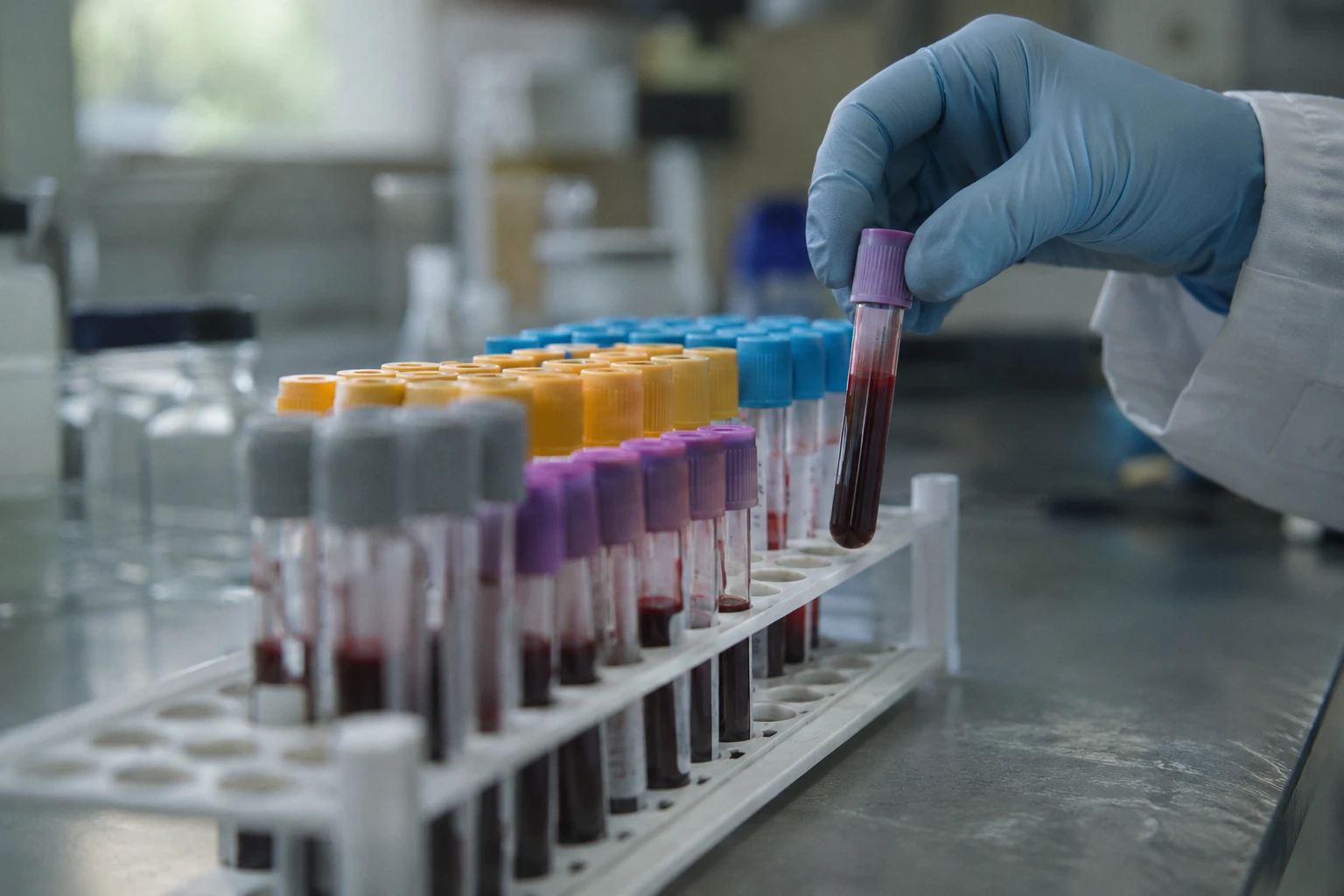
Lab values turn up all over the NCLEX. A question about heart failure may hinge on a potassium level, a question about anticoagulants on an INR, and a case study may hand you a full set of ABGs. You don't need to memorize every test a hospital runs, but you do need to know the common adult ranges well enough to spot an abnormal result at a glance.
The ranges below are the adult reference ranges most widely taught in nursing programs, in the US conventional units the NCLEX uses. Ranges vary slightly from lab to lab and between textbooks, so if your course uses a slightly different number, go with your course. In practice, always use the range printed on the lab report.
Each guide is followed by a round of questions. The questions are less about reciting numbers and more about what the nurse should do with an abnormal result, which is how the exam tests them.
Quick takeaways
- Know the big four cold: potassium 3.5–5.0, sodium 135–145, pH 7.35–7.45 and platelets 150,000–400,000.
- For anticoagulants, know the usual goals: INR 2.0–3.0 on warfarin and aPTT 1.5–2.5 times the control on heparin.
- For ABGs, use ROME: in respiratory problems pH and PaCO2 move in opposite directions; in metabolic problems pH and HCO3 move the same way.
Guide 1
Electrolytes
Electrolyte questions often ask which result to report first or which symptom to expect. Potassium matters most, because both low and high levels can cause dangerous heart rhythms.
These are widely taught adult ranges. Ranges vary slightly by lab and textbook; calcium and magnesium in particular are sometimes given with slightly different limits or units.
| Test | Normal adult range | What to think about |
|---|---|---|
| Sodium | 135–145 mEq/L | Low: headache, confusion, seizures. High: thirst, dry mucous membranes, restlessness. |
| Potassium | 3.5–5.0 mEq/L | Low or high can cause dysrhythmias. Low: muscle weakness, cramps. High: peaked T waves. |
| Chloride | 98–106 mEq/L | Usually moves in the same direction as sodium. |
| Calcium (total) | 9.0–10.5 mg/dL | Low: tingling, muscle cramps, positive Chvostek's and Trousseau's signs. High: weakness, constipation, kidney stones. |
| Magnesium | 1.3–2.1 mEq/L | Low: tremor, brisk reflexes, often alongside low potassium and calcium. High: reduced reflexes, slow breathing. |
| Phosphorus | 3.0–4.5 mg/dL | Tends to move opposite to calcium; often high in kidney failure. |
Round 1
Electrolyte questions
Decide first whether the value is low, normal or high, then think about what that level does to the body.
1Which potassium value should the nurse report to the health care provider first?
Answer: 6.2 mEq/L. A potassium of 6.2 mEq/L is above the normal range of 3.5 to 5.0 and puts the client at risk of dangerous dysrhythmias. The tempting choice is 5.0, but that is still at the top of the normal range. The other two values are normal.2A client taking furosemide has a serum potassium of 3.1 mEq/L. Which finding should the nurse expect?
Answer: Muscle weakness and leg cramps. Loop diuretics such as furosemide cause potassium loss, and low potassium causes muscle weakness and cramps. Peaked T waves are the tempting distractor, but they are a sign of high potassium, not low. Chvostek's sign points to low calcium.3A client's serum sodium is 125 mEq/L and the client is newly confused. Which action is the priority?
Answer: Put seizure precautions in place. A sodium of 125 mEq/L is well below the normal 135 to 145, and new confusion shows it is affecting the brain, which raises the risk of seizures. Safety comes first. Extra water is the tempting wrong answer: it dilutes sodium further and makes hyponatremia worse.4A client had a thyroidectomy yesterday. Which finding suggests the client's calcium level is low?
Answer: Tingling around the mouth and a positive Trousseau's sign. The parathyroid glands can be injured or removed during thyroid surgery, causing low calcium. Tingling around the mouth and Trousseau's sign (a hand spasm when a blood pressure cuff is inflated) are classic signs. Absent reflexes are tempting, but low calcium makes reflexes brisker, not weaker; reduced reflexes point to high calcium or high magnesium.5A client with a history of alcohol use disorder has an electrolyte panel drawn. Which magnesium level should concern the nurse most?
Answer: 1.0 mEq/L. A magnesium of 1.0 mEq/L is below the normal range of about 1.3 to 2.1. Low magnesium is common with alcohol use disorder and can cause tremor, brisk reflexes and dysrhythmias, and it often comes with low potassium and calcium. A value of 1.5 may look low, but it is still within the normal range.
Guide 2
Blood counts and clotting tests
The complete blood count (CBC) tells you about infection risk, bleeding risk and anemia. The clotting tests matter most for clients on anticoagulants.
For warfarin, the INR is the test to watch; vitamin K is the antidote. For a continuous unfractionated heparin infusion, the aPTT is the test to watch; protamine sulfate is the antidote. Low molecular weight heparins such as enoxaparin usually don't need aPTT monitoring.
| Test | Normal adult range | Nursing point |
|---|---|---|
| White blood cells (WBC) | 5,000–10,000/mm³ | Low: high infection risk, so protect the client from infection. High: infection or inflammation. |
| Hemoglobin | Men 14–18 g/dL; women 12–16 g/dL | A falling hemoglobin after surgery or injury may mean bleeding. |
| Hematocrit | Men 42–52%; women 37–47% | High with dehydration; low with bleeding or fluid overload. |
| Platelets | 150,000–400,000/mm³ | Low: bleeding precautions, such as a soft toothbrush, an electric razor and no IM injections if possible. |
| PT | 11–12.5 seconds | Prolonged by warfarin; usually reported with the INR. |
| INR | 0.8–1.1 (not on warfarin) | Usual warfarin goal 2.0–3.0; higher for some mechanical heart valves. |
| aPTT | 30–40 seconds | On a heparin infusion the goal is usually 1.5–2.5 times the control value. |
Round 2
Blood count and anticoagulant questions
In anticoagulant questions, remember that a result above normal can be exactly what the prescriber wants. Compare it with the therapeutic goal, not just the normal range.
6A client taking warfarin for atrial fibrillation has an INR of 2.5. What should the nurse do?
Answer: Give the warfarin as prescribed. For atrial fibrillation, the usual INR goal on warfarin is 2.0 to 3.0, so 2.5 is right where it should be. Holding the dose is tempting because 2.5 is above the normal range for someone not on warfarin, but for this client it is therapeutic.7A client on a continuous heparin infusion has an aPTT of 120 seconds; the control is 32 seconds. Which medicine should the nurse make sure is available?
Answer: Protamine sulfate. An aPTT of 120 seconds is well over 2.5 times the control, so the client is at high risk of bleeding. Protamine sulfate reverses heparin. Vitamin K is the tempting choice, but it is the antidote for warfarin. The nurse should also stop or adjust the infusion per protocol, check for bleeding and notify the provider.8Which laboratory result should the nurse report first?
Answer: Platelet count of 40,000/mm³. A platelet count of 40,000/mm³ is far below the normal 150,000 to 400,000, and the risk of bleeding rises as platelets fall. The client needs bleeding precautions. The other results are within normal limits, including a hematocrit of 45%, which is normal for a man.9A client receiving chemotherapy has a WBC count of 2,000/mm³. Which action should the nurse include in the plan of care?
Answer: Make sure staff and visitors clean their hands and stay away if they are ill. A low white cell count means a high risk of infection, so hand hygiene and keeping sick people away are key. A soft toothbrush and electric razor are tempting, but those are bleeding precautions for a low platelet count. Fresh flowers can carry organisms, and rectal temperatures are avoided because they can injure the mucosa.10The day after hip surgery, a client's hemoglobin has dropped from 12.8 to 9.1 g/dL. What should the nurse do first?
Answer: Check the dressing and drain for bleeding and take vital signs. A drop of more than 3 g/dL the day after surgery may mean active bleeding, so the nurse assesses for bleeding and checks for signs of shock before reporting. Iron-rich foods and supplements help rebuild hemoglobin over weeks, but they do nothing for blood loss that may be happening now.
Guide 3
Arterial blood gases (ABGs) and how to read them
ABG questions look hard, but they follow the same steps every time. Learn the normal values, then work through the four steps below in order.
Respiratory acidosis
Too little breathing, so CO2 builds up: COPD, opioid overdose, sedation, weak respiratory muscles.
Respiratory alkalosis
Too much breathing, so CO2 is blown off: anxiety or panic, pain, fever, early hypoxia.
Metabolic acidosis
Acid builds up or bicarbonate is lost: diabetic ketoacidosis, kidney failure, severe diarrhea, lactic acidosis.
Metabolic alkalosis
Acid is lost or bicarbonate builds up: vomiting, nasogastric suction, too much bicarbonate or antacid.
- Step 1, the pH: below 7.35 is acidosis, above 7.45 is alkalosis.
- Step 2, the PaCO2: if it moves opposite to the pH (high CO2 with a low pH, or low CO2 with a high pH), the cause is respiratory.
- Step 3, the HCO3: if it moves in the same direction as the pH (low with low, high with high), the cause is metabolic.
- Step 4, compensation: if the other value is still normal, it is uncompensated. If both are abnormal and the pH is still abnormal, it is partly compensated. If the pH is back in the normal range, it is fully compensated, and a pH below 7.40 points to an acidosis, above 7.40 to an alkalosis.
| Value | Normal adult range | Meaning |
|---|---|---|
| pH | 7.35–7.45 | Below 7.35 acidosis; above 7.45 alkalosis |
| PaCO2 | 35–45 mm Hg | The respiratory value; CO2 acts as an acid |
| HCO3 | 22–26 mEq/L | The metabolic value; bicarbonate acts as a base |
| PaO2 | 80–100 mm Hg | Oxygen dissolved in arterial blood |
| SaO2 | 95–100% | Oxygen saturation of hemoglobin |
Tip: Use ROME to remember step 2 and 3: Respiratory Opposite, Metabolic Equal.
Round 3
ABG interpretation questions
Work through the four steps on each one before you look at the options.
11A client's ABGs are pH 7.30, PaCO2 52 mm Hg and HCO3 25 mEq/L. How should the nurse interpret these results?
Answer: Uncompensated respiratory acidosis. The pH is low, so it is an acidosis. The PaCO2 is high, moving opposite to the pH, so the cause is respiratory. The HCO3 is normal, so the kidneys haven't compensated yet. Metabolic acidosis is the tempting answer because the pH is low, but in metabolic acidosis the HCO3 would be low too.12Which set of ABGs would the nurse expect in a client who is breathing fast during a panic attack?
Answer: pH 7.50, PaCO2 30 mm Hg, HCO3 24 mEq/L. Breathing fast blows off CO2, so the PaCO2 falls and the pH rises: respiratory alkalosis. The last option is tempting because the pH is also high, but there the PaCO2 is normal and the HCO3 is high, which is metabolic alkalosis, as seen with vomiting.13A client with diabetic ketoacidosis has ABGs of pH 7.25, PaCO2 30 mm Hg and HCO3 15 mEq/L. Which breathing pattern explains the low PaCO2?
Answer: Deep, rapid breathing (Kussmaul respirations). This is a partly compensated metabolic acidosis. The lungs try to correct the acid by blowing off CO2 through deep, rapid Kussmaul breathing, which lowers the PaCO2. Slow, shallow breathing would do the opposite and raise the PaCO2. Cycles of deepening breaths and apnea describe Cheyne-Stokes breathing.14Which condition most likely explains these ABGs: pH 7.49, PaCO2 44 mm Hg, HCO3 33 mEq/L?
Answer: Repeated vomiting over two days. The pH is high and the HCO3 is high, moving the same way, so this is a metabolic alkalosis; the normal PaCO2 shows it is uncompensated. Vomiting causes it by losing stomach acid. Diarrhea is tempting because it is also a GI fluid loss, but diarrhea loses bicarbonate and causes metabolic acidosis.15A client with long-standing COPD has ABGs of pH 7.36, PaCO2 58 mm Hg and HCO3 32 mEq/L. How should the nurse interpret these results?
Answer: Fully compensated respiratory acidosis. The pH is within the normal range, so the problem is fully compensated. A pH of 7.36 is on the acid side of 7.40, so the original problem is an acidosis, and the high PaCO2 is the acid, so it is respiratory. The kidneys have held on to bicarbonate to balance it. Metabolic alkalosis is tempting because the HCO3 is high, but the pH below 7.40 tells you the primary problem is acidosis.
Guide 4
Kidney tests, glucose and therapeutic drug levels
Kidney tests tell you whether a client can clear fluids and drugs. Glucose and HbA1c come up constantly in diabetes questions. Therapeutic drug levels matter for medicines with a narrow gap between a helpful dose and a toxic one.
Drug level ranges in particular differ between sources and can depend on why the drug is being used, so treat these as the classic exam values and follow your course and the prescriber's goals.
| Test | Normal adult range | Nursing point |
|---|---|---|
| BUN | 10–20 mg/dL | Rises with dehydration and reduced kidney function. |
| Creatinine | About 0.6–1.2 mg/dL (a little lower in women) | The better marker of kidney function. Watch for a rise with drugs that can harm the kidneys. |
| Fasting blood glucose | About 70–100 mg/dL | Below 70 mg/dL is hypoglycemia and needs prompt treatment. |
| HbA1c | Below 5.7% | 5.7–6.4% is prediabetes; 6.5% or higher is diabetes. Reflects average glucose over about 2–3 months. A common goal for many adults with diabetes is below 7%. |
| Digoxin | 0.5–2.0 ng/mL | Toxicity: nausea, vomiting, vision changes such as yellow-green halos, slow or irregular pulse. Low potassium raises the risk. |
| Lithium | 0.6–1.2 mEq/L | Toxicity becomes likely above 1.5 mEq/L. Dehydration and low sodium intake raise the level. |
| Phenytoin | 10–20 mcg/mL | Toxicity: nystagmus, unsteady gait (ataxia), slurred speech. Gum overgrowth is a common side effect. |
Round 4
Kidney, glucose and drug level questions
For drug levels, the exam usually pairs the number with symptoms. Look at both before you decide.
16A client taking digoxin reports nausea and yellow-green halos around lights. The potassium is 3.2 mEq/L. Which digoxin level fits digoxin toxicity?
Answer: 2.6 ng/mL. A level of 2.6 ng/mL is above the classic range of 0.5 to 2.0, and nausea with visual halos are typical signs of toxicity. The low potassium makes toxicity more likely. It is worth knowing that low potassium can cause toxic effects even at a level in the normal range, which is why the potassium is checked as well.17A client taking lithium has a coarse hand tremor, diarrhea and a lithium level of 1.9 mEq/L. What should the nurse do first?
Answer: Hold the next dose and notify the health care provider. A level of 1.9 mEq/L is above 1.5, and a coarse tremor with diarrhea are signs of toxicity, so the dose is held and the provider notified. The reassurance option is tempting because a fine hand tremor is a common side effect of lithium, but a coarse tremor is not. Cutting down on salt would raise the lithium level further.18Which phenytoin level is within the therapeutic range?
Answer: 15 mcg/mL. The classic therapeutic range for phenytoin is 10 to 20 mcg/mL, so 15 is within it. A level of 25 is just above the range and is where signs of toxicity such as nystagmus may begin. A level of 5 is below the therapeutic range.19A client with type 2 diabetes has an HbA1c of 9.2%. What does this result tell the nurse?
Answer: Average blood glucose has been high over the past 2–3 months. HbA1c reflects average blood glucose over about 2 to 3 months, and 9.2% is well above the common goal of below 7% for many adults with diabetes. The first option is tempting, but a single high HbA1c doesn't tell you the glucose right now; a fingerstick or serum glucose does that.20Which client's laboratory result should the nurse act on first?
Answer: A blood glucose of 52 mg/dL in a client who is sweaty and confused. A glucose of 52 mg/dL with sweating and confusion is symptomatic hypoglycemia, which can quickly lead to seizures and loss of consciousness, so it needs treatment now. The high creatinine is tempting, but in long-standing kidney disease it is a chronic, expected finding. The other two results are normal.
Tip: NCLEX and NCLEX-RN are registered trademarks of the National Council of State Boards of Nursing (NCSBN). This article is a study aid, is not affiliated with or endorsed by NCSBN, and is not medical advice.
Quick quiz: normal ranges
Five quick checks on the numbers that come up most. Tap an answer; each question locks after your first pick.
0 / 5 answered
1What is the normal adult range for serum potassium?
Answer: 3.5–5.0 mEq/L. Normal serum potassium is 3.5 to 5.0 mEq/L. 135 to 145 mEq/L is the range for sodium.2What is the normal pH range of arterial blood?
Answer: 7.35–7.45. Normal arterial pH is 7.35 to 7.45. Below 7.35 is acidosis and above 7.45 is alkalosis.3What is the usual INR goal for a client taking warfarin for atrial fibrillation?
Answer: 2.0–3.0. The usual goal is 2.0 to 3.0. An INR of 0.8 to 1.1 is normal for someone not taking warfarin.4Which medicine reverses heparin?
Answer: Protamine sulfate. Protamine sulfate reverses heparin. Vitamin K reverses warfarin, naloxone reverses opioids and flumazenil reverses benzodiazepines.5Above which level does lithium toxicity become likely?
Answer: 1.5 mEq/L. The usual therapeutic range is 0.6 to 1.2 mEq/L, and toxicity becomes likely above 1.5 mEq/L.
Frequently asked questions
Which lab values are most important for the NCLEX?
Focus first on potassium, sodium, calcium and magnesium, the CBC (WBC, hemoglobin, hematocrit, platelets), PT/INR and aPTT, ABGs, BUN and creatinine, glucose and HbA1c, and the levels of digoxin, lithium and phenytoin. These come up again and again.
Why do lab ranges differ between textbooks?
Each laboratory sets its own reference ranges based on its equipment and methods, and textbooks round them differently. The differences are usually small. For the exam, learn the ranges your course teaches; in practice, always use the range on the lab report.
What does ROME mean in ABG interpretation?
Respiratory Opposite, Metabolic Equal. In respiratory problems, the pH and PaCO2 move in opposite directions. In metabolic problems, the pH and HCO3 move in the same direction.
Does an abnormal lab value always mean I should call the provider?
Not always. Some results are expected for the client's condition or treatment, such as an INR of 2.5 on warfarin or a raised creatinine in long-standing kidney disease. Look at the whole client: new, unexpected or dangerous results, especially with symptoms, need action and reporting.
How can I memorize lab values faster?
Learn a few at a time, write them out from memory each day, and practice questions that use them. NCLEX Exam Practice brings back the questions you miss after 1, 3 and 7 days, which suits learning numbers like these.
Know the numbers, then think about the client
Lab value questions reward two skills: knowing the common adult ranges, and deciding what a result means for this particular client. Learn the big electrolytes, blood counts, clotting goals and ABG steps first, then the drug levels. Ranges vary slightly by lab and textbook, so anchor on the ones your course teaches.
- Learn potassium, sodium, pH and platelets until you can recall them without thinking.
- Practice ABGs with the four steps and ROME until you can do one in under a minute.
- Test yourself on lab-based questions in NCLEX Exam Practice and read every rationale.
Study lab results as decisions, not numbers
Make a small set of result cards for electrolytes, blood counts, coagulation tests, blood gases and kidney function. On each card, write the direction of change, the finding you would assess next and the action or escalation the question is asking for. That turns a memorized range into a clinical judgment step.
Reference intervals can differ by laboratory and method. Use the range supplied in a question or on a real report, and use your course's required values for exam study.