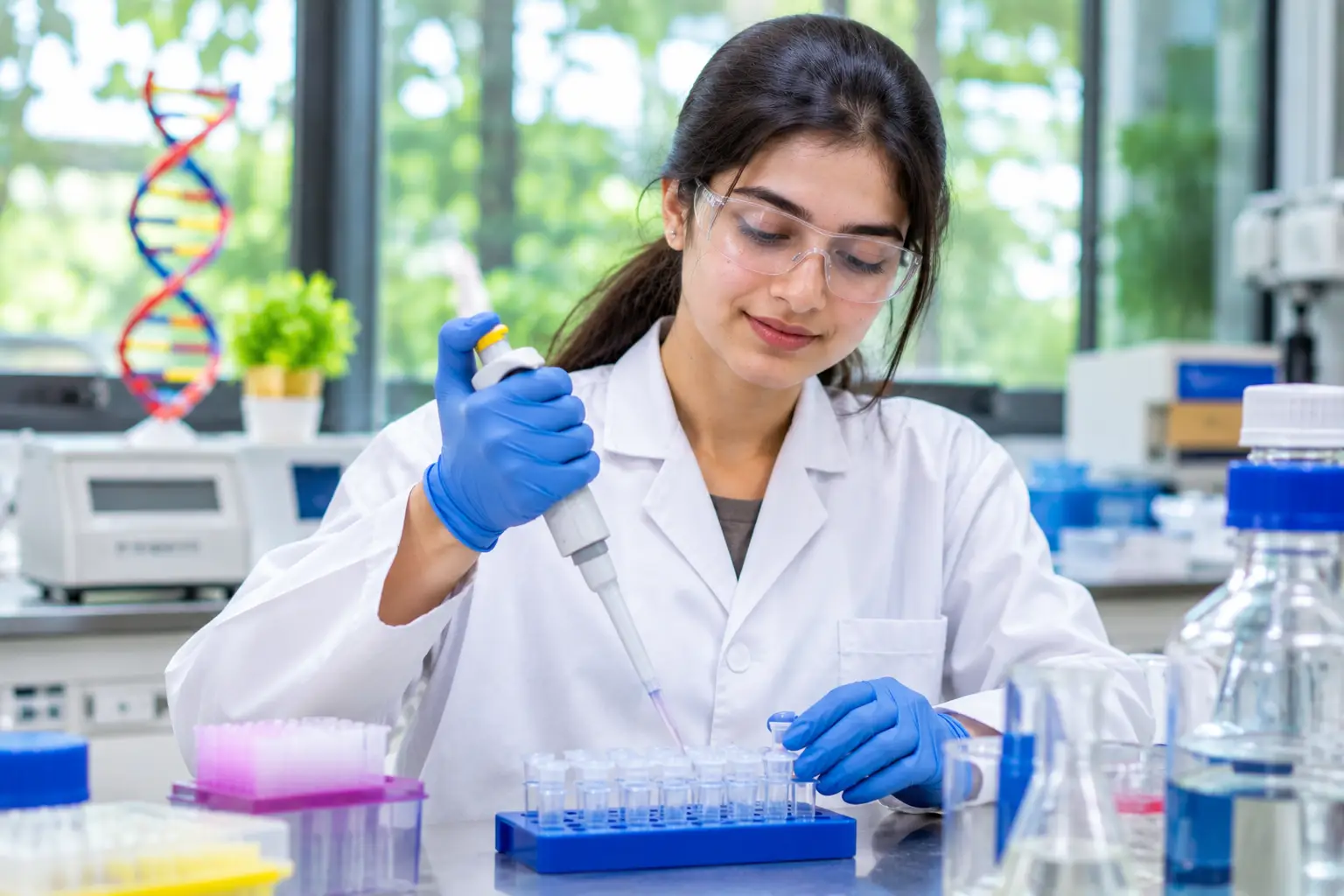
Biochemistry is the subject many Step 1 students dread, because it looks like a wall of pathways and enzyme names. In practice the exam asks a smaller set of questions over and over: which enzyme is missing, which substance builds up, which vitamin is the cofactor and how the disease is inherited. These 25 questions drill exactly that.
We start with how biochemistry and genetics show up on Step 1, then work through five rounds: core metabolism, storage and amino acid disorders, vitamins, inheritance patterns, and molecular biology.
Every question is an original practice item, not a real exam question. Each explanation says why the right answer is right and why the most tempting wrong answer is wrong.
Quick takeaways
- Most enzyme-deficiency questions can be solved by asking what builds up behind the block and what runs short after it.
- Most enzyme deficiencies are autosomal recessive, while many structural-protein disorders are autosomal dominant; learn the exceptions.
- Vitamin questions usually hinge on which enzyme the vitamin serves as a cofactor for.
The basics
How biochemistry and genetics appear on Step 1
Biochemistry and genetics are tested as disciplines inside nearly every organ system. A child with hypoglycemia might be a glycogen storage question, a hemolytic anemia might be an enzyme question, and a pedigree might be hidden inside a neurology vignette.
The best way to study is by pattern: the clinical clue, the enzyme or gene, what accumulates, and how it is inherited. If you can fill in those four columns for a disease, you can answer most questions about it.
| Topic | What Step 1 usually asks | Clue to watch for |
|---|---|---|
| Carbohydrate metabolism | Rate-limiting enzymes and glycogen storage diseases | Fasting hypoglycemia, exercise cramps |
| Lysosomal storage diseases | Missing enzyme and stored substance | Cherry-red macula, hepatosplenomegaly |
| Amino acid disorders | Blocked step and what builds up | Musty odor, dark urine |
| Vitamins | Cofactor role and deficiency signs | Alcohol use, diet, drugs |
| Inheritance | Pattern and recurrence risk | Pedigrees, sex of affected relatives |
| Molecular biology | Replication, repair, transcription and lab techniques | Sun sensitivity, autoantibodies |
Round 1
Core metabolism and enzyme deficiencies
Know the rate-limiting enzyme of each major pathway and what happens when a key enzyme is missing. A vignette that mentions fasting, exercise or a trigger food is usually pointing you to a specific step.
1Which enzyme catalyzes the rate-limiting step of glycolysis?
Answer: Phosphofructokinase-1. Phosphofructokinase-1 converts fructose-6-phosphate to fructose-1,6-bisphosphate and is the main control point of glycolysis, activated by AMP and fructose-2,6-bisphosphate. Hexokinase is the tempting answer because it catalyzes the first step, but that step also feeds other pathways and is not the committed, rate-limiting one.2A 4-month-old has severe hypoglycemia after short fasts, a large liver, lactic acidosis, high uric acid and high triglycerides. Which enzyme is deficient?
Answer: Glucose-6-phosphatase. Without glucose-6-phosphatase, the liver cannot release free glucose from glycogen or gluconeogenesis, so fasting causes severe hypoglycemia and the trapped glucose-6-phosphate spills into lactate, urate and lipid production; this is von Gierke disease. Lysosomal acid alpha-glucosidase is the tempting choice because it is another glycogen storage disease enzyme, but its deficiency (Pompe disease) mainly enlarges the heart and does not cause fasting hypoglycemia.3A 17-year-old gets painful muscle cramps and dark red urine during sprints, and his venous lactate does not rise during a forearm exercise test. Which enzyme is deficient?
Answer: Muscle glycogen phosphorylase. In McArdle disease, muscle cannot break down its glycogen, so exercise causes cramps and myoglobinuria, and lactate fails to rise because no glucose enters glycolysis. Glucose-6-phosphatase is the tempting choice because it is the best-known glycogen storage enzyme, but that liver enzyme defect causes fasting hypoglycemia rather than exercise symptoms.4Which enzyme catalyzes the rate-limiting step of the urea cycle?
Answer: Carbamoyl phosphate synthetase I. Carbamoyl phosphate synthetase I, in the mitochondria and activated by N-acetylglutamate, makes carbamoyl phosphate from ammonia and is the rate-limiting step. Ornithine transcarbamylase is the tempting answer because its deficiency is the most common urea cycle disorder, but it catalyzes the next step, not the rate-limiting one.5A man develops dark urine and anemia after eating fava beans. His blood smear shows bite cells and Heinz bodies. Which enzyme is deficient?
Answer: Glucose-6-phosphate dehydrogenase. G6PD makes NADPH in the pentose phosphate pathway, and red cells need NADPH to keep glutathione reduced; without it, oxidant stress denatures hemoglobin into Heinz bodies and causes hemolysis. Pyruvate kinase deficiency is the tempting choice because it also causes hemolytic anemia, but it causes chronic hemolysis without an oxidant trigger and without Heinz bodies.
Round 2
Lysosomal storage and amino acid disorders
For storage diseases, pair each missing enzyme with the substance it fails to break down and the one or two clinical clues that set it apart. Most are autosomal recessive; Fabry and Hunter are the X-linked exceptions.
6In a child with classic phenylketonuria, which amino acid becomes essential in the diet?
Answer: Tyrosine. Phenylalanine hydroxylase normally converts phenylalanine to tyrosine, so when it is missing, tyrosine must come from the diet. Phenylalanine is the tempting answer, but it is always essential, and in PKU intake must be limited because it builds up and damages the brain.7A 40-year-old man has back and knee pain, bluish-black discoloration of his ear cartilage, and urine that turns black when left standing. Which enzyme is deficient?
Answer: Homogentisate oxidase. In alkaptonuria, homogentisic acid cannot be broken down; it darkens urine on standing and deposits in connective tissue (ochronosis), causing arthritis. Tyrosinase is the tempting choice because it is also in the tyrosine pathway and linked with pigment, but its deficiency causes albinism, a lack of pigment rather than dark deposits.8A 10-year-old has a large liver and spleen, bone pain and anemia. Bone marrow shows macrophages with cytoplasm that looks like crumpled tissue paper. Which enzyme is deficient?
Answer: Glucocerebrosidase. Gaucher disease is caused by glucocerebrosidase deficiency, and glucocerebroside builds up in macrophages, giving the crumpled tissue paper look and affecting the liver, spleen and bone. Sphingomyelinase is the tempting answer because Niemann-Pick disease also enlarges the liver and spleen, but it shows foamy macrophages and often a cherry-red macula with neurodegeneration.9A 6-month-old who was developing normally now startles easily and is losing motor skills. The retina shows a cherry-red macula, and there is no enlargement of the liver or spleen. Which enzyme is deficient?
Answer: Hexosaminidase A. Tay-Sachs disease is caused by hexosaminidase A deficiency, so GM2 ganglioside builds up in neurons, causing neurodegeneration, an exaggerated startle and a cherry-red macula without hepatosplenomegaly. Sphingomyelinase is the tempting choice because Niemann-Pick disease also gives a cherry-red macula, but it typically comes with a large liver and spleen.10Which of these lysosomal storage diseases is inherited in an X-linked recessive pattern?
Answer: Fabry disease. Fabry disease, caused by alpha-galactosidase A deficiency, is X-linked recessive and causes burning pain in the hands and feet, angiokeratomas and later kidney and heart disease. Gaucher disease is the tempting answer because it is the most familiar storage disease, but like Tay-Sachs and Krabbe it is autosomal recessive.
Round 3
Vitamins and nutrition
Vitamin questions are rarely about food sources. They ask which enzyme the vitamin helps, what the deficiency looks like and which situation (alcohol use, a drug, a disease) causes it.
11A man with long-standing heavy alcohol use is brought in confused and unsteady, with abnormal eye movements. A deficiency of which vitamin causes this picture?
Answer: Thiamine (B1). Confusion, ataxia and ophthalmoplegia make up Wernicke encephalopathy, caused by thiamine deficiency, and thiamine is given before glucose because glucose metabolism uses up the remaining thiamine. B12 is the tempting answer because it also causes neurologic problems in people at nutritional risk, but its deficiency develops slowly with neuropathy and dorsal column signs, not this acute triad.12A man on a diet with almost no fruit or vegetables has bleeding, swollen gums, bruising around hair follicles and corkscrew-shaped hairs. Which step is impaired?
Answer: Hydroxylation of proline and lysine in collagen. Vitamin C is needed to hydroxylate proline and lysine residues in procollagen; without it, collagen is weak, so vessels and gums bleed (scurvy). Gamma-carboxylation is the tempting choice because vitamin K deficiency also causes bleeding, but it prolongs the PT and does not cause gum disease or corkscrew hairs.13A patient with a metastatic carcinoid tumor develops a scaly rash on sun-exposed skin, diarrhea and memory problems. A deficiency of which vitamin is most likely?
Answer: Niacin (B3). Niacin can be made from tryptophan, and a carcinoid tumor diverts tryptophan into serotonin, leaving too little for niacin and producing pellagra. Pyridoxine is the tempting answer because B6 is a cofactor in niacin synthesis from tryptophan, but its own deficiency mainly causes neuropathy, cheilosis and sideroblastic anemia.14A patient being treated for tuberculosis develops numbness and tingling in the feet. Which vitamin should be given to prevent this complication?
Answer: Pyridoxine (B6). Isoniazid interferes with vitamin B6 and can cause B6 deficiency with peripheral neuropathy, so B6 is commonly given with it. B12 is the tempting choice because its deficiency also causes neuropathy, but isoniazid does not deplete B12.15A man eats a large number of raw egg whites every day. Which group of enzymes is most likely to lose its cofactor?
Answer: Carboxylases, such as pyruvate carboxylase. Avidin in raw egg white binds biotin, and biotin is the cofactor for carboxylases such as pyruvate carboxylase, acetyl-CoA carboxylase and propionyl-CoA carboxylase. Dehydrogenases are the tempting choice because pyruvate dehydrogenase also acts on pyruvate, but it depends on thiamine, lipoic acid, CoA, FAD and NAD+, not biotin.
| Vitamin | Key cofactor role | Deficiency clue |
|---|---|---|
| B1 (thiamine) | Pyruvate dehydrogenase, alpha-ketoglutarate dehydrogenase, transketolase | Wernicke encephalopathy, beriberi |
| B3 (niacin) | Part of NAD+ and NADP+ | Pellagra: diarrhea, dermatitis, dementia |
| B6 (pyridoxine) | Transamination and decarboxylation reactions | Neuropathy with isoniazid |
| B7 (biotin) | Carboxylase enzymes | Large intake of raw egg whites |
| C (ascorbic acid) | Hydroxylation of proline and lysine in collagen | Scurvy: bleeding gums, corkscrew hairs |
Round 4
Inheritance patterns
Inheritance questions are easier if you draw a quick Punnett square instead of working it out in your head. Read carefully whether the question asks about any child, a son, a daughter or a sibling who is already known to be unaffected.
Autosomal dominant
Affects both sexes and appears in every generation; often involves structural proteins or receptors.
Autosomal recessive
Affected children usually have unaffected carrier parents; often involves enzymes.
X-linked recessive
Mostly affects males, and there is no father-to-son transmission.
Mitochondrial
Passed only from the mother, with variable severity because of heteroplasmy.
16Which of these disorders is inherited in an autosomal dominant pattern?
Answer: Marfan syndrome. Marfan syndrome is caused by a mutation in fibrillin-1, a structural protein, and one abnormal copy is enough to cause disease. Cystic fibrosis is the tempting choice because it is so common, but like sickle cell disease and PKU it is autosomal recessive, so both copies must be affected.17A woman is a carrier of an X-linked recessive disorder and her partner is unaffected. What is the chance that their next son will be affected?
Answer: 50%. Every son gets his X chromosome from his mother, and she passes the affected X half the time, so each son has a 1 in 2 chance. 25% is the tempting answer, but that is the chance for any child before sex is known (1/2 chance of a son × 1/2 chance he gets the affected X).18Two unaffected parents have a child with an autosomal recessive disease. Their other child is unaffected. What is the probability that this unaffected child is a carrier?
Answer: 2/3. Each parent is a carrier, so the possible outcomes are 1 affected, 2 carriers and 1 non-carrier out of 4; once you know the child is unaffected, only 3 outcomes remain, and 2 of those are carriers. 1/2 is the tempting answer because it is the carrier chance for any child before you exclude the affected outcome.19A disease affects all the children of affected women but none of the children of affected men, and severity varies widely within the family. Which pattern fits?
Answer: Mitochondrial inheritance. Mitochondria come only from the egg, so affected mothers pass the disease to all their children, affected fathers to none, and the mix of normal and mutant mitochondria (heteroplasmy) makes severity vary. X-linked dominant is the tempting choice, but there an affected father passes the disease to all his daughters, and an affected mother passes it to only half her children.20Huntington disease is caused by an expanded repeat of which trinucleotide?
Answer: CAG. Huntington disease is an autosomal dominant expansion of CAG repeats in the huntingtin gene, and the repeat can grow in later generations, causing anticipation. CGG is the tempting answer because it is another well-known repeat, but it causes fragile X syndrome; CTG is myotonic dystrophy and GAA is Friedreich ataxia.
Round 5
Molecular biology and lab techniques
Molecular biology questions often hide inside a clinical story, such as a skin cancer from DNA repair failure or an autoantibody against a nuclear protein. Link each enzyme or technique to its single job.
21A child has severe sunburn after brief sun exposure, many freckles and early skin cancers. Which DNA repair process is defective?
Answer: Nucleotide excision repair. Xeroderma pigmentosum is a defect in nucleotide excision repair, which removes UV-induced pyrimidine (thymine) dimers. Mismatch repair is the tempting answer because it is the other well-known repair defect linked to cancer, but its loss causes Lynch syndrome with colon and endometrial cancers, not sun sensitivity.22In bacterial DNA replication, which enzyme removes RNA primers and replaces them with DNA?
Answer: DNA polymerase I. DNA polymerase I has 5' to 3' exonuclease activity that removes RNA primers, and it fills the gaps with DNA. DNA ligase is the tempting choice because it also works on Okazaki fragments, but it only seals the final nick in the backbone once the DNA is in place.23Which of these codons is a stop codon?
Answer: UGA. UAA, UAG and UGA are the three stop codons that end translation. AUG is the tempting answer because it marks the boundary of a gene too, but it is the start codon and codes for methionine.24A woman with suspected systemic lupus erythematosus has anti-Smith antibodies. These antibodies target proteins of which structure?
Answer: Small nuclear ribonucleoproteins of the spliceosome. Anti-Smith antibodies bind core proteins of snRNPs, which form the spliceosome that removes introns from pre-mRNA, and they are highly specific for lupus. Histones are the tempting choice because anti-histone antibodies are also linked with lupus, but they are typical of drug-induced lupus.25A researcher wants to measure how much of a specific mRNA a tissue makes. Which technique is used?
Answer: Northern blot. A Northern blot separates RNA and uses a labeled probe to detect a specific mRNA. A Southern blot is the tempting answer because it uses the same probe approach, but it detects DNA, and a Western blot detects protein.
Tip: USMLE is a program of the Federation of State Medical Boards (FSMB) and the National Board of Medical Examiners (NBME). This article is an independent study aid and is not affiliated with or endorsed by FSMB, NBME or USMLE. Questions here are original practice items, not real exam questions, and are not medical advice.
Quick review: biochemistry and genetics
Five quick questions to lock in the basics. Tap an answer; each question locks after your first pick.
0 / 5 answered
1Which enzyme catalyzes the rate-limiting step of gluconeogenesis?
Answer: Fructose-1,6-bisphosphatase. Fructose-1,6-bisphosphatase is the rate-limiting enzyme of gluconeogenesis. Phosphofructokinase-1 runs the opposite reaction in glycolysis.2Lesch-Nyhan syndrome, with self-injury and high uric acid, is caused by a deficiency of which enzyme?
Answer: HGPRT. Lesch-Nyhan syndrome is an X-linked recessive deficiency of hypoxanthine-guanine phosphoribosyltransferase, which blocks purine salvage. Purines are broken down to uric acid instead.3Classic galactosemia, with jaundice, vomiting and cataracts after milk feeding, is caused by a deficiency of which enzyme?
Answer: Galactose-1-phosphate uridyltransferase. Classic galactosemia is a deficiency of galactose-1-phosphate uridyltransferase, so galactose-1-phosphate builds up and damages the liver, brain and lens. Galactokinase deficiency is milder and mainly causes cataracts.4How is cystic fibrosis inherited?
Answer: Autosomal recessive. Cystic fibrosis is autosomal recessive and caused by mutations in the CFTR gene on chromosome 7. Both copies must be affected.5Which of these vitamins is water-soluble?
Answer: Folate. Folate (B9) is water-soluble, like the other B vitamins and vitamin C. Vitamins A, D, E and K are fat-soluble.
Frequently asked questions
How much biochemistry is on USMLE Step 1?
USMLE publishes percentage ranges for each discipline in the Step 1 content outline on usmle.org, and those ranges are updated from time to time. Biochemistry and genetics questions also appear inside organ-system vignettes, so they show up more often than a single subject total suggests.
What are the highest-yield biochemistry topics for Step 1?
Rate-limiting enzymes, glycogen and lysosomal storage diseases, amino acid disorders, vitamin deficiencies, inheritance patterns and DNA repair defects come up again and again. Learn each disease as a pattern: clinical clue, missing enzyme, what builds up and how it is inherited.
How do I remember inheritance patterns for Step 1?
Learn the rules rather than lists: enzyme defects are usually autosomal recessive, structural-protein defects are often autosomal dominant, X-linked recessive disease skips father-to-son transmission, and mitochondrial disease passes only through the mother. Then draw a quick Punnett square for every risk question.
Where can I practice Step 1 biochemistry questions?
USMLE Step 1 Exam Practice MCQ has biochemistry and genetics among its 12 question groups, with an explanation after every answer and bookmarks for the questions you want to revisit. Use it alongside a standard biochemistry text to review the pathways behind any question you miss.
Learn diseases as patterns, not lists
Step 1 biochemistry is manageable when every disease fits the same template: the clue, the missing enzyme or gene, what builds up and how it is inherited. Work through the rounds you missed most, rebuild those patterns, and test yourself again within a few days.
- Make a one-page table of rate-limiting enzymes and the storage diseases from this article.
- Redo every inheritance question by drawing the Punnett square on paper.
- Practice biochemistry and genetics topic quizzes daily in USMLE Step 1 Exam Practice MCQ.
Check the official sources
Exam patterns, syllabi and eligibility rules change, so confirm every date and requirement with the official body before you register or plan your revision.
Use practice questions to find weak topics, then go back to the standard texts and official documents to learn the reasoning behind each answer.