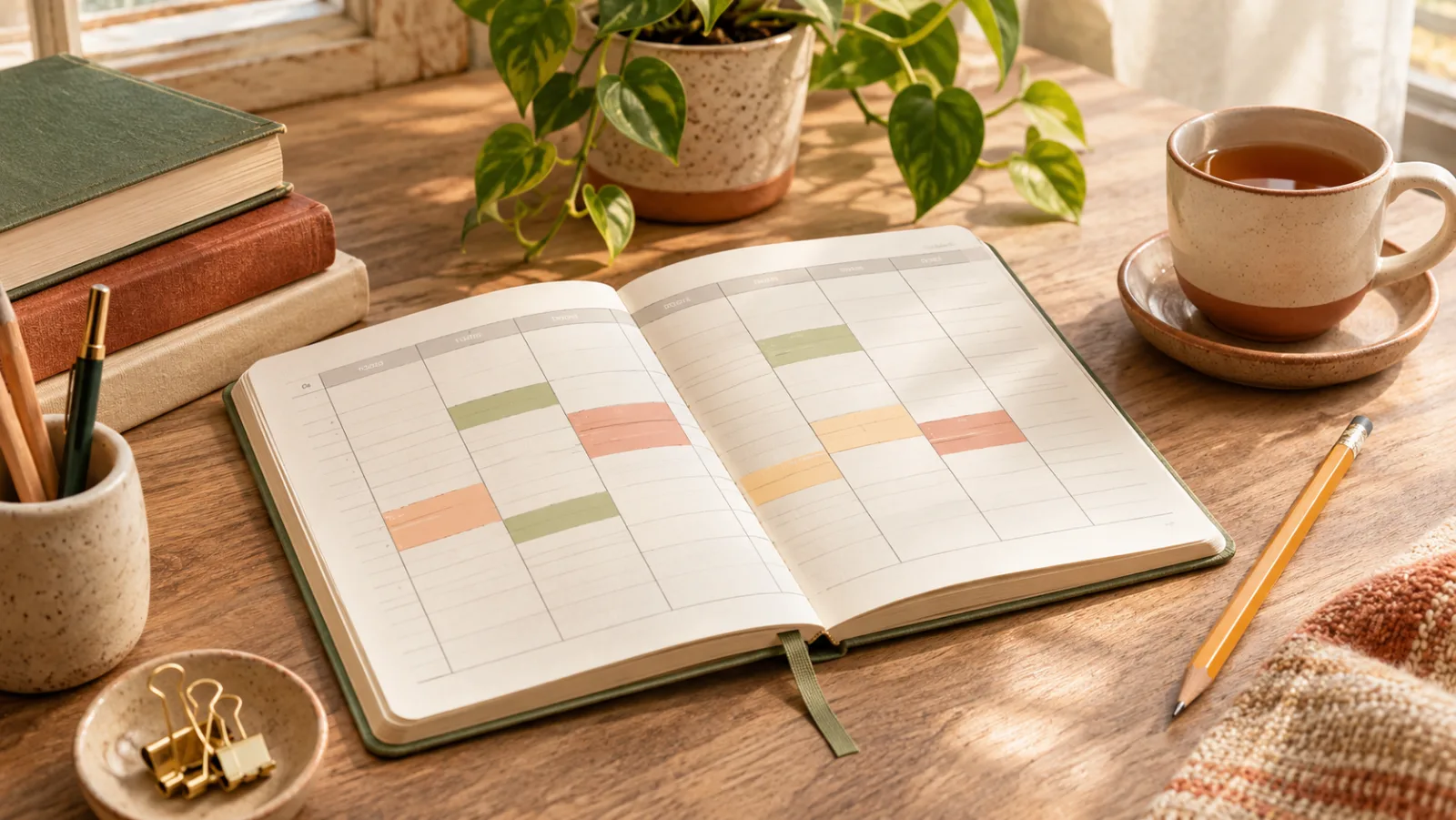
A timetable is useful only if you can still follow it on an ordinary Tuesday. A grid filled with six hours of study after a full day of work may look impressive, but it leaves no room for travel, meals, fatigue or the question that takes twice as long as expected.
Start with the time that is already spoken for. Then give the remaining blocks a specific task and a finish line. Leave open space so one delayed assignment does not collapse the whole week.
Think of the timetable as a decision tool. It tells you what to start next and what can move when priorities change. It is not a scorecard for how closely you obeyed Monday's prediction.
Put fixed commitments on the calendar first
Add classes, work shifts, commuting, appointments, meals and sleep before drawing study blocks. This shows the time you actually control. A twenty-minute gap between classes may support flashcards; it will not support a full practice exam.
Check the week for unusually busy days. Put demanding work in the larger, quieter blocks and lighter reviews in short gaps. If a day has no realistic study time, leave it empty and plan around it.
Turn 'study' into a task you can finish
Replace 'science, 6–8 pm' with 'answer 15 cell-biology questions, check explanations, write down two weak areas'. The second version tells you when the session is done. It also gives you a useful record if the topic takes longer than expected.
Put each task in one of three buckets: first learning, practice, or review. A balanced week needs all three, but the mix changes as the exam gets closer. New learning takes longer; review can fit smaller blocks.
- First learning: read a focused section and make questions.
- Practice: answer new questions without notes.
- Review: retrieve older topics and correct mistakes.
Build a week with room to move
For example, a student with classes on weekdays might plan two 45-minute practice blocks on Monday and Thursday, a 25-minute review on Tuesday and Friday, and a 90-minute mixed set on Saturday. Wednesday and Sunday can hold rest, catch-up or other work.
This is an example, not a recommended number of hours. Choose a workload you can repeat for two weeks. Add time only after the existing plan survives real commitments.
Schedule review before the week fills up
New topics are easy to give calendar space because they feel urgent. Older topics need appointments too. Put a short retrieval block after the first learning session and another later in the week. Use questions you got wrong before reviewing comfortable material.
Near the exam, reserve one block for a mixed set under realistic conditions. Mark errors by topic and use the next available block to repair them. A practice score is diagnostic information, not a prediction of your final result.
What to do when you miss a block
Do not squeeze every missed task into tomorrow. Decide which task has the closest deadline or largest knowledge gap, move that one into the next open block, and shorten or drop a lower-priority task. Keep at least some buffer unassigned.
Review the plan once a week. Compare estimated and actual time, then make next week's blocks more realistic. If you repeatedly avoid one subject, shrink the first step until it is clear enough to start.
Frequently asked questions
How many hours should I study each day?
The useful amount depends on your commitments, exam date and current knowledge. Start with blocks you can complete consistently and adjust after you see how long tasks really take.
Should every hour be scheduled?
No. Open time absorbs delays and allows rest. A timetable with no buffer is fragile.
Is a digital planner better than paper?
Either works. Choose the one you will check daily and that lets you move a block without rebuilding the whole week.
Putting it into practice
Build next week from real commitments, then schedule specific practice and review tasks in the remaining space. Leave a buffer and revise the plan after using it.
- Mark fixed commitments.
- Name the outcome of each study block.
- Check and adjust the timetable weekly.