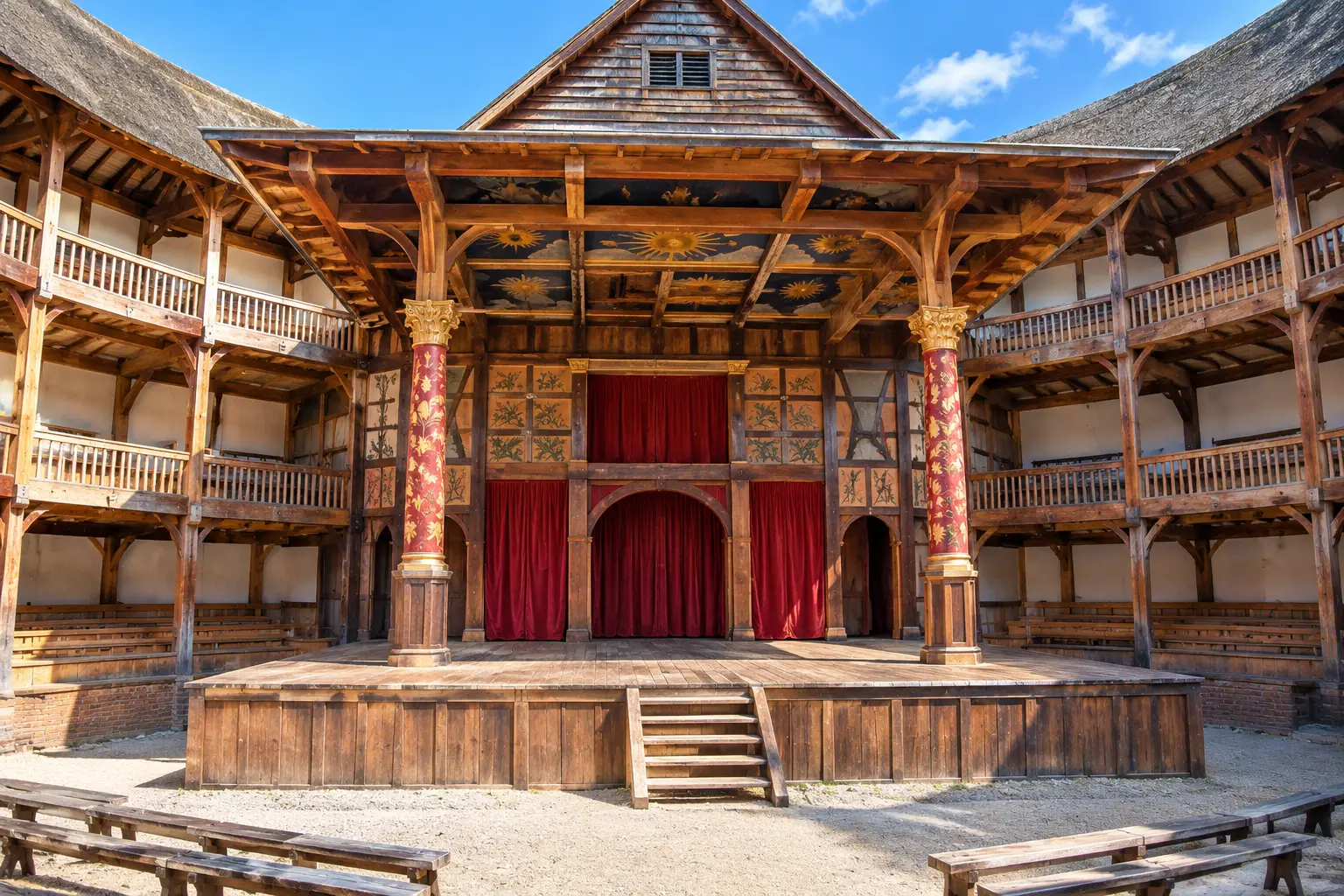
William Shakespeare was born in Stratford-upon-Avon in 1564 and died in 1616. He wrote around 37 plays, as well as 154 sonnets and several longer poems.
In 1623, seven years after his death, two of his fellow actors, John Heminges and Henry Condell, published 36 of his plays in one volume, now called the First Folio. They sorted the plays into three groups: comedies, histories and tragedies. Scholars later added a fourth group, the romances or late plays.
The tragedies
A Shakespearean tragedy follows a central character, often of high rank, whose choices or flaws lead to their downfall and death. The best known are Romeo and Juliet, Hamlet, Othello, King Lear and Macbeth.
Hamlet contains one of the most famous lines in English, 'To be, or not to be', spoken by the prince as he thinks about life and death. Julius Caesar and Antony and Cleopatra are tragedies drawn from Roman history.
The comedies and histories
The comedies are full of disguises, mistaken identity and young lovers, and they usually end in marriage. Examples include A Midsummer Night's Dream, Much Ado About Nothing, As You Like It, Twelfth Night and The Merchant of Venice.
The histories dramatise the lives of English kings. One group runs from Richard II through the two parts of Henry IV to Henry V, which shows the Battle of Agincourt in 1415. Another runs through the three parts of Henry VI to Richard III.
The late romances and a quick guide
Near the end of his career Shakespeare wrote plays that mix sorrow with magic and reunion, such as The Winter's Tale and The Tempest. The First Folio listed these as comedies, but many modern editions call them romances.
The table lists some well-known plays with their usual group and setting.
| Play | Group | Main setting | Central character |
|---|---|---|---|
| Romeo and Juliet | Tragedy | Verona | Romeo and Juliet |
| Hamlet | Tragedy | Denmark | Prince Hamlet |
| Othello | Tragedy | Venice and Cyprus | Othello |
| Macbeth | Tragedy | Scotland | Macbeth |
| A Midsummer Night's Dream | Comedy | Athens and a forest | Four young lovers |
| Twelfth Night | Comedy | Illyria | Viola |
| Henry V | History | England and France | King Henry V |
| Richard III | History | England | King Richard III |
| The Tempest | Romance | An island | Prospero |
Sort the plays
0 / 4 answered
1In which year was the First Folio published?
Answer: 1623. It came out seven years after Shakespeare's death in 1616.2Which group was not used in the First Folio?
Answer: Romances. The romances, or late plays, were named by later scholars.3Which history play shows the Battle of Agincourt?
Answer: Henry V. Henry V's victory at Agincourt in 1415 is the high point of the play.4In which city is Romeo and Juliet set?
Answer: Verona. The play follows two feuding families of Verona, the Montagues and the Capulets.
Frequently asked questions
Why do sources give different numbers for Shakespeare's plays?
Some plays were written with other playwrights, and scholars disagree about which shared works to count. Pericles and The Two Noble Kinsmen, for example, were left out of the First Folio, so totals usually range from 37 to 39.
Three groups, then a fourth
Tragedies end in death, comedies end in marriage, histories follow English kings, and the late romances end in reunion and forgiveness.
Check the evidence behind the guide
Use these references to check terminology and pursue a topic in more depth. Photo quizzes help you practise observation; a single picture rarely proves a difficult identification.
When a source describes a broad group, compare its details with the exact species, model or specimen you are studying. Record the feature that supports your answer rather than relying on a name alone.