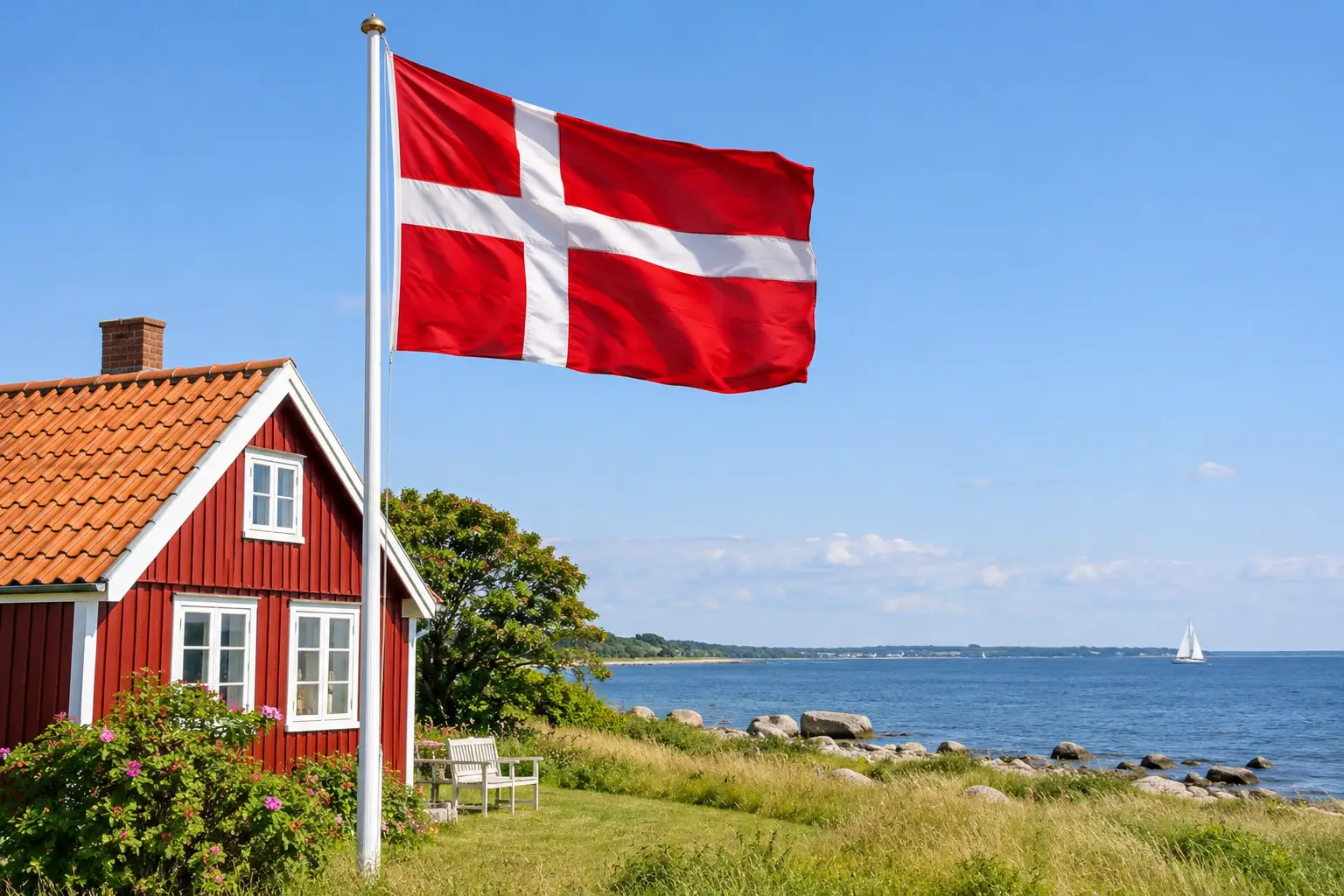
A Nordic cross flag has a cross that reaches all four edges, with the upright arm set closer to the flagpole than the centre. Denmark's flag, the Dannebrog, came first, and Sweden, Norway, Finland and Iceland all adopted their own versions of it.
The design also spread to self-governing islands such as Åland and the Faroe Islands, and to regional flags in Scotland and beyond. This guide explains where the cross came from, how each country changed it, and how to tell the flags apart at a glance.
Quick takeaways
- The Nordic cross is offset towards the hoist and runs edge to edge.
- Denmark's Dannebrog is often said to be the oldest continuously used national flag.
- Norway and Iceland add a second colour around the cross; Denmark, Sweden and Finland do not.
- Åland and the Faroe Islands have their own Nordic cross flags.
What is a Nordic cross?
A Nordic cross, also called a Scandinavian cross, is a cross that stretches right to the edges of a flag. Its horizontal arm runs across the middle, but its upright arm is moved towards the hoist, the side nearest the flagpole. That makes the part of the flag on the fly side longer than the part next to the pole.
The shift is not an accident. When a flag flies, the fly end flaps and curls, and a cross placed in the exact centre can look as if it has slid towards the pole. Setting it nearer the hoist keeps it looking balanced in the wind. It also gives the design a sense of movement, as if the cross is pointing forwards.
The cross itself comes from the Christian banners of medieval Europe. Crusaders and kings carried crosses into battle, and the Danish royal banner was one of them. Over the centuries the Danish design became the model for the rest of the region, and a shared flag style is now one of the most visible signs of the close ties between the Nordic countries.
Offset cross
The upright arm sits nearer the flagpole, so the fly side of the flag is longer.
Edge to edge
The arms always reach the edges of the flag, unlike the Swiss cross, which floats in the centre.
Single or double
Denmark, Sweden and Finland use a plain cross; Norway, Iceland, Åland and the Faroe Islands edge it in a second colour.
Why is Denmark's flag called the Dannebrog?
Dannebrog means 'the Danish cloth' or 'the Danish banner'. The flag is a white cross on red, and it is often said to be the oldest continuously used national flag in the world. Its long history is the reason the other Nordic flags look the way they do.
A famous legend explains its origin. During the Battle of Lyndanisse in Estonia on 15 June 1219, the Danish army under King Valdemar II was said to be losing when a red banner with a white cross fell from the sky, and the Danes went on to win. Historians treat this as a legend rather than a record, but Danes still mark 15 June as Valdemarsdag, a flag day.
The firmest early evidence is a picture. The Gelre Armorial, a book of coats of arms made around 1340 to 1370, shows a red banner with a white cross beside the arms of the King of Denmark. By the 16th century the design was in wide use as a Danish flag.
Denmark also has a swallow-tailed version called the Splitflag, which is the state flag. The ordinary rectangular flag is the one people fly at home, and Danes use it far more than many other nations use theirs, at birthdays, on Christmas trees and in gardens.
How Sweden and Norway made the cross their own
Sweden's flag is a yellow cross on blue. The colours come from the Swedish coat of arms, three gold crowns on a blue shield, and pictures of a blue cloth with a yellow cross date from the early 16th century. A royal warrant of 1562 described it, and a flag law of 1906 fixed its current colours and shape. Its proportions are 5:8, with the cross dividing it 5:2:9 across and 4:2:4 from top to bottom.
Sweden's national day, 6 June, was celebrated as Swedish Flag Day for decades before it became the national day in 1983. The armed forces and the royal family also use a triple-tailed version of the flag.
Norway was ruled from Denmark for centuries and used the Dannebrog until 1814. In 1821 Fredrik Meltzer, a member of the Norwegian parliament, proposed a new flag: the Danish white cross on red, with a blue cross laid on top. The result is a blue cross edged in white on a red field, and red, white and blue were seen at the time as colours of liberty, used by France, Britain and the United States.
From 1814 to 1905 Norway was in a union with Sweden. In 1844 both countries added a union mark to the corner of their flags, mixing Norwegian and Swedish colours, and Norwegians nicknamed it 'the herring salad'. Norway's parliament removed it from the ordinary flag in a law that took effect in 1899, and the union itself ended in 1905.
Finland and Iceland: flags of independence
Finland's flag is a blue cross on white. Finland was part of Sweden for centuries and then a grand duchy under Russia, and it declared independence in December 1917. The flag was adopted in May 1918, in a form set by the artists Eero Snellman and Bruno Tuukkanen. The idea of blue and white goes back to the 1860s and is linked to the poet Zachris Topelius.
The blue is often said to stand for Finland's thousands of lakes and the sky, and the white for winter snow. The state flag adds the national coat of arms where the arms of the cross meet. Finns fly the flag on many official flag days, and Midsummer Day is also the Day of the Finnish Flag.
Iceland's flag is a red cross edged in white on blue, the colours of Norway's flag rearranged. A blue and white flag was used unofficially from the 1890s, and the red cross was added in 1915, when the Danish king approved the flag for use in Iceland. It became the national flag when Iceland became a sovereign kingdom in 1918, and a law of 17 June 1944, the day Iceland became a republic, confirmed it.
The colours are commonly read as the landscape: blue for the mountains and the sea, white for ice and snow, and red for volcanic fire. Iceland's flag has a ratio of 18:25 and strict rules on when it may fly, such as not before 07:00.
Åland, the Faroe Islands and other Nordic cross flags
Åland is a self-governing, Swedish-speaking group of islands that belongs to Finland. Its flag, adopted in 1954, is a red cross edged in yellow on blue. The blue and yellow echo Sweden's flag, and the red is taken from Finland's coat of arms, so the flag reflects both sides of the islands' identity.
The Faroe Islands are a self-governing part of the Kingdom of Denmark. Their flag, called Merkið, meaning 'the banner', is a red cross edged in blue on white. Faroese students in Copenhagen designed it in 1919. During the Second World War, after Germany occupied Denmark, the British authorities approved it for Faroese ships on 25 April 1940, and that date is still the Faroese Flag Day. It was formally recognised in the home rule settlement of 1948.
The cross has spread further. The Scottish islands of Shetland and Orkney, which were once ruled from Norway, both use Nordic cross flags: Shetland's is a white cross on blue, and Orkney's, chosen in 2007, is a blue cross edged in yellow on red. Greenland is the exception in the Danish realm. Its flag, adopted in 1985, is a red and white design with a half-red, half-white disc, often read as the sun over the ice.
The table sets out the main Nordic cross flags. Read the field colour first, then the cross, then check whether the cross has an edge of a third colour.
| Flag | Field | Cross | In use since |
|---|---|---|---|
| Denmark | Red | White | Shown in the Gelre Armorial, c. 1340 to 1370 |
| Sweden | Blue | Yellow | Early 16th century; flag law of 1906 |
| Norway | Red | Blue, edged in white | 1821 |
| Finland | White | Blue | 1918 |
| Iceland | Blue | Red, edged in white | 1915; national flag from 1918 |
| Faroe Islands | White | Red, edged in blue | Designed 1919; recognised 1948 |
| Åland | Blue | Red, edged in yellow | 1954 |
Tip: Norway and Iceland swap red and blue, while the Faroe Islands and Iceland swap white and blue between the field and the edging. If two crosses are edged in white, the field colour decides it: red for Norway, blue for Iceland.
Nordic cross check
Five questions to test what you read.
0 / 5 answered
1What is the name of Denmark's flag?
Answer: The Dannebrog. Dannebrog means 'the Danish cloth'. Merkið is the name of the Faroese flag.2Which flag is white with a red Nordic cross edged in blue?
Answer: The Faroe Islands. The Faroese flag, Merkið, was designed in 1919. Iceland's flag has a red cross too, but on blue and edged in white.3Which flag is blue with a red Nordic cross edged in yellow?
Answer: Åland. Åland's flag adds Finland's red to Sweden's blue and yellow. Orkney's flag is the other way round, a blue cross on red.4In which year did Fredrik Meltzer propose Norway's red, white and blue cross flag?
Answer: 1821. Norway had used the Danish flag until 1814. Meltzer's design added a blue cross to the Danish white cross on red.5What nickname did Norwegians give the union mark their flag shared with Sweden's?
Answer: The herring salad. The union mark, added in 1844, mixed both countries' colours in a busy pattern. Norway removed it from the ordinary flag in 1899.
Frequently asked questions
What is the oldest flag in the world?
Denmark's Dannebrog is often said to be the oldest continuously used national flag. Legend links it to a battle in 1219, and the earliest accepted picture, in the Gelre Armorial, dates from around 1340 to 1370. Older banners and symbols exist, but few have stayed in continuous use as a national flag for so long.
Why do Scandinavian flags have crosses?
The cross comes from the Christian banners of medieval Europe. Denmark's royal banner, a white cross on red, became the Danish national flag, and as Sweden, Norway, Finland and Iceland developed their own flags they adopted the same cross shape in their own colours. Today the shared design is a visible sign of the region's common history.
Which countries have a Nordic cross flag?
Five sovereign countries use one: Denmark, Sweden, Norway, Finland and Iceland. The self-governing Faroe Islands and Åland have their own Nordic cross flags too, and so do the Scottish islands of Shetland and Orkney. Greenland, also part of the Danish realm, chose a different design in 1985, with a red and white disc instead of a cross.
Why is Greenland's flag not a Nordic cross?
Greenland adopted its own flag in 1985, after it gained home rule within the Kingdom of Denmark. The design, by Thue Christiansen, is a red and white bicolour with a disc that is half red and half white, often described as the sun setting over the ice cap. It keeps the Danish colours but drops the cross.
How can I tell the Nordic flags apart quickly?
Check the field colour, then the cross, then any edging. Red with white is Denmark; blue with yellow is Sweden; white with blue is Finland. Red with a white-edged blue cross is Norway, and blue with a white-edged red cross is Iceland. Flags Quiz has a Europe round where you can practise these side by side until they stick.
One cross, many colours
Every Nordic cross flag follows the Danish model: a cross that runs edge to edge, shifted towards the pole. The colours tell the story of each country, from Sweden's coat of arms to Iceland's volcanic red and Åland's mix of Swedish and Finnish colours.
- Learn the five national flags first, then add the Faroe Islands and Åland.
- Use the field colour to separate Norway from Iceland.
- Test yourself on the Nordic flags in the Europe round of Flags Quiz.
Check the evidence behind the guide
Use these references to check terminology and pursue a topic in more depth. Photo quizzes help you practise observation; a single picture rarely proves a difficult identification.
When a source describes a broad group, compare its details with the exact species, model or specimen you are studying. Record the feature that supports your answer rather than relying on a name alone.