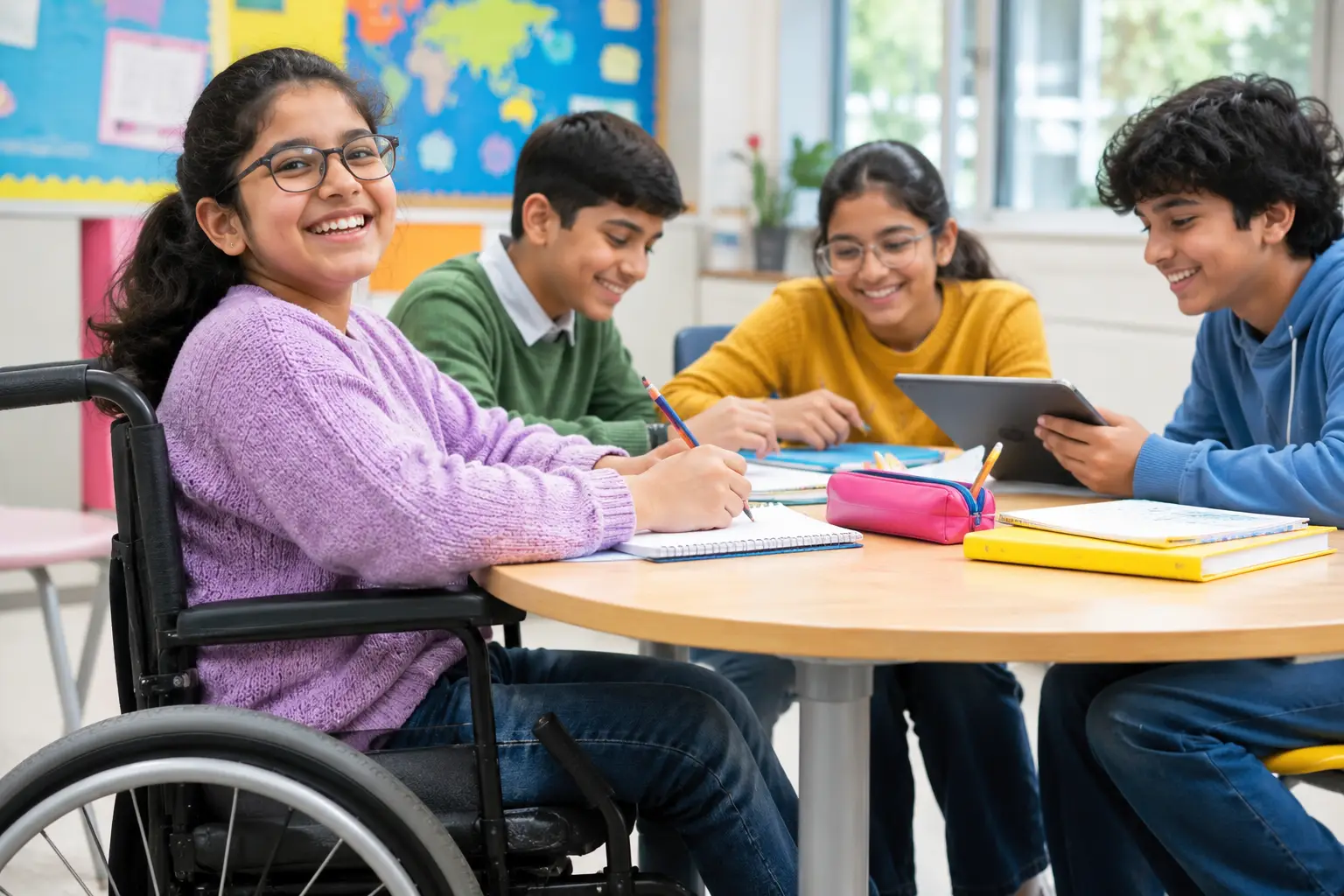
Inclusive education carries only a handful of CDP questions, but they are some of the easiest marks to secure once you understand the idea behind them. Almost every question asks the same thing in a new form: how should the school change so that this child can learn alongside everyone else? This set of 25 practice questions works through that idea for different groups of learners.
We start with what inclusion means and how it differs from segregation and integration. Then come five rounds: specific learning disabilities, ADHD and other needs, gifted and creative learners, learners from diverse and disadvantaged backgrounds, and the RTE Act 2009.
Every question is an original practice item written in the style of CTET, not a previous-year question. Tap an option to see the answer and an explanation of why it is right and why the most tempting wrong option is wrong.
Quick takeaways
- Inclusion means the school adapts to every child; integration only places the child in a regular school.
- Dyslexia affects reading, dysgraphia writing and dyscalculia number, usually in children of average or higher ability.
- The RTE Act 2009 makes free and compulsory education a right for every child aged 6 to 14.
The basics
What inclusive education means
Inclusive education means that children of all abilities and backgrounds learn together in the same school, and that the school adapts its teaching, materials and building so that every child can take part. The Rights of Persons with Disabilities Act 2016 defines it in these terms for students with disabilities, and the CTET syllabus extends the idea to learners from disadvantaged and diverse backgrounds and to talented and creative learners.
The key test in any question is who is expected to change. If the child must fit an unchanged system, that is integration at best. If the system changes to fit the child, that is inclusion.
| Approach | Where the child learns | Who adapts |
|---|---|---|
| Exclusion | Out of school | No one; the child is denied education |
| Segregation | A separate special school or class | A separate system is built for the child |
| Integration | A regular school | The child must adjust to the existing system |
| Inclusion | A regular class | The school changes teaching, materials and environment for every child |
Round 1
Specific learning disabilities
A specific learning disability affects one area of learning, such as reading, writing or number, in a child whose general ability is otherwise typical. The names follow a pattern: 'dys' means difficulty, and the rest of the word names the skill.
Dyslexia
Difficulty with reading: decoding words, linking sounds to letters, reading fluently.
Dysgraphia
Difficulty with writing: letter formation, spacing, spelling and putting ideas on paper.
Dyscalculia
Difficulty with number: number sense, number facts, place value and calculation.
Dyspraxia
Difficulty with planning and coordinating movement.
1A Class 3 child reads very slowly, guesses at words, confuses similar words such as 'was' and 'saw', and reads far below her level in other subjects. Which learning disability is most likely?
Answer: Dyslexia. Dyslexia is a specific difficulty with reading, especially decoding words, in a child whose other abilities are typical. Dysgraphia is tempting because reading and writing problems often appear together, but dysgraphia is a difficulty with the act of writing itself, such as forming letters and spacing words.2A bright Class 5 student reads well but cannot remember basic number facts, confuses place value and struggles to tell the time. This pattern suggests:
Answer: Dyscalculia. Dyscalculia is a specific learning disability that affects understanding of numbers and arithmetic. Intellectual disability is tempting, but it involves significant limits in general intellectual functioning and everyday adaptive skills, while this child reads well and struggles only with number.3Which difficulty is the main feature of dysgraphia?
Answer: Writing: poor handwriting, uneven spacing and difficulty putting thoughts on paper. Dysgraphia affects written expression, from forming letters to organising ideas in writing. The movement option is tempting because handwriting needs fine motor control, but a broader difficulty with planning and coordinating movement is dyspraxia.4Which statement about children with specific learning disabilities is correct?
Answer: They usually have average or above-average intelligence but difficulty in particular areas such as reading or arithmetic. A specific learning disability affects particular skills and is not explained by low general ability; many such children are strong in other areas. Low intelligence in all areas is tempting because these children may score poorly on tests, but that pattern describes intellectual disability, a different condition.5Which approach is most helpful for a child with dyslexia?
Answer: Multisensory teaching that links sounds, letter shapes and movement, such as tracing letters while saying their sounds. Structured, multisensory teaching gives the child several routes to connect sounds and letters, and it is widely used for dyslexia. Daily public reading is tempting as practice, but it can deepen anxiety and embarrassment without addressing the decoding difficulty.
Round 2
ADHD and other special needs
Teachers do not diagnose conditions, but they are often the first to notice a pattern. These questions test whether you can recognise common signs and choose a response that helps the child learn in the regular class.
6Which set of signs is most typical of ADHD?
Answer: Persistent difficulty sustaining attention, acting without thinking and restlessness, at home as well as school. ADHD involves persistent inattention, impulsivity and, in many children, hyperactivity, seen in more than one setting. Difficulty only with reading and spelling is tempting because ADHD can affect schoolwork, but a difficulty limited to those skills points to dyslexia.7Which classroom strategy best supports a child with ADHD?
Answer: Break tasks into short steps, give one clear instruction at a time and allow planned movement breaks. Short, structured tasks, clear instructions and chances to move help a child with ADHD stay engaged. Seating by the door or window is tempting as a way to give the child space, but it adds distractions; a seat near the teacher and away from busy areas usually works better.8A Class 1 child avoids eye contact, becomes very upset when the routine changes and prefers to play the same game alone. What is a helpful first step for the teacher?
Answer: Keep a predictable routine and warn the child in advance of changes, for example with a picture timetable. Many children with autism find unpredictability stressful, and a visual timetable with advance warning helps them feel secure enough to learn. Changing the routine often is tempting as a way to build tolerance, but sudden, frequent change usually increases anxiety; changes work better when introduced gradually and with preparation.9A teacher suspects that a child in her class has a learning disability. What should she do first?
Answer: Observe and record the child's difficulties over time and discuss them with the parents and the school's special educator. Careful observation and records help specialists make an accurate assessment, and early support makes a large difference. Waiting for the annual examination is tempting because it gives definite evidence, but it wastes months in which support could already have started.10A child who uses a wheelchair is admitted to a school whose Class 4 room is on the first floor with no ramp or lift. Inclusive education requires the school to:
Answer: Make the class accessible, for example by moving it to the ground floor or adding a ramp. Inclusion means changing the environment to remove barriers, and the RPwD Act 2016 requires accessible buildings and reasonable accommodation for students with disabilities. Home study is tempting as a quick fix, but it shuts the child out of the class and its social life.
Round 3
Gifted and creative learners
Inclusion covers children at both ends of the range. Gifted and creative learners need challenge, not just more work, and their needs are easy to miss when they look like boredom or misbehaviour.
11Which is the best way to meet the needs of a gifted learner in a regular class?
Answer: Enrichment: deeper, open-ended tasks on the same topic that stretch the child's thinking. Enrichment gives gifted learners depth and challenge through investigations, projects or problems with several solutions. More of the same exercises is tempting because it keeps the child working, but it adds quantity rather than challenge and often leads to boredom.12Allowing a highly able child to study material meant for a higher class, or to move up a class early, is called:
Answer: Acceleration. Acceleration lets a learner move faster through the curriculum, in one subject or across the board. Enrichment is tempting because it also serves gifted learners, but enrichment deepens and widens learning at the same level instead of moving the child ahead.13Which behaviour is most characteristic of a creative child?
Answer: Producing many unusual ideas and seeing new connections between them. Creativity is linked with fluency, flexibility and originality of ideas. Remembering every textbook fact is tempting because it looks like high ability, but it shows a strong memory, which is different from producing original ideas.14A child often questions the teacher, finishes work long before others and then becomes disruptive. What should the teacher consider first?
Answer: Whether the child is a highly able learner who is not being challenged enough. Boredom with work that is too easy is a common reason for disruptive behaviour in highly able children. Stricter punishment is tempting as a quick way to stop the disruption, but it does not address the cause and can turn the child against school.15A child is highly gifted in mathematics but also has dyslexia. Such a learner is often described as:
Answer: Twice exceptional. Twice-exceptional learners have high ability in some areas along with a disability in others, so they need both challenge and support. 'A prodigy who needs no support' is tempting because of the child's talent, but the reading difficulty still needs attention, and the talent can hide it.
Round 4
Diverse and disadvantaged learners
The CTET syllabus asks teachers to address learners from diverse backgrounds, including disadvantaged and deprived groups. These questions are about attitudes as much as methods: low expectations and exclusion are always the wrong answer.
16Children from a migrant labour family arrive in the village in October and want to join the local government school. The most appropriate response is to:
Answer: Admit them in classes suited to their age and arrange special training to help them catch up. The RTE Act provides for children to be admitted to an age-appropriate class with special training to reach that level, and it does not allow admission to be refused just because it is sought later in the year or because documents are delayed. Placing them in Class 1 is tempting as a way to start from the basics, but it separates them from their age group, which is not what the Act intends.17During the midday meal, some children refuse to sit next to a classmate because of his caste. What should the teacher do?
Answer: Address it openly, seat children together and discuss equality and respect with the class. Schools must actively counter discrimination, and the teacher has a duty to make sure every child is treated with equal dignity. Seating the child separately is tempting because it avoids an immediate quarrel, but it accepts the discrimination and harms the child who is excluded.18A child from a very poor rural home does badly on a test full of examples about shopping malls and air travel. What should the teacher consider first?
Answer: That the test may be biased against the child's everyday experience. Unfamiliar contexts can hide what a child actually knows, so test items should draw on situations from all children's lives. 'The child lacks the ability to learn' is tempting as a quick conclusion from a low score, but one test set in an unfamiliar context is weak evidence about ability.19A Class 6 student often misses school during the harvest season because he works in the fields with his family. The most suitable response is to:
Answer: Talk with the family, help him catch up through extra support and keep him enrolled. The aim is to keep the child in school and learning, so the teacher works with the family and fills the gaps with support. Striking his name off is tempting under strict attendance rules, but the RTE Act does not allow a child to be expelled before completing elementary education.20A teacher expects children from one community to do poorly, gives them less attention and asks them easier questions. Over the year, they do fall behind. This is an example of:
Answer: A self-fulfilling prophecy created by teacher expectations. Low expectations change how a teacher questions, praises and supports children, and those children then achieve less, which seems to confirm the original belief. The halo effect is tempting because it is also a judgement bias, but it means letting one good quality colour your view of a person's other qualities.
Round 5
The RTE Act 2009 and inclusion
The Right of Children to Free and Compulsory Education Act 2009, usually called the RTE Act, is the legal base for many inclusion questions. Learn its core provisions rather than every section number.
21The RTE Act 2009 gives effect to which article of the Constitution of India?
Answer: Article 21A. Article 21A, inserted by the 86th Constitutional Amendment in 2002, makes free and compulsory education for children aged 6 to 14 a fundamental right, and the RTE Act sets out how it is provided. Article 45 is tempting because it was the original directive on free and compulsory education, but after the 2002 amendment it deals with early childhood care and education for children below six.22Under the RTE Act 2009, free and compulsory education is a right for children of which age group?
Answer: 6 to 14 years. The Act covers elementary education, Classes 1 to 8, for children aged 6 to 14. Other age ranges are tempting because extending the right to younger or older children has been discussed in policy, but the Act itself covers 6 to 14.23Which of these does Section 17 of the RTE Act 2009 prohibit?
Answer: Physical punishment and mental harassment of children. Section 17 bans physical punishment and mental harassment of any child. Continuous assessment is tempting if you think of it as pressure on children, but the Act actually requires continuous and comprehensive evaluation of the child's understanding.24At admission time, a school asks parents for a donation and gives the child an entrance test. Under the RTE Act 2009, this is:
Answer: Not allowed: the Act prohibits capitation fees and screening procedures for admission. Section 13 bars schools from collecting any capitation fee and from subjecting a child or the parents to any screening procedure for admission. 'Allowed if the school is private' is tempting, but the ban covers private schools as well as government ones.25Which statement correctly distinguishes inclusion from integration?
Answer: In integration the child must adjust to the school; in inclusion the school changes to meet every child's needs. Integration brings a child with special needs into a regular school but leaves teaching largely unchanged, so the child has to fit in. 'Integration means special schools' is tempting, but that describes segregation; both integration and inclusion happen in regular schools.
Tip: CTET is conducted by the Central Board of Secondary Education (CBSE). This article is an independent study aid and is not affiliated with or endorsed by CBSE, NCERT or any state TET authority. Questions here are original practice items, not previous-year questions.
Quick quiz: inclusion basics
Five quick review questions on inclusive education. Tap an answer; each question locks after your first pick.
0 / 5 answered
1Which law lists 21 specified disabilities and defines inclusive education?
Answer: Rights of Persons with Disabilities Act, 2016. The RPwD Act 2016 replaced the 1995 Act, expanded the list of disabilities from 7 to 21 and defines inclusive education.2Difficulty understanding or producing spoken language, often after brain injury, is called:
Answer: Aphasia. Aphasia affects spoken or written language, often after a stroke or brain injury. Dyscalculia is a difficulty with number.3Educating children with disabilities in separate special schools is called:
Answer: Segregation. Segregation sets up a separate system for children with disabilities. Integration and inclusion both take place in regular schools.4The RTE Act 2009 came into force on:
Answer: 1 April 2010. The Act was passed in 2009 and came into force on 1 April 2010.5A teacher's main role in an inclusive classroom is to:
Answer: Adapt teaching so that every child can take part and learn. Inclusion puts the responsibility on the school and teacher to adapt. Sending children elsewhere or setting them apart is segregation, not inclusion.
Frequently asked questions
What is inclusive education in CTET?
It is the idea that all children, including those with disabilities, learning difficulties, special talents or disadvantaged backgrounds, learn together in regular classes, and that the school adapts its teaching and environment to meet their needs. CTET questions usually describe a child and ask for the most inclusive response.
What is the difference between dyslexia, dysgraphia and dyscalculia?
All three are specific learning disabilities. Dyslexia affects reading, dysgraphia affects writing and dyscalculia affects number and arithmetic. Children with them usually have average or above-average general ability.
What is the difference between inclusion and integration?
In integration, a child with special needs is placed in a regular school but must adjust to the existing system. In inclusion, the school changes its teaching, materials and environment so that every child can take part.
What does the RTE Act 2009 say about admission?
Schools may not charge capitation fees or use screening procedures for admission, and a child who has not been to school, or has fallen behind, is admitted to a class suited to their age with special training to catch up. Private unaided schools must also reserve at least 25 percent of entry-level seats for children from weaker sections and disadvantaged groups.
How can I practise inclusive education MCQs?
Work through scenario questions and check the reasoning behind each answer, since most items test judgement rather than definitions. CDP Exam Practice: CTET, TET covers inclusive education alongside the rest of the CDP syllabus, with explained answers in English and Hindi.
Ask who should change
Inclusive education questions reward one habit of thought: when a child faces a barrier, the school should remove it rather than move the child. Learn the main learning disabilities, the difference between enrichment and acceleration, and the core provisions of the RTE Act, and most of these questions become straightforward.
- Memorise the 'dys' terms by the skill each affects: reading, writing, number and movement.
- For every scenario question, rule out options that separate, excuse or label the child.
- Practise inclusion MCQs with explanations in CDP Exam Practice: CTET, TET.
Check the official sources
Exam patterns, syllabi and eligibility rules change, so confirm every date and requirement with the official body before you register or plan your revision.
Use practice questions to find weak topics, then go back to the standard texts and official documents to learn the reasoning behind each answer.