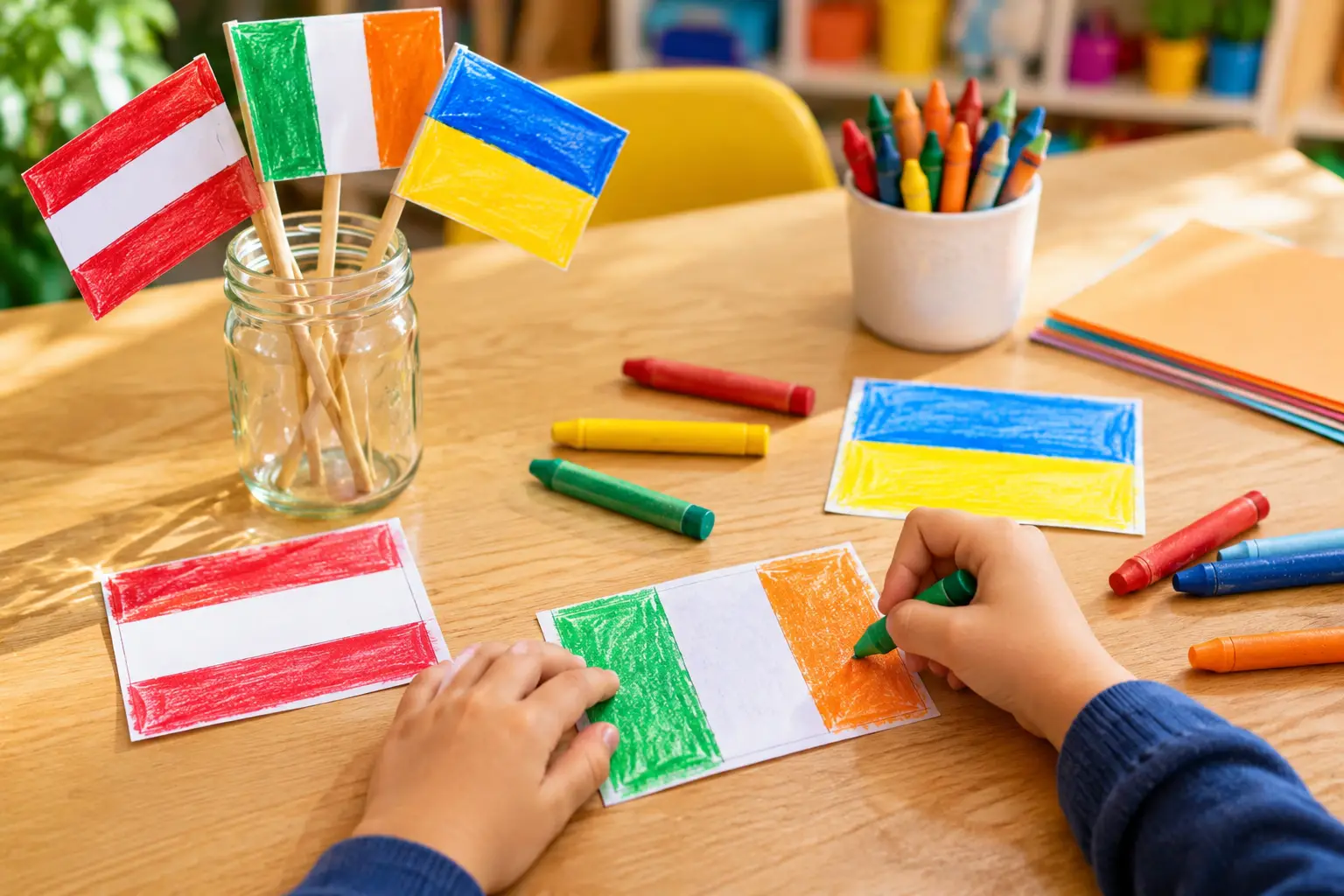
This flag quiz for kids has 25 easy questions with answers. Each flag is described in words, so children can play without pictures, at home, in class or on a car journey.
The quiz has three rounds. The first asks which country a flag belongs to, the second asks what the pictures on flags mean, and the third is about flags in sport, at sea and in everyday life. Every answer has a short note, so children learn something new even when they guess wrong.
Quick takeaways
- Look at the colours first, then the direction of the stripes, then any picture.
- Pictures on flags often stand for the sun, the land, an animal or a belief.
- Some flags, such as the chequered flag or the white flag, send a message rather than stand for a country.
Round 1
Can you name the country from its flag?
Every flag in this round is described in words. Listen for three things: the colours, which way the stripes go, and any picture or shape. Those three clues are what flag experts check first.
Some flags look almost the same. India and Niger both use orange, white and green, but India has a blue wheel and Niger has an orange circle. Greece and Uruguay both have nine stripes, but only one of them has a sun. A tiny detail is often the whole answer.
1Which country's flag is blue with a white diagonal cross shaped like a letter X?
Answer: Scotland. This is the Saltire, or St Andrew's Cross. St Andrew, Scotland's patron saint, is said to have been put to death on an X-shaped cross.2Which country's flag is white with two blue stripes and a blue six-pointed star in the middle?
Answer: Israel. The six-pointed star is the Star of David, a Jewish symbol. The two blue stripes are often compared to the stripes on a Jewish prayer shawl.3Which country's flag has orange, white and green stripes with an orange circle in the middle?
Answer: Niger. Niger's orange circle is often said to stand for the sun. India's flag has the same colours, but its circle is a navy blue wheel.4Which country's flag has a white circle on a wide blue band, with a red band above and below?
Answer: Laos. The white circle on Laos's flag is often said to be a full moon over the Mekong River. Japan's circle is red, and Thailand's stripes have no circle.5Which country's flag is half yellow and half white, with two crossed keys under a crown?
Answer: Vatican City. The keys stand for the keys of heaven given to Saint Peter, and the crown is the Pope's triple crown. Like Switzerland's flag, it is square.6Which country's flag has nine blue and white stripes and a golden sun with a face in the top corner?
Answer: Uruguay. Uruguay's sun is the Sun of May, which also appears on Argentina's flag. Greece has nine stripes too, but it has a white cross in the corner instead of a sun.7Which country's flag shows a golden lion holding a sword?
Answer: Sri Lanka. The lion stands for the Sinhalese people. Beside it are a green stripe and an orange stripe for the country's Muslim and Tamil communities.8Which country's flag is green with white Arabic writing above a white sword?
Answer: Saudi Arabia. The writing is the Islamic statement of faith, and green is a colour linked with Islam. Pakistan's flag is green too, but it has a white crescent and star.9Which country's flag is sky blue with a golden sun and an eagle flying beneath it?
Answer: Kazakhstan. The bird is a steppe eagle, which lives on the wide grasslands of Central Asia. A golden pattern runs down the side nearest the pole.
Tip: Say the colours out loud in order, from top to bottom or from the flagpole outwards. It makes similar flags much easier to tell apart.
Round 2
What do the pictures on flags mean?
Many flags carry a picture that tells a story about the country. A sun, a leaf, a bird or a cross can stand for the land, the weather, a religion or an important moment in history.
Stripes and stars often count something. The stripes on the United States flag stand for the first colonies, and its stars stand for the states. Flags for groups of countries, such as the United Nations and the Olympic Games, use pictures that everyone can share.
10What does the red circle on Japan's flag stand for?
Answer: The sun. Japan's name in Japanese can be read as 'origin of the sun', and the flag is nicknamed the Hinomaru, meaning 'circle of the sun'.11What kind of leaf is in the middle of Canada's flag?
Answer: A maple leaf. Maple trees grow across Canada, and the maple leaf was a Canadian symbol long before the flag was made.12How many red and white stripes are on the flag of the United States?
Answer: 13. There are seven red and six white stripes, one for each of the 13 colonies that became the first states. The 50 stars are for today's states.13Which colour is not on the flag of France?
Answer: Green. France's flag has three upright stripes: blue next to the pole, white in the middle and red on the outside. Italy's similar flag uses green instead of blue.14What colour is the cross on the flag of Switzerland?
Answer: White. Switzerland's flag is a white cross on a red square. The Red Cross, which was founded in Switzerland, swapped the colours for its own symbol.15Which Caribbean country's flag shows a parrot?
Answer: Dominica. The bird is the Sisserou parrot, Dominica's national bird, which lives only on that island. It sits in a red circle ringed by ten green stars.16What is in the middle of the flag of the United Nations?
Answer: A map of the world inside two olive branches. The white map is drawn as if you were looking down on the North Pole. Olive branches are an old sign of peace.17How many rings are on the Olympic flag?
Answer: Five. The five linked rings are blue, yellow, black, green and red. They stand for the continents of the world coming together at the Games.
| Picture | Flag | What it stands for |
|---|---|---|
| Red circle | Japan | The sun |
| Maple leaf | Canada | A tree that grows across Canada |
| 13 stripes | United States | The 13 original colonies |
| Sisserou parrot | Dominica | The national bird, found only on Dominica |
| World map and olive branches | United Nations | The whole world, at peace |
| Five linked rings | Olympic Games | The continents meeting at the Games |
Round 3
What do flags mean in sport, at sea and in daily life?
Long before radios and phones, people used flags to send messages. Ships hoisted coloured flags to talk to other ships and to the harbour, and armies used them to show who was who on a battlefield.
Flags still send messages today. Race marshals wave them to talk to drivers, lifeguards use them on beaches, and a flag lowered on a pole tells everyone that a town or country is sad.
18What is the traditional pirate flag with a skull and crossbones called?
Answer: The Jolly Roger. Pirates flew the Jolly Roger to frighten ships into giving up without a fight. The Blue Peter is a real sailing flag that means a ship is about to leave port.19In motor racing, what does the black and white chequered flag mean?
Answer: The race is over. The chequered flag is waved as the winner crosses the finish line, and then for every car behind. Each flag in racing has its own message for the drivers.20What does waving a plain white flag usually mean in a war?
Answer: Surrender or a wish to talk. A white flag shows that someone wants to stop fighting and talk. The rules of war say that people carrying one must not be attacked.21Why is a flag sometimes flown at half-mast, partway down the pole?
Answer: As a sign of sadness after someone has died. Lowering a flag is a way for a country or town to show respect and mourning. The flag is usually raised to the top first, then lowered.22Which country's flag is nicknamed the Stars and Stripes?
Answer: The United States. The nickname describes its 50 white stars on blue and its 13 stripes. It is also called Old Glory and the Star-Spangled Banner.23The Union Jack is the flag of which country?
Answer: The United Kingdom. The Union Jack combines the crosses of St George for England, St Andrew for Scotland and St Patrick for Ireland. Australia's flag carries it in the corner.24What is the top corner of a flag, next to the flagpole, called?
Answer: The canton. The canton is the upper corner nearest the pole, where the United States puts its stars. The fly is the edge furthest from the pole, and the field is the background.25What is the study of flags called?
Answer: Vexillology. The word comes from the Latin vexillum, a kind of flag carried by Roman soldiers. Geology is the study of rocks, and cartography is map-making.
| Flag | Where you see it | What it means |
|---|---|---|
| Chequered flag | Motor racing | The race is finished |
| White flag | War and conflict | Surrender or a wish to talk |
| Flag at half-mast | Public buildings | Mourning after a death |
| Jolly Roger | Old pirate ships and stories | Pirates are near |
| Blue Peter | Ships in harbour | The ship is about to sail |
Five bonus flag questions
Try these extra questions to see how much you remember.
0 / 5 answered
1What colour is the background of the Olympic flag?
Answer: White. White makes the five coloured rings stand out. The Olympic flag was first flown at the 1920 Games in Antwerp.2Which of these is one of the colours of the Olympic rings?
Answer: Green. The rings are blue, yellow, black, green and red. Together with the white background, these colours appear on many national flags.3In motor racing, what does a waved yellow flag tell drivers?
Answer: Danger ahead, so slow down and do not overtake. A yellow flag warns of a hazard such as a crashed car. Drivers must slow down and hold their places until they pass it.4What is a long, narrow flag that comes to a point called?
Answer: A pennant. Pennants are often flown on ships and at sports grounds. Nepal's national flag is made of two pennant shapes, one above the other.5What is an X-shaped cross on a flag called?
Answer: A saltire. Scotland's flag is a white saltire on blue, and Jamaica's has a gold saltire on green and black.
Frequently asked questions
What is the easiest way for kids to learn flags?
Start with a few flags at a time and describe each one out loud: its colours, the direction of its stripes and any picture. Drawing the flags helps too. Group flags that look alike, such as India and Niger, and learn the one detail that tells them apart. Short daily practice works better than one long session.
How many flags are there in the world?
There are 193 member states of the United Nations, plus two observer states, Vatican City and Palestine, so most lists give about 195 national flags. Many other places, such as Scotland, Greenland and Hong Kong, have their own flags too, so the total depends on which flags you count.
Which flag is the oldest in the world?
Denmark's red flag with a white cross, called the Dannebrog, is often said to be the oldest national flag still in use. A legend says it fell from the sky during a battle in 1219. The earliest pictures that historians accept date from the 1300s, which is still very old for a flag.
Why do so many flags use red, white and blue?
Red, white and blue appear on the flags of the United States, the United Kingdom, France, Russia, Australia and many other countries. Some copied older flags they admired, and others took the colours from coats of arms. Each country gives its own meaning to the colours, so red does not mean the same thing everywhere.
Is there a flag quiz app for kids?
Flags Quiz is a general flag game rather than a children's app, but its rounds are short and every question shows a real flag, so it suits children who can read, with an adult nearby. It has rounds by continent, flashcards and a daily quiz, which helps a child learn a few new flags each day.
Colours first, then the picture
Most flags can be named from three clues: the colours, the direction of the stripes and the picture in the middle. Flags in sport and at sea add a fourth idea: some flags send a message instead of standing for a country.
- Play one round a day and say each flag's colours out loud.
- Draw the flags you got wrong with crayons or coloured pencils.
- Try a continent round in Flags Quiz to see the real flags.
Check the evidence behind the guide
Use these references to check terminology and pursue a topic in more depth. Photo quizzes help you practise observation; a single picture rarely proves a difficult identification.
When a source describes a broad group, compare its details with the exact species, model or specimen you are studying. Record the feature that supports your answer rather than relying on a name alone.