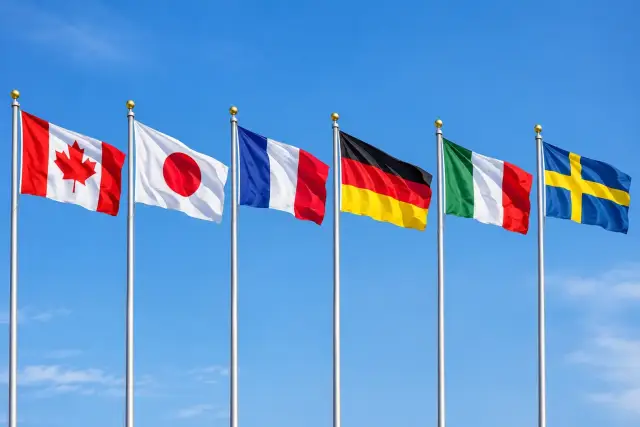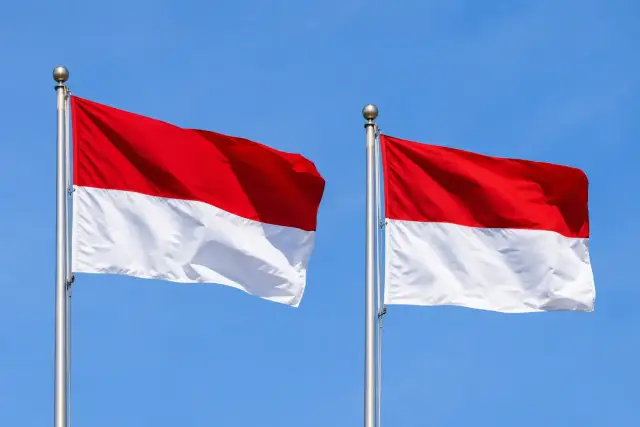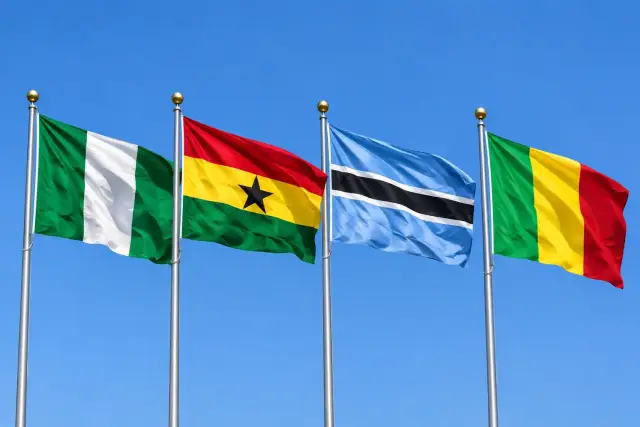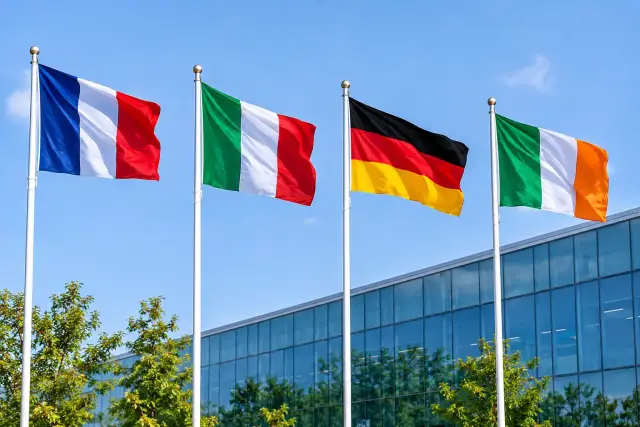
Flag colours and symbols are chosen to say something about a country, such as its history, land, beliefs or hopes. Some meanings are common across many flags, but each country decides what its own flag stands for.
Official meanings sometimes change over time, and popular explanations do not always match what a law or constitution says. Treat the general meanings below as a guide, and check a country's official description for exact wording.
Common colour meanings
Red often stands for courage, revolution or the blood of those who died for the country. White usually means peace or purity. Blue often refers to the sea, rivers or sky, and green to the land, farming or, in many Muslim-majority countries, Islam.
Yellow and gold often stand for the sun or for wealth, and black can mean the people, the soil or a period of struggle. The same colour can mean different things on different flags.
Shared colour families
Some groups of countries share colours on purpose. The Pan-African colours of green, yellow and red come from the flag of Ethiopia. Ghana, Senegal, Mali and many others use them.
The Pan-Arab colours of black, white, green and red come from the flag of the Arab Revolt of 1916, and appear on the flags of Jordan, Palestine, Sudan and the United Arab Emirates. The Pan-Slavic colours of white, blue and red appear on the flags of Russia, Serbia, Slovakia and Slovenia.
Stars, suns, crosses and emblems
Stars often stand for states, regions or ideals. The 50 stars of the United States flag represent its 50 states, and the 27 stars on Brazil's flag represent its states and the Federal District. Crosses usually reflect a Christian history, as in the Nordic flags and the Union Flag.
Many flags use a symbol from nature or history. The table lists some well-known examples.
| Symbol | Example flags | What it represents |
|---|---|---|
| Red disc | Japan | The sun |
| Sun of May | Argentina, Uruguay | A sun with a face, linked to independence |
| Star and crescent | Turkey, Pakistan | Often linked to Islam or national history |
| Southern Cross | Australia, New Zealand | A constellation seen from the southern hemisphere |
| Maple leaf | Canada | A national emblem of Canada |
| Cedar tree | Lebanon | A national emblem of Lebanon |
| Ashoka Chakra | India | A wheel of 24 spokes, the wheel of law |
Read the symbols
0 / 4 answered
1How many spokes does the wheel on India's flag have?
Answer: 24. The navy blue Ashoka Chakra has 24 spokes.2Which tree appears on the flag of Lebanon?
Answer: A cedar. A green cedar sits on a white band between two red bands.3Which country's flag is the source of the Pan-African colours?
Answer: Ethiopia. Green, yellow and red were taken from the Ethiopian flag.4What do the 50 stars on the United States flag represent?
Answer: The 50 states. The 13 stripes represent the original colonies.
Frequently asked questions
Does every flag colour have an official meaning?
No. Some countries set out meanings in law, while others give none, and popular meanings are sometimes added later. A country's government or constitution is the best source for its own flag.
Meanings are local
Red, white, blue, green and yellow have common meanings, and shared colour families link many flags, but each country's own description is the final word.
Check the evidence behind the guide
Use these references to check terminology and pursue a topic in more depth. Photo quizzes help you practise observation; a single picture rarely proves a difficult identification.
When a source describes a broad group, compare its details with the exact species, model or specimen you are studying. Record the feature that supports your answer rather than relying on a name alone.