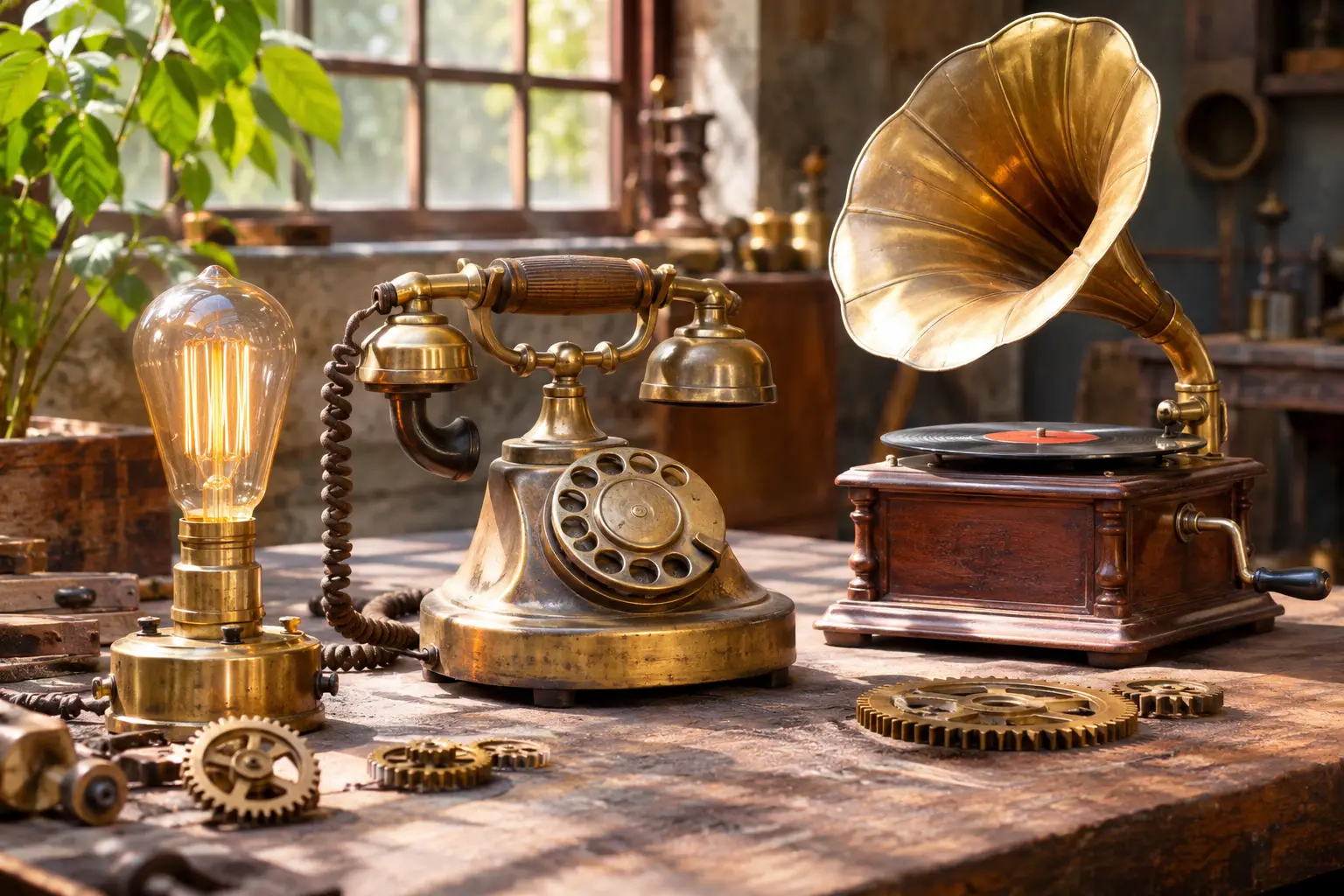
Famous inventors and their inventions include Johannes Gutenberg and the printing press, James Watt and the improved steam engine, Alexander Graham Bell and the telephone, the Wright brothers and the aeroplane, and Tim Berners-Lee and the World Wide Web. This quiz has 25 questions on them and others, with the story behind each answer.
Many inventions had more than one parent. Where a claim is disputed, the question asks what a person patented, demonstrated or is credited with, and the explanation names the rivals. That is closer to how invention really works: several people chasing the same problem at once.
Quick takeaways
- Watt did not invent the steam engine; his separate condenser made it far more efficient.
- Bell patented the telephone in 1876, but Elisha Gray and Antonio Meucci also have claims.
- The Wright brothers made the first powered, controlled aeroplane flights in December 1903.
- Women inventors gave us the dishwasher, the windscreen wiper and Kevlar.
Round 1
Who invented the engines that powered the modern world?
The Industrial Revolution ran on steam. Watt's improvements in the 1760s and 1770s made steam engines cheap enough to run factories, and within a century railways and steamships had shrunk travel times across whole continents.
Electricity and the internal combustion engine followed. Volta's battery gave scientists their first steady current, and Benz and Diesel built the engines that would replace horses on roads. The Wright brothers then added the one thing an aeroplane needs beyond power: control in the air.
1What was James Watt's key improvement to the steam engine, patented in 1769?
Answer: A separate condenser. Thomas Newcomen's engines had pumped water from mines since 1712. Watt's separate condenser stopped the cylinder being cooled on every stroke, saving a great deal of fuel.2Alessandro Volta is credited with the first electric battery, in 1800. What was it called?
Answer: The voltaic pile. The voltaic pile was a stack of zinc and copper discs separated by brine-soaked cloth. The Leyden jar was an earlier device for storing static charge, and the volt is named after Volta.3Which German engineer patented the three-wheeled Motorwagen in 1886, often called the first practical petrol-powered car?
Answer: Karl Benz. Benz's patent was filed in January 1886. Daimler built a motor carriage the same year, but the three-wheeled Motorwagen was Benz's. Ford's Model T came much later, in 1908.4The engine that ignites its fuel using the heat of highly compressed air is named after which engineer?
Answer: Rudolf Diesel. Diesel patented his engine in the 1890s. It needs no spark plug, unlike the four-stroke petrol engine linked with Nikolaus Otto.5Where did the Wright brothers make the first powered, controlled aeroplane flights in December 1903?
Answer: Near Kitty Hawk, North Carolina. Orville flew about 37 metres in 12 seconds on 17 December 1903, and Wilbur made the longest flight of the day. Dayton, Ohio, was where the brothers ran their bicycle shop and built the aircraft.6Elisha Otis's safety brake, demonstrated in New York in 1854, made which machine safe enough for passengers?
Answer: The lift (elevator). Otis stood on a raised platform and had the rope cut; his brake caught it. Safe passenger lifts later made tall buildings practical.
Round 2
Who invented the printing press, telephone, radio and television?
Communication inventions are where 'who invented it?' gets most tangled. Several inventors often worked on the same idea at once, and patent dates, public demonstrations and later court cases all affect who gets the credit.
The table shows some of the best-known disputes. A fair answer usually names the person who first made the idea practical, while acknowledging those who got close.
7Which goldsmith from Mainz developed printing with movable metal type in Europe around 1450?
Answer: Johannes Gutenberg. Gutenberg's press produced the Gutenberg Bible in the 1450s. Movable type had been used earlier in East Asia; Caxton later brought printing to England, in 1476.8The reading system Louis Braille published in 1829 is based on what?
Answer: Patterns of raised dots. Braille lost his sight as a small boy and built his code from cells of up to six dots. Before that, blind pupils read large embossed letters, which were slow to read and to make.9The dot-and-dash code used to send telegraph messages is named after which American inventor?
Answer: Samuel Morse. Morse developed his telegraph and code with Alfred Vail's help, and in 1844 sent the message 'What hath God wrought' from Washington to Baltimore.10Alexander Graham Bell received a US patent in 1876 for which invention?
Answer: The telephone. Bell's patent was granted in March 1876. Elisha Gray and Antonio Meucci also worked on telephones, which is why the question of who invented it is still argued over.11Which device for recording and playing back sound did Thomas Edison invent in 1877?
Answer: The phonograph. Edison's phonograph recorded sound on a tinfoil-covered cylinder. Emile Berliner's gramophone, which used flat discs, followed about ten years later.12In 1901, which inventor announced that radio signals had crossed the Atlantic from Cornwall to Newfoundland?
Answer: Guglielmo Marconi. Marconi reported receiving the Morse letter S in December 1901. He shared the 1909 Nobel Prize in Physics with Karl Ferdinand Braun for work on wireless telegraphy.13Which Scottish inventor gave the first public demonstration of a working television system, in London in 1926?
Answer: John Logie Baird. Baird's mechanical system used a spinning disc to scan the image. Electronic television, developed by Farnsworth, Zworykin and others, replaced it within about a decade.14Where was Tim Berners-Lee working when he proposed the World Wide Web in 1989?
Answer: CERN, near Geneva. Berners-Lee wanted a way for physicists to share documents. He wrote the first web browser and server, and the web was opened to the public in 1991.
| Invention | Usually credited to | Others with a claim |
|---|---|---|
| Movable-type printing | Johannes Gutenberg, in Europe around 1450 | Bi Sheng in China used movable clay type around the 1040s |
| Steam engine | Thomas Newcomen (1712); much improved by James Watt | Thomas Savery built an earlier steam pump in 1698 |
| Telephone | Alexander Graham Bell, patent of 1876 | Elisha Gray and Antonio Meucci |
| Light bulb | Thomas Edison, practical bulb in 1879 | Joseph Swan developed one in Britain at the same time |
| Radio | Guglielmo Marconi, long-distance wireless | Nikola Tesla, Alexander Popov and Jagadish Chandra Bose |
| Television | John Logie Baird, first public demonstration in 1926 | Philo Farnsworth and Vladimir Zworykin, electronic systems |
Round 3
Who invented everyday things like jeans, Velcro and the biro?
Plenty of everyday objects began with someone noticing a small problem. Strauss and Davis saw torn pockets; de Mestral saw burrs on his dog. Spencer noticed a melted chocolate bar, and Carrier noticed paper that would not stay flat.
Some inventions keep their inventor's name long after the brand has faded. A ballpoint is still a biro in Britain, and the Nobel Prizes come from the fortune Alfred Nobel made from dynamite.
15In Britain a ballpoint pen is often called a biro, after which inventor?
Answer: László Bíró. Bíró, a Hungarian-born journalist, developed the pen with his brother György and patented it in 1938. Waterman is linked with the fountain pen, and Marcel Bich founded the Bic company.16What gave the Swiss engineer George de Mestral the idea for Velcro?
Answer: Burrs that stuck to his dog's fur. Under a microscope de Mestral saw that burrs carry tiny hooks that catch on loops of fur. Velcro copies that hook-and-loop idea.17Levi Strauss and the tailor Jacob Davis patented which feature of work trousers in 1873?
Answer: Metal rivets at points of strain. Copper rivets stopped pockets and seams tearing on miners' and workers' trousers. The patent is usually treated as the birth of blue jeans.18Willis Carrier designed an early modern air-conditioning system in 1902 for what kind of building?
Answer: A printing plant. Changing humidity made paper swell and shrink, so colour printing went out of line. Carrier's system controlled humidity as well as temperature.19Engineer Percy Spencer came up with the microwave oven after noticing what?
Answer: A chocolate bar melting while he worked near radar equipment. Spencer worked with magnetrons, the devices that produce microwaves for radar, at the company Raytheon. A patent was filed in 1945.20Alfred Nobel, whose will founded the Nobel Prizes, patented which explosive in 1867?
Answer: Dynamite. Nitroglycerin, discovered by Ascanio Sobrero in 1847, was dangerously unstable. Nobel made it safer to handle by soaking it into a porous material, creating dynamite.
Round 4
Famous women inventors and the first computers
Women inventors were often left out of older textbooks, but their patents are on record. Mary Anderson's windscreen wiper, Josephine Cochrane's dishwasher and Stephanie Kwolek's Kevlar are used every day.
Computing has its own early pioneers. Charles Babbage designed programmable calculating machines a century before electronic computers, and Ada Lovelace wrote about what they might do.
Patents in their own names
Anderson (1903), Cochrane (1886) and Kwolek's team at DuPont all hold documented patents, which makes their claims easy to check.
An actor and a composer
Hedy Lamarr's 1942 patent with George Antheil shows inventors do not have to be professional engineers.
21Mary Anderson patented a hand-operated device for vehicles in 1903. What did it do?
Answer: Cleared rain and snow from the windscreen. Anderson's device let a driver swing a rubber blade across the glass with a lever inside the car. Automatic wipers came later.22Josephine Cochrane patented a commercially successful version of which household machine in 1886?
Answer: The dishwasher. Cochrane's machine held plates in wire racks and sprayed them with hot, soapy water. It was shown at the 1893 World's Columbian Exposition in Chicago.23Stephanie Kwolek's 1965 discovery at DuPont led to which strong fibre used in body armour?
Answer: Kevlar. Kevlar is several times stronger than steel of the same weight. Nylon, Teflon and Lycra also came out of DuPont laboratories, but from other inventors.24Film star Hedy Lamarr co-invented a frequency-hopping system meant to stop what being jammed?
Answer: Radio signals guiding torpedoes. Lamarr and the composer George Antheil were granted a patent in 1942. Frequency hopping is an ancestor of ideas later used in some wireless technologies.25Which English mathematician designed the Analytical Engine, a mechanical general-purpose computer, in the 1830s?
Answer: Charles Babbage. The Analytical Engine was never completed, but its design had a memory, a processor and punched-card input. Turing and von Neumann worked a century later.
Five more inventors
New questions, not repeats of the rounds above.
0 / 5 answered
1Who wrote what is often called the first published computer program, for Babbage's Analytical Engine, in 1843?
Answer: Ada Lovelace. Lovelace's notes included a step-by-step method for the engine to calculate Bernoulli numbers.2Which Motorola engineer made the first call from a handheld mobile phone, in 1973?
Answer: Martin Cooper. Cooper made the call on a New York street, using a prototype that weighed about a kilogram.3Which British inventor developed an incandescent light bulb at the same time as Thomas Edison?
Answer: Joseph Swan. Swan and Edison later combined their British interests in a joint company, Ediswan.4Which Chinese craftsman made movable type from baked clay around the 1040s?
Answer: Bi Sheng. Bi Sheng's method was recorded by the scholar Shen Kuo. Cai Lun is traditionally credited with improving papermaking much earlier.5Which American statesman and scientist invented the lightning rod in the 1750s?
Answer: Benjamin Franklin. Franklin's metal rod gives lightning a safe path to the ground, protecting the building beneath.
Frequently asked questions
Who is the greatest inventor of all time?
Thomas Edison is often named because of his more than a thousand US patents, including the phonograph and a practical light bulb, and his research laboratory at Menlo Park. Others argue for Gutenberg, whose printing press spread knowledge across Europe, or for Nikola Tesla, whose alternating-current system powers the world's grids. It depends on whether you value quantity or impact.
Did Thomas Edison invent the light bulb?
Not alone. Inventors had made glowing lamps for decades before 1879, but they burned out quickly. Edison's team found a long-lasting carbon filament and built the power system to run it. Joseph Swan developed a similar bulb in Britain at the same time, and the two later formed a joint company.
Who really invented the telephone?
Alexander Graham Bell received the US patent for the telephone in March 1876 and is usually credited. Elisha Gray filed a related document on the same day, and the Italian inventor Antonio Meucci had worked on a voice-carrying device years earlier. Bell's patent survived many court challenges, which is why his name is attached to it.
Who invented the first aeroplane?
The Wright brothers, Orville and Wilbur, made the first powered, controlled and sustained flights in a heavier-than-air aeroplane near Kitty Hawk, North Carolina, on 17 December 1903. Gliders and models had flown before, but the Wrights solved three-axis control, which every aircraft still relies on today.
How can I remember famous inventors and their inventions?
Learn each inventor with one invention and one year, then quiz yourself rather than rereading. Putting a face to the name helps too: Guess Famous People: Face Quiz shows portraits of scientists, inventors and other well-known figures, so you practise recalling who they are from a photo, which strengthens the memory.
Credit is often shared
Most famous inventions grew out of earlier work, and many had rivals racing to the same goal. Learn the person usually credited, the date of the patent or demonstration, and one rival, and you will understand the story as well as the answer.
- Note one rival claimant for each disputed invention.
- Group inventions by era so the dates support each other.
- Put faces to inventors' names in Guess Famous People: Face Quiz.
Check the evidence behind the guide
Use these references to check terminology and pursue a topic in more depth. Photo quizzes help you practise observation; a single picture rarely proves a difficult identification.
Dates, titles and claims of who did something first are often simplified in popular accounts. Check a museum, archive or prize-committee page before quoting a date or an achievement.