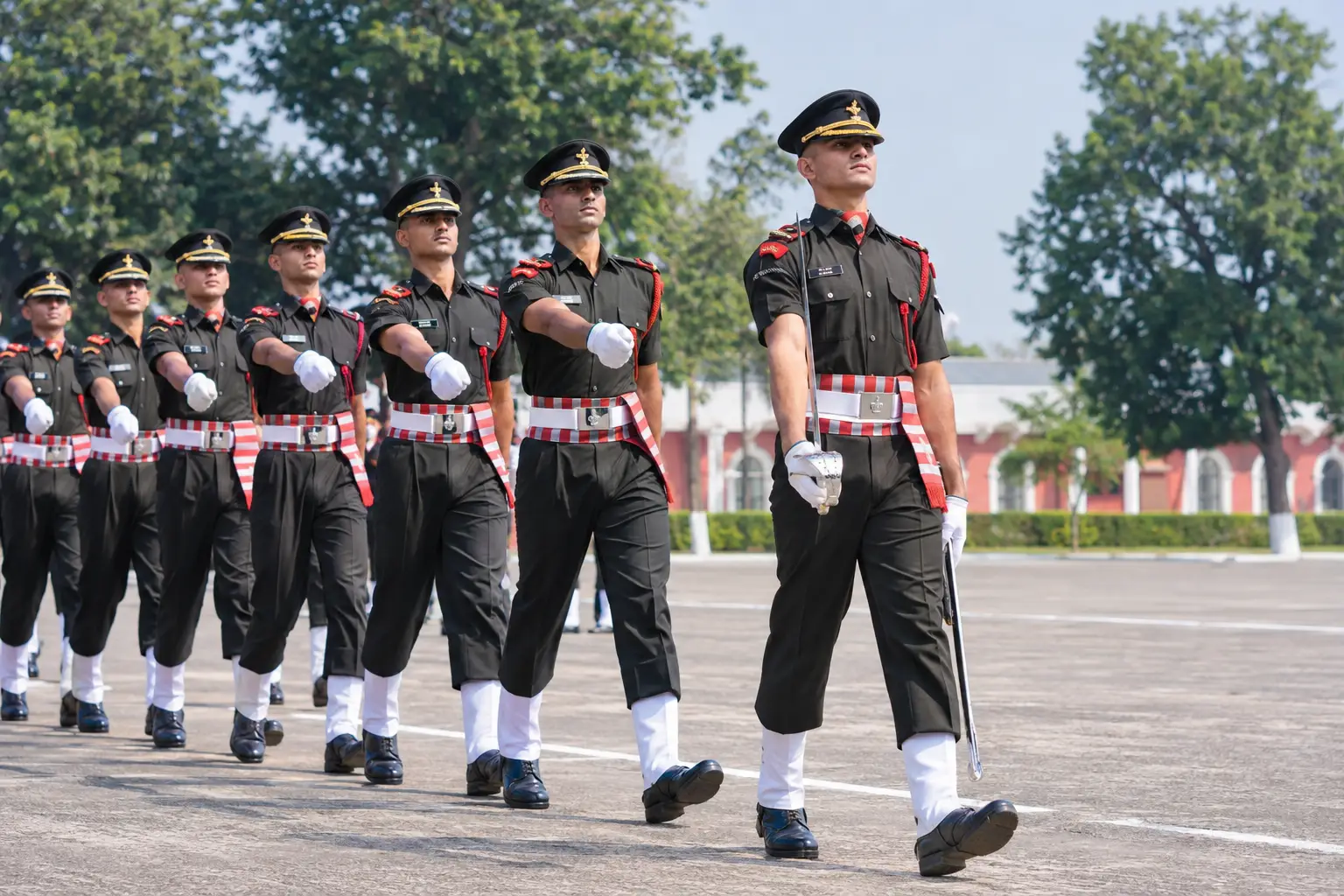
The Combined Defence Services (CDS) exam is the route for graduates who want to join the Army, Navy or Air Force as officers. The written exam tests three things: your English, your general knowledge and your school mathematics. The quickest way to see where you stand is to try a few questions from each, and that is what this set gives you.
We start with how the written exam is organised and which academy takes which papers. Then come five rounds of five questions: English, history and polity, geography and science, mathematics, and a mixed final round.
Every question is an original practice item written in the CDS style, not a previous-year question. Tap an option to see the answer and an explanation of why it is right and why the most tempting wrong option is wrong. Maths answers show the full working.
Quick takeaways
- IMA, INA and AFA candidates write English, General Knowledge and Elementary Mathematics; OTA candidates write English and General Knowledge only.
- Candidates who qualify in the written exam go on to a Services Selection Board (SSB) interview.
- Wrong answers carry a penalty, so check the current notification before deciding how much to guess.
The basics
What the CDS exam is and which papers you take
UPSC conducts the CDS exam for entry to four training academies: the Indian Military Academy (IMA) in Dehradun, the Indian Naval Academy (INA) at Ezhimala in Kerala, the Air Force Academy (AFA) at Dundigal near Hyderabad, and the Officers Training Academy (OTA) in Chennai. The exam is usually held twice a year.
All the papers are objective, multiple-choice tests. Candidates for IMA, INA and AFA write all three papers. Candidates who apply only for OTA write English and General Knowledge, with no mathematics paper. Those who qualify are called for an SSB interview, which tests intelligence and personality over several days, and final selection also depends on medical fitness.
Eligibility also differs by academy; for example, the naval and air force academies ask for particular degree subjects. Rules, dates and vacancies change from one notification to the next, so always read the current one on the UPSC website.
| Paper | What it tests | Who takes it |
|---|---|---|
| English | Vocabulary, grammar, usage and reading comprehension | IMA, INA, AFA and OTA |
| General Knowledge | History, geography, polity, economy, everyday science and current events | IMA, INA, AFA and OTA |
| Elementary Mathematics | Arithmetic, algebra, trigonometry, geometry, mensuration and statistics at school level | IMA, INA and AFA only |
Tip: Recent notifications have set each paper at 2 hours and 100 marks, but check the current notification for the exact pattern and how wrong answers are penalised.
Round 1
English: words, grammar and idioms
The English paper rewards careful reading more than fancy vocabulary. Read the whole sentence before you choose, because the words around a gap or an underlined phrase usually decide the answer.
1Choose the word or phrase closest in meaning to METICULOUS.
Answer: Careful about every detail. Meticulous means taking great care over every detail, as in a meticulous inspection of kit. 'Easily frightened' is tempting if you know the word comes from the Latin metus, fear, but that older sense has dropped out of modern English.2Choose the word most nearly OPPOSITE in meaning to SCARCE.
Answer: Plentiful. Scarce means in short supply, so its opposite is plentiful. Rare is the trap: it is a synonym, not an antonym, and antonym questions often place a synonym among the options to catch hurried readers.3Find the part of the sentence that has an error: "Each of the cadets / have been issued / a new rifle / for the exercise."
Answer: have been issued. The subject is 'each', which is singular, so the verb must be 'has been issued'. 'Each of the cadets' looks wrong because 'cadets' is plural, but that phrase is correct; the plural noun sits inside 'of the cadets' and does not control the verb.4Fill in the blank: "He has been living in Pune ___ 2015."
Answer: since. Use 'since' with a starting point in time (since 2015, since Monday) and 'for' with a length of time (for ten years). 'From' is tempting, but with a perfect tense like 'has been living' standard English uses 'since'; 'from' needs a pairing such as 'from 2015 to 2019'.5What does the idiom "to bite the bullet" mean?
Answer: To face a painful situation bravely. To bite the bullet is to accept something unpleasant and get on with it, as in 'He bit the bullet and retook the exam.' 'Give up a fight' is tempting because both involve a hard moment, but the idiom means going through with it, not quitting.
Round 2
General Knowledge: history and polity
History and polity questions usually test one clear fact. When two options look close, ask which person, battle or provision belongs to the exact event in the question, not just the same period.
6Who was the first Governor-General of independent India?
Answer: Lord Mountbatten. Lord Mountbatten, the last Viceroy, stayed on as Governor-General after 15 August 1947. C. Rajagopalachari is the tempting answer because he was the first Indian Governor-General, but he succeeded Mountbatten in 1948 and the post ended when the Constitution came into force in 1950.7Fundamental Duties were added to the Constitution of India by which amendment?
Answer: The 42nd Amendment. The 42nd Amendment of 1976 added Part IVA, with the Fundamental Duties in Article 51A. The 44th Amendment of 1978 is the tempting choice because it is close in number and time, but it is best known for removing the right to property from the Fundamental Rights.8In the Battle of Plassey (1757), the East India Company defeated:
Answer: Siraj-ud-Daulah. At Plassey in 1757, Robert Clive's forces defeated Siraj-ud-Daulah, the Nawab of Bengal, helped by Mir Jafar's betrayal. Mir Qasim is the tempting choice because he was also a Nawab of Bengal who fought the Company, but his defeat came at Buxar in 1764.9Under the Constitution, the supreme command of India's armed forces is vested in:
Answer: The President of India. Article 53 vests the supreme command of the Defence Forces in the President. The Chief of Defence Staff is tempting because it is the senior-most military post, but the CDS is a serving officer and the government's principal military adviser, not the supreme commander.10Which Mughal emperor built the Red Fort in Delhi?
Answer: Shah Jahan. Shah Jahan built the Red Fort in the 1640s as the palace of his new capital, Shahjahanabad. Akbar is the tempting answer because he built the red sandstone fort at Agra, which people often mix up with the one in Delhi.
Round 3
General Knowledge: geography and science
Geography questions reward a mental map of India, and science questions usually test school-level basics. Read the options for units and names that sound alike.
11The Tropic of Cancer does NOT pass through which of these states?
Answer: Odisha. The Tropic of Cancer crosses eight states: Gujarat, Rajasthan, Madhya Pradesh, Chhattisgarh, Jharkhand, West Bengal, Tripura and Mizoram. Odisha lies just south of it, and it is easy to include by mistake because it borders Jharkhand and West Bengal.12Which gas makes up the largest share of Earth's atmosphere?
Answer: Nitrogen. Nitrogen makes up about 78 percent of dry air. Oxygen is the tempting choice because it is the gas we need to breathe, but it is only about 21 percent.13What is the SI unit of electric charge?
Answer: Coulomb. Charge is measured in coulombs; one coulomb is the charge carried by a current of one ampere in one second. The ampere is the tempting choice, but it measures current, the rate at which charge flows, not the amount of charge.14A deficiency of which vitamin causes scurvy?
Answer: Vitamin C. Scurvy, with bleeding gums and slow wound healing, comes from a lack of vitamin C, found in citrus fruit and amla. Vitamin D is tempting because it is the other classic deficiency question, but its lack causes rickets in children.15Which Indian state has the longest coastline?
Answer: Gujarat. Gujarat has the longest mainland coastline of any Indian state, helped by the deep gulfs of Kutch and Khambhat. Andhra Pradesh is tempting because its long, straight east coast is often quoted as one of the longest, but it comes behind Gujarat.
Round 4
Elementary Mathematics
You cannot use a calculator, so write the working down. Most CDS maths questions take one formula and two or three lines of arithmetic once you set them up correctly.
16What is the LCM of 12, 18 and 30?
Answer: 180. Write the prime factors: 12 = 2² × 3, 18 = 2 × 3² and 30 = 2 × 3 × 5. The LCM takes the highest power of each prime: 2² × 3² × 5 = 180. The tempting 6 is the HCF, which takes the lowest powers instead.17A number is increased by 20% and the result is then decreased by 20%. What is the net change?
Answer: A 4% decrease. Start with 100. A 20% rise gives 120, and 20% of 120 is 24, so the fall takes it to 96: a 4% decrease. 'No change' is tempting, but the second 20% is taken on a bigger number, so it removes more than the first 20% added.18A train 240 m long passes a pole in 16 seconds. What is its speed in km/h?
Answer: 54 km/h. To pass a pole the train covers its own length, so speed = 240 ÷ 16 = 15 m/s. To convert, multiply by 18/5: 15 × 18/5 = 54 km/h. The tempting 15 is the speed in metres per second, left unconverted.19If x + 1/x = 4, what is the value of x² + 1/x²?
Answer: 14. Square both sides: (x + 1/x)² = x² + 2 + 1/x² = 16, so x² + 1/x² = 16 − 2 = 14. The tempting 16 comes from squaring 4 and forgetting the middle term, 2 × x × 1/x = 2.20What is the value of sin² 30° + cos² 60°?
Answer: 1/2. sin 30° = 1/2 and cos 60° = 1/2, so the sum is 1/4 + 1/4 = 1/2. The tempting 1 comes from the identity sin² θ + cos² θ = 1, which only holds when both use the same angle.
Round 5
Mixed final round
The last round mixes all three papers, as a timed practice set would. Switch your approach with each question: read for meaning in English, recall one fact in GK, and set up the working in maths.
21Arrange the parts to form a correct sentence: P: the parade ground / Q: the recruits marched / R: at dawn / S: across
Answer: QSPR. Q S P R gives 'The recruits marched across the parade ground at dawn': subject and verb, then the preposition with its object, then the time. QPSR is tempting because it starts correctly, but it puts 'the parade ground' before 'across', which breaks the phrase apart.22How many members can the President nominate to the Rajya Sabha?
Answer: 12. Under Article 80, the President nominates 12 members to the Rajya Sabha for their knowledge or experience in literature, science, art and social service. The tempting 2 refers to the Anglo-Indian members the President used to nominate to the Lok Sabha, a provision that ended in 2020.23The average of five numbers is 24. When one number is removed, the average of the remaining four is 22. Which number was removed?
Answer: 32. The five numbers total 5 × 24 = 120 and the remaining four total 4 × 22 = 88, so the removed number is 120 − 88 = 32. The tempting 2 is just the drop in the average; you have to work with totals, not averages.24A can finish a job in 12 days and B can finish it in 18 days. Working together, how long will they take?
Answer: 7.2 days. In one day A does 1/12 of the job and B does 1/18. Together they do 3/36 + 2/36 = 5/36 a day, so the job takes 36/5 = 7.2 days. The tempting 15 days is the average of 12 and 18, but two people working together must finish faster than either alone.25Which rank in the Indian Navy is equivalent to a Colonel in the Army?
Answer: Captain. A naval Captain is equivalent to an Army Colonel and an Air Force Group Captain. Commander is the tempting choice because it sounds senior, but it is equivalent to a Lieutenant Colonel, one rank lower; Commodore is equivalent to a Brigadier.
Tip: The CDS examination is conducted by the Union Public Service Commission (UPSC). This article is an independent study aid and is not affiliated with or endorsed by UPSC or the Ministry of Defence. Questions here are original practice items, not previous-year questions.
Quick quiz: know the CDS exam
Five quick questions on how the CDS exam works. Tap an answer; each question locks after your first pick.
0 / 5 answered
1Candidates for which academy do not take the Elementary Mathematics paper?
Answer: Officers Training Academy (OTA). OTA candidates write only English and General Knowledge. IMA, INA and AFA candidates also write Elementary Mathematics.2Which body conducts the CDS written examination?
Answer: Union Public Service Commission. UPSC conducts the written exam. Services Selection Boards run the interview stage that follows it.3Where is the Indian Naval Academy located?
Answer: Ezhimala, Kerala. The Indian Naval Academy is at Ezhimala in Kannur district, Kerala. Kochi is also in Kerala but is home to the Navy's Southern Naval Command.4The Air Force Academy that trains CDS entrants is at:
Answer: Dundigal, near Hyderabad. The Air Force Academy is at Dundigal near Hyderabad. Dehradun has the IMA and Chennai has the OTA.5What comes after the written exam for candidates who qualify?
Answer: A Services Selection Board (SSB) interview. Qualified candidates are called for an SSB interview, which tests intelligence and personality. Final selection also depends on medical fitness.
Frequently asked questions
What subjects are in the CDS exam?
The written exam has three papers: English, General Knowledge and Elementary Mathematics. IMA, INA and AFA candidates write all three; OTA candidates write only English and General Knowledge. Check the current UPSC notification for the exact pattern.
Is there negative marking in the CDS exam?
Yes. Wrong answers carry a penalty, so random guessing can lower your score. The notification explains exactly how marks are deducted, so read it before you decide how to handle questions you are unsure of.
Do OTA candidates need to study maths for CDS?
Not for the written exam if they apply only for OTA, because OTA candidates write English and General Knowledge only. Candidates who also apply for IMA, INA or AFA must write the Elementary Mathematics paper too.
How often is the CDS exam held?
UPSC usually holds the CDS exam twice a year. Dates change every year, so check the UPSC exam calendar and the current notification.
How should I practise for the CDS exam?
Take a mixed practice set to find your weakest paper, then practise that subject by topic every day and review every explanation. CDS Exam Practice: Defence MCQ has 3,800+ MCQs across all three papers in 150+ topics, with an explanation after every answer, a daily quiz and timed quizzes.
Find your weakest paper and practise it daily
The CDS written exam is broad, but it is not deep: school-level maths, standard English usage and stable general knowledge carry most of the marks. A mixed practice set shows you which paper is costing you the most. Put most of your time there, keep the other papers ticking over, and practise under time limits so the pace feels normal on the day.
- Note which of the five rounds cost you the most marks and start your revision there.
- Read the current UPSC notification for your academy's papers, eligibility and marking rules.
- Practise by topic and with timed quizzes in CDS Exam Practice: Defence MCQ.
Check the official sources
Exam patterns, syllabi and eligibility rules change, so confirm every date and requirement with the official body before you register or plan your revision.
Use practice questions to find weak topics, then go back to the standard texts and official documents to learn the reasoning behind each answer.