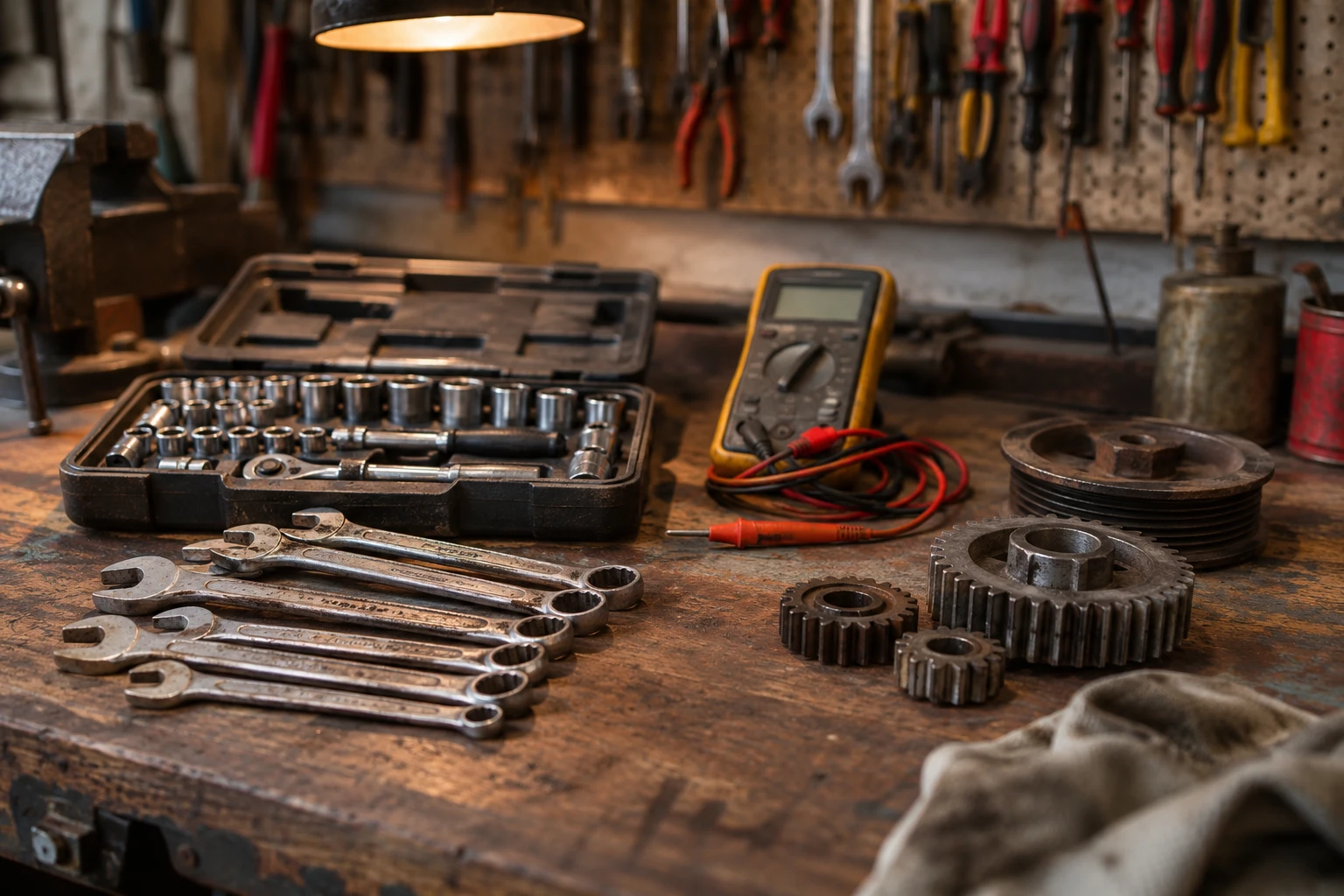
Mechanical Comprehension, Auto & Shop and Electronics Information don't count toward your AFQT, the score that decides whether you can enlist. They still matter a lot, because they feed the line scores that open mechanical, maintenance and electronics jobs. The good news is that these subtests keep coming back to a small set of rules and formulas, and you can learn them with steady practice.
On the CAT-ASVAB you get 15 Mechanical Comprehension questions in 22 minutes, 10 Auto Information questions in 7 minutes, 10 Shop Information questions in 6 minutes and 15 Electronics Information questions in 10 minutes. Auto and Shop are scored together as AS on your score report. You may also see a few unscored tryout questions in some subtests, with extra time added to match.
This guide starts with simple machines and mechanical advantage, then moves on to pulleys, gears and pressure, then engines, brakes and shop tools, and ends with electricity. Each guide is followed by a round of practice questions. The real test shows drawings with many mechanical questions. Here every setup is described in words, so read each one slowly and sketch it on scratch paper.
Quick takeaways
- Mechanical advantage is output force divided by input force. For levers, ramps and pulleys you can find it from lengths or by counting rope strands.
- Meshing gears turn in opposite directions, and the gear with fewer teeth always turns faster.
- Learn V = I × R and P = V × I, plus the series and parallel rules, and you can handle most electronics math.
Guide 1
Simple machines, levers and the formula sheet
None of these subtests count toward the AFQT, which is built from Arithmetic Reasoning, Mathematics Knowledge, Word Knowledge and Paragraph Comprehension. They show up in line scores instead. Mechanical, maintenance and electronics composites often combine them with math or science subtests, and each branch sets its own formulas, so ask a recruiter which scores your target job uses.
Most Mechanical Comprehension questions come down to one idea. A simple machine lets you use less force by moving that force through a longer distance. It never gives you more work out than you put in. Ignoring friction, the work stays the same; friction only adds to it.
The table below is your formula sheet for all three subtests. Each one needs only multiplication and division.
First-class lever
The fulcrum sits between the effort and the load: a seesaw, a pair of pliers, a claw hammer pulling a nail. The mechanical advantage can be more or less than 1.
Second-class lever
The load sits between the fulcrum and the effort: a wheelbarrow, a nutcracker, a bottle opener. The mechanical advantage is always more than 1.
Third-class lever
The effort sits between the fulcrum and the load: tweezers, a broom, a fishing rod, your forearm. The mechanical advantage is less than 1, but the load moves farther and faster.
Ramps, wedges and screws
A ramp trades a longer push for a smaller force. A wedge is two ramps back to back. A screw is a ramp wrapped around a cylinder, so finer threads give more mechanical advantage.
| Idea | Formula | Quick example |
|---|---|---|
| Mechanical advantage (MA) | MA = output force ÷ input force | Lifting a 300 lb load with 100 lb of effort: MA = 3 |
| Lever balance | Effort × effort arm = load × load arm | 200 lb at 2 ft balances 50 lb at 8 ft (both sides equal 400) |
| Inclined plane MA | Length of ramp ÷ height of ramp | A 12 ft ramp rising 3 ft has MA 4, so a 400 lb crate needs a 100 lb push |
| Pulley system MA | Number of rope strands holding up the moving load | 4 strands: a 400 lb load needs a 100 lb pull, but you pull 4 ft of rope per 1 ft of lift |
| Wheel and axle MA | Wheel radius ÷ axle radius | A 10 in wheel on a 2 in axle: MA = 5 |
| Gear ratio | Driven gear teeth ÷ driver gear teeth | A 12-tooth gear driving a 36-tooth gear: 3 to 1, so the big gear turns at one-third the speed with three times the torque |
| Gear speed | Driver teeth × driver rpm = driven teeth × driven rpm | 20 teeth at 90 rpm drives 60 teeth at 30 rpm (both sides equal 1,800) |
| Work | Work = force × distance | Pushing with 50 lb for 10 ft = 500 ft-lb |
| Pressure | Pressure = force ÷ area | 600 lb spread over 20 sq in = 30 psi |
| Ohm's law | V = I × R (so I = V ÷ R and R = V ÷ I) | 2 A through 6 ohms = 12 V |
| Electric power | P = V × I | 120 V × 5 A = 600 W |
| Resistors in series | R total = R1 + R2 + R3 ... | 4 ohms + 6 ohms = 10 ohms |
| Two resistors in parallel | R total = (R1 × R2) ÷ (R1 + R2) | 6 ohms and 3 ohms: 18 ÷ 9 = 2 ohms |
Tip: Every gain in force is paid for with extra distance. If an answer says a machine cuts both the force and the work, it is wrong.
Round 1
Lever and inclined plane questions
Picture the setup first: where is the fulcrum, where is the load and where do you push? Then pick the formula.
1A 240-pound load sits 2 feet from the fulcrum of a first-class lever. How much effort, pushing down 6 feet from the fulcrum on the other side, will balance it?
Answer: 80 pounds. Effort × effort arm = load × load arm, so effort × 6 = 240 × 2 = 480, and the effort is 480 ÷ 6 = 80 pounds. The tempting 720 comes from multiplying by the long arm instead of dividing by it. A longer effort arm reduces the force you need; it never increases it.2In a wheelbarrow, the wheel acts as the fulcrum, the load sits in the bin, and you lift at the ends of the handles. What class of lever is it?
Answer: Second-class. The load sits between the fulcrum (the wheel) and the effort (your hands), which makes it a second-class lever, so the mechanical advantage is more than 1. First-class is the tempting choice, but in a first-class lever the fulcrum sits between the effort and the load, as in a seesaw.3A ramp is 15 feet long and rises 3 feet. Ignoring friction, how much force is needed to push a 450-pound crate up the ramp?
Answer: 90 pounds. The mechanical advantage of a ramp is length ÷ height = 15 ÷ 3 = 5, so the force is 450 ÷ 5 = 90 pounds. The tempting 150 comes from dividing the weight by the height alone. The ramp's length is what lowers the force.4Two ramps both lead up to the same 4-foot loading dock. Ramp A is 8 feet long and ramp B is 16 feet long. Ignoring friction, which statement about pushing the same box up each ramp is true?
Answer: Ramp B takes half the force, but you push the box twice as far. Ramp A has a mechanical advantage of 8 ÷ 4 = 2 and ramp B has 16 ÷ 4 = 4, so ramp B needs half the force over twice the distance. The last option is tempting, but the work is the same on both ramps when you ignore friction. A gentler slope trades force for distance; it doesn't save work.5Which of these works as a third-class lever, with the effort applied between the fulcrum and the load?
Answer: A pair of tweezers. Tweezers hinge at one end (the fulcrum), you squeeze in the middle (the effort), and the tips grip the object (the load), so it is a third-class lever. A nutcracker is the tempting choice because it looks similar, but the nut sits between the hinge and your hands, which makes it second-class.
Guide 2
Pulleys, gears, belts and pressure
These questions mostly ask about direction, speed and force. A few rules cover nearly all of them.
- A single fixed pulley only changes the direction of the pull. Its mechanical advantage is 1.
- A single movable pulley hangs from two rope strands, so its mechanical advantage is 2.
- In any block and tackle, count only the rope strands that hold up the moving block. That count is the mechanical advantage.
- Two meshing gears turn in opposite directions. In a row of gears the direction flips at every gear: gears 1, 3 and 5 turn one way, and gears 2 and 4 turn the other.
- An idler gear placed between two gears changes the direction of the last gear but not the speed ratio between the first and the last.
- The gear with fewer teeth turns faster. Teeth × rpm is the same for both gears in a pair.
- Two pulleys joined by an open belt turn the same way. A crossed belt makes them turn opposite ways.
- In a closed hydraulic system, pressure is the same everywhere in the fluid (Pascal's principle). A small force on a small piston makes a large force on a large piston.
Tip: On gear questions, write CW or CCW next to each gear on your scratch paper as you work down the chain. It takes seconds and prevents most mistakes.
Round 2
Pulley, gear and pressure questions
Count strands, track direction gear by gear, and remember that pressure is force divided by area.
6A block and tackle has 4 rope strands holding up the moving block. Ignoring friction, how much pull is needed to lift a 360-pound engine?
Answer: 90 pounds. The mechanical advantage equals the number of strands holding up the moving block, which is 4, so the pull is 360 ÷ 4 = 90 pounds. The tempting 180 assumes every movable pulley setup has a mechanical advantage of 2. Always count the strands for the setup in front of you.7A single fixed pulley is bolted to a ceiling beam. A rope runs over it, with a 50-pound bag tied to one end. What does the pulley do for you?
Answer: It lets you pull down instead of lifting up, but you still need 50 pounds of force. A fixed pulley has a mechanical advantage of 1, so it only changes the direction of the force. You still pull with 50 pounds, but pulling down is easier than lifting up. Halving the force is the tempting answer, but that takes a movable pulley, where two strands share the load.8Gear A turns clockwise. It meshes with gear B, which meshes with gear C, which meshes with gear D, all in a straight row. Which way does gear D turn?
Answer: Counterclockwise. The direction flips at each mesh: A clockwise, B counterclockwise, C clockwise, D counterclockwise. The number of teeth is the tempting distractor, but it changes speed, not direction.9A 15-tooth gear turning at 120 rpm drives a 45-tooth gear. How fast does the 45-tooth gear turn?
Answer: 40 rpm. Teeth × rpm is the same on both gears: 15 × 120 = 1,800, and 1,800 ÷ 45 = 40 rpm. The tempting 360 comes from multiplying by the ratio of 3 instead of dividing. The bigger gear always turns slower.10In a hydraulic jack, a 20-pound force pushes on a small piston with an area of 2 square inches. The large piston has an area of 50 square inches. What force does the large piston produce?
Answer: 500 pounds. Pressure = force ÷ area = 20 ÷ 2 = 10 psi. That pressure acts on the whole large piston, so the force is 10 × 50 = 500 pounds. The tempting 1,000 comes from multiplying 20 by 50 and skipping the step of finding the pressure first.
Guide 3
Auto and Shop: engine systems, tools and fasteners
Auto Information asks how a car's systems work and what causes common problems. Shop Information asks which tool or fastener fits a job. You don't need to be a mechanic, but you do need to know what each part does.
Most questions are about gasoline engines, which use spark plugs. Diesel engines have no spark plugs: they compress air until it is hot enough to ignite the fuel.
Fasteners come up too. A bolt passes through the parts and takes a nut; a machine screw threads into a tapped hole. Lock washers and cotter pins keep nuts from working loose. Rivets join sheet metal permanently. Nail sizes use the penny system, written with a d, so a 16d nail is longer than an 8d nail.
The four strokes
Intake: the piston moves down and draws in fuel and air. Compression: the piston moves up and squeezes the mixture. Power: the spark plug fires and the burning mixture drives the piston down. Exhaust: the piston moves up and pushes out the burned gases. The crankshaft turns twice per cycle.
Starting, ignition and charging
The battery powers the starter motor. The ignition coil steps the battery's 12 volts up to the thousands of volts a spark plug needs. Once the engine runs, the alternator charges the battery and powers the electrics.
Cooling
The water pump circulates coolant. The thermostat stays closed until the engine warms up, then opens to send coolant to the radiator, which sheds heat into the air. The radiator cap keeps the system under pressure, which raises the coolant's boiling point.
Brakes
The pedal pushes brake fluid from the master cylinder through the lines to calipers (disc brakes) or wheel cylinders (drum brakes), which press pads or shoes against the rotors or drums. Brake fluid can't be compressed, which is why air in the lines makes the pedal spongy.
| Tool | What it's for | Good to know |
|---|---|---|
| Combination wrench | Turning nuts and bolts; an open end on one side, a box end of the same size on the other | The box end grips all the way around, so it is less likely to round off a tight nut. |
| Socket set and ratchet | Turning fasteners quickly, including in tight spots | Extensions reach recessed bolts. A 6-point socket grips a tight nut better than a 12-point. |
| Torque wrench | Tightening bolts to a set value, such as lug nuts or cylinder head bolts | Use it for final tightening, not for breaking loose a stuck bolt. |
| Pipe wrench | Gripping and turning round pipe | Its toothed jaws bite into the surface, so keep it off finished nuts. |
| Hacksaw | Cutting metal, such as bolts, pipe and tubing | Fit the blade with the teeth pointing away from the handle; it cuts on the push stroke. |
| Crosscut and rip saws | Cutting wood across the grain (crosscut) or along it (rip) | A rip saw has fewer, chisel-shaped teeth. |
| Ball-peen hammer | Metalwork, such as shaping metal and setting rivets | For driving and pulling nails, use a claw hammer. |
| Tap and die | A tap cuts threads inside a hole; a die cuts threads on the outside of a rod | Drill the correct size hole before tapping. |
| Feeler gauge | Measuring small gaps, such as valve clearance | Thin blades marked in thousandths of an inch or in millimeters. |
| Multimeter | Measuring voltage, current and resistance | Measure voltage across a part and current in series with it. |
Round 3
Auto and Shop questions
Ask yourself what each part does, and the answer usually follows. For tools, think about the material and the job.
11In a four-stroke gasoline engine, which stroke uses the burning fuel-air mixture to drive the piston down and turn the crankshaft?
Answer: Power. The spark plug fires near the top of the compression stroke, and the expanding gases then drive the piston down on the power stroke, the only stroke that delivers power. Compression is tempting because the spark happens as it ends, but the compression stroke only squeezes the mixture.12Which part of the cooling system stays closed while the engine is cold, then opens to send coolant to the radiator once the engine warms up?
Answer: Thermostat. The thermostat is a temperature-controlled valve that helps the engine warm up quickly and then holds it at operating temperature. The water pump is tempting because it moves the coolant, but it runs whenever the engine runs and doesn't control flow by temperature.13A driver says the brake pedal feels soft and spongy and sinks farther than normal. What is the most likely cause?
Answer: Air in the brake lines. Brake fluid can't be compressed, but air can. Air in the lines squeezes when you press the pedal, so the pedal feels soft and travels too far; bleeding the brakes fixes it. Worn pads are tempting, but they usually squeal or grind. A warped rotor makes the pedal pulse.14Which tool should you use to tighten cylinder head bolts to the exact value given in the service manual?
Answer: Torque wrench. A torque wrench measures how tightly you are turning the bolt, so you can stop at the value the manual gives. An impact wrench is tempting because it is fast and powerful, but it can't hit a precise value and can over-tighten or stretch bolts.15You need to cut threads inside a hole drilled in a steel plate so a bolt can screw into it. Which tool do you use?
Answer: A tap. A tap cuts internal threads inside a hole. A die is the tempting choice because taps and dies come as a set, but a die cuts external threads on a rod or bolt. A countersink makes a cone-shaped recess so a flat-head screw sits flush, and a reamer smooths a hole to an exact size.
Guide 4
Electronics: Ohm's law, circuits and components
Electric current is a flow of charge. Voltage is the push behind it, and resistance is what opposes it. Ohm's law ties the three together: V = I × R. If you know any two, you can find the third. At the same voltage, doubling the resistance halves the current.
Most of the math uses Ohm's law, P = V × I and the series and parallel rules below. The rest checks units, materials and what common parts do.
- Series circuit: one path. The same current flows through every part, the voltage drops add up to the source voltage, and the total resistance is the sum. If one part fails open, everything stops.
- Parallel circuit: several paths. Each branch gets the full source voltage, the branch currents add up to the total, and the total resistance is less than the smallest branch. Household outlets are wired in parallel.
- Good conductors: silver, copper, gold and aluminum. Good insulators: rubber, glass, plastic, ceramic and dry wood.
- A fuse or circuit breaker opens the circuit when the current gets too high. A blown fuse must be replaced; a tripped breaker can be reset.
- Direct current (DC) flows one way, as from a battery. Alternating current (AC) keeps reversing; US household power is about 120 volts at 60 hertz.
- Prefixes: milli means one-thousandth (5 mA = 0.005 A) and kilo means one thousand (2 kilohms = 2,000 ohms). A higher wire gauge number means a thinner wire.
| Quantity or part | Unit or symbol | What to know |
|---|---|---|
| Voltage | Volt (V) | The electrical pressure that pushes current. Also called electromotive force. |
| Current | Ampere, or amp (A) | The rate at which charge flows. |
| Resistance | Ohm (Ω) | Opposition to current. A longer or thinner wire has more resistance. |
| Power | Watt (W) | P = V × I. 1,000 watts = 1 kilowatt. |
| Capacitor | Farad (F) | Stores charge. Blocks steady DC and passes AC. |
| Diode | Arrow-and-bar symbol | Lets current flow one way only; used to change AC into DC. An LED is a diode that gives off light. |
| Transistor | Three leads | Switches or amplifies a signal. |
| Transformer | Two coils | Steps AC voltage up or down. It doesn't work on steady DC. |
Round 4
Electronics questions
Write down V = I × R before you start each calculation, then decide whether you need to multiply or divide.
16A 12-volt battery is connected to a 4-ohm resistor. How much current flows?
Answer: 3 amps. I = V ÷ R = 12 ÷ 4 = 3 amps. The tempting 48 comes from multiplying volts by ohms. V = I × R, so to find the current you divide the voltage by the resistance.17Resistors of 10 ohms, 20 ohms and 30 ohms are connected in series across a 120-volt source. What is the current in the circuit?
Answer: 2 amps. In series the resistances add: 10 + 20 + 30 = 60 ohms. The current is 120 ÷ 60 = 2 amps. The tempting 0.5 comes from dividing the resistance by the voltage instead of the voltage by the resistance. 12 amps would be the current through the 10-ohm resistor alone.18Two 12-ohm resistors are connected in parallel. What is their total resistance?
Answer: 6 ohms. For two resistors in parallel, R = (12 × 12) ÷ (12 + 12) = 144 ÷ 24 = 6 ohms. Two equal resistors in parallel always give half the value of one. 24 ohms is the tempting answer, but that is the series total. Parallel paths always lower the total resistance.19A space heater draws 10 amps from a 120-volt outlet. How much power does it use?
Answer: 1,200 watts. P = V × I = 120 × 10 = 1,200 watts. The tempting 12 comes from dividing 120 by 10, which gives the heater's resistance, 12 ohms, not its power.20Which component lets current flow in only one direction, which makes it useful for changing AC into DC?
Answer: Diode. A diode passes current one way and blocks it the other way, so a set of diodes (a rectifier) can turn AC into DC. A transformer is the tempting choice because it often sits in the same power supply, but it only changes the AC voltage; its output is still AC.
Tip: ASVAB is a registered trademark of the U.S. Department of Defense. This article is an independent study aid and is not affiliated with or endorsed by the Department of Defense or any branch of the military. Questions here are original practice items, not real test questions.
Quick quiz: technical basics
Five quick checks across all three subtests. Tap an answer; each question locks after your first pick.
0 / 5 answered
1What is the unit of electrical resistance?
Answer: Ohm. Resistance is measured in ohms. Volts measure voltage, amperes measure current and watts measure power.2Which statement is true of two gears that mesh directly with each other?
Answer: They turn in opposite directions. Meshing gears turn in opposite directions. They turn at the same speed only if they have the same number of teeth, and the smaller gear turns faster.3Which material is the best electrical insulator?
Answer: Rubber. Rubber resists the flow of current, which is why it is used to coat wires and tool handles. Copper and aluminum are good conductors, and salt water conducts well too.4Which part charges a car's battery while the engine is running?
Answer: Alternator. The alternator charges the battery and powers the electrical system once the engine runs. The starter motor uses battery power to crank the engine.5Three bulbs are wired in series to a battery. What happens if one bulb burns out?
Answer: All three bulbs go out. A series circuit has only one path, so a burned-out bulb breaks it and all the bulbs go out. In a parallel circuit the other bulbs would stay lit.
Frequently asked questions
Do Mechanical Comprehension, Auto & Shop and Electronics count toward the AFQT?
No. The AFQT is built from Arithmetic Reasoning, Mathematics Knowledge, Word Knowledge and Paragraph Comprehension. The technical subtests feed the line scores that decide which jobs you qualify for, especially mechanical, maintenance and electronics jobs.
How many questions are on the technical subtests?
On the CAT-ASVAB, Mechanical Comprehension has 15 questions in 22 minutes, Electronics Information 15 in 10 minutes, Auto Information 10 in 7 minutes and Shop Information 10 in 6 minutes. Auto and Shop are reported together as AS.
Can I use a calculator on the ASVAB?
No. You'll get scratch paper instead, so practice the formulas with pencil and paper. The numbers in mechanical and electronics questions are usually chosen to divide cleanly, so if you get a messy answer, check your setup.
I've never worked on a car. Can I still do well on Auto & Shop?
Yes. The questions test what parts and tools do, not hands-on skill. Learn the main engine systems, the brake and cooling systems, and the common tools and fasteners, and you'll be able to answer most of them.
How should I practice for the technical subtests?
Learn the formula sheet first, then answer a few questions every day and read every explanation. ASVAB Exam Practice covers all nine subtests and 82 topics, with study cards and timed tests of 15 questions at 30 seconds each, which suits short, fast subtests like Auto and Shop.
Learn the rules, then do the math
The technical subtests reward a small toolkit: mechanical advantage, the lever and gear rules, pressure as force over area, the main car systems, the common shop tools, and Ohm's law with the series and parallel rules. They don't change your AFQT, but they can decide which jobs you qualify for, so they are worth real study time.
- Copy the formula sheet onto a card and write it out from memory until you can do it without looking.
- Sketch every word-only mechanical setup on scratch paper, marking the fulcrum, the load and the direction of each gear.
- Practice Mechanical Comprehension, Auto & Shop and Electronics questions a little each day in ASVAB Exam Practice.
Connect ASVAB technical rules to a sketch
Draw each lever, pulley, gear or circuit before calculating. Label the input, output and direction of motion, then test whether the answer makes physical sense. For Auto, Shop and Electronics items, group unfamiliar terms by the part or system they belong to rather than learning isolated definitions.
The official ASVAB samples show the scope of the technical subtests. Use them to identify the area you need to review next; these original questions are practice, not a substitute for the official test description.